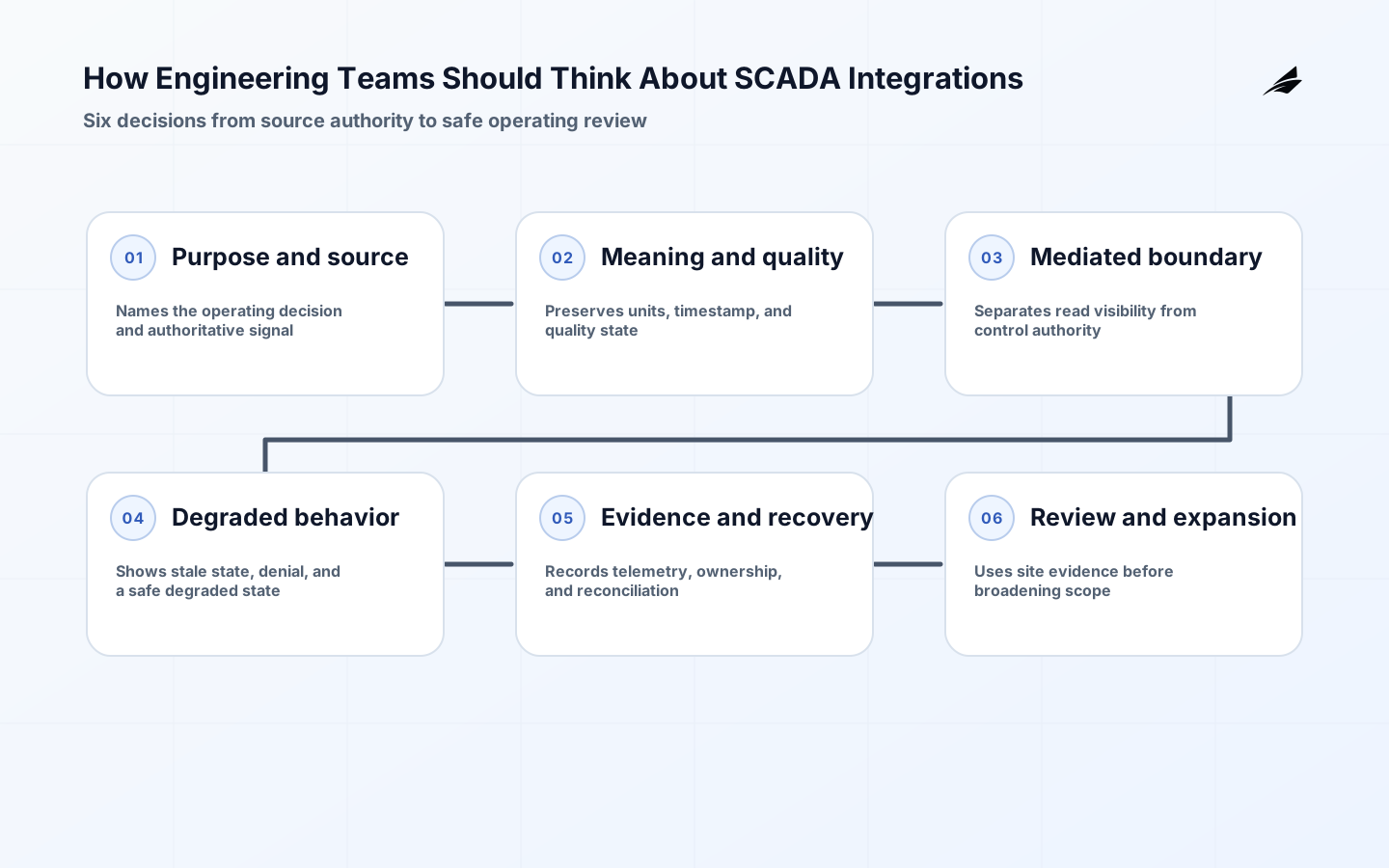
A SCADA integration is the controlled exchange of operational data between supervisory control and data acquisition systems and other software, designed so visibility does not weaken process safety, availability, or accountability. For engineering teams, the useful question is whether the design changes a real operating decision, not whether it adds another component to an architecture diagram. A maintenance application can receive approved equipment status from a historian while an enterprise system cannot issue unreviewed commands into a control network. The team needs an agreed boundary, people authorized to act, evidence they can interpret, and a safe degraded state. Connected systems join physical and digital failure modes; a design that ignores either side produces a brittle service.
What SCADA integrations must accomplish
Interview the control-room operator, site support lead, and risk owner. Walk through normal operation, maintenance, link loss, hardware replacement, delayed values, and unavailable dependencies; record what the team may continue, what must stop, and how status reaches the next responsible person.
A working model for SCADA integrations
For a SCADA boundary, combine a purpose-limited interface, controlled data semantics, mediated protocol flow, audit evidence, and exercised failure behavior. Turn each choice into a checkable claim about what enters, what leaves, who may change it, and what proves the result.
| Element | Decision to make | Evidence to keep |
|---|---|---|
| Operational purpose | Which decision SCADA integrations changes | Named user and expected action |
| Boundary | What may cross and under what authority — during a SCADA boundary review | Versioned policy or contract |
| Recovery | What happens when a dependency fails — during a SCADA boundary review | Test record and owner |
Architecture and boundaries
Architecture should express responsibility rather than merely list components. In practice, prefer a segmented boundary and a broker, historian, or gateway exposing the minimum data; preserve source timestamps and quality; treat control writes separately. Make the normal path easy to trace and state the identity, authorization rule, failure behavior, and observation method at every boundary. NIST guidance for operational technology is useful because it treats availability and safety context as essential, not incidental. The equipment and regulations differ by site, but a hidden trust boundary is never a durable simplification.
An implementation path that reduces risk
A SCADA pilot earns evidence by involving operators during normal shifts and imperfect network conditions. Compare tags, quality codes, timing, denied actions, and recovery effort before allowing a wider read scope or any separately reviewed write path.
Choices and trade-offs
Expose approved read-only history for business use. Version a changed tag mapping. Display stale state during link loss instead of quietly substituting old data. These are operating decisions, not implementation trivia while keeping SCADA authority explicit. Capture them in a concise contract that a developer, operator, and reviewer can test. The contract should distinguish observed time from received time where data moves asynchronously, distinguish an accepted request from a completed physical action, and identify what happens when a prerequisite is unavailable. Those distinctions prevent a polished interface from overstating what the underlying system knows.
| Situation | Safer response | Shortcut to avoid |
|---|---|---|
| Normal operation | Document expected SCADA integrations behavior | Depend on unstated knowledge |
| Disrupted dependency | Show status, preserve context, and follow a bounded recovery rule | Keep acting as if upstream evidence is current |
| Change or exception | Use approved ownership and an auditable path — during a SCADA boundary review | Create permanent broad access or silent overrides — during a SCADA boundary review |
Operating signals to review
Operating signals keep the design honest during a SCADA boundary review. Review tag-mapping completeness, stale-value rate, quality-code handling, interface errors, unapproved writes, and time to detect a broken path. Put each signal beside an objective and an owner able to act on it. Metrics without a decision create noise; a compact set tied to user impact makes diagnosis faster. OpenTelemetry documentation is helpful background for combining traces, metrics, and logs, but it cannot choose the right operational question for a team. Retention and access should be explicit when observations expose site behavior or customer activity.
Failure modes and recovery
The dangerous shortcut is direct database access to a controller, copying every raw tag into enterprise tools, or confusing dashboard updates with authority to control equipment. It often begins as a deadline concession and becomes difficult to remove after other teams depend on accidental behavior. Design the exception path deliberately: fail closed when an unsafe action must not occur, retain enough context to investigate, and show a visible status when automatic recovery is uncertain. A resilience claim is credible only after the team has exercised loss, restart, and recovery at the boundary that matters.
Security and governance
SCADA-integration security requires stricter treatment of control authority than business-data visibility. Keep read paths purpose-limited, use mediated identities at the boundary, and make any write path independently authorized and reviewable. NIST operational technology guidance is directly relevant to this separation. A successful data integration must never imply that an enterprise user can command a process asset.
Standards and practical testing
SCADA standards are valuable when they make tag semantics and failure behavior testable. Test a read-only path, stale quality code, changed tag mapping, unavailable historian, and denied control request. NIST operational technology guidance keeps the analysis grounded in process consequence. Each test should establish what the enterprise consumer may infer and what it must never infer from a delayed or low-quality value.
Operating review before expansion
Before expanding, conduct an operational review with the people who will carry the system. Can they identify current state and freshness during a SCADA boundary review? Can they find the owner of an exception? Can the controls team reverse a material change? Can they explain what evidence proves recovery while keeping SCADA authority explicit? The answers reveal whether the SCADA integration has become an accountable service or only a successful integration test. Improving these answers often has more value than adding more data, devices, or screens.
Keep a decision record
For SCADA integrations, keep a short decision record that names the use case, accountable owner, boundary, assumed operating conditions, evidence reviewed, and the next review date. Record the rejected alternative as well as the chosen approach. This prevents a later maintenance change from quietly undoing a safety, reliability, or access decision that made sense in the original context. When a real incident contradicts an assumption, update the record and the relevant test rather than only patching the immediate symptom.
Review a SCADA path before widening scope
A useful design review follows one signal from its physical source to the decision it supports. Ask whether the source is authoritative, how quality and timestamp travel, which gateway is allowed to translate it, and what a consumer may do when the value is late. For a chilled-water plant, an engineering dashboard may show a temperature trend and raise a maintenance task, while the control system retains authority over the process. This separation makes the interface easier to test and gives operators a clear answer when systems disagree.

Before a pilot, write three concrete scenarios: the normal read path, loss of the upstream connection, and a denied or malformed request. Include the evidence a responder needs: last known value, source quality, gateway state, configuration version, and the identity that attempted the action. Then rehearse the scenarios with an operator and support engineer. The exercise often reveals that a protocol conversion is technically correct but operationally misleading because it drops quality codes, changes units, or hides the age of a value.
| Review question | Pass condition | Owner |
|---|---|---|
| Is the source clear? | Tag, unit, quality and timestamp are mapped | Controls engineer |
| Is authority separated? | Read and write paths have distinct policy | Security and operations |
| Can the team recover? | Loss, restart and reconciliation are rehearsed | Service owner |
| Can a change be reversed? | Mapping and configuration have versioned rollback | Engineering lead |
Use primary standards for the SCADA boundary
For the boundary review, compare the topology and safety assumptions with NIST SP 800-82 Rev. 3, use NIST SP 800-207 to challenge implicit trust, and check telemetry design against OpenTelemetry documentation and the constrained-device considerations in RFC 7252. These sources inform the control choices; they do not replace a site-specific hazard and operations review.
For related context, compare sensor data pipelines, SCADA integration checklist, and SCADA implementation checklist, with SCADA authority explicit in mind. Use those perspectives to test the boundary described here while keeping the operating decision and owner in view while keeping SCADA authority explicit.
Key takeaways for SCADA integrations
- Define the decision before selecting a SCADA integrations implementation.
- Make boundaries, authority, and degraded behavior explicit during a SCADA boundary review.
- Pilot with real users and failure conditions before broad rollout.
- Use evidence tied to an owner to improve the service after launch.
SCADA integration questions from engineering teams
When should a team invest in SCADA integrations? When the current arrangement makes a material decision slow, unsafe, unreliable, or impossible to audit. What is the smallest useful first release? One workflow with named users, measurable behavior, and a recovery path while keeping SCADA authority explicit. How should success be measured? Compare the agreed operating signal before and after the change, including exceptions and manual workarounds while keeping SCADA authority explicit. Who owns it after launch? The operational owner defines the outcome; engineering, security, and support need explicit responsibilities for their parts while keeping SCADA authority explicit.
Conclusion: keep SCADA authority explicit
A SCADA integration delivers value when it makes the next decision clearer and safer. Keep the first scope bounded, preserve the context needed to interpret evidence, and refuse shortcuts that bury ownership. The durable result is not a vendor setting or a diagram. It is a service whose boundaries, recovery behavior, and accountable decisions remain understandable as the fleet, site, or product changes.
Reference checks before expansion
- Confirm the documented boundary matches observed production behavior.
- Rehearse the most consequential interruption and verify recovery evidence.
- Review access, configuration, and ownership changes on a defined cadence.
- Keep the design readable enough that a new on-call engineer can find the next safe action.