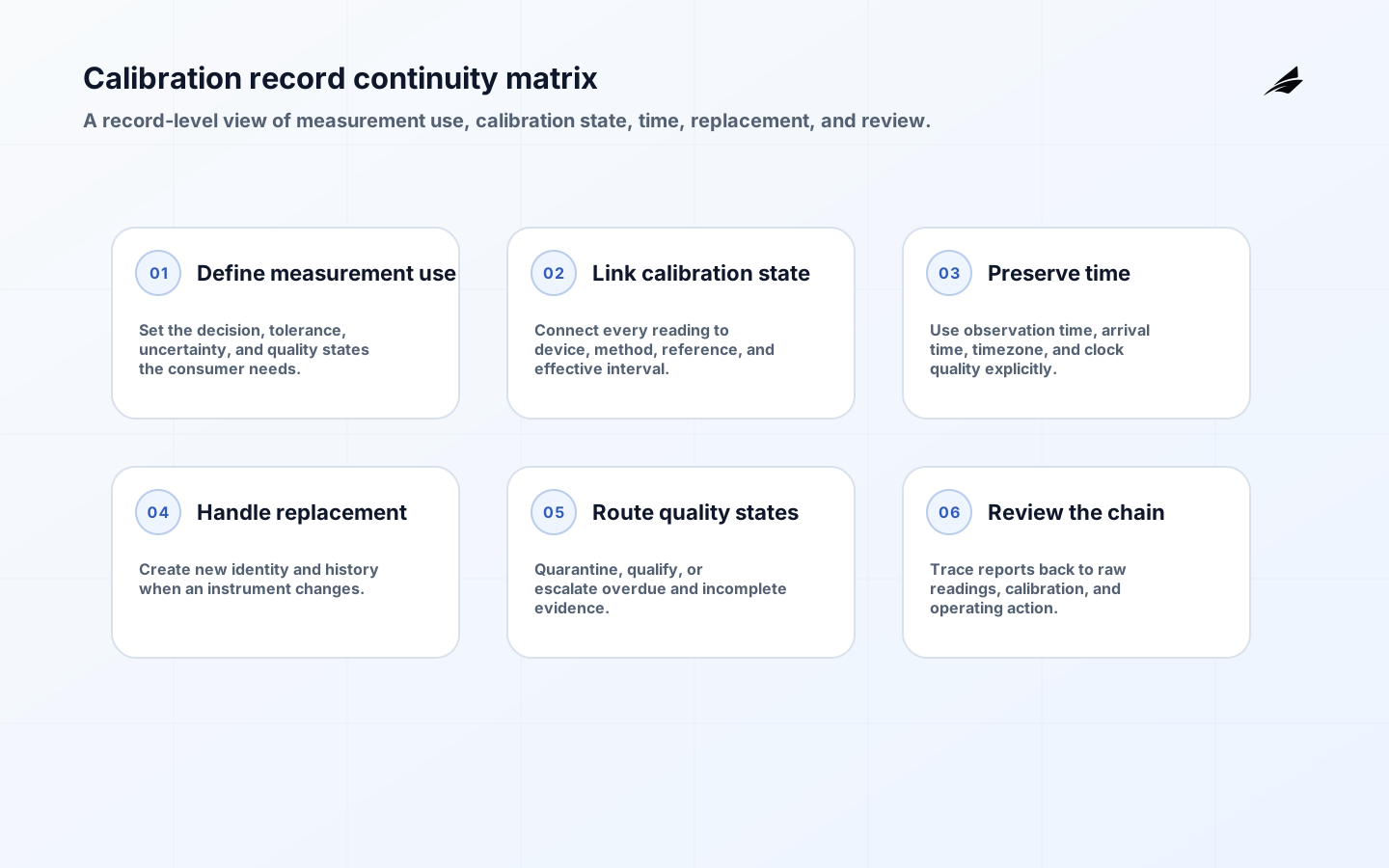
Sensor calibration data is not a certificate kept in a separate folder. It is the evidence that lets an operator decide whether a measurement supports a decision today, under these conditions, with this device and this method. A temperature, pressure, weight, or position reading can look precise while being unsuitable for control, compliance, or maintenance. Growing teams need to preserve the connection between the raw observation, the instrument identity, the reference used, the calibration result, and the rule that determines whether the device remains fit for use.
Name the decision behind calibration records
Define the decision before defining the calibration interval. A reading used to detect a hazardous condition deserves a different tolerance, review cadence, and failure response than a reading used for trend analysis. Record the expected range, required uncertainty, environmental limits, unit, and consequence of error. The NIST metrological traceability policy material is a useful starting point for traceability, while local process owners must specify which measurement uncertainty is acceptable for their operation.
| Control area | What to specify | Evidence to review |
|---|---|---|
| Purpose | State the operational decision, user, completion evidence, and cost of a wrong result. Tie the purpose to a named decision and its acceptance evidence. | A named owner, an example record, and a repeatable test that shows the purpose rule works in production conditions. |
| Authority | Name the system, role, or device that may create or correct this record. Make the authority rule explicit instead of inheriting a default. | A named owner, an example record, and a repeatable test that shows the authority rule works in production conditions. |
| Time | Keep observation time, processing time, and review deadline distinct and visible. Prevent late readings from masquerading as current facts. | A named owner, an example record, and a repeatable test that shows the time rule works in production conditions. |
| Change | Version the contract or rule and publish a migration and rollback decision. Record the version and rollback path for each rule change. | A named owner, an example record, and a repeatable test that shows the change rule works in production conditions. |
Connect readings to their calibration boundary
Keep raw readings and calibration facts distinct from corrected or normalized values. A calibration record should identify the instrument and channel, reference standard, method, operator or provider, date, result, uncertainty, adjustment, next review date, and approval state. Link it to firmware and configuration where those can change measurement behavior. Sensor data pipelines should preserve that lineage so downstream users do not mistake a displayed value for unqualified ground truth.
Turn calibration controls into checks
Validate units, ranges, timestamps, and instrument identity at ingestion, but do not discard an anomalous value without preserving why it was rejected. Flag readings taken outside a device's qualified state or after an overdue calibration instead of silently applying a correction. Version conversion and compensation rules. When a calibration is superseded, preserve the former record and state whether historic data is being reinterpreted; retroactive changes can affect decisions, reports, and investigations.
| Control area | What to specify | Evidence to review |
|---|---|---|
| Failure | Describe the safe response to loss, delay, duplication, malformed input, and access denial. Define the failure boundary before the instrument is scaled. | A named owner, an example record, and a repeatable test that shows the failure rule works in production conditions. |
| Evidence | Retain identity, correlation, configuration, result, and accountable owner for investigation. Keep the evidence chain readable to the next reviewer. | A named owner, an example record, and a repeatable test that shows the evidence rule works in production conditions. |
| Release | Test representative field conditions, permissions, degraded connectivity, and recovery before scale. Use the test to prove that controls survive real use. | A named owner, an example record, and a repeatable test that shows the release rule works in production conditions. |
| Review | Measure decision impact, exception burden, and unresolved work; assign the next improvement. Review the chain when evidence exposes drift. | A named owner, an example record, and a repeatable test that shows the review rule works in production conditions. |
Use calibration evidence at the point of use
Use drift and process evidence to improve the program. Compare field checks, redundant instruments, laboratory results, environmental exposure, and maintenance events to find devices whose behavior is changing before their scheduled review. Review overdue calibrations by operational consequence, not merely by count. A technician needs a clear answer at the asset: whether the reading may be used, what condition limits it, and who can authorize continued operation. That is more valuable than a dashboard of certificates with no decision context.
Introduce calibration changes with a measured cohort
Use a limited rollout that includes representative assets, roles, connectivity, and exception cases in a calibration record. For sensor calibration data, publish the success measure, a containment trigger, and the person allowed to pause the change. Review observed behavior with the people who perform the work, then update the operating record, test fixtures, and recovery guidance in a calibration record. A feature is not mature because it is deployed; it is mature when a new operator can understand the boundary and a support owner can resolve a failure without guessing in a calibration record.
A deeper sensor calibration data review should connect reference selection, drift evidence, and correction history. Choose one measurement that drives maintenance or compliance and trace it from the physical instrument to the report a supervisor sees. Compare the raw reading, calibration status, compensation rule, and environmental condition. Ask whether a later reviewer could distinguish a true process change from a sensor change, and whether a recalibration would alter the interpretation of previously acted-on readings. Keep the review concrete by naming the records, people, assets, and time windows involved in a calibration record. It is tempting to call an architecture sound because its normal path is tidy, but operational confidence comes from explaining an incomplete path: a message that arrived after a decision, a device that was replaced, a technician who worked offline, or a credential that should no longer work in a calibration record. For sensor calibration data, record the observed result, the expected result, the owner who decides the difference, and the smallest corrective action. That creates a reusable acceptance test for the next release and prevents a local workaround from quietly becoming a permanent rule in a calibration record. Review this evidence with engineering and the people who carry the operational consequence in a calibration record. When their accounts disagree, preserve both facts and resolve the authority rather than smoothing the difference in a dashboard or export in a calibration record. The goal is not perfect data. It is a system that tells people when its evidence is incomplete, states which record remains authoritative, and gives them a safe accountable way to respond in a calibration record.
A useful record keeps the measurement result and the decision context together. Store the instrument identity, calibration method, reference, uncertainty, environmental conditions, software or firmware version, and the moment each state became effective. When a reading is copied into a report or alert, retain the link back to that record and show whether the value was current, delayed, estimated, or disputed. This makes a handoff safer: a technician can see what to check, an analyst can judge comparability, and an auditor can reconstruct why a result was accepted or held. The added context is especially important when teams work across shifts or when a replacement instrument is introduced during an outage.
Keep calibration records usable during exceptions
A growing team needs a calibration data model that works when the same sensor is used by maintenance, control, quality, and reporting. Start with the measurement claim and then choose the fields that make the claim testable. At minimum, connect quantity, unit, device identity, observation time, acquisition context, calibration state, uncertainty or tolerance, and quality decision. Do not collapse every condition into a boolean valid flag. A sensor can be in-date but disconnected, connected but misconfigured, or accurate enough for a trend but not for a control decision. Preserve those distinctions where a user must act on them.

Separate the calibration record from the message transport while retaining a stable link between them. MQTT topics or another protocol can carry measurement events, but the consumer still needs to resolve which calibration version applied. Include a reference identifier or a compact state that points to an authoritative record; do not copy a mutable certificate into every message and assume it remains current. When messages are delayed or replayed, use the observation time and calibration effective interval rather than arrival time alone. This is how an audit can reconstruct the state that existed when the physical condition was observed.
Design a replacement and exception workflow before the fleet grows. When a sensor fails, the replacement must receive a new identity and an explicit relationship to the old asset. The system should retain the reason, removal time, last accepted reading, new installation context, and verification result. When calibration is overdue, route the measurement according to decision risk: quarantine it for control, mark it qualified for a trend, or require a human review. Make the rule visible to the consumer, because silent suppression creates gaps that look like normal operation.
Review the data service with both metrology and operations owners. Look for missing uncertainty, orphaned calibration references, devices with repeated corrections, readings outside expected ranges, timestamp disagreement, and consumers that ignore quality states. Compare raw and transformed values during a controlled sample. The goal is not a larger archive; it is a traceable chain from physical measurement to operational choice. If the chain cannot be followed from a dashboard or report back to device and calibration evidence, the team should treat the output as provisional until the linkage is repaired.
| Check | Evidence to capture | Decision if missing |
|---|---|---|
| Identity and ownership | Stable asset, service, site, and accountable owner. | Hold the action and route the exception. |
| Freshness and quality | Observation time, state, source, and known delay. | Qualify or reject the result according to risk. |
| Change and authority | Policy version, permitted role, approval, and expiry. | Do not widen access or automate the action. |
| Recovery | Tested degraded path, reconciliation, and named responder. | Keep the cohort narrow until recovery is proven. |
For adjacent implementation context, see IoT telemetry fundamentals, sensor pipeline fixes, and calibration buyer guidance. These references help separate the sensor calibration data decision from neighboring concerns such as data movement, connected operations, and support in a calibration record. Use them to compare boundaries, not to copy a design: the right choice depends on the asset, consequence, timing, people, and evidence in the local workflow in a calibration record.
The official references should be read alongside the operating record. MQTT 5.0 informs message and session choices; TLS 1.3 informs transport protection; RFC 3339 timestamps supports unambiguous time representation; and NIST metrological traceability policy provides a device cybersecurity baseline. Taken together, they support a practical rule: select the smallest capability that satisfies the named decision, make its authority explicit, test degraded behavior, and retain enough evidence to explain both normal and exceptional outcomes in a calibration record.
Sensor calibration data: operating takeaways
- Specify calibration tolerance from the operational decision and consequence of error.
- Retain raw observations, calibration results, corrections, and rule versions separately.
- Bind calibration evidence to the instrument, channel, firmware, and environment.
- Flag questionable readings visibly instead of hiding uncertainty behind a corrected value.
- Use drift and field checks to prioritize work before a routine interval expires.
Sensor calibration data questions for teams
Can software compensate for a poorly calibrated sensor?
Software can apply a documented correction when its assumptions are valid, but it cannot remove uncertainty or replace a traceable calibration process. Keep both the raw value and the correction evidence.
How long should calibration data be retained?
Retain it for at least as long as decisions, service records, or regulatory obligations may need explanation. The useful retention period follows the asset and decision lifecycle, not only the next calibration date.
Keep a compact decision record for sensor calibration data changes. It should capture instrument identity, reference method, uncertainty result, qualified range, and recalibration decision. This record is not bureaucracy for its own sake: it lets the next engineer, operator, or support owner understand what changed, what evidence was reviewed, and which question remains open in a calibration record. During an incident, it also prevents the team from relying on a screenshot or an unverified recollection when deciding whether to contain, correct, or continue the service in a calibration record.
Conclusion: preserve measurement confidence
Sensor calibration data becomes operationally valuable when it travels with the reading and the asset context. Define acceptable uncertainty from the real decision, preserve the lineage of adjustments, and make questionable measurements visible to the people who act on them. That is how a calibration program earns trust beyond a compliance audit.