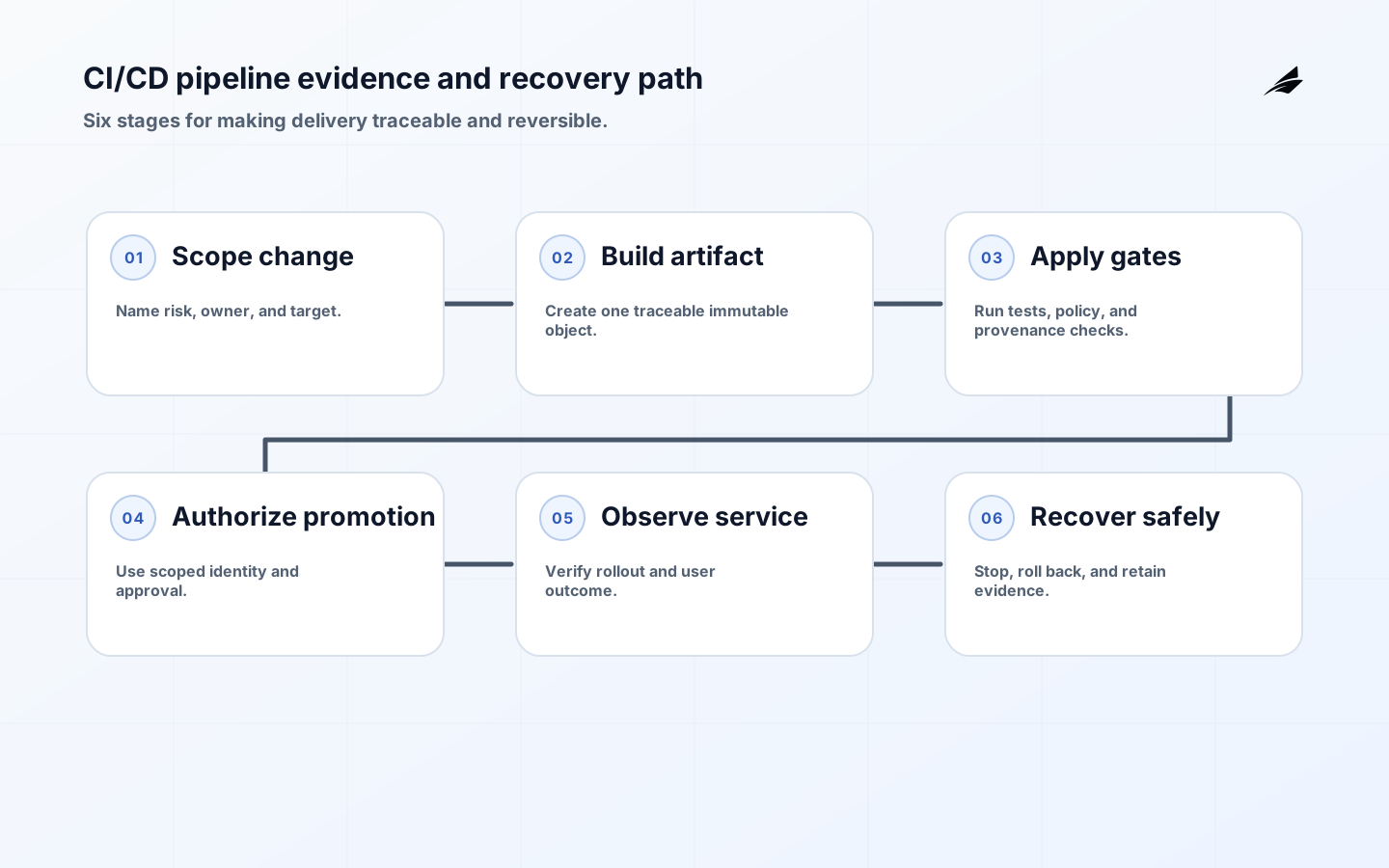
CI/CD pipelines are the system through which a team turns a change into a running service. Thinking of them as a collection of build jobs misses the operating questions: what evidence permits movement, who owns a failed gate, which credentials can act, how a release is observed, and how an operator returns to safety. The AWS Well-Architected reliability guidance treats reliable delivery as a set of deliberate practices; Google’s release engineering material adds the importance of repeatability and controlled artifacts. Speed comes from trustworthy repetition, not from deleting every check.
Establish the CI/CD pipeline boundary
Map the path from source revision to user exposure. Name the artifact, build environment, tests, security checks, infrastructure changes, target, promotion rule, observation gate, and rollback route. Identify which stages are deterministic and which require context-dependent review. A documentation change, a database migration, and a payment-service release should not carry identical consequence, even when they share a runner. The CI/CD pipelines explained guide and pipeline planning guide are useful companions for separating common mechanics from local risk.
| Pipeline concern | Question | Evidence |
|---|---|---|
| Change identity | What revision and intent are being delivered? | Commit, change record, owner, and scope. |
| Artifact | What exact object will be promoted? | Digest, dependency record, and provenance. |
| Authority | Which identity can deploy where? | Short-lived credential and target permission. |
| Outcome | How will the team know the release helped? | Health signal, user check, and rollback trigger. |
Design CI/CD pipelines for safe change
Build once where practical, attach identity and provenance, and promote the same artifact through environments instead of rebuilding with hidden inputs. Restrict changes to pipeline definitions because a workflow file can expand deployment authority. Separate build, test, package, and release credentials. Require review for changes to protected branches, production targets, and shared infrastructure. The SLSA security levels provide a useful vocabulary for increasing build and provenance assurance, while Google's release engineering guidance reinforces repeatable, controlled delivery. The local pipeline still needs a threat model and an owner who can act when a check fails.

A pipeline should fail with actionable information. Report which assumption, contract, or check failed; identify the owning team; and show the relevant artifact or log without exposing secrets. Keep test environments representative enough to catch the failure modes that matter, while avoiding a slow suite that nobody trusts. For Kubernetes workloads, deployment behavior such as rollout status, readiness, and revision history must be part of the release contract, not an afterthought. The Kubernetes Deployment documentation describes the controller behavior teams should observe.
Control the risks around CI/CD pipelines
Pipeline workers handle source, dependencies, credentials, and release authority, making them valuable targets. Isolate jobs, pin or verify dependencies where feasible, protect caches, restrict network access, and remove credentials after use. Prevent untrusted pull requests from accessing production secrets. Record who approved a promotion, which identity executed it, and whether a policy exception was used. A security gate that blocks without an owner or repair route creates bypass pressure; a precise gate makes the secure path the usable path.
| Risk | Failure effect | Control |
|---|---|---|
| Mutable build input | Two builds from the same revision differ. | Pin dependencies and retain build environment evidence. |
| Overpowered runner | A compromised job reaches unrelated systems. | Use scoped identities, isolation, and target-specific permissions. |
| Missing provenance | Operators cannot connect a deployment to source. | Record digest, builder, inputs, and approval. |
| Weak rollback | A bad release remains active while teams debate. | Test a reversible route and define the stop signal. |
Test CI/CD pipelines under pressure
Do not test only the happy path. Exercise a failed dependency scan, an unavailable registry, a partial deployment, a revoked credential, an unhealthy canary, and a rollback after a schema change. Ask a person unfamiliar with the pipeline to locate the evidence and make the next safe decision. Measure queue time, execution time, failure classification, rerun rate, rollback time, and change-related incidents. A fast pipeline that encourages repeated manual reruns can be less reliable than a slightly slower pipeline with clear failure ownership.
Operate and improve the delivery service
Give the pipeline a service owner, an availability expectation, and a change cadence. Monitor runner capacity, queue pressure, dependency health, artifact storage, secret rotation, and release outcomes. Review flaky tests as reliability debt, not background noise. Remove gates that have no decision value, and strengthen gates where incidents show a blind spot. The deployment rollbacks guide can help when recovery design needs to be made explicit, while the canary security review covers a narrower progressive-delivery boundary.
Implementation field notes
Choose one service and trace a real change end to end. Record how a revision becomes an artifact, how a reviewer sees risk, how a deployment is authorized, how a customer path is checked, and how the team returns to the previous safe version. Then compare that path with a higher-risk change such as a data migration. Reuse platform conventions where they remove ambiguity, but keep the decision boundary visible. A template should make good evidence easy to produce, not hide important differences behind a green status badge.
Pipeline ownership includes the failure experience. Decide who maintains runners, build images, caches, signing or provenance integrations, and release credentials. Give that owner a service-level expectation and a recovery path when the pipeline itself is unavailable. A release process that cannot operate during a registry outage or identity failure needs an explicit, authorized alternative rather than an informal bypass that nobody reviews later.
Make policy messages understandable to the person who must repair the change. Name the violated assumption, link to the relevant evidence, show the affected scope, and state whether an exception is possible and who can approve it. This reduces repeated reruns and discourages teams from copying a workaround into every repository. Good feedback is a control because it keeps the normal path usable under delivery pressure.
Release records should survive beyond the pipeline screen. Retain the artifact digest, checks, approvals, target, deployment result, and recovery decision where an incident responder can find them. Connect the record to user-impact signals and follow-up work. When a later incident occurs, the team should be able to answer whether a change was present, whether the pipeline had complete evidence, and which rollback action remains safe.
Review the pipeline with engineers, security owners, and operators together. Each group sees a different failure mode: build integrity, credential scope, or recovery usability. Sample a normal release, a blocked release, and a failed production rollout. Keep improvements small and owned. The pipeline becomes a dependable product when its users can predict both its successful path and its response to failure.
A delivery platform should also make deliberate slowness visible. Queue time, flaky checks, manual approvals, and repeated reruns each have a different cause and repair path. Do not report only the average duration: show which teams wait, which stages fail, and which gates prevent incidents. This gives leaders a fair basis for deciding where to invest rather than rewarding a superficially fast path that shifts work into production.
When a pipeline change affects release authority, treat it like a security-sensitive production change. Test the workflow with an untrusted contribution, a revoked credential, a tampered artifact, and a failed policy service. Confirm that the safe behavior is to stop, explain, and preserve evidence. That small exercise often reveals permissions inherited by convenience rather than granted for the delivery decision.
The delivery contract should state what happens when a check is unavailable. A failed policy service, registry outage, or missing test result should not silently become approval. Provide a bounded retry, an authorized fallback, or a clear stop state, and record which evidence was absent. This keeps reliability work honest: the pipeline can be temporarily unavailable without pretending the release was fully assessed.
Review changes to the pipeline itself with the same care as application changes. A new plugin, runner image, cache rule, or deployment permission can alter the trust boundary for every service. Test the change on a low-risk target, compare the generated provenance and logs, and communicate any new operator behavior. Small control-plane changes deserve a visible record because their effects are wide even when their diff is short.
Key takeaways for CI/CD pipelines
- Treat CI/CD as a production service with users, dependencies, and failure modes.
- Map intent, artifact, authority, checks, exposure, observation, and rollback.
- Promote traceable immutable artifacts and protect pipeline definitions and credentials.
- Make gates proportional to consequence and attach every failure to an owner.
- Exercise partial failure, unavailable dependencies, and recovery under realistic pressure.
- Use release outcomes and operator experience to retire noise and close blind spots.
Frequently asked questions about CI/CD pipelines
Question: What should teams define before using CI/CD pipelines? Answer: Define the service outcome, artifact identity, approval boundary, and rollback authority. A pipeline is useful when a responder can trace a customer change to its evidence.
Is continuous delivery the same as continuous deployment? No. Continuous delivery keeps a tested release ready for promotion; continuous deployment automatically promotes under defined conditions. Should every pipeline use one template? Share safe defaults, but allow explicit differences for data, security, and availability risk. How can a slow pipeline be improved safely? Measure queue and stage time, remove redundant work, parallelize independent checks, and keep the evidence that protects the user. Is a green build enough? No. A release also needs deployment health, user outcome, and a recovery path.
Conclusion: make CI/CD an operating capability
A dependable CI/CD pipeline turns change into a traceable decision. Preserve artifact identity, limit authority, make checks useful, observe the real service, and rehearse recovery. When engineers can explain why a release moved, what evidence supported it, and how to stop it safely, delivery becomes faster because the organization has earned confidence in its routine.