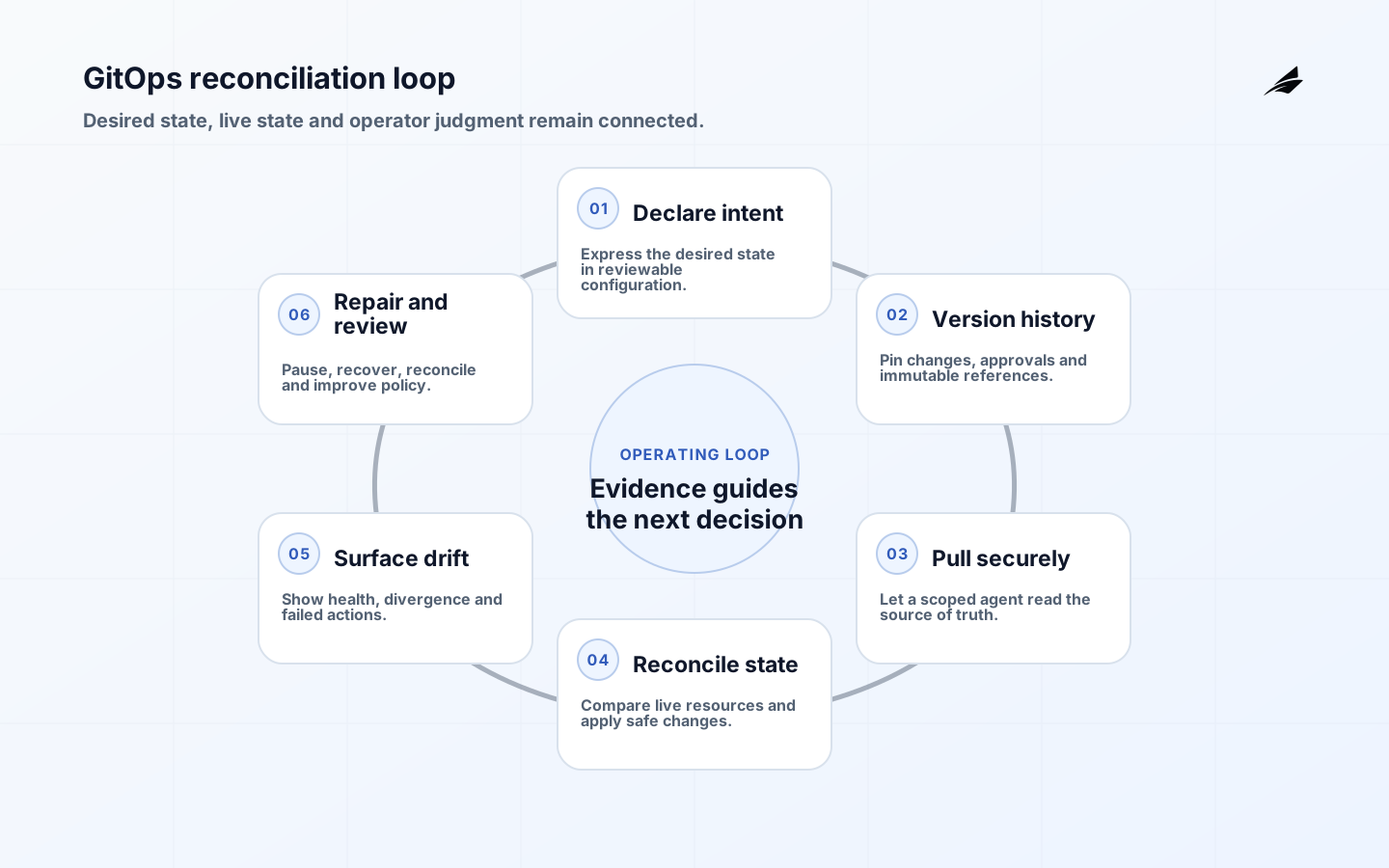
GitOps deserves a plain-language operating model because CTOs need to make choices that remain understandable after the first implementation. GitOps is an operating model in which a version-controlled repository expresses desired system state and an automated agent reconciles the running environment toward that state. Git is not the runtime control plane; it is the reviewable record of intent. The reconciler, access controls, policy checks, and observable feedback loop are equally important. A GitOps approach is useful when it makes a deployment or configuration change easier to inspect, reproduce, and recover rather than merely moving shell commands into a pull request.
Key takeaways
- Make one repository or declared boundary authoritative for each managed target.
- Use Git for desired-state history, not as a substitute for runtime health evidence.
- Give reconcilers least-privilege credentials and visible failure status.
- Decide self-heal and deletion behavior before an incident forces the choice.
- Keep secret handling and policy enforcement outside plain configuration diffs.
- Practice pausing, repairing, and reconciling drift.
What GitOps means in practice
Identify the source of truth, the environments it governs, the agent allowed to reconcile them, and the emergency route. A production cluster should not have several repositories or humans silently competing to declare the same resource. The OpenGitOps principles emphasize declarative desired state, versioned and immutable history, automated pull, and continuous reconciliation. Translate those ideas into a practical ownership map: which repository owns each namespace or service, who may merge, which identity applies the desired state, and how an urgent change is recorded afterward.
| Decision area | Question to settle | Useful evidence |
|---|---|---|
| Desired state | Where is the intended configuration recorded? | Versioned repository and an explicit ownership boundary. |
| Reconciler | Who applies and compares state? | Scoped agent identity with observable health. |
| Policy | What changes are prohibited or reviewed? | Automated checks plus accountable human approval. |
| Emergency route | How is automation paused or overridden? | Documented, logged action followed by reconciliation. |
An operating model for GitOps
Keep application code, environment configuration, and reusable templates separable enough that a reviewer can see the scope of a change. A promotion may update an image digest in an environment repository; a platform change may update a shared policy package; a service owner should not need broad cluster credentials to change either. The reconciler needs narrowly scoped permissions and a visible health model. It should report drift, failed applies, and dependency ordering issues rather than retrying indefinitely without a human-readable explanation.
Build the GitOps promotion path
A sound flow begins with a proposed declarative change, automated validation and policy checks, a review by the relevant owner, merge into the environment source of truth, reconciliation by the agent, and confirmation from both resource health and user-facing service signals. Decide whether automated synchronization may self-heal drift and whether deletion is permitted. Self-heal is helpful for an accidental manual change, but it can be dangerous during incident investigation if responders do not understand it. Write the pause, override, and reconciliation steps into the incident routine.
Make GitOps controls explicit
GitOps does not eliminate secret management. Store references to secrets, encrypted secret material under an approved process, or integrate an external secret provider; do not normalize plaintext credentials in repositories. It also does not replace policy: a valid YAML change can widen network access or resource cost. Review diffs in context, apply admission or policy controls, and restrict reconciliation credentials. A reconciliation loop can amplify a bad desired state quickly, so staged environments and scoped blast radius remain valuable.
| Stage | What to check | Decision rule |
|---|---|---|
| Propose | Change declarative configuration through a reviewable diff. | Reject invalid schema, policy, or ownership changes. |
| Merge | Accept the approved desired state. | Record who accepted the operational decision. |
| Reconcile | Agent applies and compares actual state. | Pause on unexpected failure or unsafe drift. |
| Verify | Check workload and user-facing signals by revision. | Close only when state and service behavior agree. |
Use GitOps operating signals
Track reconciliation latency, sync success and failure rate, drift count and age, policy denials, manual changes, time from merge to healthy state, and resources with unknown ownership. Add commit or revision identifiers to workload telemetry so a request spike can be compared with the desired-state change that preceded it. The incident response guide is the companion practice: a controlled pause and a durable incident record are more valuable than a frantic series of untracked terminal commands.
A GitOps checklist for the next change
Pilot GitOps on one namespace and one service with a clear dependency boundary. Intentionally make a harmless out-of-band configuration change and observe how drift appears, how the reconciler responds, and how an operator pauses it. Then restore the declared state through the normal path. The exercise verifies that the model supports people under pressure, not just automation in a quiet demo.
Repository layout should match the way teams make operational decisions. A directory that mixes independent environments, unrelated services, and shared credentials can turn a small change into a broad review or merge conflict. Prefer boundaries that make ownership and promotion visible. When a shared component must change across services, state that coordination explicitly and use a rollout plan; do not conceal it inside a mass formatting commit that operators cannot reason about during recovery.
Work through a GitOps promotion
A service's image digest and replica count live in an environment repository. An approved pull request changes the digest, then a scoped in-cluster agent reconciles the revision and reports workload health. During an outage, an engineer changes replica count directly to preserve capacity. Drift becomes visible; the commander pauses reconciliation if needed, records the emergency action, then either commits the new desired state or restores the declared one. The conflict is managed rather than hidden.
Phase GitOps adoption deliberately
Phase GitOps through one bounded service or workflow first. For GitOps reconciliation, establish the owner, evidence record, access boundary, and stop rule before standardizing a template or expanding automation. For GitOps reconciliation, the first implementation should expose its awkward dependency, not hide it behind a happy-path demonstration. In a GitOps incident, after the team can explain why the control exists and show its outcome, reuse only the conventions that made the decision clearer. In a GitOps rehearsal, this avoids turning a local tool choice into a broad platform mandate before its operating assumptions are tested.
Keep the working record close to the change. For GitOps, that means retaining the version or configuration involved, the person or automated identity that acted, the signal examined, the exception if there was one, and the recovery decision. This is not paperwork for its own sake. In a GitOps rehearsal, during a later failure, those few facts prevent responders from confusing an old condition with a new one or repeating an action whose effect is still unknown.
Set a GitOps review cadence
Review GitOps with real examples rather than a generic scorecard. Sample one normal outcome, one unexpected outcome, and one manual exception. For platform operations, ask whether a new owner could locate the relevant evidence, understand the boundary, and decide what to do next without relying on private memory. For the repository owner, a repeated exception points either to a missing capability or to a constraint that should be made explicit. In both cases, the review should create a small, owned improvement.
Run a deliberately limited exercise before widening use. During drift review, change one safe input, observe the stated signals, invoke the documented containment or recovery step, and verify that the intended service behavior returns. Record where access, timing, or ownership was unclear. For platform operations, an exercise is successful when it reveals a practical weakness early enough to repair it, not when every participant follows the expected script. That habit makes GitOps more dependable under ordinary pressure as well as during an incident.
Frequently asked questions
Question: Does GitOps mean every operational change must be committed to Git? Answer: The desired state should have a versioned, reviewable source, but emergency operations may need a controlled pause or break-glass action. Reconcile the exception back into the source of truth and record why it occurred.
Question: How should teams detect GitOps drift? Answer: Compare declared and live state, expose differences with ownership and impact, and distinguish intentional emergency changes from unauthorized drift. A reconciler’s health signal should be paired with service outcomes.
Question: What is the safest first GitOps path? Answer: Choose one workload with a clear desired state, scoped reconciler permissions, observable health, and a tested pause and recovery procedure. Expand only after the team can explain a change from commit through reconciliation to runtime.
GitOps does not require every operational value to be stored directly in Git; it requires the desired state and the route to it to be declarative, versioned, and auditable. Pull-based agents reduce the need to expose a cluster API to a central pipeline, but their credentials still require careful scope. A manual emergency action can be justified, provided the team records it and reconciles it after the service is stable.
Conclusion
GitOps turns deployment intent into a shared, reviewable operating record. Give each target a single source of truth, use a scoped reconciler, make health and drift visible, and plan the emergency pause. That creates disciplined automation without pretending that human judgment has vanished.
Prove the GitOps reconciliation path
A GitOps review should trace one change from a reviewed commit to the reconciler, the applied resources, health status and any drift or exception. OpenGitOps defines four principles: declarative desired state, versioned and immutable history, automatic pull and continuous reconciliation. Argo CD makes the distinction concrete by reporting live state as out of sync and offering automatic or manual synchronization.
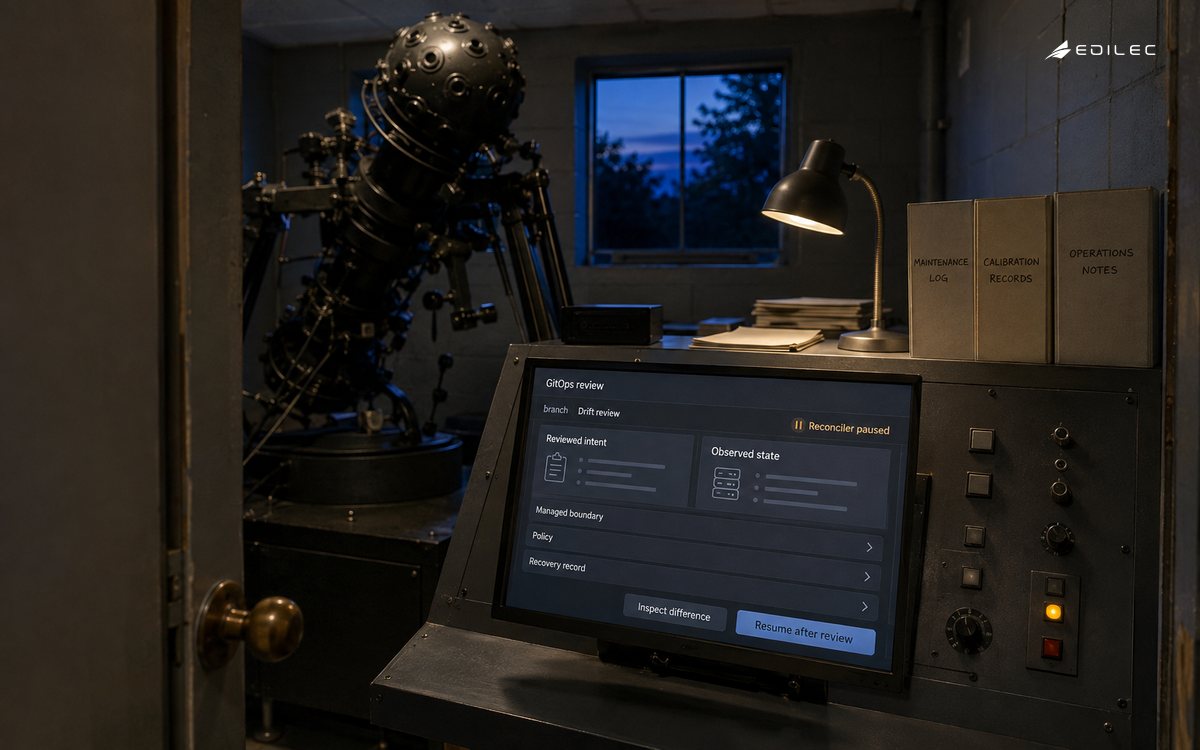
Keep runtime secrets in an appropriate secret system and ensure the reconciler has only the permissions its target requires. Decide what happens when a person changes a resource directly, a desired-state commit is unsafe, or the controller loses access to its source. A useful exercise pauses reconciliation, repairs a controlled drift and verifies that the next sync does not erase an emergency fix unexpectedly. See the observability guide, GitOps cost and scaling, and the GitOps scaling guide.
Further Edilec context: Observability guide, GitOps cost guide, GitOps scaling guide. The production path applies those references specifically to the plain-language guide to gitops.
Source trail: OpenGitOps defines declarative, immutable, pulled and reconciled desired state; Argo CD explains drift comparison and synchronization; Flux documents source and reconciliation controllers; and GitHub deployment environments adds approval and protection context. These references distinguish Git history from runtime health.
Reconciliation should be observable to the people who own the service, not only to the controller team. Clear status, failure context and escalation ownership make the model usable during a busy release window.