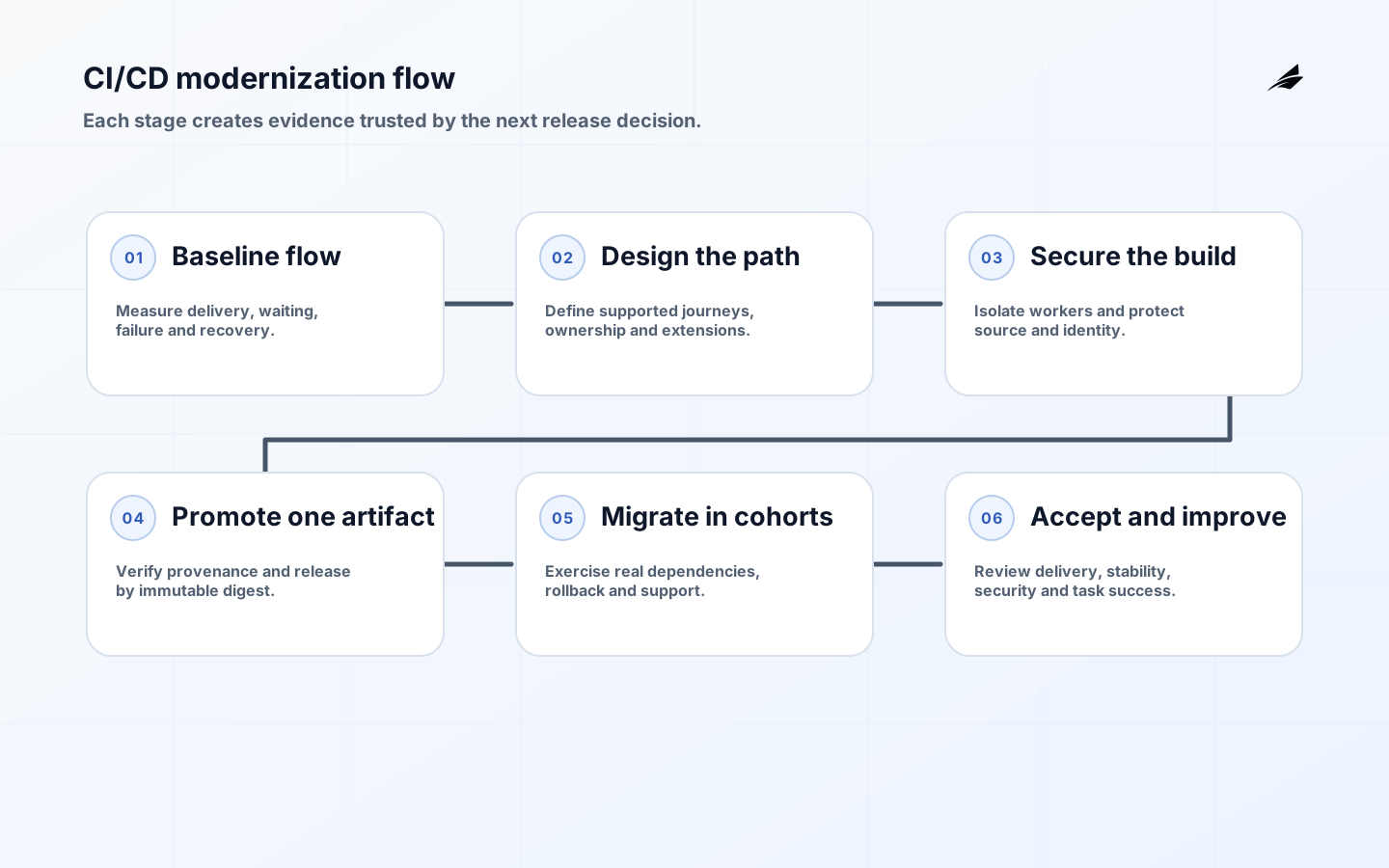
CI/CD modernization services should improve the complete path from an accepted change to a verified production outcome. Replacing a build server or translating pipeline syntax may be necessary, but it does not resolve slow approvals, untrusted dependencies, duplicated tests, fragile environments or releases that operators cannot reverse. A useful engagement establishes a baseline, designs a supported delivery product, migrates representative applications and leaves evidence that application teams can release and recover without specialist intervention.
Use this delivery plan with Edilec's CI/CD modernization implementation checklist, cloud DevOps scope guide and enterprise CI/CD FAQ. They help turn the commercial scope below into application-level controls and acceptance work.
Baseline the delivery and recovery value streams
Map one real service from change request through source review, build, test, artifact publication, environment promotion, deployment, verification and support. Capture active work, queues, manual handoffs, credentials, systems of record and evidence generated. Map the recovery path too: alert, diagnosis, rollback or fix, redeployment and customer confirmation. DORA's value-stream mapping guide distinguishes the ordinary delivery stream from the recovery stream; modernization must shorten both rather than making the happy path attractive while emergencies remain manual.
Baseline by application archetype, not one company-wide average. A stateless API, mobile application, regulated batch service and packaged platform have different release units and constraints. Record deployment frequency, lead time, failed-change recovery, change failure, rework, approval wait, test duration and developer effort. Qualitative evidence matters too: ask teams where they create workarounds, wait for platform staff or distrust pipeline results. This reveals whether the main constraint is architecture, tooling, policy, environment or ownership.
| Scope area | Baseline evidence | Modernization outcome | Out of scope unless named |
|---|---|---|---|
| Source to build | Queue, failure and credential paths | Repeatable isolated build | Product code refactoring |
| Artifact control | Registries, versions and overwrite rules | Immutable promoted artifact | All legacy package cleanup |
| Verification | Test suites, duration and false failures | Risk-based automated feedback | Creating missing business requirements |
| Release | Approvals, deployment and rollback | Progressive, observable promotion | Application resilience redesign |
| Operations | Alerts, ownership and recovery records | Release-linked diagnosis and recovery | Full service-management replacement |
Design a paved path as an internal product
Define supported application types, tenant boundaries, extension points and service commitments. The paved path should provide reviewed templates, isolated execution, artifact storage, identity, policy checks, deployment strategies, telemetry and documentation. Teams need a clear way to request a capability or propose an exception. Standardization should remove repeated plumbing while preserving justified product choices; a rigid universal pipeline often drives high-risk teams back to custom scripts.
Keep source, build and deployment responsibilities separable. Build once, assign a unique digest and promote the same artifact through environments with environment-specific configuration. Use short-lived workload identity where supported instead of shared long-lived secrets. Restrict runners by trust level and prevent untrusted pull-request code from reaching release credentials. Define who owns the platform, templates, policy, application configuration, production decision and incident response before migration begins.
The NIST Secure Software Development Framework groups practices around preparing the organization, protecting software, producing well-secured releases and responding to vulnerabilities. Use those outcomes to examine the whole delivery design. A scanner added late in a pipeline does not protect source branches, build workers, signing identity or release metadata. Security controls should be near the relevant trust boundary and return actionable feedback to the owner.
Protect artifact integrity and build provenance
Threat-model developer accounts, repository settings, dependencies, workflow definitions, runner images, caches, registries, signing services and deployment agents. The joint CISA and NSA developer guidance recommends practices spanning secure development environments, source, build and delivery. Translate relevant recommendations into controls that can be tested, such as protected branches, reviewed workflow changes, isolated workers, dependency policy and verified release identity.

SLSA provides a useful vocabulary for increasing artifact assurance. The current SLSA 1.2 specification defines tracks and levels, including build requirements and provenance formats. Select a target because it addresses a threat, not for a badge. Generate provenance in the trusted build platform, bind it to the artifact digest, protect signing material and verify policy before deployment. An attestation that is stored but never checked does not constrain the release path.
| Boundary | Control decision | Evidence | Failure exercise |
|---|---|---|---|
| Source | Protected change and reviewed workflow | Commit, review and policy result | Compromised contributor account |
| Build | Isolated ephemeral worker | Builder identity and dependency record | Untrusted build attempts credential access |
| Artifact | Immutable digest and retention | Registry event and signature | Tag is moved after approval |
| Promotion | Policy checks same artifact | Attestation verification and approval | Unsigned artifact presented |
| Production | Scoped deployer with stop conditions | Release, health and rollback timeline | Canary breaches error threshold |
Migrate applications in evidence-producing waves
Select a thin first cohort that covers common dependencies and one meaningful exception. Avoid choosing only the easiest service or the most politically visible one. For each application, inventory triggers, secrets, integrations, artifacts, deployment targets, schedules and rollback. Run old and new paths only long enough to compare outputs safely, and prevent concurrent production authority. Acceptance should include an ordinary release, denied change, failed test, rollback and recovery when a platform dependency is unavailable.
Turn lessons into versioned platform capabilities before the next cohort. Track migration blockers by recurring cause: application packaging, missing test data, environment drift, network access, policy ambiguity or ownership. Retire old jobs, credentials, plug-ins and agents after accepted cutover. A dual estate maintained indefinitely duplicates attack surface and support effort, and it makes delivery telemetry unreliable because teams can choose an unobserved route.
Plan change management around user tasks. Provide a migration worksheet, working examples, office hours and a support route with response expectations. Platform engineers should observe application teams completing setup and recovery rather than demonstrating it for them. Product teams retain accountability for their software; the platform team owns the shared experience and guardrails. Make exceptions time-bounded, attributed to an owner and reviewed against an exit condition.
Estimate cost, timeline and commercial scope honestly
Cost is driven less by the number of pipeline files than by application diversity, custom integrations, test debt, regulated evidence, data migration, identity change and old-platform retirement. Separate discovery, target-platform build, per-application migration, enablement and stabilization. Include licenses, hosted runners, build minutes, storage, network transfer, observability, security services and parallel-run cost. A fixed price is credible only when archetypes, assumptions, acceptance and change control are explicit.
Use milestone payments tied to working evidence: baseline accepted, target path exercised, first cohort released and recovered, migration factory repeatable, legacy authority removed, and operations transferred. State customer dependencies such as product-owner time, test data, network decisions and change windows. Forecast a range and update it after the representative cohort. Counting migrated jobs can create false progress when the difficult production and retirement work remains.
The contract should identify deliverables that the customer can continue to use: value-stream maps, target architecture, threat model, template repositories, policy definitions, migration records, service objectives, runbooks and a prioritized backlog. Define intellectual-property and administrative access up front. Provider-controlled accounts or opaque proprietary wrappers can turn a modernization into a new dependency, even when the underlying platform is widely supported.
Measure delivery performance without metric theater
DORA's current software delivery metric history describes five measures: change lead time, deployment frequency, failed deployment recovery time, change failure rate and deployment rework rate. Measure them for a service over time and preserve their definitions. Do not use deployment frequency as an individual quota or compare unlike application populations without context. Pair system data with developer task success, satisfaction, security findings, platform reliability and customer outcomes.
Acceptance is broader than a faster green build. Require reproducible artifacts, bounded credentials, verified provenance where selected, production observability, tested rollback, traceable approvals, supported templates, documented ownership and decommissioned legacy access. Review results 30 and 90 days after migration. A temporary lead-time improvement can disappear if teams accumulate flaky tests, policy exceptions or manual support work.
Operationalize the platform itself as a service. Publish availability and support expectations for runners, registries, deployment controllers and policy services; monitor queue time, worker saturation, failure by cause and recovery. Keep a tested path for urgent releases when a shared component is impaired, with authority and reconciliation recorded afterward. Without this layer, centralization can convert dozens of local inconveniences into one organization-wide release outage.
Use a final acceptance workshop to trace one production revision from request to customer result and one failed revision through recovery. The receiving team should locate every approval, artifact, attestation, deployment signal and incident action without provider narration.
Key takeaways
- Baseline delivery and recovery streams for representative services.
- Treat the shared path as a product with users, commitments and extension rules.
- Build once and promote an immutable, identifiable artifact.
- Place security controls at source, build, artifact and production boundaries.
- Migrate in cohorts that expose real dependencies and retire old authority.
- Measure flow, stability, security, task success and customer outcomes together.
CI/CD modernization services FAQ
Does modernization require replacing the current CI/CD platform?
Not always. If the main constraints are workflow design, ownership or test architecture, a configured upgrade may produce more value than migration. Replace a platform when lifecycle, security, scale or experience requirements cannot be met economically.
How long does a CI/CD modernization take?
A representative paved path and first cohort may take weeks or months; a diverse portfolio can take much longer. Estimate by application archetype and accepted migration wave, then reforecast after real cutover evidence.
Should every pipeline use every security check?
No. Establish a common minimum, then add checks according to technology, exposure and consequence. Each check needs an owner, useful feedback, exception path and maintenance plan. Untriaged findings create delay without reliable risk reduction.
Conclusion
Effective CI/CD modernization services redesign an operating path, not just a tool. Ground scope in measured constraints, secure every trust boundary, migrate representative applications, retire obsolete authority and judge the result through both delivery performance and recoverability. That is how a new pipeline becomes a durable production capability.