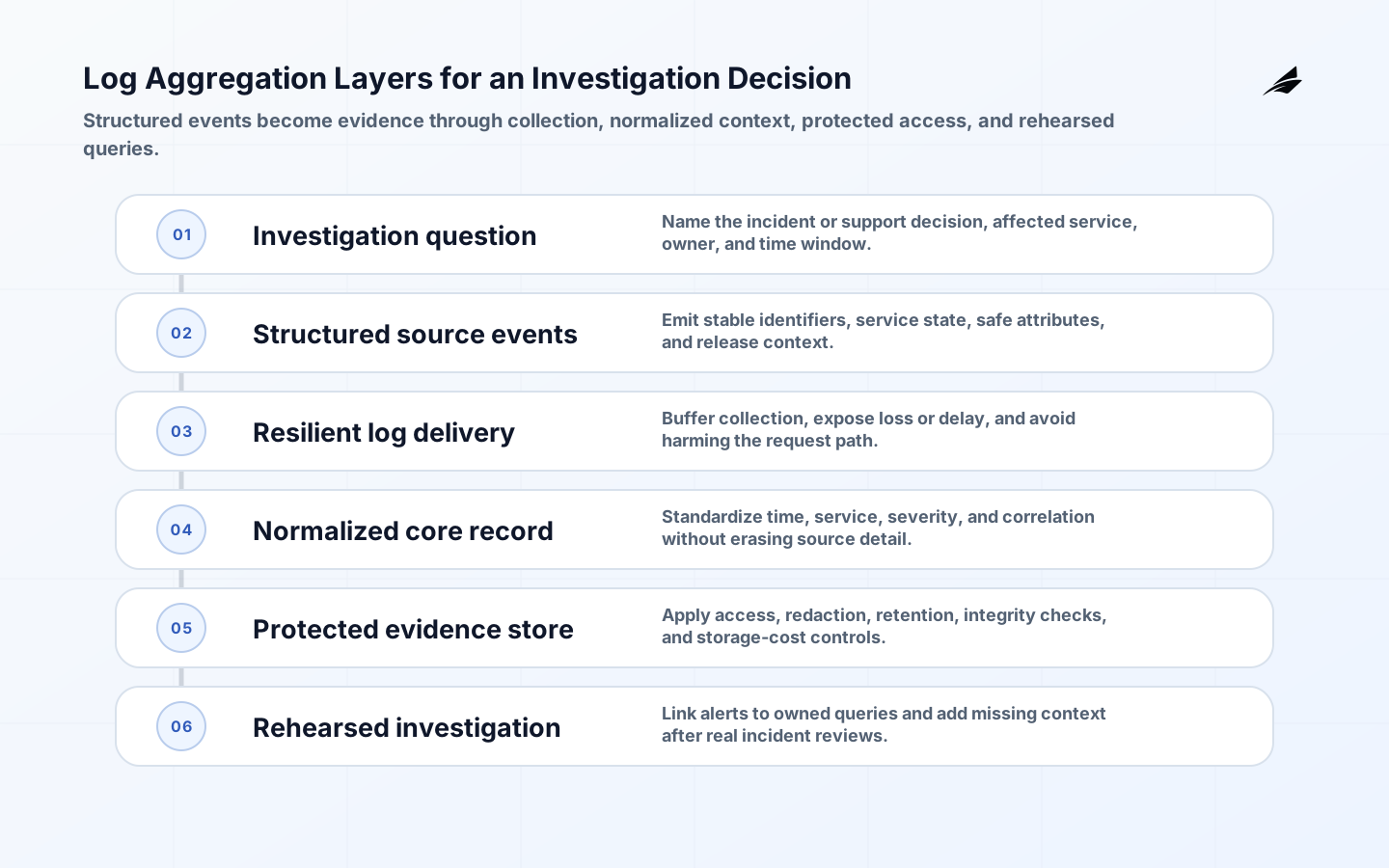
Log aggregation is the practice of collecting events from applications, infrastructure, platforms, and security controls so operators can investigate a question across system boundaries. For an operations leader, the goal is not to keep every line forever. It is to preserve the context needed to make decisions: what happened, where it happened, which release or identity was involved, who was affected, and what action is safe now. A useful log service has an explicit purpose, a data model, an access boundary, a retention decision, and a recovery plan for collection or search failure.
Start with the investigation decisions
Before choosing a collector or storage engine, list the questions responders must answer. They may need to distinguish a failed deployment from a dependency outage, trace a request across services, identify a user-visible error, confirm a security event, or reconcile a job after partial completion. For each question, state the required event fields, acceptable delay, search audience, retention period, and response owner. This prevents the log platform from becoming an unbounded archive. It also gives the team a way to test value: a responder should be able to move from a symptom to an action without manually joining unrelated systems.

Design a useful event model
Structured logs should carry stable fields that support filtering and correlation: timestamp, service, environment, severity, operation, request or trace identifier, outcome, version, region, and relevant resource identity. Define how fields are named, typed, and redacted. Keep the original source context when normalization changes the event. Decide how clocks, duplicate delivery, retries, and multiline exceptions are handled. A common model helps operators search across systems, but it must not erase distinctions that matter to the source team. Record schema changes with the producer and consumer impact so a seemingly small field change does not break a critical investigation.
| Decision | Working rule | Evidence |
|---|---|---|
| Purpose | Define the investigation question first. | Owner and supported use. |
| Context | Preserve source, release, and correlation fields. | Sample event and schema. |
| Protection | Limit access and remove sensitive values. | Role and redaction test. |
| Recovery | Make collection gaps and replay behavior visible. | Runbook and exercise. |
Protect log data as operational data
Logs often contain identifiers, request details, configuration values, and accidental secrets. Classify the data before expanding collection, then apply collection-time redaction where possible and storage access controls everywhere. Separate routine operational access from security investigation access. Define who can search, export, delete, and change retention. A retention period should reflect the investigation and legal needs of the system, along with cost and exposure. Avoid treating a long retention period as a replacement for a precise archive policy. Test a representative event for sensitive leakage and verify that access decisions are recorded.
Build a resilient collection pipeline
Treat collection as a delivery path with its own failure modes. Map sources, agents, buffers, transports, processors, indexes, and query interfaces. Define what happens when a destination is slow, a network is unavailable, a collector restarts, or an event exceeds a size limit. Decide whether the source buffers locally, drops data, samples it, or retries, and make the trade-off visible to the investigation owner. Monitor delivery delay, drop rate, parse failures, storage health, and query availability. A green application dashboard cannot prove that the evidence pipeline is complete.
Preserve correlation across systems
Correlation identifiers allow a responder to follow a request or workflow across services, but they need consistent propagation and clear limits. Combine trace or request identifiers with service, operation, deployment, tenant or account context where appropriate, and resource identity. Do not put sensitive values into identifiers simply because they are convenient. Check how asynchronous work, retries, queues, and batch operations carry context. When a correlation link is missing, the event should still explain its local action and outcome. The operating team should be able to distinguish a missing event from an event that never existed.
| Failure | Control | Response evidence |
|---|---|---|
| Collector backlog | Bound buffers and alert on delay. | Source and destination counts. |
| Parse change | Version schemas and quarantine failures. | Sample raw and normalized event. |
| Sensitive field | Redact at source or ingestion. | Negative leakage test. |
| Search outage | Keep an alternate evidence route. | Rehearsed query and escalation. |
Give responders a practiced search path
A log platform becomes operationally useful when people can use it under pressure. Build a small set of queries around the investigation decisions defined at the start. For each query, show the starting symptom, required access, expected fields, common false positives, and next action. Link the result to the service owner, deployment context, or runbook. Practice with an operator who did not create the dashboard. If the query depends on undocumented field names or a specialist's memory, it is not yet a reliable support path. Keep examples current after schema, service, or retention changes.
Test loss, delay, and recovery
Exercise the pipeline with a normal event, a malformed event, a burst, a delayed destination, and a full search outage. Verify which evidence is preserved, which signal alerts the operator, and how the team reconstructs the gap. Test replay or backfill if the system supports it, and confirm that duplicate events do not create a false incident. During a security investigation, verify that access to retained data remains available to the right role and that preservation does not bypass normal authority. Recovery is complete only when the team can state what was lost, what was restored, and what limitation remains.
Govern retention, cost, and change
Review volume by source, field usefulness, query demand, storage tier, and retention need. High-volume events should have a reason to exist and a clear consumer. Sampling may be appropriate for repetitive success events, but preserve enough context to answer the defined question and never sample away the signal needed for a rare failure without understanding the consequence. Changes to parsers, indexes, access roles, and retention can alter investigations, so stage them and keep a before-and-after sample. Assign a service owner who can balance availability, privacy, cost, and responder effectiveness.
Review evidence quality with responders
Ask responders to walk through a recent investigation using the current search path. Note the fields they could not find, the systems they had to query separately, the access requests that delayed action, and the point at which they stopped trusting the data. Review collection delay and missing events alongside the query result. A platform may have high availability while still being unhelpful if the relevant source is not correlated, the schema changed without notice, or the retention window ended before the incident was understood.
Turn each gap into a bounded change with an owner and verification step. Add a field only when it answers a known question, change a parser with a sample comparison, and adjust retention after considering privacy and cost. Re-run the investigation after the change and keep the result with the service review. This creates a feedback loop in which log aggregation improves the decisions responders make instead of expanding simply because more data is available.
- Define the investigation decisions before collecting more data.
- Use stable fields for source, outcome, version, and correlation.
- Protect logs with redaction, access control, and proportionate retention.
- Monitor delivery delay, drops, parsing, storage, and query availability.
- Rehearse the search path and recovery for missing or delayed evidence.
Key takeaways for operations leaders
- Log aggregation is an evidence service built around decisions, not a warehouse of lines.
- A common event model should improve correlation without erasing source meaning.
- Collection gaps, parser failures, and search outages must be visible.
- Access, redaction, and retention are part of operational reliability.
- The strongest test is whether a responder can use the evidence during a difficult incident.
Frequently asked questions
What should be collected first?
Start with events that answer a defined operational or security question. Include identity, service, operation, outcome, release, and correlation context that the responder needs, then expand when a real investigation shows a gap.
Why use structured logging?
Stable fields make filtering, correlation, redaction, and aggregation more dependable than parsing prose after the fact. Structure still needs a versioned contract and source context so changes remain understandable.
How long should logs be retained?
Retain them long enough for the investigations, customer commitments, security needs, and legal requirements they support, while considering cost and exposure. Use different tiers when access frequency and preservation needs differ.
Further reading and adjacent practice
For surrounding platform and reliability context, consult the Kubernetes documentation, Google SRE Book, AWS Well-Architected Framework, and OpenTelemetry documentation. Delivery automation is covered in the related guide on CI/CD pipelines for cloud and DevOps.
For adjacent decisions, continue with Edilec's CI/CD Pipeline Best Practices for Reliable Cloud Delivery and Observability for Cloud and DevOps: From Telemetry to Decisions.
Conclusion: make evidence usable under pressure
Log aggregation succeeds when it helps an operator answer a real question with enough context to choose a safe action. Define the decision, design the event model, protect the data, observe the pipeline, and rehearse recovery. That discipline keeps collection proportionate and makes missing evidence visible. The result is a calmer incident path in which logs support judgment rather than create another system that responders must decipher.