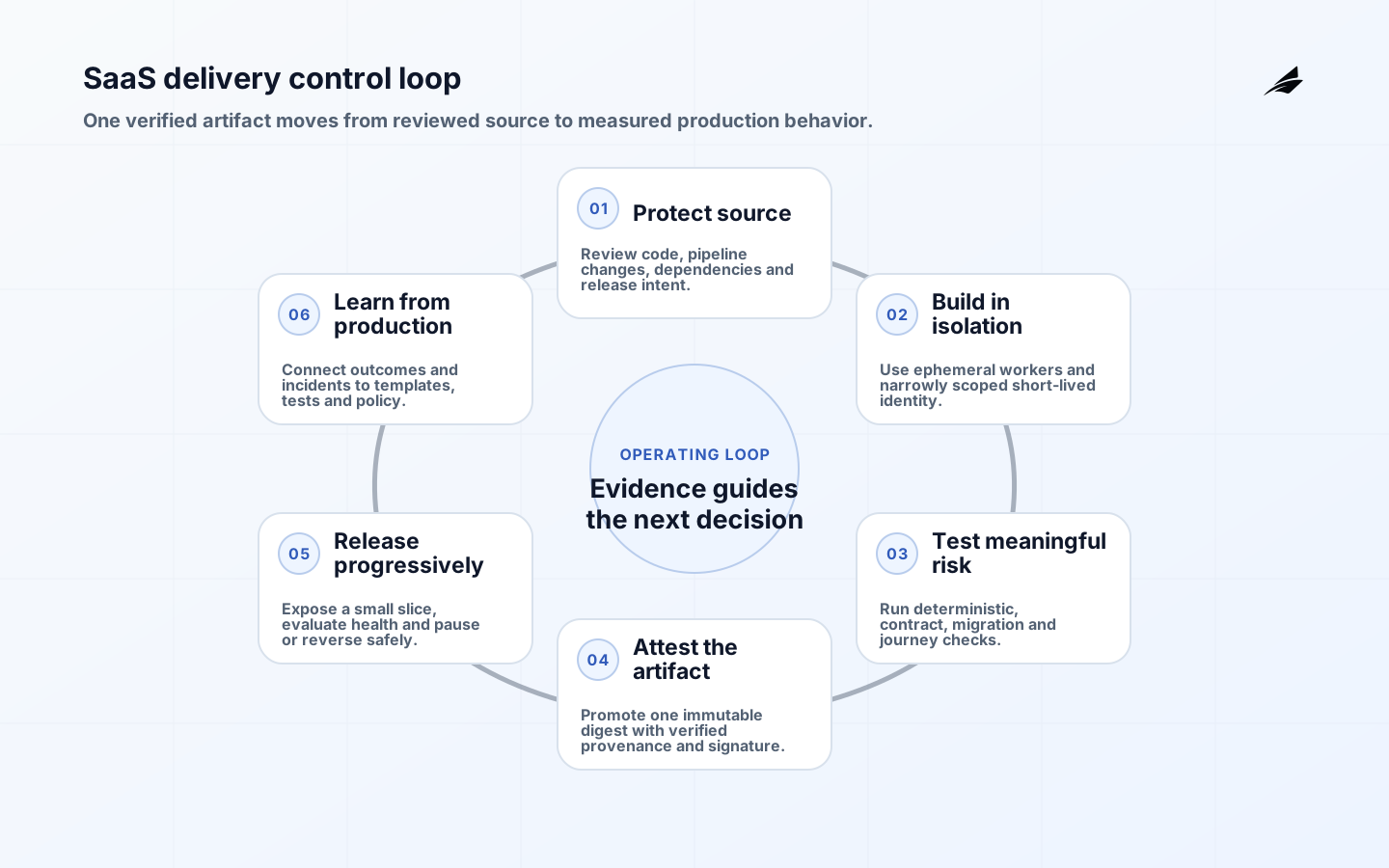
A CI/CD modernization services for SaaS companies implementation checklist should improve the path from reviewed source to verified production behavior. Replacing one build server with another is not modernization if teams still share credentials, rebuild artifacts between environments, wait on opaque approvals or cannot restore service. The goal is a paved delivery path that makes routine changes fast and low-risk while preserving stronger controls for migrations, security boundaries and other high-impact work.
Set commercial scope with the CI/CD modernization delivery plan and resolve buyer questions in the CI/CD modernization FAQ. The cloud DevOps implementation checklist helps coordinate adjacent platform work. Assign one product owner for the developer experience and one accountable owner for production delivery risk.
1. Baseline the current delivery system
Map representative changes from commit to customer: code review, build, test, security checks, packaging, approvals, deployment, migration, validation and rollback. Record queue and execution time separately. Sample failed and emergency releases to expose manual steps that normal diagrams omit. Inventory repositories, runners, plugins, credentials, artifact stores, environments, deployment targets and ownership. Mark unsupported components and jobs nobody understands. A migration plan built from pipeline names rather than actual change journeys will miss the highest-friction dependencies.
Establish outcomes and baseline measures. DORA's current software delivery performance metrics cover throughput and instability dimensions; use their definitions carefully and segment by service or change class. Add build queue time, flaky-test rate, rollback success, credential age, unsupported runner count and developer satisfaction. Metrics should improve decisions, not rank individuals. A team shipping a safety-critical migration monthly should not be compared mechanically with a team updating static content daily.
| Baseline item | Measure | Modernization signal |
|---|---|---|
| Commit path | Lead time and manual handoffs | Shorter wait without more failures |
| Build estate | Runner versions and reproducibility | Ephemeral standardized workers |
| Test system | Duration, flake and defect escape | Reliable risk-based feedback |
| Release | Failure and recovery time | Progressive rollout and proven rollback |
| Supply chain | Artifact identity and provenance | Verified promotion from one build |
2. Define the target delivery contract
Create a reference pipeline with versioned stages and extension points: source policy, dependency resolution, compile, unit tests, static checks, package, attest, deploy to test, integration tests, promote, progressive production release and post-deploy verification. Define required inputs and outputs for each stage. Teams should consume the template by version and be able to test upgrades. Avoid a central pipeline so rigid that services fork it; provide governed escape hatches with owner, reason and expiry.
Align controls to development risk using the NIST Secure Software Development Framework, which groups practices around preparing the organization, protecting software, producing well-secured software and responding to vulnerabilities. Translate practices into workflow behavior: protected branches, reviewed pipeline code, dependency policy, isolated builds, retained artifacts, vulnerability intake and remediation. Record which services use each control and where an approved alternative applies.
3. Isolate identity, secrets and runners
Give every workflow a narrowly scoped service identity. Prefer short-lived workload federation to stored cloud keys, constrain trust to repository, branch, environment and workflow attributes, and separate pull-request permissions from release permissions. Protect production environments with authorization appropriate to impact. Never expose deployment credentials to untrusted fork builds. Store secrets in a managed system, mask output, rotate on suspicion and test that deleted workflows cannot continue using old credentials.
Use ephemeral, patched runners for sensitive builds where practical. Separate trusted release workloads from arbitrary pull-request jobs, restrict outbound network access when builds should be hermetic, and pin third-party actions or plugins to reviewed immutable versions. Generate an inventory of runner images and pipeline dependencies. Administrators of the CI platform can alter release behavior, so protect their access, log configuration changes and require review for organization-wide templates.
4. Build once and establish artifact provenance
Produce an immutable artifact once, identify it by digest and promote that exact artifact through environments. Rebuilding from the same source can resolve different dependencies or tools. Capture source revision, build recipe, builder identity, dependencies and parameters. The SLSA 1.2 specification defines build provenance and increasing assurance against supply-chain threats. Select a realistic target based on threat model and verify attestations at promotion or admission, not merely generate files nobody checks.

Sign releases and bind signatures to artifact identity. Sigstore's overview describes short-lived identity-based signing, transparency logging and verification in its ecosystem. Whether using Sigstore or another mechanism, define trusted identities, issuer, repository, workflow and expected claims. Preserve metadata for the supported product life. A valid signature proves an asserted origin under policy; it does not prove the software is vulnerability-free or functionally correct.
| Pipeline control | Required test | Failure behavior |
|---|---|---|
| Source policy | Unreviewed protected-branch write | Commit blocked and logged |
| Workload identity | Token request from wrong branch | Credential not issued |
| Artifact promotion | Digest differs from tested artifact | Deployment denied |
| Provenance | Builder or source claim mismatches | Promotion denied |
| Progressive release | Health objective burns rapidly | Rollout pauses or reverses |
| Rollback | Schema and application version regress | Known recovery path executes |
5. Rebuild testing around fast risk feedback
Classify tests by defect detected, runtime, reliability and required environment. Put deterministic unit and policy checks early; run contract tests at service boundaries; use integration and end-to-end tests for high-value journeys rather than every permutation. Quarantine flaky tests only with an owner and expiry, because silently rerunning them hides signal. Parallelize after fixing shared-state coupling. Cache dependencies with integrity validation and measure whether cache complexity actually reduces lead time.
Treat database and event-schema changes as compatibility work. Use expand-and-contract migrations, test old and new application versions against transition states, and separate irreversible data changes from routine deployment. Build synthetic post-deploy checks around customer outcomes. Production verification should compare error, latency, saturation and business signals to a baseline. Keep manual approval for material judgment, but present the approver with artifact, changes, test results, risk, rollout and rollback instead of a bare button.
6. Introduce progressive delivery and recovery
Deploy a small slice, observe defined health criteria, then expand. Feature flags can separate code deployment from feature exposure, but every flag needs owner, default, security review and removal date. For Kubernetes workloads, the official Deployment documentation describes rollout status, strategies, history and rollback behavior; validate the platform's exact semantics, readiness signals and capacity during overlap. A successful controller rollout does not prove a customer journey works.
Define rollback by change class. Application rollback may be automatic; database restoration, financial event replay or security changes may require a forward fix and explicit command. Exercise recovery in staging and selected production game days. Preserve the previous verified artifact and configuration. Incident responders need a release timeline that links commit, artifact, deployment, flags and health changes. The fastest pipeline is unsafe if it cannot tell operators what changed.
Roll out the platform through service cohorts
Choose a pilot that is important enough to expose reality but not the most fragile service. Pair platform engineers with the owning team, document friction and improve the template before a second cohort. Migrate by service journey, not by copying every legacy job unchanged. Publish a support channel, service-level expectations and a deprecation date for old runners. Fund the application changes needed to adopt the paved path; pipeline tooling cannot repair untestable code or unsafe schemas on its own.
Review adoption and outcomes together. Count services on current templates, exceptions, lead time, failures, recovery, security findings and developer effort. Investigate shifts rather than declaring a universal target. Maintain pipeline templates like a product with release notes, compatibility tests, telemetry and user research. Remove legacy credentials and infrastructure after verified migration. Modernization is complete when the old risk can be retired, not when the new interface launches.
Create a migration acceptance record for every service. It should identify the current template version, release identity, environments, artifact repository, secret sources, production permissions, rollback method, owning team, exception list and last successful recovery exercise. Require two ordinary production releases through the new path before disabling the old one, then revoke its credentials and archive its configuration. Sample the first cohorts for hidden manual actions and local scripts. This prevents a dual pipeline from becoming permanent and gives support teams a reliable inventory during an incident. Verify scheduled jobs, release notifications and emergency procedures as part of the same acceptance, with evidence retained by the service owner.
Key takeaways
- Map real change journeys and baseline both speed and instability.
- Offer versioned reference pipelines with governed extension points.
- Use short-lived identities, isolated runners and reviewed pipeline dependencies.
- Build once, promote by digest and verify provenance against policy.
- Combine progressive delivery with tested rollback and customer-outcome checks.
Frequently asked questions
Should delivery stop during modernization?
Usually no. Run a thin vertical pilot beside the existing path, migrate cohorts and keep a tested fallback until acceptance. Freeze only risky configuration during defined cutovers. A long feature freeze creates pressure to bypass controls and makes the eventual change larger.
Do we need to replace every CI/CD tool?
No. Replace components that block the target contract, are unsupported or create disproportionate risk. Existing tools may be retained behind standardized identity, artifact and telemetry interfaces. Tool consolidation is useful when it removes operating burden, not as an end in itself.
Are manual production approvals always bad?
No. They are useful when an authorized person must assess material context. They are harmful when every low-risk release waits for someone who lacks evidence. Automate deterministic controls and reserve human approval for defined risk classes, with complete decision context and attribution.
Conclusion
CI/CD modernization turns delivery into an observable, verifiable production system. Baseline reality, define a versioned contract, isolate trust, promote immutable artifacts, test meaningful risks and roll out progressively. When teams can ship routine changes with clear evidence and recover confidently, the modernization has changed capability rather than merely changing tools.