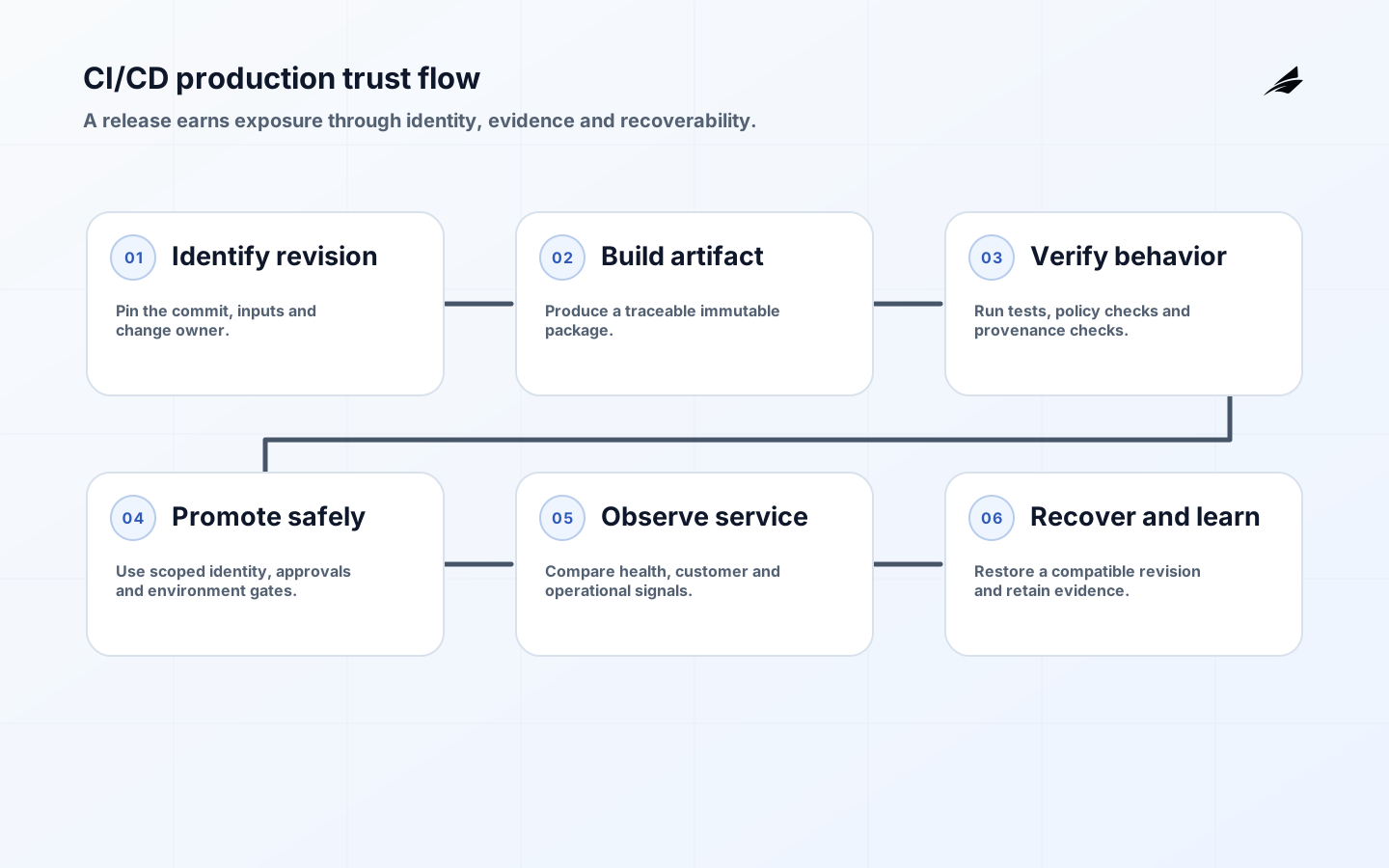
CI/CD pipelines are a chain of evidence and controlled transformation, not a sequence of vendor screens. A source revision becomes a build artifact, the artifact is tested and identified, then a deployment mechanism exposes it to an environment with known configuration and authority. Each boundary exists because a production change needs to be repeatable, inspectable, and recoverable. Teams get into trouble when they let the pipeline rebuild different inputs for every environment, use a human workstation as the hidden deployment system, or call a job successful without checking the service outcome.
Key takeaways
- Treat CI/CD pipelines as an operating decision with a named owner and explicit evidence.
- For CI/CD delivery, separate the normal delivery path from the exception or recovery path before production pressure arrives.
- For CI/CD delivery, use customer, service, and operational signals together so a technically green result does not hide a failed outcome.
- For CI/CD delivery, improve the supported pattern from incidents, exercises, and recurring exceptions rather than relying on informal memory.
Start with the artifact and the trust boundary
Define what a release artifact is for each service: a signed container image, package, static bundle, infrastructure plan, or another immutable unit. Record the source revision, build inputs, dependency resolution, test results, and artifact digest. The same artifact should move through environments whenever practical; environment-specific behavior belongs in reviewed configuration and secrets, not an untracked rebuild. This separation makes it possible to compare a production incident with the exact item that passed earlier checks and to restore a known version without reconstruction.
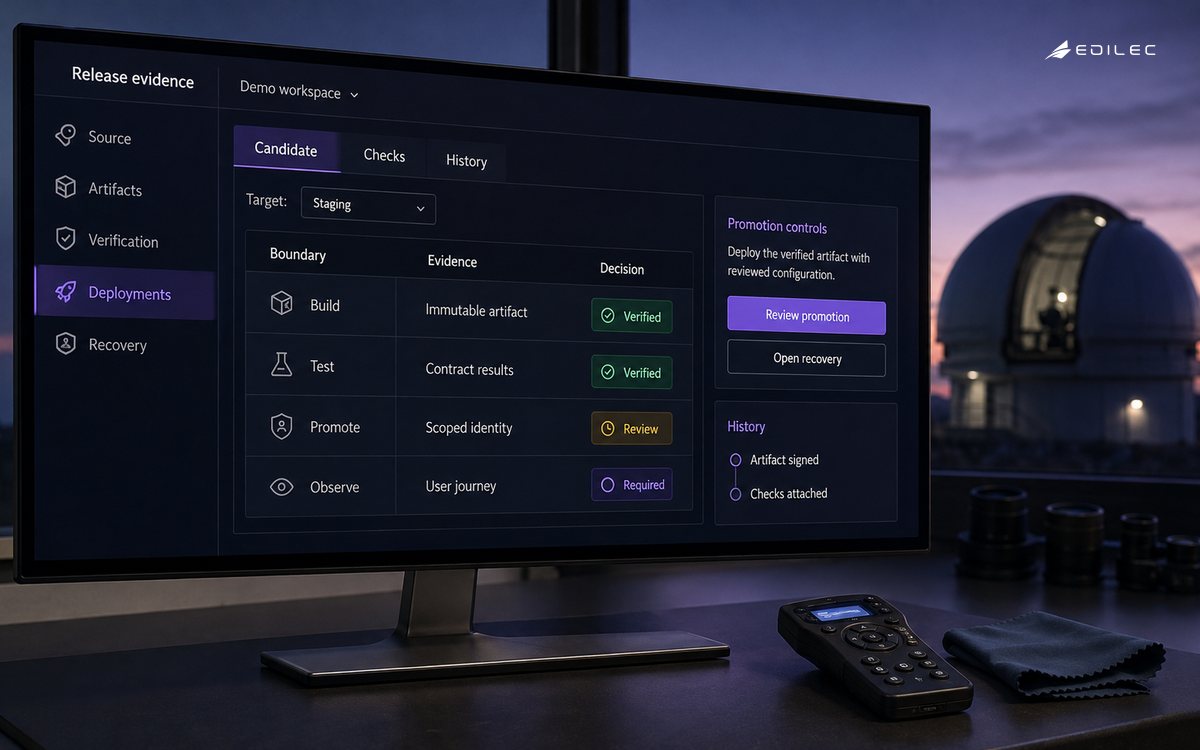
Treat credentials as a pipeline architecture decision. Build and deploy jobs need only the scope required for their stage, with production identity separated from ordinary development access. Prefer short-lived workload identity where the platform supports it, and keep approval or environment protection around the job that can make the real deployment. A static administrator key in a CI variable turns every compromised repository action into a production access path. The visible convenience conceals a very broad trust boundary.
| Pipeline boundary | Evidence produced | Failure it should prevent |
|---|---|---|
| Source to build | Revision, dependency inputs, and artifact digest | An unrepeatable binary or image. |
| Build to verification | Test result tied to the artifact | Tests passing on something different from release. |
| Verification to deploy | Approved target and scoped identity | A job deploying to the wrong environment. |
| Deploy to observe | Version marker and health result | A green job masking a broken customer journey. |
Make quality gates proportionate and informative
A gate should answer a decision question. Unit and integration tests establish behavior at different layers; static analysis and dependency checks surface known classes of risk; contract or smoke tests confirm the packaged service works in a target setting. Do not make every check a required production gate simply because the tooling can run it. Long, flaky suites delay feedback and encourage bypasses. Instead, classify checks by confidence, execution time, and consequence, then make failures actionable with a clear owner and path to reproduce.
Environment strategy should preserve the purpose of each stage. A local environment gives fast feedback. A review environment helps a stakeholder inspect a bounded change. An integration setting exercises shared contracts and protected test data. Production provides real demand and failure modes, so it needs controlled exposure and observation. Do not promise that staging is a perfect copy of production; it rarely is. Use it to test known interactions, then use progressive production delivery to learn what tests cannot represent.
Design the CI/CD pipelines decision path
The pipeline path moves from a reviewed change through reproducible build, artifact verification, protected environment promotion, controlled production exposure, and evidence-led recovery or improvement. It is a flow of progressively stronger evidence, not merely an automation sequence.
| Pipeline result | Question before promotion | Response when it fails |
|---|---|---|
| Build succeeds | Can this artifact be identified and reproduced? | Fix inputs or metadata before treating it as releasable. |
| Test fails intermittently | Is the test exposing a real race or environmental dependency? | Investigate flakiness; do not normalize retries indefinitely. |
| Deployment job succeeds | Did the expected version reach the intended audience? | Check deployment record, routing, and runtime version markers. |
| Health check degrades | Is the condition version-specific and within stop criteria? | Pause exposure, contain, then rollback or repair. |
Keep production promotion observable and reversible
Production should receive a versioned artifact with a visible deployment record, release notes appropriate to the audience, and a link to the metrics that decide expansion. Use a canary, cohort, region, or feature control when the service allows it. The control is valuable only if the team can measure the new population separately enough to see harm and can halt further exposure quickly. A gradual rollout without a decision rule simply makes an incident slower to recognize.
Build recovery into the workflow. Keep prior artifact references, deployment configuration, compatibility assumptions, and the steps for traffic reversal or feature disablement. For data changes, identify what cannot be undone and who owns reconciliation. Practice the workflow with a bounded failure. CI/CD pipelines become trusted when a team can deploy, pause, diagnose, and restore through the normal path without privileged improvisation. That confidence is what permits higher delivery frequency.
Improve the pipeline from delivery outcomes
Track how long a normal change takes from merge to safe exposure, but pair speed with change failure rate, time to contain, and the quality of recovery evidence. A fast pipeline offers no delivery advantage if its changes are invisible or unrecoverable. Look at queue time separately from execution time; long waits may point to unclear ownership or an overloaded shared environment, while long jobs may point to test design or build caching. Fix the constraint that actually limits flow.
Review failures by category: source inputs, packaging, test environment, authorization, configuration, runtime behavior, or dependency health. This prevents a generic conclusion that the pipeline is unreliable. When a failure repeats, encode the lesson in a template, validation, or runbook. When a control adds no decision value, remove or redesign it. A pipeline is platform capability, and it should get the same product stewardship as any other system used every day.
Worked pipeline decision
A service change passes unit tests and is packaged into an image. The pipeline records the commit, digest, and test results, then deploys that digest to an integration environment where a contract check finds that a downstream API rejects a new optional field. Because the failure is tied to the immutable artifact, the developer can reproduce it without wondering which build was used. The team changes the serialization behavior, creates a new artifact, and promotes that version through the same route. In production, a small cohort receives the release and a version marker lets the operator compare error rate and transaction completion with the prior digest. When the cohort is healthy for the stated window, exposure expands.
The value of the pipeline is not that it prevented every defect. It made the defect visible at a useful boundary and retained enough evidence to correct it without inventing a special release path. If the release had degraded in production, the same artifact record and deployment history would make a pause or rollback a controlled decision rather than a search through workstation history.
Teams should keep the pipeline's recovery operation as close as possible to its promotion operation. The same system that moves a digest forward should be able to select a previous digest, apply the appropriate configuration, and record the reason for reversal. A separate emergency script with undocumented credentials is often fast once and expensive forever. It cannot benefit from the checks, identity boundaries, or history of the normal path. For stateful releases, the recovery action should also surface the compatibility decision: restore traffic only, pause writers, or run a bounded repair. Stating those alternatives in the pipeline documentation helps a delivery team avoid treating an artifact rollback as a complete customer recovery.
Frequently asked questions about CI/CD pipelines
Question: Is continuous deployment required for a CI/CD pipeline? Answer: No. Continuous integration and automated delivery can coexist with an approval gate or scheduled release. The important property is a traceable artifact, proportionate validation, visible promotion criteria, and a recoverable production change.
Question: Why promote the same artifact through environments? Answer: The same immutable artifact reduces uncertainty by separating build evidence from environment configuration. Rebuilding for each environment can introduce untested differences and weaken the connection between what was tested and what was released.
Question: What should a pipeline do when a gate fails? Answer: Preserve the evidence, stop promotion, identify the responsible owner, and provide a safe retry or repair path. A failed gate should explain whether the issue is code, environment, policy, dependency, or test reliability.
Is continuous deployment required for a CI/CD pipeline?
No. Continuous integration can produce verified artifacts while production promotion remains controlled by environment rules or human decisions. The important property is that the path is repeatable and evidence is retained.
Why deploy the same artifact through environments?
It removes a major source of uncertainty. Differences can then be attributed to configuration, data, dependencies, or demand rather than a hidden rebuild with different inputs.
Conclusion
CI/CD pipelines make delivery safer when they preserve identity from commit to production and make each promotion decision evidence-based. Invest in immutable artifacts, scoped authority, meaningful gates, and a practiced recovery route.
Review the pipeline as an evidence chain
A delivery review should be able to answer five questions without opening a developer laptop: which revision produced the artifact, which checks ran, who or what approved exposure, which environment received it, and what service evidence followed. GitHub deployment environments documents approval and protection mechanisms that can gate secrets and promotion. SLSA adds a supply-chain lens: provenance is valuable because the deployment decision depends on knowing what was built and from which inputs.
Use one immutable artifact through test, staging and production, changing only explicitly managed configuration. A failed check should produce a useful status and a named next action rather than a green pipeline with a warning hidden in logs. Keep the recovery operation close to the promotion operation: the same identity and history should be able to select a prior revision, restore compatible configuration and record why exposure changed. For practical context, connect this pattern with the plain-language CI/CD guide, deployment rollbacks, and SLO planning.
Further Edilec context: Plain-language CI/CD guide, Deployment rollback guide, SLO planning guide. The production path applies those references specifically to ci/cd pipelines from commit to recoverable production change.
Source trail: GitHub deployment environments documents approvals and protected secrets; Google SRE release engineering explains repeatable release practice; Kubernetes Deployments shows revision-aware rollout; and SLSA supplies provenance vocabulary. Read them together when deciding which evidence permits exposure.