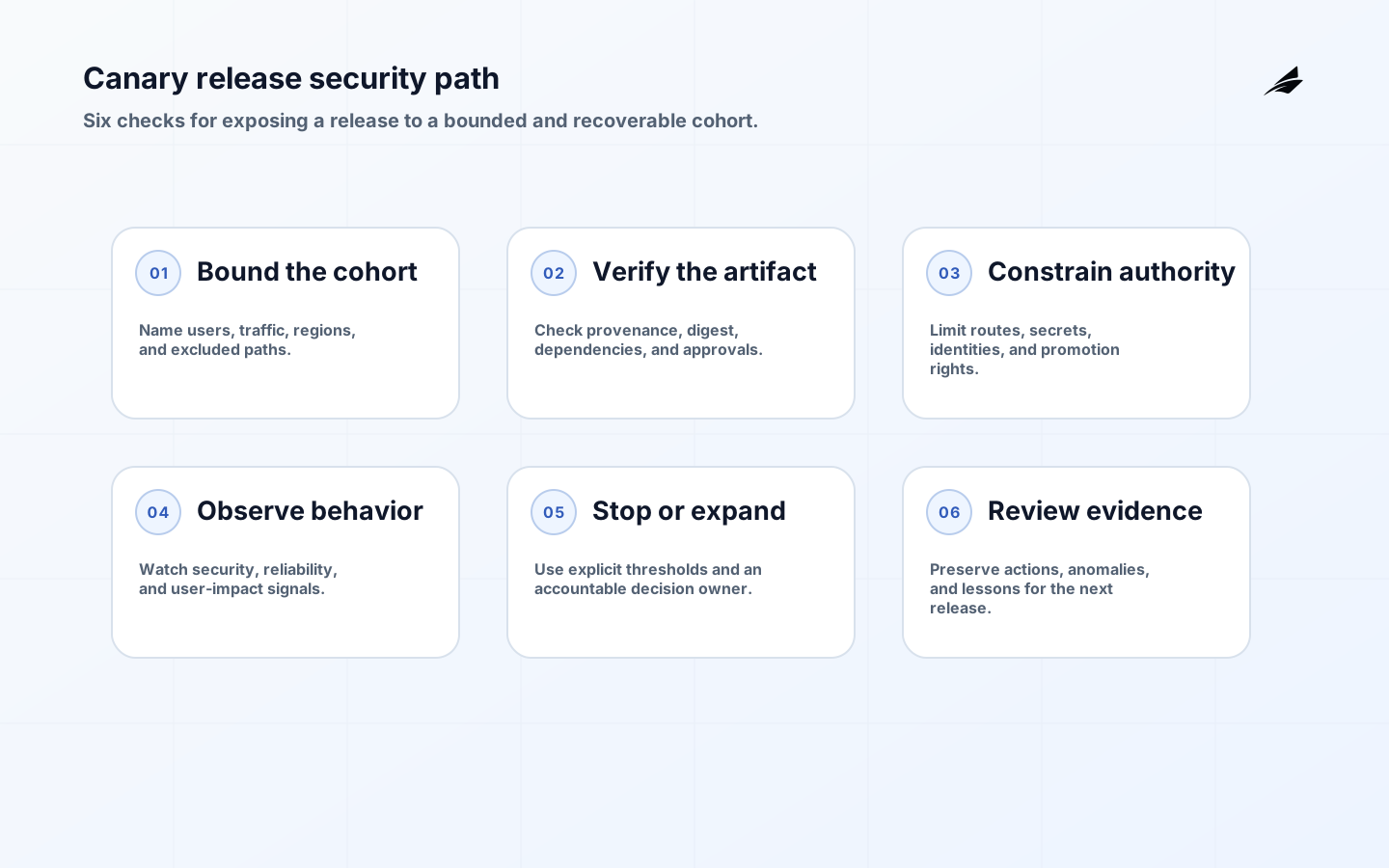
Canary releases reduce exposure only when the cohort is real, bounded, and observable. Sending a build to one percent of traffic is not automatically safer if that percent includes privileged administrators, one large tenant, payment operations, or a segment whose data represents everyone else. Security review begins before traffic shaping. Teams need to know which identities, data classes, permissions, and outbound connections the canary can touch, and which conditions stop it from advancing.
Establish the canary releases operating boundary
Define the population in product and security terms, not only a percentage. Prefer internal, synthetic, or opt-in cohorts where the workflow permits; avoid random groups for changes that alter authorization, billing, retention, or irreversible writes. Record the artifact, policy revision, flags, infrastructure change, and configuration scope. A canary packages several changes together, and a signal cannot be assessed when nobody knows which change introduced a permission or data path.

| Decision area | Working rule | Evidence to keep |
|---|---|---|
| Cohort | Internal, synthetic, opt-in, or risk-approved segment is explicit. | Routing rule and product approval. |
| Access | Identity, data, queue, and egress permissions are enumerated. | Policy diff and identity binding. |
| Stop rule | Customer and security thresholds have owner and window. | Release decision record. |
| Containment | Flag, route, credentials, and workers can be limited independently. | Rollback rehearsal. |
Design canary releases for safe change
Constrain the cohort at several layers. Traffic routing does not limit a worker consuming a shared queue or a token with broad access. Use scoped service identity, environment separation, egress policy, least-privilege cloud roles, and feature controls that enforce the same cohort definition. Preserve release revision, actor type, tenant boundary, and decision outcome. This lets investigators distinguish a canary fault from normal noise or a control-plane change.
Control the risks around canary releases
Set expansion rules before observation begins. Combine customer signals with authentication failures, authorization anomalies, data-export volume, privilege changes, sensitive configuration access, and unexpected egress. Establish duration and the owner who can halt or promote. Do not use one green dashboard as a waiver; privacy and abuse signals may arrive late. Protect flags and traffic controls from casual modification, and ensure emergency containment does not depend on the same compromised credential set.
| Scenario | Expected response | Verification |
|---|---|---|
| Authorization spike | Hold promotion and compare denied actions by revision. | Access returns to expected baseline. |
| Sensitive egress | Block at policy boundary and preserve metadata. | No payload reaches unapproved destination. |
| Flag error | Disable with independent audited authority. | Exposure ends without code deploy. |
| Async defect | Pause or partition consumer work. | Cohort context supports repair. |
Test canary releases under pressure
Confirm that an authorization regression is visible, forbidden egress is blocked, and the team can disable a flag or return traffic before expansion. Exercise an asynchronous export or queue consumer, then verify it carries cohort and release context. Test the control plane too: traffic-weight or policy changes should require intended authority and leave an audit record. These exercises turn security review into an operational capability.
Operate and improve canary releases
Keep release context searchable through the plausible detection period. Review whether stop conditions were useful, whether the cohort was truly bounded, and whether operators resolved ambiguity without waiting for the author. Repeated exceptions usually indicate a progressive-delivery limitation, not a need for more approval meetings. Improve defaults, remove unneeded privilege, and update review criteria when a new change class repeatedly creates risk.
- Choose a cohort that matches change risk.
- Attach artifact and policy revisions to telemetry.
- Review permission and egress changes before expansion.
- Keep a separate audited containment path.
- Include delayed asynchronous effects in observation.
Implementation field notes for canary releases
Architecture review for canary releases starts with the cohort rule, workload identity, feature flag, route, queue, audit event, and egress policy. For canary security, give each element an owner, an authoritative source, and expected failure behavior. For canary security, follow a normal request across automation, people, and vendor boundaries, then test late, denied, stale, and partial outcomes. For canary containment, that turns a feature list into an operating design. For canary security, it makes the route from ordinary work to accountable recovery visible and reveals assumptions that belong in a runbook, configuration review, or smaller scope rather than in private memory.
Acceptance evidence must be practical. For canary security, define what proves the intended control works in representative conditions, who reads the proof, and what result stops expansion. For canary security, evidence can be a versioned configuration comparison, scoped identity decision, customer-safe synthetic transaction, audit event, or reconciliation record. Keep it with the release or operating decision. For canary security, when an operator must gather proof from dashboards, chat threads, and private notes, the control becomes slow exactly when speed and clarity matter. Canary acceptance includes cohort membership, denied access patterns, egress decisions, and delayed worker outcomes. The release owner needs a stop rule that limits exposure rather than asking for more customers.
Decision rights are part of canary releases. For canary security, separate authority to observe, change, approve, and override. For canary security, the person running routine work needs a fast supported path; the person accepting a material exception needs context and a durable record. For canary security, define the escalation route before the exception, including the point at which work pauses rather than silently continuing. For canary security, this avoids broad permanent privilege and makes handoffs inspectable by engineering, security, product, and support without forcing each group to master every implementation detail.
For canary security, use a failure exercise that crosses the boundary instead of a healthy-path demonstration. In the approach, a one-percent web canary can trigger a worker with credentials for every tenant export. For canary security, the response should name containment, stakeholder communication threshold, evidence preservation, and the reconciliation action that proves closure. For canary security, rehearse it in non-production where possible, then run a tabletop with the people who would decide and communicate. For canary security, these exercises expose unavailable permissions, incomplete audit context, undocumented dependencies, and unclear ownership before customers depend on the path.
Measure behavior rather than activity volume. Combine an outcome relevant to canary releases with a review of operator confusion, support contacts, recurring overrides, and workarounds. For canary security, version the calculation and alert separately when evidence is incomplete; a quiet chart is not proof of health if collection failed or people stopped recording exceptions. For canary security, this lets the team distinguish genuine improvement from a reporting change and gives leadership a defensible reason to prioritize a repair, investment, or retirement.
Cost and capacity belong in the operating review. For canary security, estimate direct infrastructure spend alongside release delay, support demand, training, investigation time, and recurring exception cost. For canary security, start with one representative workflow and a success and stop criterion rather than a broad commitment based on feature lists. For canary security, expand only when teams can explain the value, operate the path without private expertise, and show that it removes a meaningful risk or handoff instead of moving it to another queue. For canary releases, review the economic trade-off with the owner who experiences it.
For canary security, publish what changed, what stays deliberately out of scope, the evidence collected, and the date owners will retest the assumption. For canary security, revisit after architecture, ownership, customer-commitment, or incident changes. This keeps canary releases connected to live operations and makes continual improvement normal delivery work rather than a retrospective promise that disappears after the immediate problem has passed.
Field application: Canary acceptance includes cohort membership, denied access patterns, egress decisions, and delayed worker outcomes. The cohort owner should be able to halt without widening the experiment. For canary security, in the next operating review, compare that evidence with the stated risk boundary and decide whether the control can expand, needs correction, or remains limited. For canary security, record the decision with its accountable owner so later changes do not recreate the same uncertainty.
Key takeaways
- Define the customer, service, or risk boundary before implementing canary releases.
- Make the normal path observable and exceptions attributable.
- Use rehearsals to prove recovery, not dashboards to claim readiness.
- Review the model when architecture, ownership, or commitments change.
A canary security review should follow the same release evidence as the functional review, with extra attention to who can influence the cohort and what happens when the control plane is unavailable. Kubernetes documents how a Deployment manages ReplicaSets and rollout progress in its Deployment documentation; the Google SRE release engineering chapter emphasizes repeatable, reversible release practice. SLSA security levels provide a supply-chain lens for provenance and build integrity, while NIST’s SP 800-204A service-mesh guidance helps teams reason about identity, policy, and observability at service boundaries. Together these sources suggest that a secure canary is not simply a small percentage of traffic; it is a bounded experiment with an authenticated artifact, an observable audience, and a pre-authorized stop path.
Before increasing exposure, verify the image provenance, deployment identity, routing rule, secrets scope, audit events, and rollback permissions in the same environment where the canary runs. Review both a healthy promotion and an emergency halt with the on-call engineer. Related reading on deployment rollbacks, feature flags, and release risk controls can broaden the review without replacing the service-specific threat model. These companion articles are Deployment Rollbacks: Architecture Guide, Blue-green Deployment: Mistakes and Fixes, SLOs: Hands-on Planning Guide.
Frequently asked questions
Question: Does a canary replace security testing? Answer: No; it limits exposure while testing release behavior, identity, provenance, data access, and telemetry in a controlled cohort. Question: What makes a cohort unsafe? Answer: Privileged users, sensitive data, irreversible actions, or a shared dependency whose blast radius is not bounded.
Does a canary replace security testing?
Answer: No. A canary limits exposure and supplies runtime evidence, but secure development, provenance, least privilege, dependency review, and incident response remain necessary.
What makes a canary cohort unsafe?
Answer: Unexpected privileged users, sensitive tenants, unbounded data access, weak isolation, or a routing rule nobody can reconstruct make the cohort unsafe.
Who authorizes promotion?
Answer: The release owner should coordinate explicit operational and security approval against the predeclared evidence and stop conditions.
When should canary security checks block promotion?
No. It complements build-time testing, review, dependency checks, and policy by observing limited real conditions. Basic authorization and data defects should be found earlier.
Which cohort boundaries need extra containment?
A small percentage is unsafe when it carries disproportionate harm, including privileged users, regulated tenants, or irreversible financial and data operations.
Who authorizes canary expansion?
The release owner acts within agreed rules. Crossing security, privacy, or customer-risk thresholds needs the accountable authority defined before release.
Conclusion
A canary earns its safety margin by limiting power as well as traffic. Define the cohort, map permissions and data reach, set stop conditions, and verify containment. That lets a team learn from limited exposure without treating customers as an uninstrumented test environment.