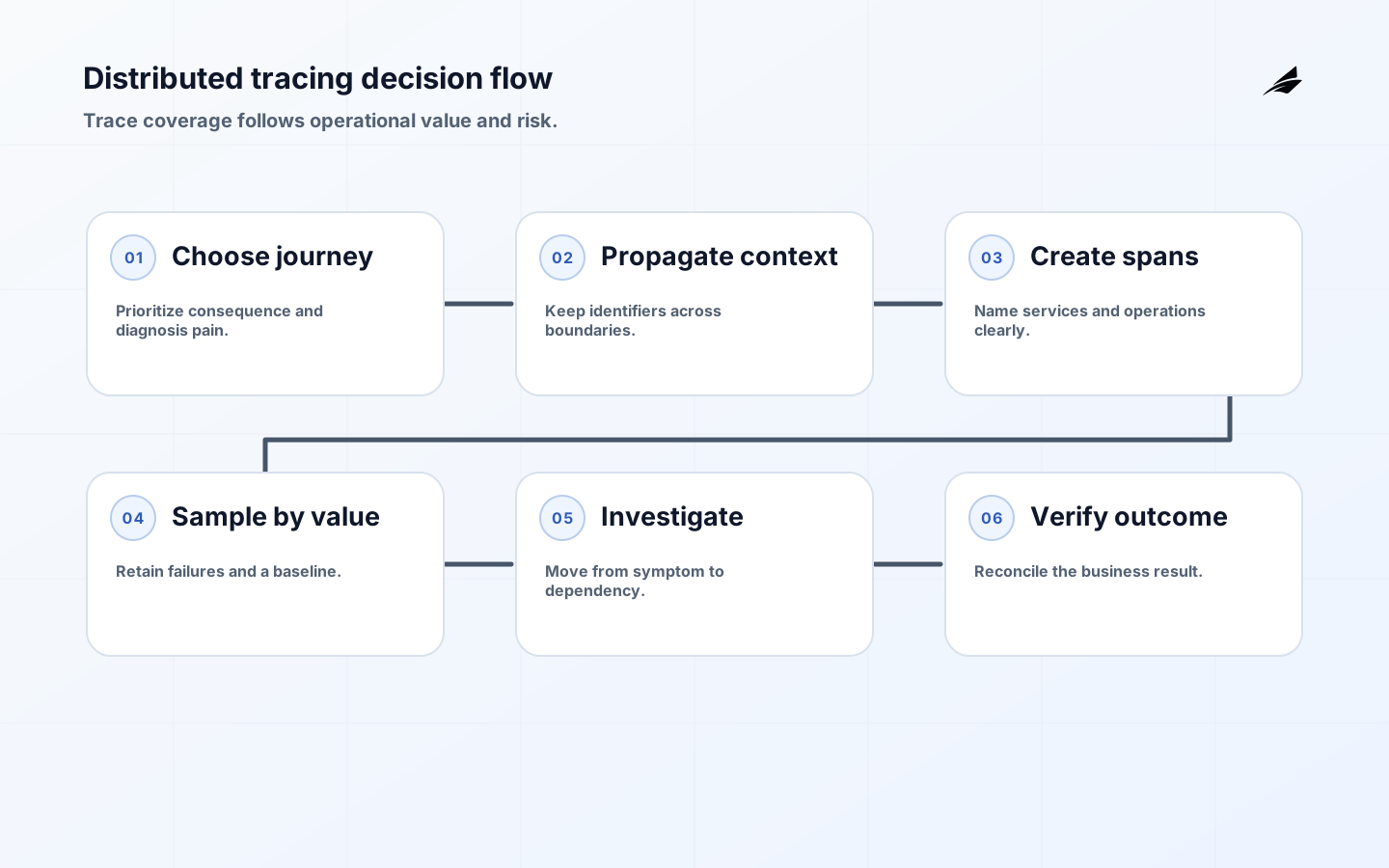
Distributed tracing for operations leaders is a decision about which customer journeys must remain understandable after they cross services, queues, regions and suppliers. A trace follows one execution through spans; it does not replace service-level metrics, logs or business reconciliation. The leadership task is to set coverage, ownership, sampling, retention, access and cost boundaries so traces answer operational questions without becoming uncontrolled data exhaust. The W3C Trace Context recommendation standardizes interoperable identifiers across HTTP boundaries, while OpenTelemetry supplies common instrumentation conventions. Neither standard decides what the organization may propagate, which failures deserve complete capture, or how a responder links a trace to an affected order.
Choose coverage from incident decisions and unit economics
Start with journeys where diagnosis is slow or ownership disputed. Map synchronous calls, asynchronous messages, batch boundaries and third-party handoffs. Set a propagation contract covering trusted ingress, span names, service identity, safe correlation fields and baggage restrictions. The distributed tracing buyer guide covers architecture, the observability engineering notes place traces beside other signals, and the incident response guide shows how responders consume evidence.

Sampling is a policy, not merely a percentage. Head sampling decides early and cheaply but can miss a rare failure discovered downstream. Tail sampling can retain traces based on latency, errors or later attributes, but needs buffering and adds cost. OpenTelemetry’s sampling guidance explains the distinction. Keep a representative baseline, all traces for selected critical errors, a bounded share of slow requests and temporary elevated capture during investigation. Measure backend cost per successful journey, redact secrets before export, limit high-cardinality attributes and make retention proportional to operational need.
| Coverage decision | Useful policy | Leadership measure |
|---|---|---|
| Critical checkout | End-to-end context plus error retention | Trace completeness by journey |
| Routine success | Representative head sample | Cost per 1,000 journeys |
| Rare downstream error | Tail rule with bounded buffer | Captured known failures |
| Third-party boundary | Record call and provider reference | Unresolved external handoffs |
| Incident capture | Time-boxed increased sampling | Expiry and incremental cost |
Key takeaways
- Make distributed tracing for operations leaders answer a concrete service decision, not a tool-adoption question.
- Document the boundary, owner, and recovery action before broad production use.
- Use evidence from customer outcomes and technical signals together.
- Start with a bounded implementation, then standardize what survives a real exercise.
Set the purpose and boundary for distributed tracing for operations leaders
The first design task is deciding what belongs inside the system and what remains an explicit dependency. Define the transactions worth following: checkout, identity verification, report generation, a support case update, or another outcome with a clear owner. Adopt a propagation standard across ingress, service calls, and asynchronous messages where feasible. W3C Trace Context defines portable headers for request context; queue and batch boundaries still need an explicit convention so the trace does not vanish when work becomes asynchronous. That description should be short enough to use during a release or incident and specific enough to expose missing owners. It also prevents an attractive platform feature from being mistaken for an end-to-end guarantee. A reliable operating boundary tells a team what it can change, what it must observe, and when it needs another owner involved.
For a trace, state the transaction that must remain intelligible across boundaries and the point where context cannot be lost. The failure statement should describe broken propagation, unsafe attributes, sampling gaps, and the operator who can connect the trace to a recovery decision.
| Trace boundary | Required decision | Failure without it |
|---|---|---|
| Ingress request | Which transaction and owner begin work? | No clear root for investigation |
| Service call | How is context forwarded? | Broken dependency chain |
| Queue message | How is context carried and resumed? | Invisible asynchronous delay |
Build an operating model for distributed tracing for operations leaders
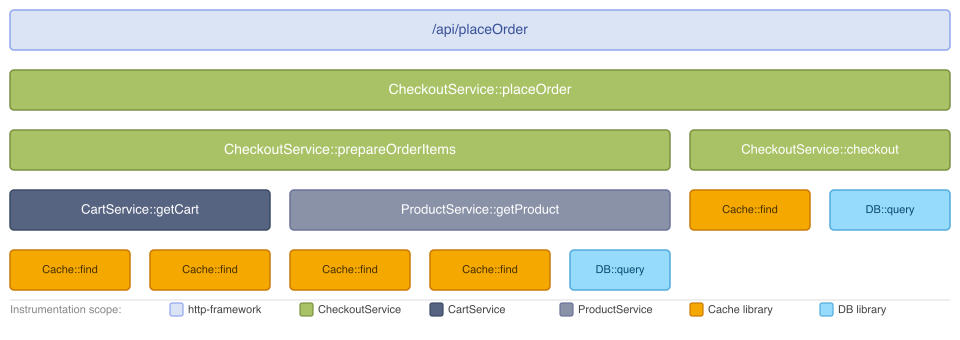
A workable model gives routine operators authority to make the ordinary safe action and makes escalation predictable when evidence is incomplete. Set span naming and attribute conventions, exclude secrets and unnecessary personal data, and document sampling by transaction class. Keep errors and slow paths discoverable while controlling cost. Trace access can reveal system topology and user activity, so apply the same access and retention discipline used for other operational records. The model should identify the accountable service owner, the platform or security partners who set shared guardrails, and the person who validates customer recovery. It should also preserve a narrow exception path. Teams will bypass controls that block urgent recovery; a reviewed, recorded exception is safer than an invisible workaround.
Use proportionate controls and retained evidence
Controls should reduce a specific uncertainty rather than add ceremony. Set span naming and attribute conventions, exclude secrets and unnecessary personal data, and document sampling by transaction class. Keep errors and slow paths discoverable while controlling cost. Trace access can reveal system topology and user activity, so apply the same access and retention discipline used for other operational records. Keep a durable record of the relevant revision, the target or affected cohort, the decision maker where needed, the observed condition, and the recovery action. This lets an on-call engineer distinguish a known change from an unknown symptom. It also makes a later review about the system and its evidence rather than recollection. For related release containment, see observability engineering notes.
| Trace quality signal | Interpretation | Action |
|---|---|---|
| Missing parent link | Propagation or instrumentation gap | Inspect boundary and library behavior |
| Slow span concentration | Likely constrained dependency | Compare workload, errors, and capacity |
| Cost surge | Sampling or attribute issue | Adjust policy without losing critical evidence |
Measure the service outcome and operating health
A dashboard should help someone decide what to do next. Track propagation coverage across priority paths, traces with missing parent links, sampling rates, ingestion lag, query latency, trace storage cost, and the time required to identify the responsible dependency during incidents. Review whether trace evidence changes a decision; a beautifully rendered waterfall with ambiguous service names is operational decoration. Define a baseline before changing the system, label new revisions or cohorts where useful, and avoid treating a single aggregate as the whole story. Pair a leading signal that helps contain harm quickly with a customer or business signal that confirms whether the service obligation was restored. Review the signals after a real event and remove measurements that cannot support an action.
Adopt distributed tracing for operations leaders in deliberate increments
Broad mandates often hide unresolved edge cases. Start with one cross-service journey that has a recurring diagnosis problem. Instrument ingress and the two or three most consequential dependencies, agree on resource and operation names, then verify propagation in a test environment and under a controlled failure. Add asynchronous work and more services after the initial trace can be read by the on-call team without expert translation. Publish the reference path, its owner, and the conditions under which a team may use an exception. Then revisit the reference after an incident, recovery exercise, or significant architectural change. The point of standardization is not uniformity for its own sake; it is to make the next decision faster, safer, and easier to explain.
Worked operating scenario
Consider a concrete situation rather than an idealized diagram. A support team reports that a report export sometimes never completes. A trace starts at the request but ends at a queue because the worker does not restore context. Operations can see enqueue latency but not whether a worker accepted the job. The team propagates the trace identifier in the message metadata, creates a processing span, and correlates the final storage operation. The next incident shows a particular worker pool is saturated, which leads to a capacity and retry decision rather than a vague claim that exports are slow. This kind of scenario is valuable because it tests the handoffs between engineering, operations, product, and security. Ask who observes the first signal, who has authority to contain the effect, which records or customers need repair, and what evidence proves normal service has returned. When those answers are clear before pressure arrives, the system can change with considerably less guesswork.
Run a readiness review for distributed tracing for operations leaders
A readiness review turns distributed tracing for operations leaders from a proposed design into a demonstrated operating capability. Review a trace across an ingress request, a service call, and an asynchronous boundary. Confirm that standard context continues, operation names identify the responsible service, and attributes do not expose unnecessary customer data. Force a slow or failing dependency and time how quickly a responder can identify both the path and the owner able to act. Capture the result as a small decision record: the scenario, participants, observed evidence, elapsed time, unresolved assumptions, and the owner for each correction. Repeat after a material architecture or ownership change. This is deliberately practical work. It shows whether instructions, permissions, telemetry, and decision rights still line up when a team must protect a real service rather than explain an ideal workflow.
Frequently asked questions about distributed tracing for operations leaders
Does trace context expose application data?
Trace identifiers are intended to identify and correlate work, but span attributes and logs can expose sensitive context if teams add it carelessly. Limit fields to operationally necessary, classified data and review instrumentation like any other data-producing code.
Should every request be sampled?
Not necessarily. Full capture can be costly at high volume. Use a policy that preserves important error, latency, and representative traffic evidence, and verify that the chosen sampling method still supports the investigations the service needs.
What evidence should leaders ask for?
Ask for evidence that the stated boundary, controls, and recovery path work in the environment that matters. For distributed tracing for operations leaders, that normally includes a named owner, a current revision or configuration record, service and customer signals, and the result of a relevant test or exercise. Prefer a small set of evidence tied to a decision over a large inventory that nobody uses under pressure.
Conclusion
Distributed tracing pays for itself when it resolves ownership and shortens a consequential investigation. Standardize context, instrument complete journeys, sample according to operational value and protect telemetry as production data. Leaders should ask whether responders can move from a user symptom to the responsible dependency and verify the final business outcome. If traces cannot answer that question, collecting more spans is unlikely to fix the design.