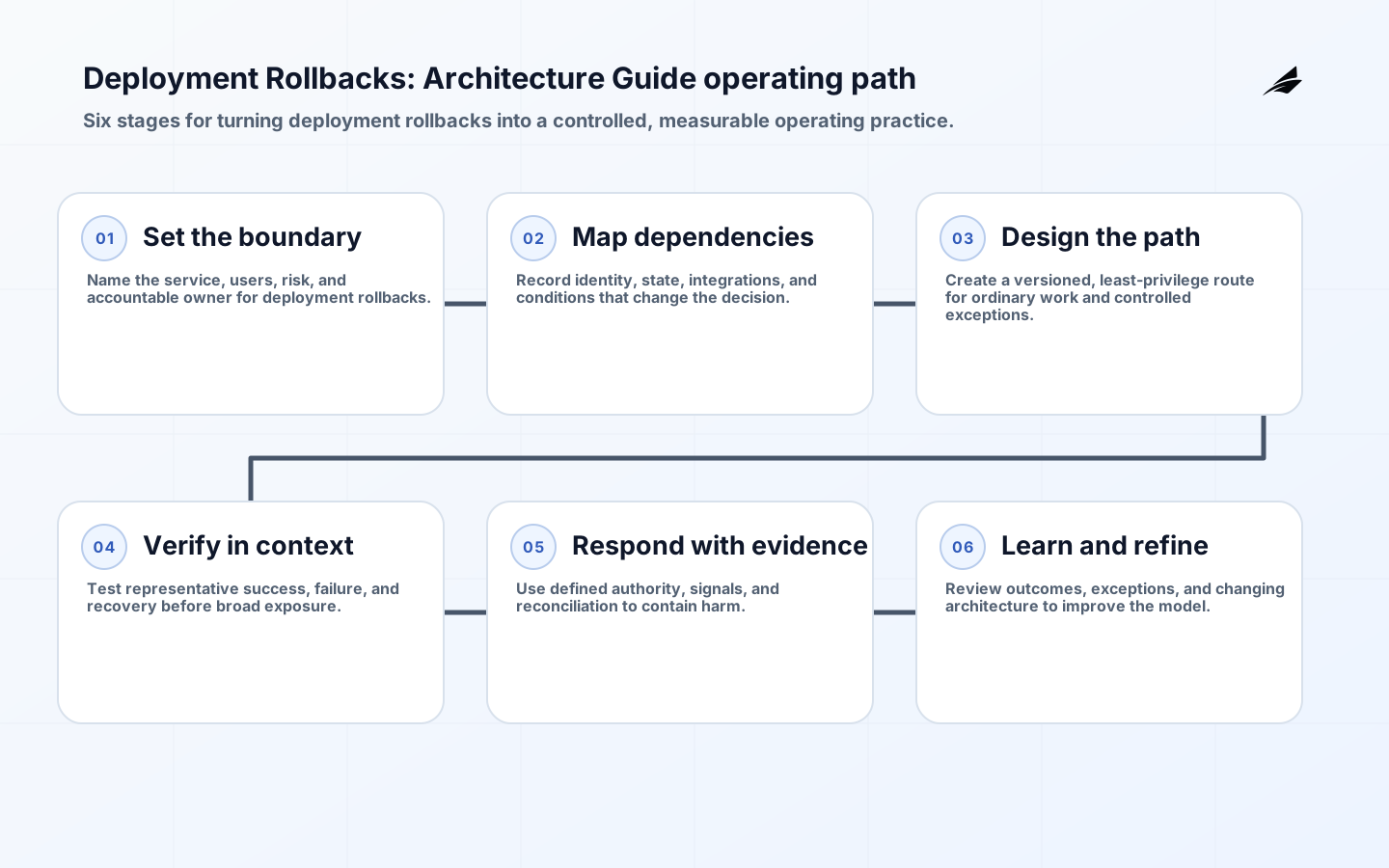
Deployment rollbacks are not a button at the end of a delivery tool. They are a service-recovery decision with consequences for data, customers, support staff, and the next release. A team that can restore a binary has not necessarily restored the experience: a schema may have advanced, a message may have been consumed, or a feature flag may still expose the broken path. Treat rollback design as part of release architecture. The objective is to return a defined service boundary to a safe state quickly enough that the response reduces harm rather than merely records it.
Establish the deployment rollbacks operating boundary
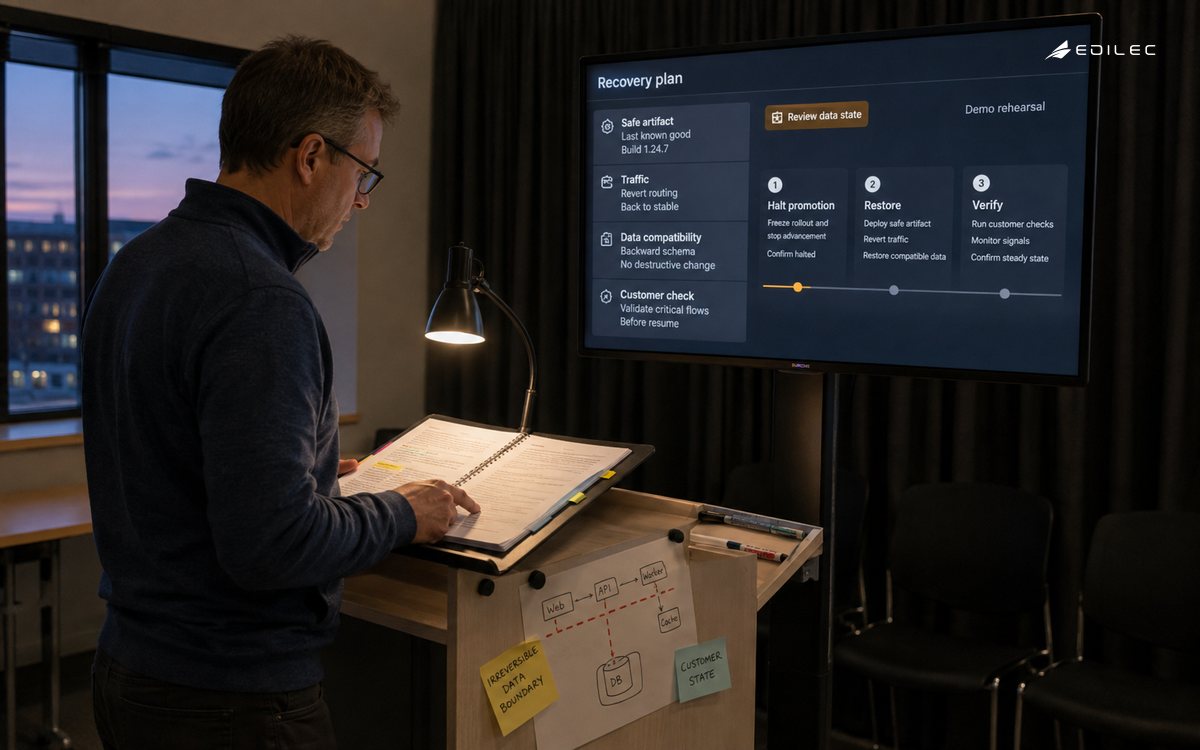
Name the rollback unit before discussing commands. It may be one stateless API, a web experience and its edge configuration, or a change set that crosses repositories. Record the safe artifact, the traffic control, the data transformations that cannot be reversed, the owner who can halt promotion, and the customer commitment that matters. This prevents the dangerous assumption that an infrastructure reversal and business recovery are the same action. They often are not when asynchronous work or third-party effects are involved.
| Decision area | Working rule | Evidence to keep |
|---|---|---|
| Scope | Artifact, configuration, traffic, and feature state are identified separately. | A release record maps controls to owners. |
| State | Messages, schemas, and external writes are reversible, compensable, or permanent. | Migration and reconciliation plan. |
| Authority | Operator can halt exposure; incident lead can freeze follow-on change. | Decision time and reason. |
| Recovery | Critical transactions succeed and deferred work is reconciled. | Service, data, and support checks agree. |
Design deployment rollbacks for safe change
Separate deployable code from irreversible state. Keep a compatibility window where old and new versions can read the required data shape, use expand-and-contract migrations, and make feature activation independently controllable. Versioned manifests, immutable artifacts, and a traceable release record make the target of a reversal unambiguous. Dependency contracts need the same care: a new client that writes a field an older service cannot understand turns a quick traffic switch into a slow repair.
Control the risks around deployment rollbacks
Rollback authority must be narrow but usable. The release operator needs a tested control path; the incident lead needs authority to freeze follow-on change; and the data owner needs a route to approve repair when reversal cannot undo an effect. Keep the artifact digest, manifest revision, traffic change, decision maker, and reason together. That evidence lets the next on-call engineer distinguish a failed rollout from a successful rollback followed by a separate dependency incident.
| Scenario | Expected response | Verification |
|---|---|---|
| Synthetic failure | Stop promotion and return traffic to the approved artifact. | Gate fails in the stated window. |
| Migration defect | Restore service and confirm old code reads the expanded schema. | No workflow needs a removed field. |
| Queue backlog | Throttle or replay safely under an owner. | Backlog and duplicates reconcile. |
| External side effect | Use a compensating operation and communicate impact. | Repair result is retained. |
Test deployment rollbacks under pressure
Exercise a realistic fault, not only a healthy deployment. Introduce an error after a migration-compatible release, force the health gate to fail, switch traffic back, and verify that the old version serves the relevant workflow. Check queues, caches, scheduled jobs, background consumers, and reconciliation. A second rehearsal should assume rollback is unavailable because of state change; it tests the compensating action and communication plan. Measure from detection to restored customer outcome, not merely the deployment command.
Operate and improve deployment rollbacks
A rollback plan ages with every new state store, identity boundary, ingress path, and vendor integration. After a material rollback or near miss, compare the written contract with the operator experience. Remove repeated manual delay, but do not automate away a decision that still needs product, safety, or legal judgment. Healthy release culture makes it ordinary to stop a change early and uses the evidence to improve the next design.
- Store the approved artifact digest and manifest with every release.
- Separate feature disablement, traffic reversal, and data repair in the runbook.
- Assign a decision maker for each promotion window.
- Rehearse a rollback that includes a worker and data check.
- Review every manual exception for a missing platform capability.
Implementation field notes for deployment rollbacks
Architecture review for deployment rollbacks starts with the artifact, routing, schema, queue, cache, and external side effect. Give each element an owner, an authoritative source, and expected failure behavior. Follow a normal request across automation, people, and vendor boundaries, then test late, denied, stale, and partial outcomes. For rollback design, that turns a feature list into an operating design. It makes the route from ordinary work to accountable recovery visible and reveals assumptions that belong in a runbook, configuration review, or smaller scope rather than in private memory.
Acceptance evidence must be practical. Define what proves the intended control works in representative conditions, who reads the proof, and what result stops expansion. Evidence can be a versioned configuration comparison, scoped identity decision, customer-safe synthetic transaction, audit event, or reconciliation record. Keep it with the release or operating decision. When an operator must gather proof from dashboards, chat threads, and private notes, the control becomes slow exactly when speed and clarity matter. A release record should pair an artifact digest with traffic state, migration state, and a named reconciliation owner. Acceptance is complete only when a normal transaction, queued operation, and rollback window agree.
Decision rights are part of deployment rollbacks. Separate authority to observe, change, approve, and override. The person running routine work needs a fast supported path; the person accepting a material exception needs context and a durable record. Define the escalation route before the exception, including the point at which work pauses rather than silently continuing. This avoids broad permanent privilege and makes handoffs inspectable by engineering, security, product, and support without forcing each group to master every implementation detail.
Use a failure exercise that crosses the boundary instead of a healthy-path demonstration. In this guide, a checkout handler can return while a fulfillment message still needs owned reconciliation. The response should name containment, stakeholder communication threshold, evidence preservation, and the reconciliation action that proves closure. Rehearse it in non-production where possible, then run a tabletop with the people who would decide and communicate. These exercises expose unavailable permissions, incomplete audit context, undocumented dependencies, and unclear ownership before customers depend on the path.
Measure behavior rather than activity volume. Combine an outcome relevant to deployment rollbacks with a review of operator confusion, support contacts, recurring overrides, and workarounds. Version the calculation and alert separately when evidence is incomplete; a quiet chart is not proof of health if collection failed or people stopped recording exceptions. This lets the team distinguish genuine improvement from a reporting change and gives leadership a defensible reason to prioritize a repair, investment, or retirement.
Cost and capacity belong in the operating review. Estimate direct infrastructure spend alongside release delay, support demand, training, investigation time, and recurring exception cost. Start with one representative workflow and a success and stop criterion rather than a broad commitment based on feature lists. Expand only when teams can explain the value, operate the path without private expertise, and show that it removes a meaningful risk or handoff instead of moving it to another queue. For deployment rollbacks, review the economic trade-off with the owner who experiences it.
Publish what changed, what stays deliberately out of scope, the evidence collected, and the date owners will retest the assumption. Revisit after architecture, ownership, customer-commitment, or incident changes. This keeps deployment rollbacks connected to live operations and makes continual improvement normal delivery work rather than a retrospective promise that disappears after the immediate problem has passed.
Field application: A release record should pair an artifact digest with traffic state, migration state, and a named reconciliation owner. Acceptance is complete only when a normal transaction, queued operation, and rollback window agree. In the next operating review, compare that evidence with the stated risk boundary and decide whether the control can expand, needs correction, or remains limited. Record the decision with its accountable owner so later changes do not recreate the same uncertainty.
Key takeaways for deployment rollbacks
- Define the customer, service, or risk boundary before implementing deployment rollbacks.
- Make the normal path observable and exceptions attributable.
- Use rehearsals to prove recovery, not dashboards to claim readiness.
- Review the model when architecture, ownership, or commitments change.
Frequently asked questions about deployment rollbacks
When should a team use a forward fix?
Use a forward fix only when state, blast radius, and time to a tested correction are understood. When customers are actively harmed and a known safe version exists, restoring service usually takes priority.
Can a database migration be rolled back?
Some can, but architecture should not rely on it. Prefer additive changes, shift readers and writers, validate, and remove obsolete structures after the compatibility window.
What should trigger automatic rollback?
Use automation for clear customer-outcome signals with guardrails, so a transient dependency or bad alert does not create a second incident.
Conclusion: make deployment rollbacks an operating capability
Good deployment rollbacks make a release reversible where possible and explicit where it is not. Put compatibility, traffic control, evidence, and decision rights into the design before the urgent incident. The resulting system can state what returns, what must be repaired, who decides, and how the team proves that customers are safe again.