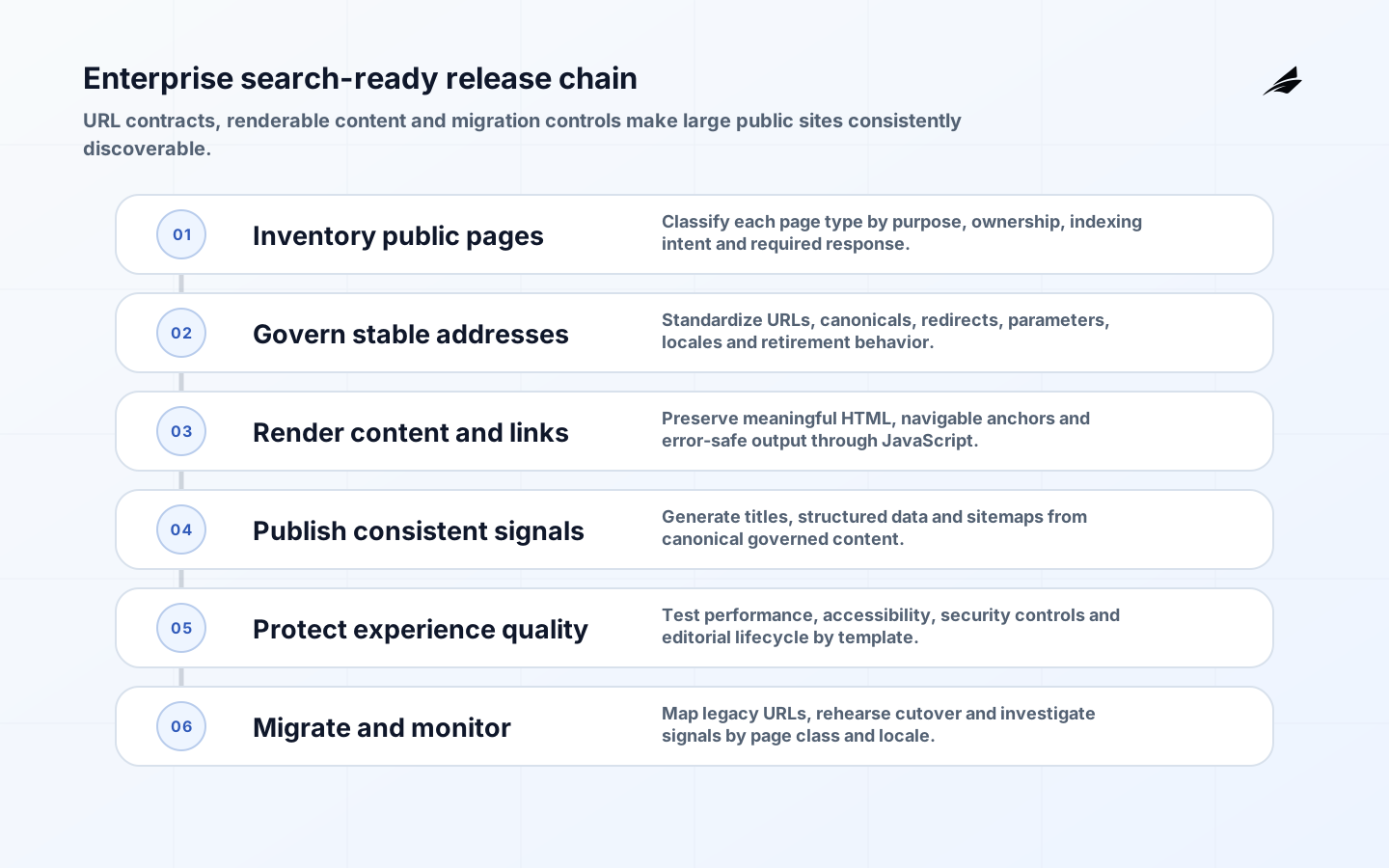
SEO-ready website development for enterprise teams is an engineering and governance practice: important public content must have stable addresses, return usable responses, render meaningful information, connect through navigable links and survive organizational change. It does not guarantee indexing or ranking. It gives search systems and people a technically coherent site while preserving security, accessibility and performance.
This checklist is for platform, content, product and regional teams building or migrating a large public website. Pair it with the enterprise search-ready website guide and the broader website implementation checklist. Search readiness belongs in templates, content models, release tests and ownership—not in a late audit.
1. Scope seo-ready website development for enterprise teams with an inventory
Inventory domains, subdomains, locales, page types, rendering systems, feeds and owners. Classify URLs as indexable, intentionally non-indexable, redirected, retired or authenticated. For each indexable type, define its user purpose, canonical pattern, title source, main content, navigation, status behavior and structured-data eligibility. This turns an abstract requirement into a contract that product teams can test.
Google’s technical requirements are intentionally minimal: Googlebot must not be blocked, the page must work with an HTTP success response and it must contain indexable content. Enterprise readiness goes further by preventing accidental duplication, thin generated pages, orphaning and contradictory signals. Keep an approval path for new URL-generating features because filters and campaigns can multiply crawlable states rapidly.
| Page class | Indexing intent | Required contract |
|---|---|---|
| Editorial or product page | Indexable when approved | Unique URL, content, title, canonical and internal links |
| Search or filter result | Usually constrained | Allowlisted valuable combinations; control the rest |
| Campaign variant | Consolidated or time-bounded | Canonical and retirement rule |
| Account or private page | Not publicly indexable | Authentication plus appropriate indexing control |
2. Establish URL, canonical and redirect governance
Define lowercase, readable, durable URL patterns and the source of each path segment. Decide trailing slash, parameters, pagination, locale and case behavior. Avoid embedding internal platform names or volatile taxonomy when it does not help users. Maintain a registry of redirects with owner and reason, prevent chains and loops, and return truthful 404 or 410 responses for removed content that has no substitute.
Canonicalization consolidates duplicate or similar representations; it is not a substitute for coherent navigation. Google’s canonical guidance recommends consistent signals and supports HTML link elements, HTTP headers, redirects and sitemap inclusion in different circumstances. Generate self-referential canonical URLs for primary pages, test them after locale and proxy transformations, and never canonicalize genuinely distinct content merely to suppress a reporting problem.
3. Deliver renderable content and crawlable internal links
Return meaningful main content and metadata in the initial HTML whenever practical. Client rendering can work, but it adds dependencies and diagnostic complexity. Google’s JavaScript guidance describes crawling, rendering and indexing as separate phases. Ensure blocked scripts, API failures, consent behavior or unsupported browser APIs do not erase essential text, links, titles or canonical signals.

Use ordinary anchor links with resolvable destinations for navigation and contextual discovery. Build hierarchy from user tasks and information relationships, not from a desired click depth alone. Breadcrumbs, related content and indexes should be generated from governed relationships. Detect orphan pages, broken links and links to redirect chains in continuous tests. Keep important information in text rather than only images, video or canvas.
| Automated check | Failure caught | Release action |
|---|---|---|
| Rendered HTML snapshot | Missing main content, title or canonical | Block affected template |
| Link graph crawl | Orphans, broken targets and redirect chains | Assign owner and repair |
| Status and header test | Soft errors, cache mistakes and conflicting controls | Correct response contract |
| Mobile performance test | Regression in loading and interaction | Investigate against agreed budget |
4. Govern metadata, structured data and sitemaps
Create metadata from fields editors understand, with preview and validation. Titles and descriptions should identify the specific page; global concatenation rules need length and duplication monitoring. Use one primary heading that matches the visible purpose while preserving a logical heading outline. Alternate-language annotations require reciprocal, valid locale mapping and should not point users to materially different pages.
Structured data must describe visible page content and use an applicable supported type. Google’s structured-data policies make clear that valid markup does not guarantee a rich result. Generate it from the same source as visible facts, validate syntax and required properties, and remove types when pages no longer qualify. Do not let marketing fields silently make unsupported claims.
Generate sitemaps from canonical, indexable, successful URLs rather than using them as a dump of database records. Google’s sitemap guidance documents format and size limits and recommends absolute URLs. Segment large sitemaps by useful ownership or page class, provide accurate modification signals, and monitor submitted versus accepted URLs to locate systemic issues.
5. Protect performance, accessibility and content quality
Set performance budgets by template and measure field experience as well as laboratory runs. Optimize server response, image sizing, font loading, JavaScript execution and layout stability. Cache safely with content fingerprinting for versioned assets. Performance work should preserve functionality and accessibility; removing labels, focus behavior or content to improve a score is not a valid optimization.
Make content ownership explicit. Templates cannot compensate for duplicated, obsolete or unhelpful pages. Provide editorial states, review dates, authoring guidance and retirement workflows. Accessibility testing with keyboard, screen reader and zoom improves the same semantic structure that makes content understandable to machines. Security headers, consent tools and bot controls must be tested so they do not block essential resources or expose private content.
6. Migrate and operate with measurable controls
For a migration, capture the old URL inventory and map every valuable address to an equivalent new destination, deliberate retirement or unchanged location. Test mappings before cutover, preserve content meaning and avoid redirecting everything to a homepage. Rehearse DNS, certificates, caches, analytics, robots rules, sitemaps and rollback. Freeze uncoordinated URL changes during the critical window and keep the old mapping available for diagnosis.
After launch, monitor server errors, excluded page patterns, crawl anomalies, sitemap processing, structured-data errors, performance and key template rendering. Compare by page class and locale instead of chasing daily totals. Assign platform, content and regional owners with response expectations. Search visibility changes can have several causes; retain release and configuration history so teams can investigate rather than guess.
7. Create cross-team release governance without a bottleneck
Assign a platform owner for shared rendering and routing, content owners for page quality, and regional owners for localized accuracy. Publish reusable components and automated checks so teams can meet the contract independently. Reserve central review for new URL generators, major navigation changes, migrations and exceptions. This keeps standards consistent without routing every page edit through one specialist group.
Maintain a production change ledger containing template releases, redirect batches, canonical rules, consent changes, bot controls and content migrations. Annotate monitoring with these events. When visibility or crawl behavior shifts, compare affected page classes, dates, server responses and rendered output before proposing a cause. Search reporting is delayed, so combine it with server logs, controlled crawls and release history.
Set remediation priority from scale and user impact. One incorrect title can be handled editorially; a template that emits conflicting canonicals across millions of pages needs incident ownership and a rapid safe release. Retest fixed examples and the broader page class. Record preventive action in components, validation or authoring guidance so the defect cannot return through another business unit.
Review automated checks as the site evolves. False positives encourage bypass, while missing page types create blind spots. Sample real pages from every locale and content system, compare crawler and browser output, and retire rules that no longer represent the contract. Preserve accessibility and privacy requirements when teams propose search-related changes; public discoverability never justifies exposing private content or weakening consent.
Include non-HTML assets in governance. PDFs, images, video and downloadable documents may have public URLs, metadata, links and retirement obligations. Decide when information belongs in an accessible webpage. If a file is indexable, give it a stable address, descriptive linking context, accurate headers and an update path. Avoid publishing duplicate files under new names for every revision when a controlled page can hold the current resource and history.
For international sites, assign source and translation ownership separately. Define whether locale pages are translations, market adaptations or distinct offers, and ensure alternate-language annotations reflect real equivalents. Do not force redirects solely from inferred location. Test missing translations, fallback navigation, currency and legal content. Locale expansion multiplies lifecycle work, so measure completeness before generating new public paths.
Key takeaways
- Give every public page type an explicit indexing and URL contract.
- Keep canonical, link, sitemap and redirect signals consistent.
- Test rendered output under dependency and consent failure.
- Generate markup from visible, governed content.
- Treat migrations as controlled data and routing changes with ownership.
Frequently asked questions
Does technical readiness guarantee indexing?
No. It makes a page eligible and understandable, but search systems decide what to crawl and index. Useful original content, coherent site relationships and consistent technical signals remain necessary, and visibility can change over time.
Must an enterprise site avoid JavaScript?
No. Use JavaScript where it improves the service, while ensuring essential content, links and metadata remain available after the real rendering path. Test initial and rendered HTML, resource access, error states and performance on representative devices.
How should staging environments be protected?
Use authentication or network access controls so staging content is not public. A robots rule alone controls crawling, not access or guaranteed indexing prevention. Ensure production deployment does not inherit staging authentication or noindex settings.
Conclusion
SEO-ready website development for enterprise teams is the product of stable contracts and disciplined operations. When URLs, rendering, links, metadata and migrations share clear ownership and automated verification, teams can publish at scale without turning every release into a crawlability investigation.