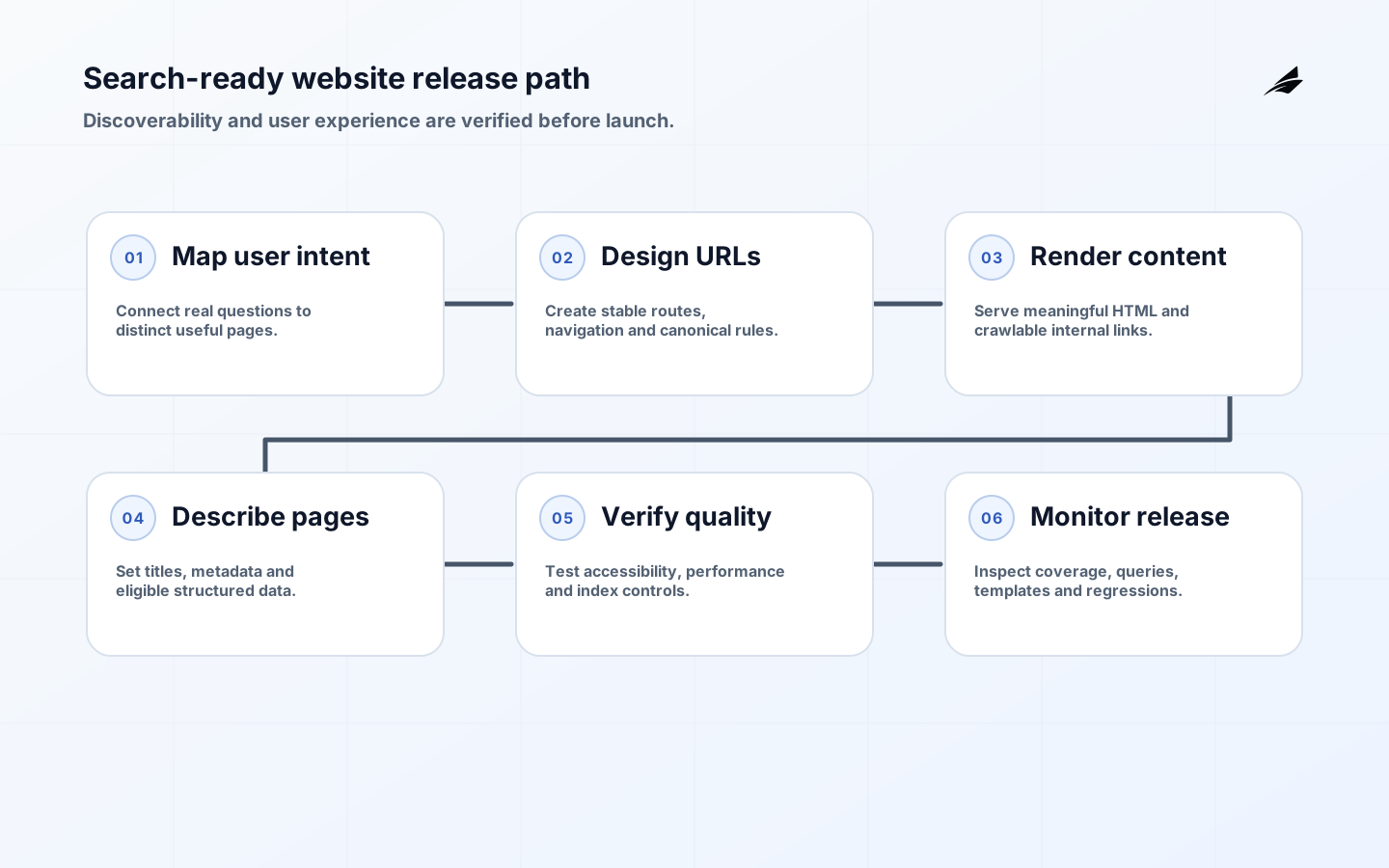
SEO-ready website development means search discoverability is built into information architecture, rendering, content operations and release quality. It is not a plugin installed after design approval. A search-ready site gives people useful pages, gives crawlers stable paths and understandable responses, and gives operators evidence when templates or releases regress. This implementation checklist covers the engineering and editorial decisions required before launch and the monitoring needed afterward.
Read the SEO-ready website development guide for architecture context and the SEO-ready website FAQ for launch questions. Enterprise programs can use the related enterprise search-ready guide and enterprise implementation checklist. Search engines do not guarantee crawling, indexing or ranking, so define success through eligible pages, useful acquisition and user outcomes rather than an indexing promise.
1. Map user intent to distinct useful pages
Start with audience tasks, questions and evidence needs. Group terms only when one page can satisfy the same intent; split pages when users need materially different answers, products, locations or decision stages. Assign each indexable page a purpose, primary audience, owner and conversion or completion event. Inventory existing URLs and performance before migration. Preserve valuable pages where possible, consolidate genuine duplication, and identify expired or low-value content that should redirect, remain available but unindexed, or return a clear removal status.
Create templates around content meaning, not phrase repetition. A service page may need scope, eligibility, process, proof, limitations, price drivers and next action; a guide may need definition, decision framework, implementation detail and sources. Put the direct answer near the opening, use descriptive headings, and link to useful related pages in context. Maintain author, review date and source ownership for claims that change. Search readiness follows usefulness and clarity; metadata cannot rescue a page that does not resolve the query.
| Page decision | Implementation requirement | Failure to catch |
|---|---|---|
| Purpose | One defined audience need and useful next action | Several thin pages competing for one intent |
| URL | Stable readable route independent of presentation state | Session, fragment or uncontrolled parameter URLs |
| Index state | Explicit index, noindex, redirect or removal decision | Staging or filtered pages becoming eligible |
| Canonical | Preferred absolute URL consistent across signals | Canonical pointing to a non-equivalent page |
| Ownership | Named content and template maintainer | Stale claims and orphaned pages |
| Measurement | Page purpose linked to search and user outcome | Traffic reported without usefulness |
2. Build crawlable information architecture and URLs
Important pages should be reachable through ordinary links from meaningful navigation or hub pages, not only search forms or client-side interactions. Use anchor text that explains the destination. Keep hierarchy understandable without forcing every URL to mirror organization charts. Handle pagination, filters, sorting, locale and tracking parameters deliberately so they do not produce an unbounded crawl space. Google’s crawling and indexing documentation distinguishes URL structure, sitemaps, crawler controls, canonicalization, mobile and JavaScript concerns; test each as a system.

Return accurate HTTP status codes. A removed page should not render a friendly error with status 200. Permanent moves normally need server-side permanent redirects to the closest equivalent destination, avoiding chains and unrelated home-page redirects. Serve one preferred HTTPS host and normalize trailing slash and case policy. Keep redirect mappings from old to new URLs as a versioned migration artifact. Test inbound links, canonical tags, hreflang where used, sitemap entries and analytics after every routing change.
3. Render meaningful HTML and accurate metadata
Ensure the initial or rendered HTML contains the page’s primary content, headings, links and metadata without requiring a user gesture. Server rendering, static generation and client rendering can all work, but each has different failure and caching modes. Google explains that JavaScript pages are queued for crawling and rendering in its JavaScript SEO guidance. Test rendered output as an anonymous crawler, with failed APIs and delayed scripts, and confirm private or personalized content is not exposed in public HTML.
Give every indexable page a concise, specific title and a useful description. Use one visible H1 that matches the page subject, followed by logical H2 and H3 structure. Set language, viewport, social metadata and image alternatives appropriately. Structured data must describe visible page content and use an eligible type; validate syntax and required properties, but do not treat it as a display guarantee. Generate canonical URLs from trusted route data rather than the incoming request when parameters or alternate hosts are possible.
4. Coordinate canonical, robots and sitemap controls
Use canonical signals for duplicate or closely equivalent pages, not as a substitute for redirects or access control. Google ranks redirects and rel=canonical as strong signals and sitemap inclusion as weaker in its canonical URL documentation. Keep preferred URL signals consistent. Do not canonicalize unrelated local or product pages to a generic parent. Verify that canonical targets return 200, are index-eligible and do not themselves point elsewhere.
Robots.txt controls crawler requests; it does not reliably remove a known URL from results or protect confidential data. Use authentication for private content and a crawlable noindex directive for pages that should be excluded. Do not block the crawler from seeing a noindex directive. Sitemaps should contain preferred, indexable, successful URLs with accurate modification data. Google’s sitemap documentation sets a limit of 50 MB uncompressed or 50,000 URLs per sitemap; use sitemap indexes and segment by useful operational groups when larger.
| Release check | How to verify | Pass condition |
|---|---|---|
| Crawl path | Traverse navigation and extracted links | Every priority URL has an ordinary discoverable link |
| Rendered content | Inspect anonymous rendered HTML | Content, title, canonical and links are present |
| Status behavior | Request success, redirect, missing and error cases | Codes and destinations match policy |
| Index controls | Compare robots, meta, headers, canonical and sitemap | No contradictory signals |
| Accessibility | Automated scan plus keyboard and assistive review | Target criteria and core journeys pass |
| Performance | Field and lab measures by template | Budgets met without hiding slow cohorts |
5. Treat accessibility and performance as release quality
Build semantic landmarks, keyboard operation, visible focus, properly associated labels, descriptive errors, sufficient contrast and meaningful alternatives into components. WCAG 2.2 is a testable standard intended for automated and human evaluation; automated scans alone cannot verify context, focus order or equivalent experience. Test reusable components and complete page variations at supported breakpoints. Accessible structure also makes content relationships more robust for browsers, assistive technology and parsers.
Set performance budgets for HTML, JavaScript, CSS, images, fonts and third-party code. Measure representative devices, networks and geographies. Current Web Vitals guidance identifies Core Web Vitals around loading, responsiveness and visual stability; monitor field distributions for Largest Contentful Paint, Interaction to Next Paint and Cumulative Layout Shift rather than relying only on a fast lab run. Optimize critical assets, responsive images, caching and hydration, and require owners for third-party scripts.
6. Launch with inspection and regression monitoring
Before launch, crawl staging under controlled access, compare URL inventories, validate redirects, inspect rendered templates, test structured data and scan for staging hosts, noindex directives and placeholder metadata. At launch, verify DNS, TLS, status codes, canonical hosts, robots.txt, sitemaps, analytics and key conversion events. Inspect representative URLs in search-console tools after deployment. Keep the old environment and redirect logs available long enough to diagnose unexpected traffic and crawler behavior.
Monitor index eligibility, discovered-versus-indexed patterns, crawl errors, canonical selection, search queries, landing-page engagement and user completion by template. Alert on broad changes such as a sharp fall in indexable pages, titles disappearing, error status growth or canonical targets switching. Review releases against annotations rather than attributing every movement to one code change. Continue pruning duplicate paths, repairing internal links and refreshing claims. Search readiness is an operating capability, not a launch-day certificate.
Build search requirements into the content management model. Authors need controlled fields for title, description, slug, canonical state, language, image alternative, author, review date and structured attributes, with preview and validation before publication. Restrict arbitrary index directives to trained roles. When content is unpublished, define whether its URL redirects, returns not found, remains available to authorized users or stays public with a historical notice. Template defaults should be safe but editable; identical generated titles or descriptions across thousands of pages make both search diagnostics and user choice harder.
For international sites, decide whether language, country or both define distinct pages. Use fully qualified alternate references only among genuine equivalents, include a self-reference and avoid automatically redirecting users solely from IP or browser language. Localize navigation, metadata and visible content together. Monitor each market separately because indexing, demand and performance differ. Translation workflows need source-version tracking and review ownership so canonical and alternate clusters do not connect stale or materially different pages.
Key takeaways
- Create distinct pages around user needs and stable ownership, not phrase variants.
- Make priority content reachable through ordinary links and accurate HTTP behavior.
- Coordinate canonical, robots and sitemap signals around one preferred index state.
- Verify rendered HTML, accessibility and real-user performance before release.
- Monitor template-level eligibility and user outcomes after launch; indexing is never guaranteed.
Frequently asked questions
Can a single-page application be SEO-ready?
Yes, if each useful state has a stable crawlable URL, meaningful rendered HTML, ordinary links, accurate metadata and correct status behavior. Server rendering or static generation often reduces rendering risk, but architecture must be tested rather than assumed from the framework name.
Does a sitemap guarantee indexing?
No. It helps discovery and communicates preferred URLs, but search engines still evaluate accessibility, duplication, usefulness and other signals. Keep sitemap entries accurate and investigate patterns rather than treating submission as acceptance.
Is one audit score enough for launch?
No. Automated scores sample particular conditions and cannot fully assess content usefulness, accessibility or field performance. Use a release matrix combining crawls, rendered inspection, status and metadata checks, human accessibility review, lab budgets and production monitoring.
Conclusion
SEO-ready website development joins useful content with crawlable, accessible and observable engineering. Make URL purpose, rendering, index controls and quality budgets explicit, then test them through migration and operation. The result is a website that can be understood by users and crawlers and maintained without relying on last-minute fixes.