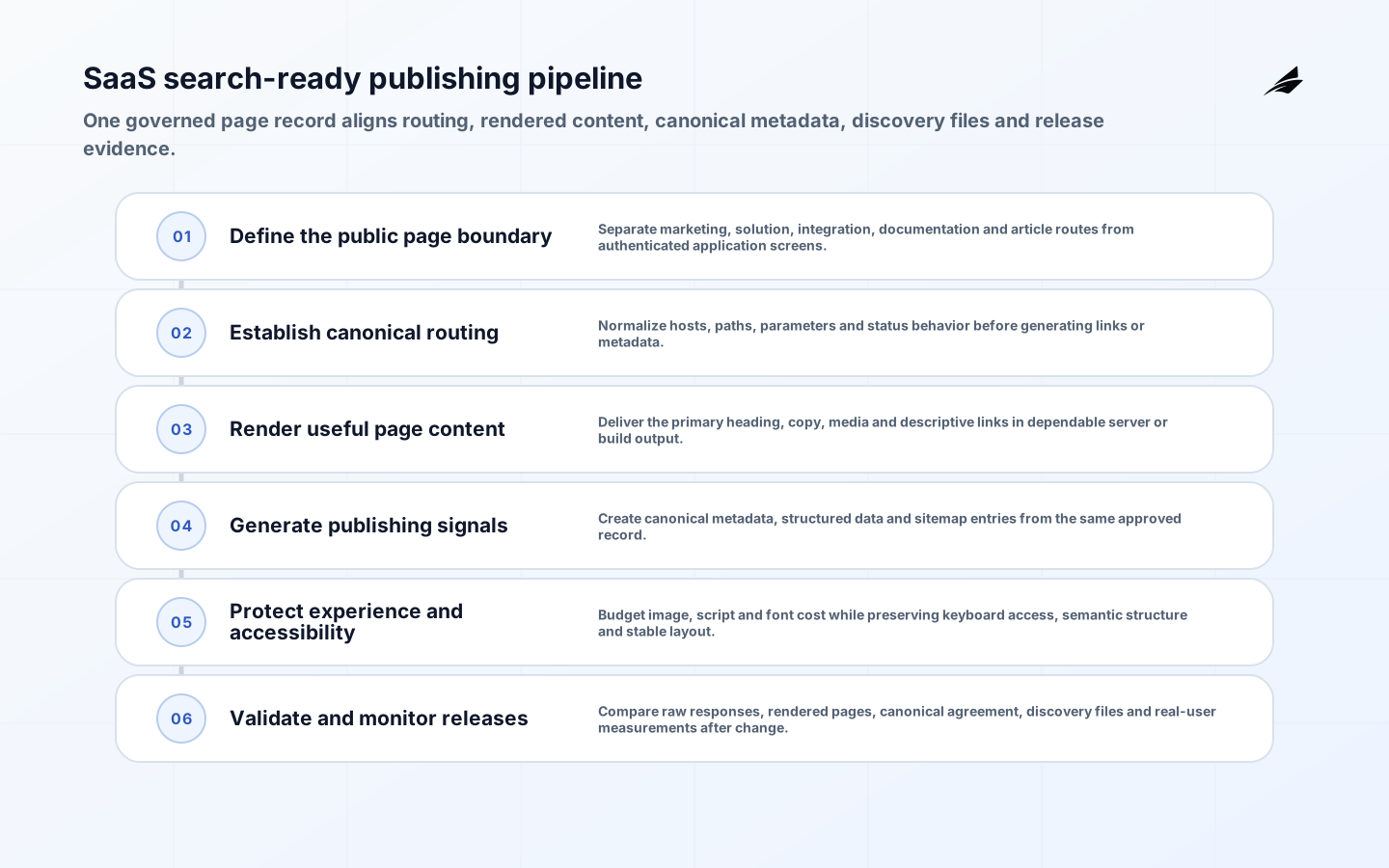
A SaaS website can look complete to a browser user while serving an empty shell, contradictory canonical or endless parameter routes to a crawler. SEO-ready website development for SaaS companies is therefore an architecture and release discipline, not a final pass over title tags. Marketing pages, documentation, comparisons and editorial content need stable public URLs, meaningful initial HTML, crawlable navigation and truthful metadata. This FAQ addresses JavaScript rendering, canonicalization, sitemaps, structured data, performance and the boundary between the public site and authenticated product.
Define the service boundary before selecting technology
Start with public marketing, solution, documentation and editorial routes rather than authenticated application screens. Observe real cases, including exceptions, reversals and incomplete inputs. Record who initiates the work, which system owns each fact, who may approve an outcome, what makes an action irreversible and how staff recover when an integration fails. This boundary prevents technical SEO for SaaS from becoming a vague transformation program. It also exposes policy disagreements before software silently turns them into inconsistent behavior.
Define requirements by page type. A product page should return 200 with a unique title, description, H1, explanatory copy and canonical in the initial HTML. A retired page should use a purposeful redirect or genuine 404/410, not a soft error rendered after load. Documentation needs crawlable hierarchy and version rules. Filtered collections require explicit indexability. The sitemap should contain only canonical public URLs and update from the same content source. These rules must hold in production responses, not merely in a hydrated browser view.
Architecture and ownership

The architecture must preserve authority across routing, status codes and server-rendered HTML, canonical metadata, structured data and sitemaps, content models and internal navigation, performance, accessibility and search monitoring. Each component needs an owner, a versioned contract and observable failure behavior. Avoid direct point-to-point writes from an interface or model into a critical record. A narrow orchestration layer can validate identity, current state, policy and idempotency before an action proceeds, while an audit event records the evidence and rule version used.
| Architecture area | Required design decision | Evidence before release |
|---|---|---|
| routing, status codes and server-rendered HTML | For this design choice, name the accountable owner, supporting evidence, exception route, and next measurable check. | Approved data-flow and owner |
| canonical metadata, structured data and sitemaps | Within this design choice, name the accountable owner, supporting evidence, exception route, and next measurable check. | Authorization and negative tests |
| content models and internal navigation | When implementing this design choice, name the accountable owner, supporting evidence, exception route, and next measurable check. | Versioned interface plus retry behavior |
| performance, accessibility and search monitoring | Before releasing this design choice, name the accountable owner, supporting evidence, exception route, and next measurable check. | Dashboard, alert and recovery runbook |
A six-stage delivery path
Begin with a route inventory and sample every template using raw HTTP, rendered DOM and mobile layout. Normalize trailing slashes, hostnames and parameters before generating canonicals. Render primary content and links on the server or during a dependable build. Generate sitemap entries from published records, then compare them with status and canonical output. Add structured data only after visible content supports it. Finally, test deployment previews for redirects, robots directives, missing assets and performance budgets so a framework upgrade cannot quietly change indexability.
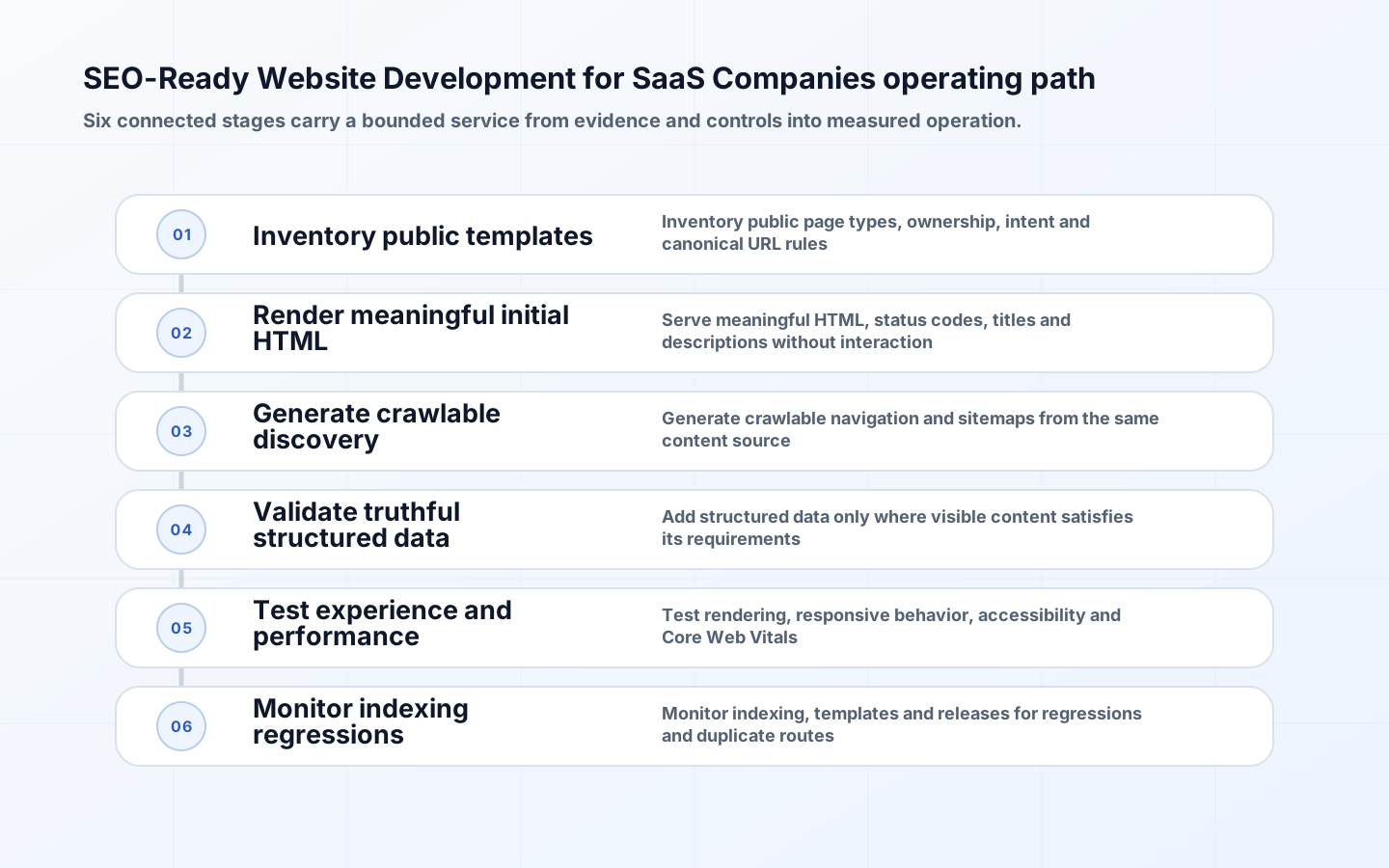
- Inventory public page types, ownership, intent and canonical URL rules.
- Serve meaningful HTML, status codes, titles and descriptions without interaction.
- Generate crawlable navigation and sitemaps from the same content source.
- Add structured data only where visible content satisfies its requirements.
- Test rendering, responsive behavior, accessibility and Core Web Vitals.
- Monitor indexing, templates and releases for regressions and duplicate routes.
Controls and failure modes
Search controls belong in code and content governance. Route helpers should produce one canonical and reject contradictory variants. Publishing should require title, description, heading and internal placement, while unpublishing updates links and sitemaps. Robots rules should protect crawl capacity, not attempt canonicalization. Structured-data components need schema validation and content parity. Image and video resources intended for discovery must be anonymously accessible. Monitor templates rather than isolated URLs because one rendering defect can affect an entire product or documentation section.
| Failure mode | Design response | Operating signal |
|---|---|---|
| Client-only empty states | Render primary text and links into initial HTML or dependable server output. | Rendered content parity |
| Conflicting canonicals | Generate one absolute canonical from normalized route data. | Canonical mismatch count |
| Unbounded faceted routes | Constrain parameters and expose only purposeful indexable collections. | Discovered duplicate URLs |
| Performance regressions | Set page-type budgets for image, script and interaction work. | Core Web Vitals by template |
Measure outcomes, not activity
A dashboard should connect technical behavior to the intended operating result. Track valid indexable pages returning the intended status; canonical and sitemap agreement; organic landing-page engagement by page type; LCP, INP and CLS distributions for real users. Segment results by workflow type and material risk instead of hiding poor tails inside a global average. Review a sample of accepted, corrected, escalated and failed cases. When a metric moves, retain enough trace evidence to identify whether the cause was source data, policy, interface behavior, model output, reviewer workload or downstream execution.
Combine Search Console evidence with server logs and site analytics. Track valid 200 pages, canonical agreement, sitemap inclusion, rendered-content parity and index status by template. Watch LCP, INP and CLS distributions for real users, not a single lab score. A rise in discovered URLs may indicate useful growth or uncontrolled facets, so inspect patterns before celebrating. Measure whether organic visitors reach meaningful product evaluation or documentation outcomes. Rankings alone cannot diagnose whether a technical release improved the site’s usefulness.
Cost, timeline and commercial model
Budget for content modeling, rendering architecture, migration redirects, analytics, image delivery, accessibility and release checks. Search readiness is a maintained system property, not a metadata task completed at launch. Timeline should be expressed as evidence-bearing stages: discovery, thin-slice build, controlled pilot and measured expansion. Procurement should require source access, documentation, data export, incident support and transition assistance. A lower quote is not cheaper if it omits evaluation, operating ownership or the path away from the chosen provider.
Rehearse the operating model before expansion
A useful rehearsal for SEO-ready website development for SaaS companies follows one representative case from intake through final evidence. The team should interrupt the exercise after each transition and ask which record is authoritative, whether the acting identity has permission, whether the rule is current, and whether retrying would create a duplicate outcome. Run the same case with a missing field, delayed dependency and unavailable reviewer. This reveals assumptions that unit tests and polished demonstrations often miss, especially where routing, status codes and server-rendered HTML meets canonical metadata, structured data and sitemaps.
Next, simulate the two most consequential failure modes: client-only empty states and conflicting canonicals. Operators should identify the alert, inspect the trace without broad production access, contain further actions, communicate with affected users and restore a known state. Record elapsed time and every manual workaround. If the team cannot determine what happened from the retained evidence, the workflow is not ready for a wider cohort, even if its normal path appears efficient.
The release packet should contain the route inventory, redirect map, canonical rules, robots policy, sitemap samples, rendering comparison, structured-data validation and performance results. Include checks for representative product, solution, documentation, article and error pages. Record which authenticated routes are intentionally excluded and why. A content migration should also reconcile inbound links and internal navigation. This evidence lets developers reproduce a regression and lets content owners understand which publication choices alter public discovery.
Test a production-like build with JavaScript disabled, delayed and failed. Request mixed-case, parameter, old-slug and trailing-slash variants and verify their status and destination. Remove a content record and ensure navigation, sitemap and canonical signals update together. Block an image host temporarily to confirm that text remains useful. Then inspect the rendered page with URL Inspection or equivalent tooling. These exercises reveal mismatches between application behavior and crawler-visible output before thousands of URLs inherit them.
Practical takeaways
- Anchor SEO-ready website development for SaaS companies to one named outcome and accountable owner.
- Treat public marketing, solution, documentation and editorial routes rather than authenticated application screens as the first deliverable, not an assumption.
- Keep permissions, policy and irreversible actions in deterministic services with review evidence.
- Pilot with representative exceptions and retain a tested manual route.
- Measure valid indexable pages returning the intended status alongside quality, risk and human workload.
- Expand only when the current release is supportable, observable and recoverable.
Frequently asked questions
- What should the first engagement deliver? It should deliver a process map, data and authority model, risk register, thin-slice backlog, evaluation plan, cost range and explicit decision on what will remain manual.
- How long should a pilot run? Long enough to include ordinary cases, realistic exceptions and at least one controlled recovery exercise. Calendar duration matters less than representative evidence and a pre-agreed exit decision.
- Can a team buy a platform before discovery? A short technical trial can inform discovery, but procurement should follow the service boundary and control requirements. Otherwise the available product features begin defining the business process.
- Who owns the released service? A business owner is accountable for policy and outcomes; a technical owner is accountable for reliability and change; security, privacy and domain specialists approve relevant controls. A vendor can support these roles but should not replace them.
- How is success demonstrated? Compare the agreed baseline with completed outcomes, corrections, exceptions, failures, cost and user impact. Pair aggregate metrics with case review so a favorable average cannot conceal harmful edge cases.
Conclusion
A search-ready SaaS site is one where public content is consistently reachable, canonical and useful through ordinary web standards. Stable routing, meaningful HTML, crawlable links, honest status codes and maintained performance do more than scattered metadata tweaks. Treat page types as products with tests and owners, monitor rendering after every platform change and keep sitemaps aligned with canonical publication. That foundation supports discovery while also producing a faster, more accessible site for prospective customers and users.