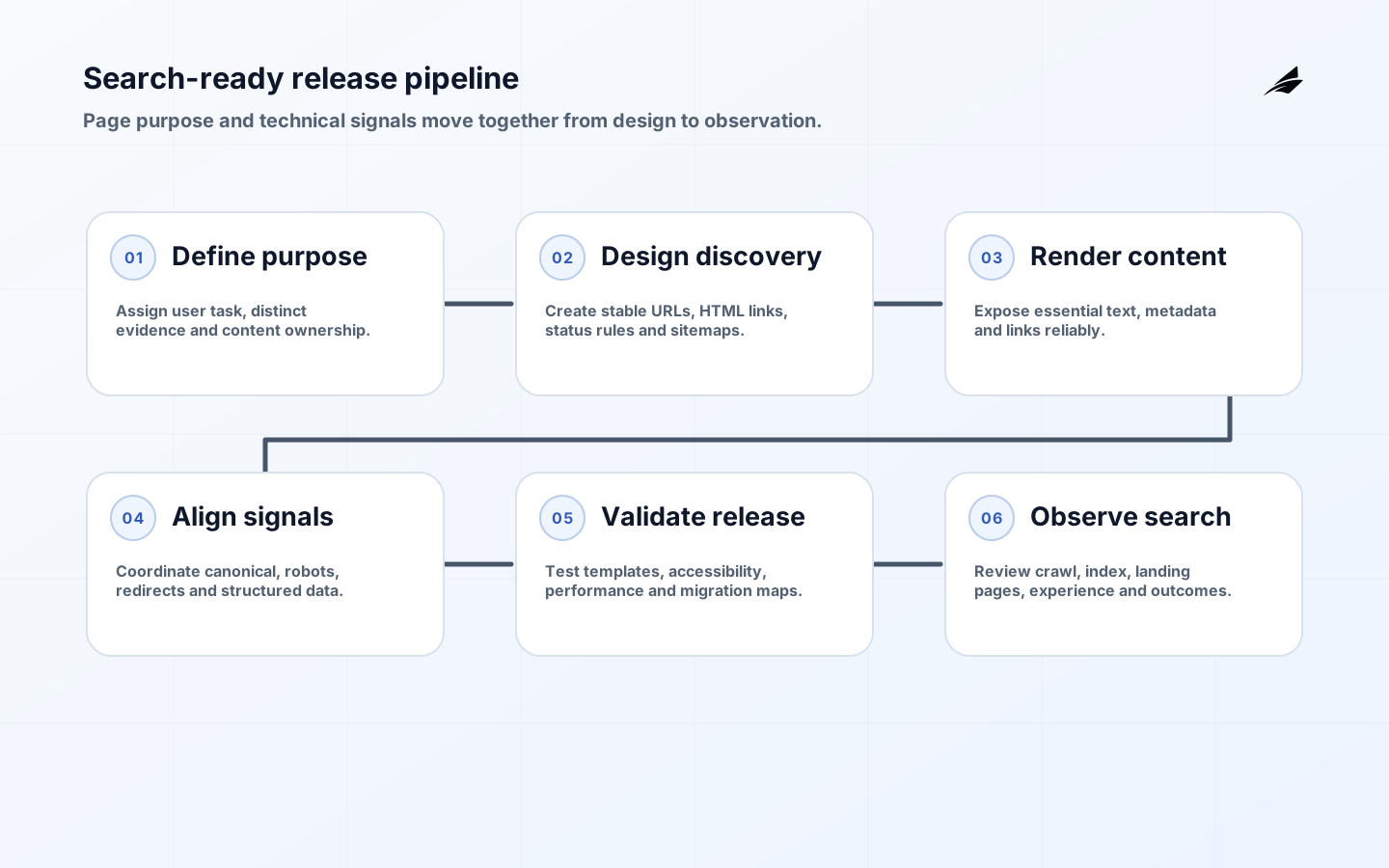
SEO-ready website development makes pages understandable and usable before promotion begins. Search readiness is not a plugin installed after launch. It depends on content that answers a real need, URLs that remain stable, links a crawler can follow, server responses that describe state correctly, rendered HTML that exposes essential information, and controls that prevent a routine release from changing indexability across thousands of pages.
This guide covers the design and engineering decisions behind that result. Teams moving into execution can use the SEO-ready implementation checklist, compare common decisions in the SEO-ready website FAQ and adapt the enterprise search-ready checklist for a larger estate.
Define search intent and page purpose
Begin with the audience’s task and the organization’s evidence. Group queries by the decision they support, not by superficial wording. A product-category page should help compare products; a service page should clarify fit, process and proof; a guide should resolve a complex question. Assign one primary purpose to each indexable page and decide what makes it materially distinct. Creating near-duplicate pages for every phrase, city or industry produces weak choices for users and complicated canonicalization for engineers.
Write a content model before a component library. Define required fields, authorship, review dates, relationships and lifecycle states. Product pages may require availability and variant relationships; regulated guidance may require an owner and effective date. Keep essential copy in the document flow rather than hiding it behind interaction. Search systems are not the only concern: headings, labels, focus order and alternative text also determine whether people can navigate. WCAG 2.2 gives testable accessibility criteria that belong in design and acceptance.
| Page class | Primary user task | Required evidence |
|---|---|---|
| Product or service | Evaluate fit and proceed | Clear offer, constraints, price or quote path, proof and contact action |
| Category | Compare a coherent set | Useful taxonomy, item summaries, filters with controlled URL behavior |
| Guide | Understand or complete a task | Direct answer, structured steps, examples, sources and update ownership |
| Location | Assess a genuine local operation | Distinct address, service facts, staff or operational evidence |
| Support | Resolve a known problem | Symptoms, verified steps, edge cases and escalation |
Design crawlable URL and link architecture
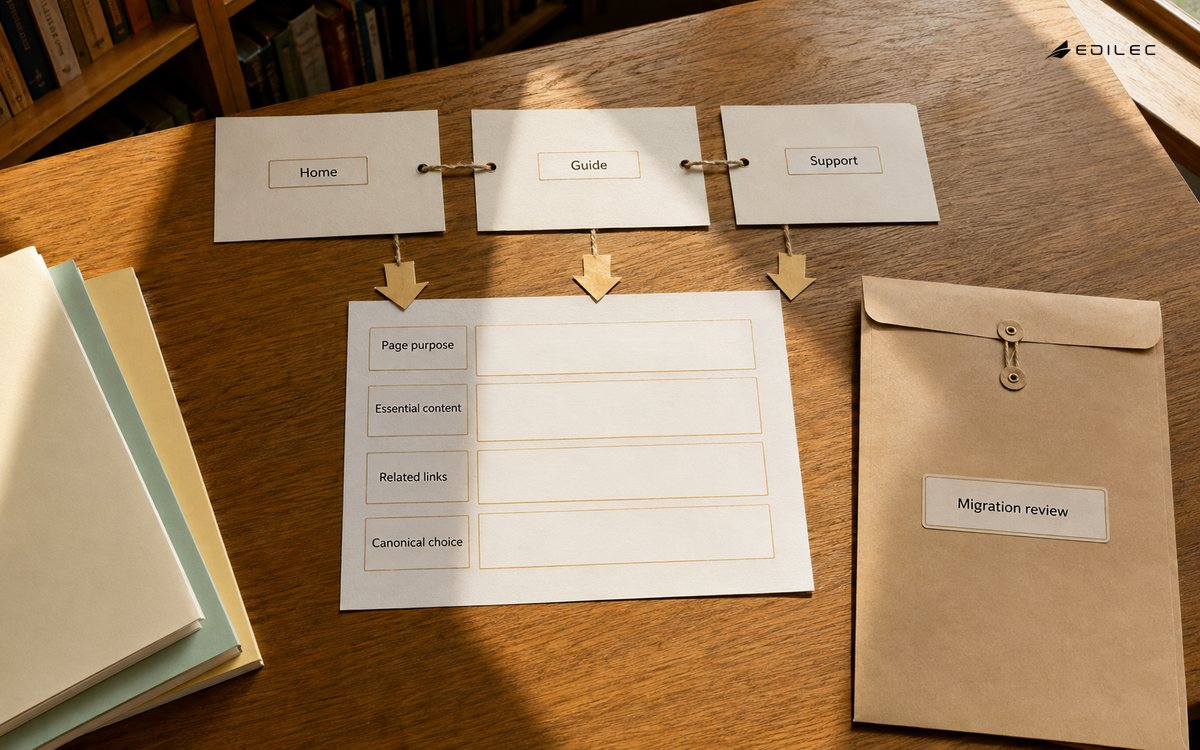
Use readable, persistent URLs derived from content identity, not volatile UI state. Define lowercase and trailing-slash rules, parameter handling, pagination, faceted navigation and retirement behavior centrally. Every indexable page should be reachable through ordinary HTML links from a logical hierarchy. A sitemap helps discovery but does not replace links or guarantee indexing. Google’s minimum technical requirements are simple: Googlebot must not be blocked, the page must work with a successful status and it must contain indexable content. Search inclusion still is not guaranteed.
Treat HTTP status as part of the content contract. Return 200 for a real page, a permanent redirect for a durable move, 404 or 410 for removed content without a replacement, and 5xx for temporary server failure. Do not serve a “not found” message with 200. Generate XML sitemaps from canonical, indexable records and omit redirects, errors and filtered duplicates. Google’s sitemap guidance explains format and size rules; monitor processing rather than treating submission as completion.
Make rendering predictable
Server-render or statically generate essential titles, headings, main content, links and metadata when practical. Client-side rendering can be indexed, but it adds a rendering stage and new failure modes. Test with JavaScript disabled, with APIs delayed, and with unauthenticated requests. Google’s JavaScript SEO guidance describes crawling, rendering and indexing as distinct phases. A component that looks correct in a developer’s browser can still expose an empty shell, blocked dependency or transient error to a crawler.
Hydration must not replace valid HTML with conflicting content. Keep links as anchor elements with usable href values. Avoid generating canonical or robots directives only after an unreliable API call. If localization changes visible text, ensure the route, language signal and server response agree. Capture rendered snapshots for representative page classes in continuous integration and compare the title, canonical, robots, heading, primary copy, internal links and structured data after significant framework changes.
Control canonicalization, indexing and duplication
Canonicalization identifies a preferred URL among duplicate or very similar versions; it is not a substitute for preventing unnecessary URLs. Google describes redirects and rel=canonical as strong signals, while sitemap inclusion is weaker in its canonical URL documentation. Align all three. A canonical page should normally return 200, be indexable, link to itself canonically and appear in the sitemap. Its internal links should use the canonical form.
Use robots.txt to manage crawling, not to remove an already known URL from search. Use a crawlable noindex directive when a page should not be indexed. Define rules for previews, staging, on-site search, campaign parameters, print views and account pages. Test combinations because contradictions are easy: a blocked URL cannot expose its noindex directive, and a noindexed page should not be declared canonical for an indexable page. Keep production index controls outside content editors’ accidental reach or require guarded approval.
Generate useful metadata and structured data
Create a unique, descriptive title and a concise description from page-specific fields, with editorial override for important pages. The visible H1, title and purpose should agree without being identical strings. Social metadata does not directly make a page searchable, but correct previews improve sharing and quality checks. Structured data should represent visible facts and use the most specific supported type. Validate syntax and eligibility, then monitor reports after release; passing a validator does not guarantee a rich result.
For an article, connect headline, author, publication date, modification date and primary image to the displayed content. For products, maintain price and availability from the same authoritative record used on screen. Do not mark up invented reviews, hidden questions or content unavailable to users. Metadata pipelines need the same ownership and test fixtures as user-interface components because a faulty global template can alter every page at once.
Engineer performance around real user experience
Set budgets by page class for server response, JavaScript, CSS, fonts, images and third-party scripts. Deliver responsive images with explicit dimensions, preload only critical resources and defer nonessential code. Avoid a single global bundle for features used on a few routes. The Web Vitals guidance identifies Largest Contentful Paint, Interaction to Next Paint and Cumulative Layout Shift as core measures of loading, responsiveness and visual stability. Use field data where available because laboratory tests cannot represent every device, network and interaction.
Performance work must preserve content and measurement integrity. Lazy loading should not require scrolling to place primary content in the DOM. Consent tools, personalization and experiments should not indefinitely delay navigation or create divergent canonical metadata. Measure representative templates at the 75th percentile and investigate segment differences. A fast homepage does not compensate for slow product pages, and an aggregate score can hide severe regressions on the pages search visitors actually enter.
| Release check | Test method | Failure action |
|---|---|---|
| Indexability | Fetch canonical samples as an unauthenticated crawler | Block release if status, robots or main content is wrong |
| Rendering | Compare raw and rendered HTML for required fields | Repair dependency or render essential content server-side |
| Links | Crawl staging and classify broken, redirected and orphaned URLs | Fix templates and navigation before launch |
| Performance | Run lab budgets and review field trend after rollout | Reduce rollout or revert the responsible change |
| Structured data | Validate representative output against visible facts | Remove or correct invalid properties |
Release and migrate without losing search signals
Inventory existing URLs, traffic, links, index state and page purpose before redesign. Build a one-to-one redirect map only where a relevant replacement exists; do not redirect every removed page to the homepage. Keep old redirects long enough for users and systems to update. Rehearse with production-like routing, robots, authentication and CDN behavior. At launch, verify DNS, certificates, status codes, canonical targets, sitemap location, analytics and high-value journeys from outside the corporate network.
Observe by page class, not only total clicks. Track crawl errors, indexed versus submitted pages, canonical selection, query and landing-page trends, conversion, field performance and server logs. Annotate releases and allow enough time to separate normal search variation from a defect. Roll back technical regressions quickly; do not roll back useful content merely because rankings fluctuate for a few days. Search readiness is an operating capability with owners across editorial, product, engineering and analytics.
Key takeaways
A practical final audit should sample one URL from every page class and follow it from discovery link to response, rendered content, canonical signal, sitemap entry and analytics record. Template diversity matters more than checking many URLs generated by the same component.
- Give every indexable page a distinct user task and authoritative content owner.
- Make canonical pages reachable through HTML links and consistent status, canonical and sitemap signals.
- Render essential content and metadata reliably before optional client-side behavior.
- Test accessibility, indexability, performance and structured data at the template level.
- Treat migration maps and post-release observation as part of development scope.
SEO-ready website development FAQ
Is one web framework inherently best for SEO?
No. Search readiness depends on the output and operation: accessible content, valid responses, crawlable links, stable URLs and controlled metadata. Framework choice affects how easily the team can produce and test that result. Evaluate representative templates and failure behavior rather than relying on a framework label.
Does meeting technical requirements guarantee indexing or ranking?
No. Technical compliance makes content eligible and reduces avoidable ambiguity. Search systems still decide whether to crawl, index and display a page based on many signals. The engineering goal is to present useful content consistently and preserve trustworthy evidence for diagnosis.
Conclusion
An SEO-ready website is coherent from content model to server response. Its architecture helps people and crawlers discover meaningful pages, its rendering exposes what matters, and its release process catches broad template failures early. Build those properties into normal product delivery and search quality becomes maintainable instead of a recurring launch emergency.