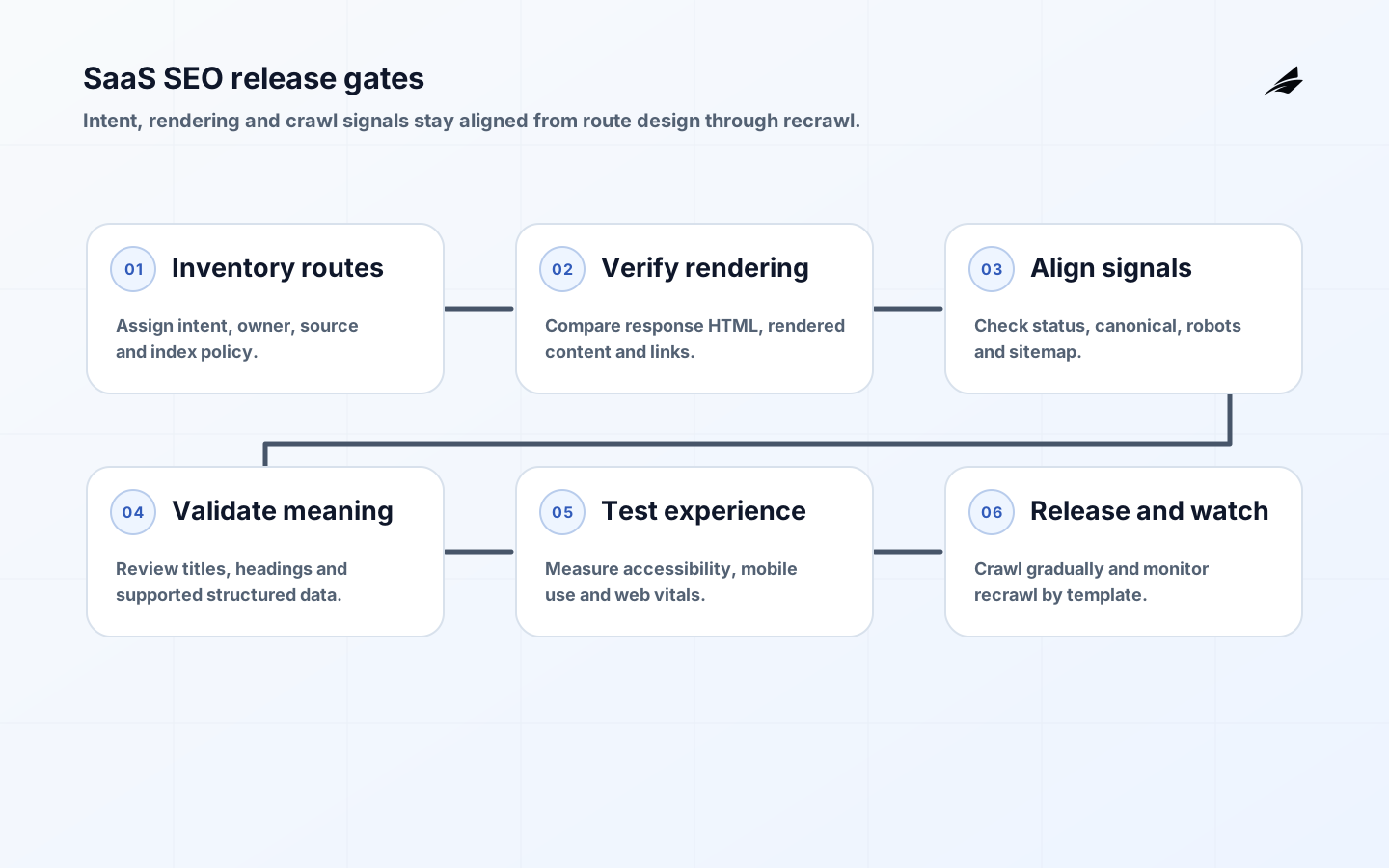
SEO-ready website development for SaaS companies means building public pages that satisfy a real search intent, return understandable HTML and status codes, expose crawlable links, declare consistent canonical and index signals, perform well for users and survive frequent product releases. It does not mean inserting terms into a client-rendered shell or generating thousands of thin integration pages.
Pair this checklist with the SaaS architecture and release guide, the technical FAQ and the broader implementation readiness checklist. Google documentation explains eligibility and processing, but no implementation guarantees ranking; relevance, usefulness and competition still matter.
Inventory page types and search intent
List every route family: home, product, solution, use case, pricing, comparison, integration, documentation, changelog, template, customer story and editorial content. Assign each a user intent, owner, source data, index policy and lifecycle. Pages without distinct value should be consolidated, noindexed where appropriate or excluded from generation. Filter, search, preview and account routes need explicit handling.
Define one canonical URL pattern and stable identifiers. Avoid creating indexable variants for tracking parameters, casing, trailing slash, sort or navigation state. Localized pages need distinct useful content and language annotations. Keep protected application routes separate from public acquisition pages so authentication redirects and app shells do not accidentally become the crawl experience.
| Page family | Search purpose | Index decision |
|---|---|---|
| Product capability | Understand a specific capability | Index when content is distinct and current |
| Integration | Assess a real supported connection | Index only with substantive implementation detail |
| Documentation | Complete a technical task | Index stable public docs; control versions |
| Internal search/filter | Navigate the site | Usually noindex or block generation |
| Account/application | Use the product | Keep out of public search where appropriate |
Render useful content and links in discoverable HTML
Google processes JavaScript through crawling, rendering and indexing, and rendering can be delayed. Server rendering or prerendering can improve resilience and speed when the initial HTML contains the primary content, title, description, canonical and crawlable links. Test raw response and rendered DOM. Important text should not require user interaction, authentication or an API call that blocks crawlers.
Use real anchor elements with href attributes for navigation. Give every content view a stable URL and use the History API for client-side routing. Avoid fragment-only routes for distinct content. Make hydration failure graceful: a visitor should still understand the page and follow core links. Do not block JavaScript or CSS resources needed to render the content you expect search engines to evaluate.
Align status, canonical, robots and sitemap signals
Return 200 only for a real page, 301 or 308 for durable moves, 404 or 410 for removed content, and 5xx for temporary server failure. Client-side not-found screens that return 200 create soft-404 ambiguity. A canonical is a strong hint, not a directive; point it to the preferred equivalent page and keep internal links, redirects and sitemap entries aligned. Do not canonicalize unrelated thin pages to a generic destination.
Robots.txt controls crawling, not guaranteed removal from the index. Use a robots meta tag or X-Robots-Tag for index control where the crawler can fetch it. Include canonical, indexable URLs in XML sitemaps with accurate last modification data. Split and monitor large sitemaps by meaningful page family. Avoid contradictory combinations such as a blocked URL that also carries a noindex tag the crawler cannot read.
| Signal | Implementation check | Common failure |
|---|---|---|
| HTTP status | Matches actual page state before rendering | Soft 404 with 200 |
| Canonical | Absolute preferred equivalent URL | Conflicts with links or sitemap |
| Robots meta | Present in accessible HTML or header | Trying to noindex via robots.txt |
| Sitemap | Canonical useful URLs only | Stale, redirected or parameter URLs |
| Internal links | Crawlable href and descriptive context | Buttons or script-only navigation |
Implement page metadata and structured data from authoritative content
Generate unique, descriptive titles and concise descriptions from approved page content, not uncontrolled concatenation. One clear H1 and semantic headings help users and parsers understand structure. Social metadata should agree with the canonical page. Images need dimensions, meaningful alt text where informative and optimized formats. Do not repeat the same boilerplate across every integration or industry page.
Add structured data only for types the page genuinely supports and follow current Google feature guidance. Values must match visible content and remain accurate. Validate JSON-LD in automated tests and a rich-results tool where applicable. Structured data does not make a weak page useful and does not guarantee a rich result. Assign ownership when product prices, availability, organization identity or review policy changes.
Protect user experience, accessibility and Core Web Vitals
Measure Core Web Vitals with field data when available and use laboratory tools for diagnosis. Control server response, critical resources, image sizing, font loading, third-party scripts and client work. Reserve space for dynamic banners and embeds to prevent layout shifts. Performance budgets should apply to templates and marketing integrations, not only application code.
Accessibility and search readiness reinforce usable structure. Follow WCAG 2.2 guidance for keyboard operation, focus, labels, contrast, alternatives and errors. Test responsive views and zoom. Cookie, chat and campaign overlays must not obscure navigation or content. A page that is technically indexable but unusable on mobile is not production ready.
Add SEO acceptance tests to every release
For each route family, test representative URLs for status, title, canonical, robots, headings, links, structured data and sitemap membership. Compare raw and rendered content. Crawl a staging build that is protected from indexing, then crawl production after release. Preserve redirects during migrations and test chains, loops and high-value backlinks. Release templates gradually where a defect could affect thousands of pages.

Keep an automated URL fixture set for product, locale, pagination, removed content and error states. Validate that analytics consent does not block essential rendering. Record expected index policy alongside route configuration. A launch checklist should name an owner and rollback condition; discovering a sitewide noindex after recrawl is an avoidable control failure.
- Approve page inventory and index policy.
- Verify response HTML, links and status codes.
- Align canonical, robots and sitemap signals.
- Validate metadata and eligible structured data.
- Test field performance and accessibility.
- Crawl, release gradually and monitor recrawl.
Monitor crawl behavior and useful organic outcomes
Use Search Console, server logs and scheduled crawls to inspect indexing, selected canonicals, errors, crawl demand and template regressions. Segment by page family; a sitewide average can hide a broken documentation section. Investigate unexpected growth in URLs, duplicate titles, redirect chains and rendering failures. Keep alerts proportional because index changes can lag releases.
Connect search visibility to qualified sign-ups, documentation success and assisted revenue without treating last-click attribution as complete truth. Review content freshness and retire obsolete pages with an appropriate redirect or clear removal response. Technical SEO is an operating practice shared by engineering, content and product, not a one-time launch ticket.
Create a template-level launch certificate
For every indexable template, retain representative production URLs and expected status, canonical, robots, title, heading, internal links, structured data and sitemap state. Capture raw response HTML and rendered output, field or laboratory performance, mobile and keyboard checks, and the owner for content freshness. Include removed and redirected examples because failure behavior is part of the search contract.
Re-run the certificate when routing, rendering, CMS schema, localization or deployment architecture changes. Compare the crawl before and after release and monitor the template until recrawl evidence stabilizes. This does not certify ranking; it certifies that the engineering surface consistently exposes the intended page and does not contradict itself.
Add a route-growth review before enabling a new integration, locale, comparison or programmatic page family. Estimate the URL count, source-data completeness, uniqueness criteria, update frequency and removal behavior. Build a sample set and review it with content and product owners. Generation should stop when data is missing instead of publishing shells that differ only by a name.
Keep a migration ledger during domain, framework or information-architecture changes. Record each old URL, intended destination or removal state, canonical, redirect status and verification result. Sample high-value and long-tail routes after release, and preserve redirects while meaningful demand or references remain. This turns a risky launch weekend into a traceable reconciliation process.
Document ownership where page content is assembled from product databases, CMS entries and localization systems. Define which source controls names, availability, pricing, screenshots and deprecation. Add freshness checks and fail visibly in editorial workflows when required source data disappears. Search quality depends on accurate product truth as much as crawler-facing tags.
Key takeaways
- Give every route family an intent, owner and index policy.
- Serve useful content, metadata and links in resilient HTML.
- Keep status, canonical, robots, sitemap and links consistent.
- Treat performance and accessibility as release requirements.
- Monitor by template and connect visibility to useful customer outcomes.
Frequently asked questions
Does a SaaS site need server-side rendering?
Not always, but important content must be reliably crawlable and usable. Server rendering or prerendering often reduces dependency on delayed JavaScript rendering and improves resilience.
Should login and app pages appear in search?
Usually public acquisition and documentation pages should carry search intent, while account and private application routes should be controlled. Define the policy by route and avoid exposing protected content.
How often should sitemaps update?
Update when canonical indexable URLs or meaningful modification dates change. Do not set every lastmod value to the build time if the page content did not change.
Can structured data improve rankings?
It can help search systems understand eligible content and enable certain presentations, but it is not a ranking guarantee. Markup must match visible, policy-compliant content.
Conclusion
An SEO-ready SaaS website is a controlled publishing system. Page intent, resilient rendering, coherent crawl signals, fast accessible templates and release evidence must remain aligned as the product changes. Building those checks into route design and deployment is more dependable than repairing index problems after thousands of URLs have shipped.