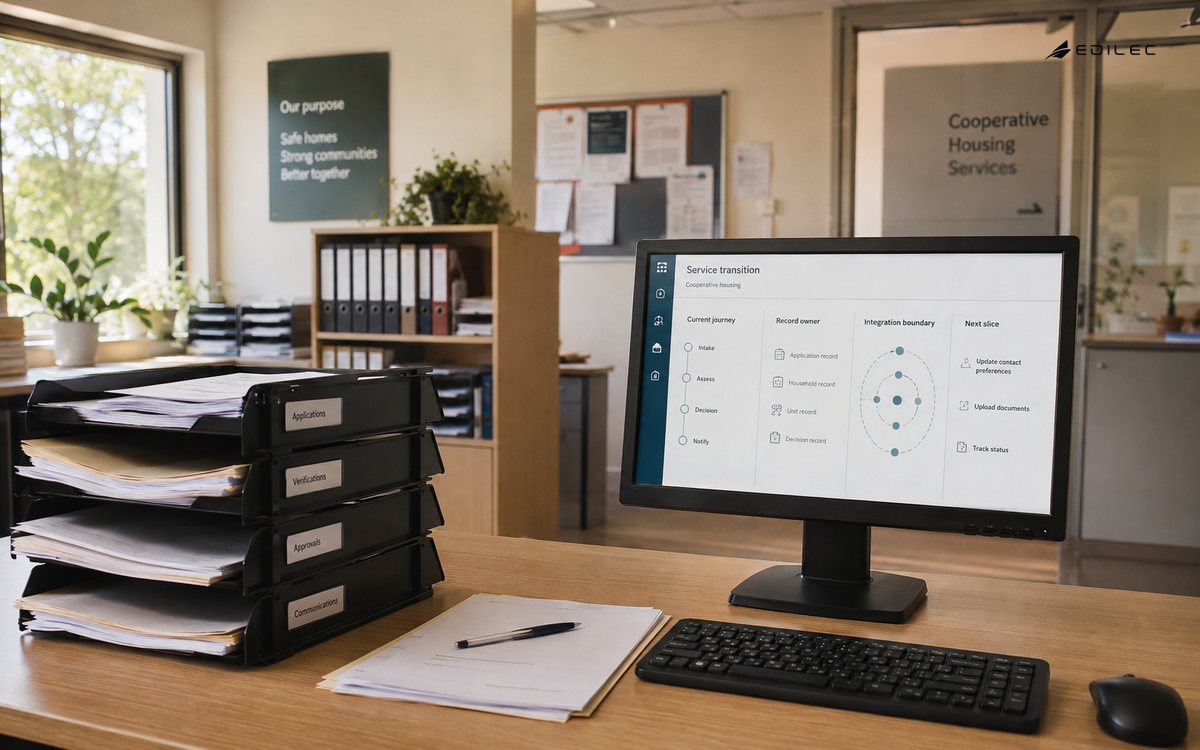
Enterprise digital solutions are coordinated changes to services, workflows, data and technology that improve how an organization operates. They may include a client portal, ERP or CRM integration, approval workflow, reporting platform, identity layer, mobile application or modernization of a legacy system. The useful unit of scope is an end-to-end business outcome, not a software category. A new portal that still requires staff to re-key data into three back-office systems is a new interface on an old problem.
What buyers need from an enterprise digital solution plan
Teams researching enterprise digital solutions usually face a mixed portfolio: valuable legacy applications, manual handoffs, duplicate records, brittle integrations and reporting that arrives too late. They need to decide what to improve first, which systems remain authoritative, where custom software is justified and how to migrate without interrupting daily work. The UK Government Service Standard offers a durable principle: solve a whole problem for users while delivering useful increments. That prevents both narrow point fixes and an unmanageable attempt to replace everything at once.
| Problem pattern | Likely intervention | Evidence of value |
|---|---|---|
| Users submit the same data in several channels | Joined-up service journey, shared identity and controlled data reuse | Fewer repeated fields, contacts and abandoned cases |
| Teams re-key records between ERP, CRM and spreadsheets | API-led integration, record ownership and exception queue | Lower reconciliation effort and fewer duplicate records |
| Approvals disappear into email | Stateful workflow with roles, deadlines, escalation and audit history | Shorter cycle time and visible exception age |
| Legacy application blocks frequent change | Replatform, refactor or incremental replacement by business capability | Reduced change lead time, incidents and support burden |
| Reports disagree across departments | Shared metric definitions, governed data pipeline and lineage | Reconciliation differences and decision latency decline |
Discover the service before selecting the solution
Discovery should map the complete journey from trigger to business outcome. Interview frontline users, customers, approvers, support staff, data owners, security and finance. Observe real cases rather than relying only on procedure documents. Record channels, wait states, handoffs, policy constraints, accessibility needs, volumes, peaks, exception types and workarounds. Inventory applications and interfaces, but do not let the application boundary define the service boundary.
- Write a problem statement with the affected user, current friction, business consequence and measurable target.
- Create a service blueprint that links user steps to staff work, systems, records and controls.
- Name the system of record for each core entity: customer, employee, product, order, invoice, asset or case.
- Classify data and document retention, residency, privacy and audit obligations.
- Map dependencies, unsupported interfaces, batch windows, vendor limits and contract renewal dates.
- Baseline cycle time, failure demand, manual touch time, incident volume and reconciliation work.
- Define the smallest release that completes a meaningful journey and leaves a reversible migration path.
Define a target architecture that can change in stages
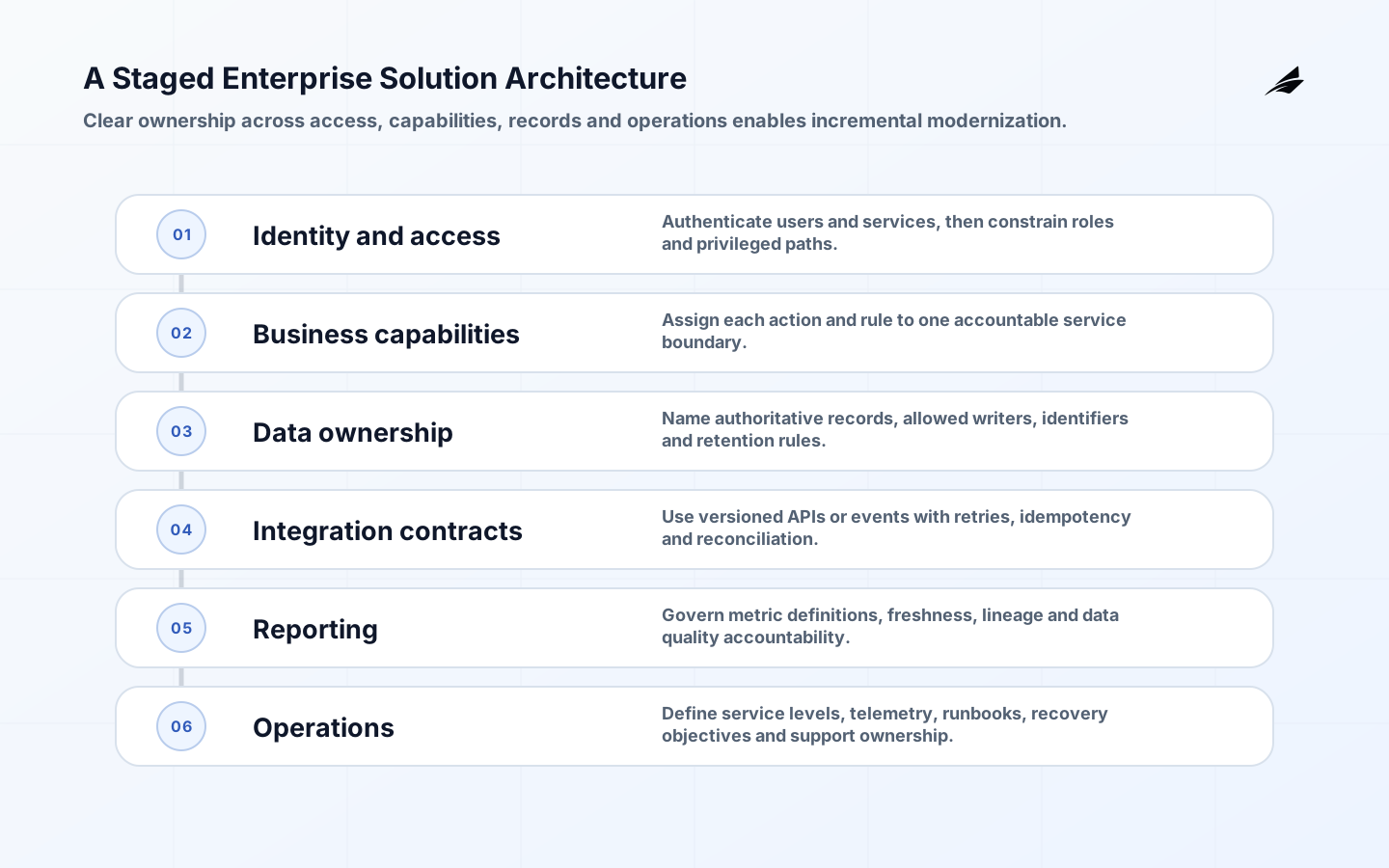
The target architecture is a set of boundaries and decisions, not a poster filled with products. It should show channels, identity, business capabilities, integration contracts, systems of record, analytics, security and operations. Each component needs an owner and lifecycle. The design should support coexistence because a phased program normally runs old and new paths together for a period. ERP, CRM and workflow integration provides a deeper view of record ownership and synchronization.
| Architecture concern | Decision to document | Common failure to avoid |
|---|---|---|
| Identity and access | Authentication source, role model, privileged paths and service identities | Trusting a user because they are on an internal network |
| Business capability | Which service owns each action and its rules | Duplicating policy logic across portal, CRM and integration code |
| Data ownership | Authoritative source, allowed writers, identifiers and retention | Bi-directional synchronization without conflict policy |
| Integration | API or event contract, versioning, idempotency, retry and reconciliation | Point-to-point scripts with shared credentials and no ownership |
| Reporting | Metric definitions, freshness, lineage and quality accountability | Treating a dashboard as authoritative when its source data is not |
| Operations | Service levels, telemetry, runbooks, recovery objectives and support model | Handing over software without operational capacity |
Apply zero-trust thinking to every resource interaction. NIST SP 800-207 states that network location alone should not grant implicit trust. In practice, a portal, integration worker and analyst each receive a distinct identity and minimum permissions. Authentication and authorization happen before access to a resource; sensitive actions may require stronger assurance or separation of duties. This is more durable than assuming anything inside a corporate network is safe. See Zero trust for business applications for implementation context.
Choose where to buy, configure, integrate or build
Use packaged software where the process is standard and product lifecycle support matters. Configure rather than customize when a supported extension point can meet the need. Build a custom capability when the workflow creates genuine differentiation, crosses products in a way no package owns, or needs a user experience that standard software cannot provide. Integration is not a leftover line item: it is often the mechanism that turns separate products into one service.
- Assess functional fit using real scenarios and exceptions, not a feature checklist alone.
- Review APIs, event support, export formats, rate limits, sandbox access and identity integration before purchase.
- Model exit: data export, contract termination, replacement of proprietary extensions and archive access.
- Separate mandatory requirements from preferences so customization does not recreate the legacy system inside a new product.
- Score accessibility, security, privacy, observability, support and roadmap alongside license price.
- Assign an internal product owner even when a vendor delivers and hosts the system.
Modernize each workload according to its constraint
A portfolio rarely needs one universal strategy. Retire unused systems and retain stable ones that still meet needs. Rehost when the immediate problem is infrastructure exit and code change is not justified. Replatform to reduce operational burden with limited application change. Refactor when maintainability or cloud use needs code improvement. Rearchitect only when current boundaries prevent required scale, resilience or delivery speed. Replace with a product when business capability is standard and migration is manageable.
For a large legacy application, the strangler fig pattern can replace one capability at a time. A routing layer initially sends requests to the old application; newly implemented capabilities move behind the same boundary, and the old portion is retired only after traffic, data and support have migrated. This avoids a single cutover, but it introduces temporary complexity. The program must fund routing, data coexistence, reconciliation and eventual decommissioning rather than allowing the transition layer to become permanent by accident.
Build a total-cost model that includes transition and operation
Initial cost includes discovery, user research, architecture, licenses, configuration, development, integrations, data cleansing, migration, testing, security assurance, training and change support. Transition adds parallel environments, duplicate licenses, data synchronization and temporary operational procedures. Recurring cost includes subscriptions, cloud consumption, support, observability, security operations, vendor management and a team capable of improving the service. Decommissioning has its own work: archival, legal retention, interface removal, contract closure and support retirement.
Compare options over an agreed planning horizon and state assumptions about users, transactions, storage, environments, growth and support coverage. Attach cost to a business unit such as cost per completed order or served client, not only infrastructure units. Include the cost of delay and current manual work, but do not count the same benefit twice across projects. Use ranges for uncertain migration and integration work, with a discovery gate that narrows the estimate before committing the full program.
Manage enterprise delivery risks explicitly
| Risk | Early control | Release evidence |
|---|---|---|
| Scope expands across every department | Prioritize one end-to-end journey and publish boundaries | A usable increment completes a measurable outcome |
| Poor source data undermines the new service | Profile data, assign owners and define remediation rules | Migration reconciliation meets agreed quality criteria |
| Integration fails under real load or outage | Contract tests, retries, idempotency, back-pressure and failure queues | Load and recovery tests cover dependency failure |
| Access exceeds job need | Role design, service identities, privileged access review and separation of duties | Access tests and owner sign-off cover sensitive actions |
| Users keep shadow spreadsheets and workarounds | Co-design with frontline staff and preserve necessary exception handling | Pilot users complete real cases with falling off-system work |
| Legacy system never retires | Fund decommissioning, define exit criteria and track remaining dependencies | Traffic, records, interfaces and support obligations reach zero |
Deliver through reversible increments
- Discovery: validate the user problem, baseline performance, map records and identify the riskiest assumptions.
- Alpha: prototype the journey and integration boundary with representative users and data; test accessibility and exception paths.
- Foundation: establish identity, environments, deployment, observability, security controls and data contracts needed by the first release.
- Pilot: serve a limited group or capability, run reconciliation and keep a documented fallback to the current service.
- Progressive rollout: increase users, regions or transaction categories while monitoring service and business guardrails.
- Migration: move records with repeatable scripts, quality reports, cutover rehearsals and rollback criteria.
- Decommission: archive required data, remove interfaces and permissions, close contracts and update operating documentation.
- Continuous improvement: maintain a product backlog based on user research, operational telemetry and policy change.
Release gates should be evidence-based. A pilot may require successful completion of priority journeys, no unresolved critical security findings, reconciled data, tested recovery and trained support. Expansion may require stable tail latency, declining manual work and acceptable incident rates. A calendar date alone is not a release criterion. Microsoft modernization guidance similarly emphasizes phasing, progressive deployment and rollback for higher-risk changes.
Measure service performance, not software installation
Measure whether people can complete the full job. Useful metrics include completion rate, cycle time at the median and slow tail, manual touches, avoidable contacts, exception age, data quality, synchronization failures, accessibility defects, availability, recovery time and cost per completed outcome. For reporting architecture, Dashboards that become a source of truth explains why metric ownership and freshness matter as much as visualization.
- Scope around a user outcome that crosses the necessary teams and systems.
- Name systems of record and data owners before integrating.
- Select modernization treatment workload by workload, based on constraints and value.
- Make identity, security, accessibility, operations and decommissioning part of the first estimate.
- Use coexistence and rollback deliberately, then retire temporary transition components.
- Keep an accountable product team after launch; enterprise services are operated and improved, not simply installed.
Frequently asked questions
What counts as an enterprise digital solution? It is a coordinated service capability supported by software, data, integration and operating processes. It can use packaged or custom products. The defining feature is that it improves a meaningful enterprise outcome across the necessary boundaries.
Should we replace the ERP first? Not automatically. Determine whether the ERP is the constraint or whether surrounding workflows, data ownership and integrations cause the friction. A portal or integration layer may deliver value while the ERP remains authoritative. Replace a core platform only with a clear capability, risk and lifecycle case.
How long does enterprise modernization take? There is no responsible universal duration. A workflow around supported APIs differs from a multi-country core-system migration. Estimate by increment and dependency: discovery, foundations, first capability, migration waves and decommissioning. Deliver valuable releases before the entire roadmap ends.
How do we avoid vendor lock-in? Use clear contracts, open standards where practical, documented APIs, portable data exports, internal ownership and an exit plan. Some dependency is unavoidable; make it visible and proportionate to the value of the managed capability.
What should a vendor hand over? Require source and configuration ownership as agreed, architecture decisions, API and data contracts, deployment automation, test suites, security evidence, migration and reconciliation records, dashboards, runbooks, recovery procedures, license inventory and a prioritized backlog.
Conclusion
Enterprise digital delivery succeeds when the organization improves a complete service while changing technology in manageable pieces. The practical sequence is to understand the journey, establish ownership, define secure boundaries, choose the right treatment for each workload and migrate with evidence and fallback. Edilec enterprise systems services can turn that sequence into a discovery, target architecture, prioritized backlog and phased delivery program that remains connected to operating outcomes.