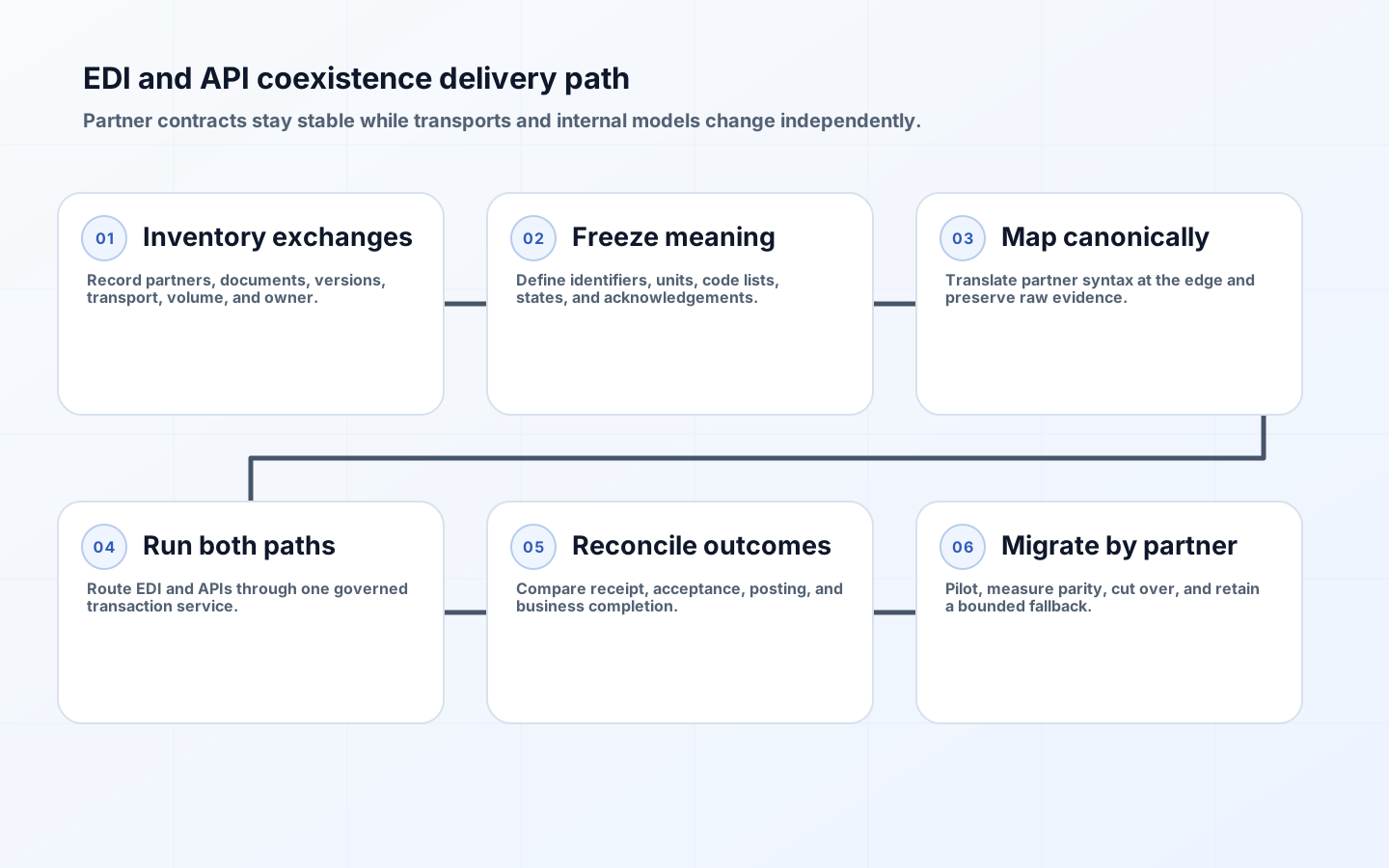
EDI modernization is rarely a replacement project with one finish date. A manufacturer may exchange EDIFACT orders with a strategic distributor, X12 shipment notices through a network, UBL invoices through a regional access point, and JSON requests with a newer marketplace. Those partners have different budgets, release calendars, legal agreements, and tolerance for change. The practical goal is therefore controlled coexistence: preserve dependable B2B document exchange while APIs improve immediacy, onboarding, or product experience where they genuinely help.
Treating an API as merely a modern transport for the same transaction misses the hard parts. A purchase order is a business assertion with identifiers, parties, lines, units, tax treatment, dates, references, and lifecycle expectations. OASIS UBL 2.4 defines reusable business information entities and many document schemas, while ebMS distinguishes messaging receipts and errors. Modernization must preserve that meaning and evidence even when XML becomes JSON or a batch mailbox becomes an HTTPS endpoint.
Inventory exchanges before choosing a target
Build an exchange register at partner-document-version level. For every inbound and outbound flow, record the business purpose, standard and release, implementation guideline, envelope, transport, schedule, peak volume, payload size, security method, acknowledgement types, timeout, replay process, system of record, operational owner, partner contact, and contractual retention. Do not collapse all purchase orders into one row. A partner using the same nominal message may require different qualifiers, code lists, tax rules, or acknowledgement timing.

Then classify the reason to change. Transport risk, expensive network fees, slow partner onboarding, brittle point mappings, inadequate status visibility, and demand for synchronous availability are different problems. An API can improve an interactive availability check without replacing the legally or operationally established order document. Conversely, replacing FTP with managed file transfer may reduce security risk without changing the message. This problem-first inventory prevents a fashionable protocol decision from expanding into an unnecessary commercial renegotiation.
| Exchange concern | Contract to preserve | Modernization option | Proof before release |
|---|---|---|---|
| Business meaning | Identifiers, quantities, units, dates, tax, references | Canonical transaction model | Golden-document semantic comparison |
| Partner syntax | Standard release and implementation guide | Versioned edge mapper | Schema and rule validation |
| Transport | Endpoint, encryption, receipt, retry | API, AS4, managed file, or network | Failure and duplicate test |
| Acknowledgement | Receipt, acceptance, rejection, completion | Explicit status events | State-transition reconciliation |
| Evidence | Raw payload, signature, timestamps, decisions | Immutable exchange journal | Audit retrieval exercise |
Use a canonical model as a boundary, not a universal language
A canonical model should represent the business transaction your organization operates, not every element in every standard. Define stable concepts such as transaction ID, seller, buyer, ship-to, lines, item identity, quantity, unit, requested date, price, allowance, tax, and references. Preserve extension bags or raw source evidence for information that is not yet normalized. For each field, document source path, target path, transformation, default, code-list translation, cardinality, precision, time zone, and loss behavior.
Keep partner-specific interpretation at adapters. The core should receive a validated, versioned command or event and should not branch on partner names. This anti-corruption boundary reduces the number of mappings from every format to every application. It does not eliminate mapping work: it makes omissions visible and testable. When a partner qualifier has no canonical equivalent, choose deliberately among adding a governed concept, storing an extension, routing for review, or rejecting the document. Silent truncation is never a compatibility strategy.
Separate receipt, acceptance, and business completion
One status called successful creates false confidence. Define at least four possible checkpoints: transport received the envelope; syntax and signature passed; the receiving application accepted the transaction; and the business process posted or completed it. An HTTP 202 can mean only that an API accepted work for later processing. An ebMS receipt can have transport or delivery semantics depending on the profile. Neither proves that an ERP created a usable sales order. Give every checkpoint its own timestamp, actor, reason code, and correlation key.
Design negative states with equal care. Distinguish malformed syntax, unsupported version, unknown party, invalid code, duplicate transaction, business-rule rejection, downstream timeout, and unresolved posting. Return machine-readable codes plus safe explanatory text. Keep the original partner identifier and assign an internal immutable transaction identifier. A retry should refer to the same business identity unless the business transaction itself is intentionally new. This makes duplicate detection possible across EDI and API paths.
Route both channels through one transaction service
During coexistence, adapters should converge on common validation, orchestration, idempotency, authorization, journal, and reconciliation services. An EDI gateway parses the interchange and partner profile; an API gateway authenticates the caller and validates the request. Both produce the same versioned internal command. Downstream processing records the transaction before side effects, applies a deterministic idempotency key, and emits status events. This design prevents separate EDI and API teams from inventing incompatible definitions of accepted, posted, or canceled.
Do not force synchronous APIs around slow ERP work. If validation and posting cannot complete inside a dependable response window, return an accepted transaction resource with a status endpoint or callback contract. Apply queue backpressure, bounded retries, dead-letter handling, and replay authorization. Preserve ordering only where the business requires it, such as amendments after an original order. A global queue that blocks every partner behind one poison document defeats the purpose of a more responsive channel.
| Migration phase | Partner experience | Internal behavior | Exit evidence |
|---|---|---|---|
| Observe | Existing EDI unchanged | Journal and classify current flow | Known volumes, variants, failures, and owners |
| Shadow | Existing path authoritative | Map into canonical form without posting | Field and rule parity on representative traffic |
| Pilot | Limited API or new document version | Canary posting with strict stops | Business outcome and duplicate reconciliation |
| Dual run | One authoritative path plus bounded fallback | Shared status and support view | Stable service and exception measures |
| Cutover | New path authoritative | Old route receive-only or disabled | Partner sign-off and tested fallback window |
| Retire | Legacy endpoint closed | Mappings and credentials archived | No residual traffic and evidence retained |
Test semantics and reconcile business outcomes
Create a versioned conformance pack for each partner. Include normal documents, maximum lines, optional segments, code-list edges, decimal precision, time-zone boundaries, duplicate identifiers, corrections, cancellations, malformed envelopes, expired credentials, delayed acknowledgements, and downstream outages. Validate both schema and business rules. UBL itself recommends schema validation and describes two-phase validation for content constraints; production tests should add organization and partner rules beyond the base schema.
Reconciliation compares expected business transitions with authoritative records. For a daily order population, match received transactions to accepted commands, ERP orders, rejection cases, and unresolved items using immutable identifiers. Compare counts, amounts, currencies, line populations, and status age, not only totals. Sample transformed documents field by field and let process owners inspect meaningful cases. Establish stop thresholds for unknown losses, duplicates, material value variance, and overdue unposted transactions. A dashboard without an exception queue and owner is observation, not control.
Migrate partner by partner with commercial discipline
Segment partners by volume, value, document complexity, technical capability, strategic importance, and support risk. Start with a cooperative but representative partner, not a trivial internal affiliate whose flow proves little. Provide a partner pack with schemas, profiles, examples, authentication, test endpoints, status semantics, service expectations, change policy, contacts, and certification cases. Give version deprecation dates early and support overlapping versions for a declared period rather than indefinitely.
Define fallback precisely. It might allow a partner to resume the old transport for seven days while the same transaction identifiers and reconciliation continue. It should not permit simultaneous authoritative submission on both channels. Rehearse credential revocation, endpoint rollback, queued-work disposition, and support communication. Retire mappings, certificates, mailboxes, network rules, monitoring, and commercial fees only after residual-traffic checks. Old pathways left quietly open become unmonitored attack surface and accidental sources of duplicate orders.
Key takeaways
- Modernize the business exchange contract, mapping boundary, and evidence chain independently from transport choice.
- Use a focused canonical transaction model while retaining raw documents and explicit handling for information that cannot be normalized safely.
- Model transport receipt, syntax acceptance, application acceptance, and business completion as different states.
- Converge EDI and API adapters on shared idempotency, orchestration, status, reconciliation, and support services.
- Cut over one partner and document version at a time using semantic parity and business outcome evidence.
Frequently asked questions
Should APIs replace every EDI flow?
No. Choose the channel that fits the partner, interaction, evidence requirement, latency, and operating model. APIs are useful for interactive queries and incremental events; structured documents remain effective for asynchronous, contract-based exchange. A coherent internal transaction service can support both.
Does a canonical model remove partner mappings?
It reduces many-to-many coupling, but each partner profile still needs a versioned edge mapping and tests. The value is that partner variance is isolated from core applications and semantic loss becomes an explicit decision.
What is the most important migration metric?
No single metric is sufficient. Track unresolved transaction count and age, duplicate rate, rejection reasons, posting parity, value variance, acknowledgement latency, and partner support incidents. Business completion matters more than gateway uptime alone.
Conclusion
A defensible EDI migration strategy accepts that coexistence may last years. Stable semantics, versioned adapters, explicit acknowledgements, durable evidence, and transaction-level reconciliation let the organization improve channels without gambling with trade. When each partner cutover is bounded and reversible, modernization becomes routine portfolio work rather than one dangerous switch.