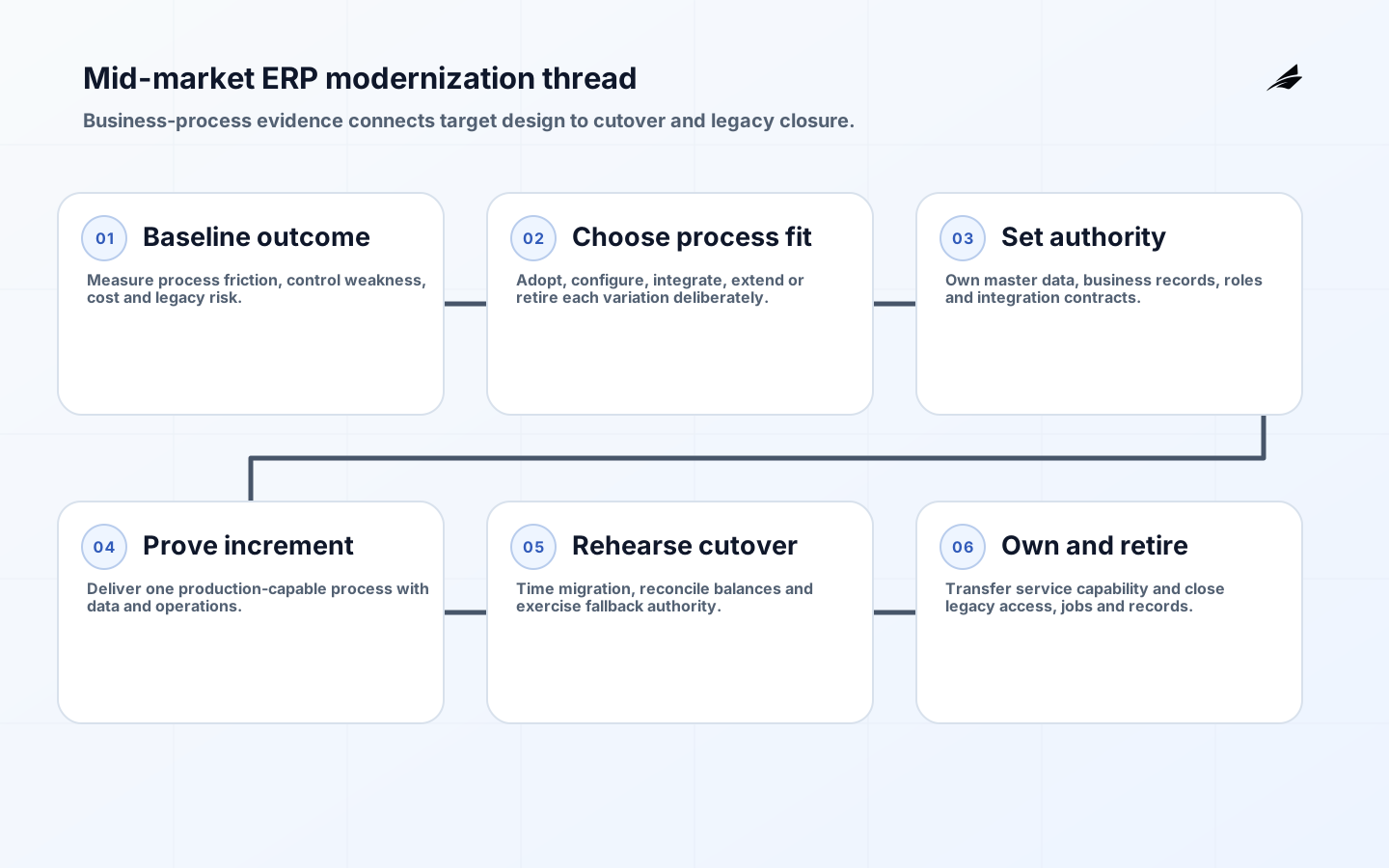
ERP modernization for mid-market companies should improve how orders, inventory, finance, purchasing, production and people work together without breaking the routines that close books or serve customers. Replacing technology is only one part. The program must simplify processes, establish record ownership, migrate trustworthy data, integrate surrounding systems, train users and retire legacy obligations. A lift-and-shift can preserve the same complexity on a newer bill.
This roadmap is for leaders evaluating replacement, cloud migration, major upgrade or modular modernization. It favors incremental evidence over a single distant cutover. GAO's agile assessment guidance is written for government programs, but its emphasis on iterative delivery, customer collaboration and program controls is broadly useful. Adapt governance and assurance to the organization's sector, contracts and legal duties.
Build the case around business outcomes and legacy risk
Baseline cycle time, manual re-entry, close effort, inventory variance, exception age, support cost, unsupported components and control weaknesses. Define outcomes such as faster order release, more reliable availability or fewer reconciliation adjustments. Avoid a case based only on version age. Acceptance evidence should identify the responsible owner, the source record, the expected result and the decision required when the result is missing.
Separate mandatory risk reduction from optional process improvement. Identify deadlines such as vendor support, audit findings, acquisitions or capacity constraints. State which benefits depend on behavior change, data cleanup or retirement of local customizations, not merely software installation. Test the normal path, boundary conditions and a realistic failure path; a successful demonstration alone does not prove the ERP modernization program is ready.
| Outcome | Baseline | Acceptance |
|---|---|---|
| Financial close | Days, adjustments and manual reconciliations | Shorter controlled close with traceable adjustments |
| Order fulfillment | Handoffs, re-entry and exception age | Fewer touches and visible owned exceptions |
| Inventory integrity | Variance and stale movements | Reconciled stock and timely movement capture |
| Technology risk | Unsupported versions and privileged access | Supported platform, least privilege and tested recovery |
Map processes and exceptions before selecting a target
Trace order-to-cash, procure-to-pay, record-to-report and other critical flows with the people who perform them. Capture normal work, approvals, substitutions, corrections, cutoffs and month-end behavior. Distinguish genuine control from a workaround caused by the current system. Keep the definition and its effective date with the implementation so later teams can explain why historical and current behavior differ.
Create a fit-to-standard decision record for each variation: adopt target process, configure, integrate, extend or retire. Require business rationale and lifecycle owner for customization. Do not let a demonstration script become the future operating model. Make exceptions visible in the same operating workflow instead of routing them to private spreadsheets or undocumented support messages.
Define record authority and integration architecture
Name the authoritative system for customer, supplier, item, price, inventory, order, invoice and employee records. Define keys, ownership, effective dates and correction. Surrounding CRM, commerce, warehouse, planning and payroll systems need explicit contracts. Use progressive exposure and explicit stop conditions so the team can learn from production without placing the entire estate at risk.
Prefer supported APIs and events over direct database coupling. Specify idempotency, ordering, retry, reconciliation and degraded behavior. Decide which integrations are synchronous because the user needs an immediate decision and which should be asynchronous for resilience. Measure the business completion time and error consequence, not only component uptime or the number of tasks closed.
Treat migration as a governed data product
Profile source data early for duplicates, missing keys, invalid values, inactive records and inconsistent hierarchies. Assign business owners for cleansing and mapping. Define what history will move, remain accessible or be retained outside the target. Preserve identifiers, timestamps and version information across handoffs so reconciliation can distinguish delay, duplication and correction.
Use repeatable extraction and transformation with source snapshots, mapping versions and exception queues. Reconcile counts, balances and complete business chains after each rehearsal. Sampling complements but does not replace control totals for financial and inventory data. Document the recovery sequence and exercise it with representative state before relying on it during a live incident.
Design access, controls and supplier assurance
Map roles to job responsibilities and separation of duties. Remove inherited access, shared administrators and excessive emergency privileges. Use strong authentication, time-bounded support access and auditable configuration change. NIST CSF 2.0 adds explicit governance emphasis useful for modernization risk ownership. Apply least privilege to people and services, and record material administrative actions with enough context for later review.
Apply CISA software-acquisition questions and NIST SSDF expectations to vendors and custom extensions. Review development practices, dependencies, vulnerabilities, logging, secure defaults, incident notification and exit. A SaaS assurance report does not prove customer roles and integrations are configured correctly. Review this control when scope, integrations, users or obligations change; a launch-time decision should not become a permanent assumption.
Deliver representative increments rather than a big-bang build
Choose an increment that proves process, data, integration, control, reporting and support end to end. It might be one legal entity, product family or bounded process. A small increment should be production-capable and include operations, not just a configured sandbox. Separate a commercial promise from the operational mechanism and evidence that will make the promise dependable.
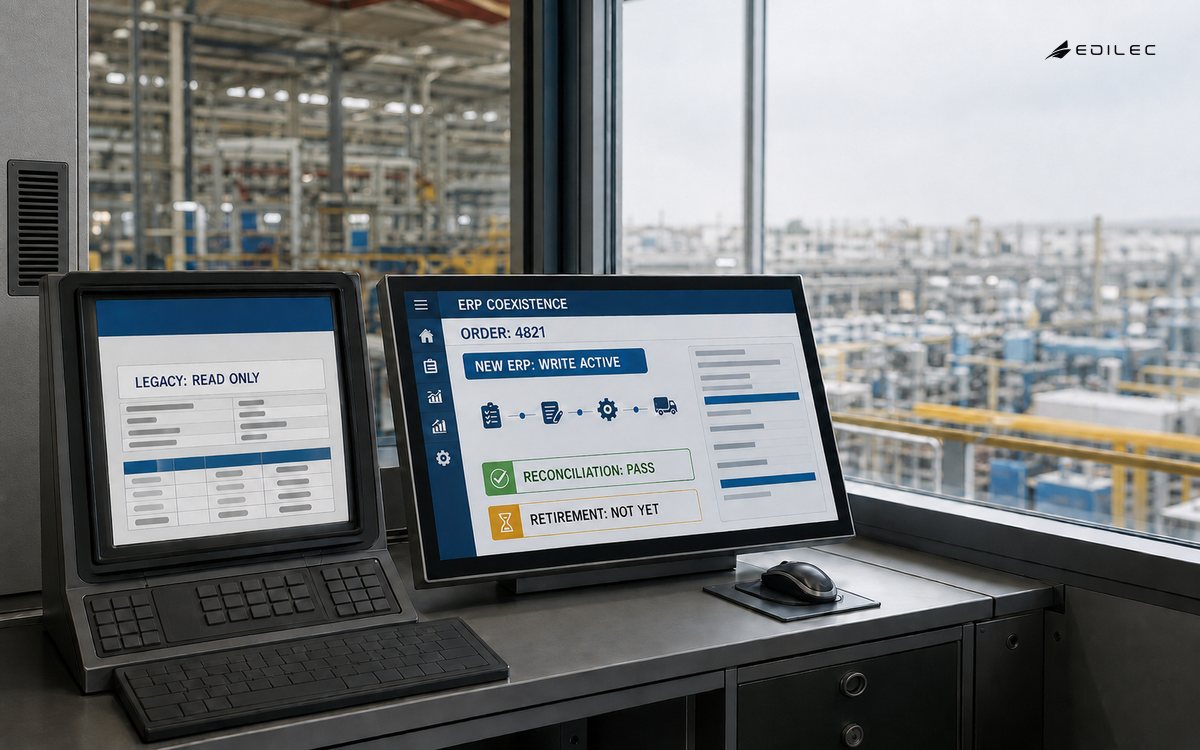
Use demonstrations with real roles and representative data, then track decisions and unresolved assumptions. GAO guidance emphasizes iterative delivery and customer feedback; apply that discipline while retaining finance, security and cutover controls. Give users a clear degraded state and next action instead of allowing partial data or failed automation to appear complete.
| Gate | Evidence | Stop condition |
|---|---|---|
| Design | Approved process, authority and integration decisions | Critical exception or owner unresolved |
| Migration rehearsal | Reconciled balances, counts and business chains | Material variance lacks explanation |
| Operational readiness | Access, support, monitoring and recovery exercised | Permanent team cannot run the service |
| Cutover | Timed plan, fallback and decision authority | Fallback or reconciliation window is infeasible |
| Legacy closure | Consumers, retention and access removed | Hidden report or interface still depends on legacy |
Rehearse cutover, reconciliation and fallback
Plan freeze, extraction, transformation, validation, switching, communications and post-cutover support. Time every rehearsal and measure data change between runs. Define who can proceed, pause or fall back and the latest safe decision point. Automate repeatable verification where it shortens feedback, while retaining accountable human judgment for consequential ambiguity.
Fallback must account for transactions created after the freeze and for surrounding systems already switched. A technical rollback without business reconciliation can create two ledgers. Use command structure, checklists and visible decision logs. Version configuration with code and deployment records so a defect can be reproduced, contained and corrected without guesswork.
Transfer ownership and retire legacy obligations
Train by role with realistic tasks and exceptions, not generic feature tours. Confirm support tiers, release management, master-data governance, access reviews and reporting ownership. Have permanent staff deploy, recover and resolve a representative incident before transition closes. Define a small set of leading and lagging measures, then remove metrics that have no owner or operating response.
Decommission interfaces, accounts, licenses, servers and scheduled jobs only after consumers and retention duties are resolved. Preserve legally required records in usable form. Measure realized process, control, adoption and cost outcomes, then fund remaining improvement rather than declaring victory at go-live. Keep target-platform and implementation-partner limits visible in the residual roadmap rather than treating go-live as transferred accountability.
Create a decision system for the modernization program
Maintain a decision log for process adoption, customization, master-data ownership, integration, migration, security, cutover and legacy retention. Each record should contain options, evidence, consequence, owner and effective date. Link decisions to the process and release they affect. This prevents the same debate recurring in several workstreams and makes later teams aware of assumptions that may no longer hold.
- Assign one accountable business owner for each end-to-end process and master-data domain.
- Set escalation clocks for decisions blocking design, migration or control evidence.
- Require architecture and security review for unsupported integration or extension patterns.
- Track benefits, transition cost, unresolved risk and legacy retirement together.
- Publish wave readiness and stop conditions to operational leaders before cutover.
Governance should accelerate evidence-based decisions, not add a ceremonial meeting. Delegate routine choices within guardrails and reserve the steering group for cross-process tradeoffs, residual risk and investment. Monitor decision age and reversals. Slow decisions can be as damaging as poor configuration because teams fill the gap with assumptions, local workarounds and custom code that later becomes expensive to remove.
Key takeaways
- Build the case from process outcomes and legacy risk.
- Map real exceptions and govern every customization decision.
- Establish record authority and versioned integration contracts.
- Rehearse migration and cutover with business reconciliation.
- Transfer permanent ownership and complete legacy retirement.
Frequently asked questions
Should a mid-market company replace or upgrade its ERP?
Choose after assessing process fit, support horizon, customization, integration debt, data condition, vendor roadmap and operating capacity. An upgrade may reduce technical risk quickly; replacement may enable larger simplification. Compare target outcomes and total transition risk rather than license price alone.
Is a big-bang cutover ever appropriate?
Sometimes dependencies, legal-entity boundaries or vendor constraints make one cutover necessary. Even then, deliver and rehearse incrementally, reduce unknowns, define fallback and run command-based reconciliation. A big-bang date should not imply a big-bang discovery and testing process.
How much historical data should be migrated?
Move the history required for operations, customer service, reporting and obligations when it can be governed effectively. Older history may remain in a supported archive with clear access and retention. Avoid moving every legacy defect or leaving records in an inaccessible server by default.
Conclusion
ERP modernization is a controlled change to the company's operating system. The target succeeds when processes are clearer, records are authoritative, integrations are recoverable, controls are effective and permanent teams can operate the service. A modern interface without those outcomes is only a technology refresh.
Start with one business thread and a source-data profile. Make every process variation, record owner, integration and cutover decision visible. Deliver a representative increment and use its evidence to refine the roadmap before wider migration commits the organization to assumptions.