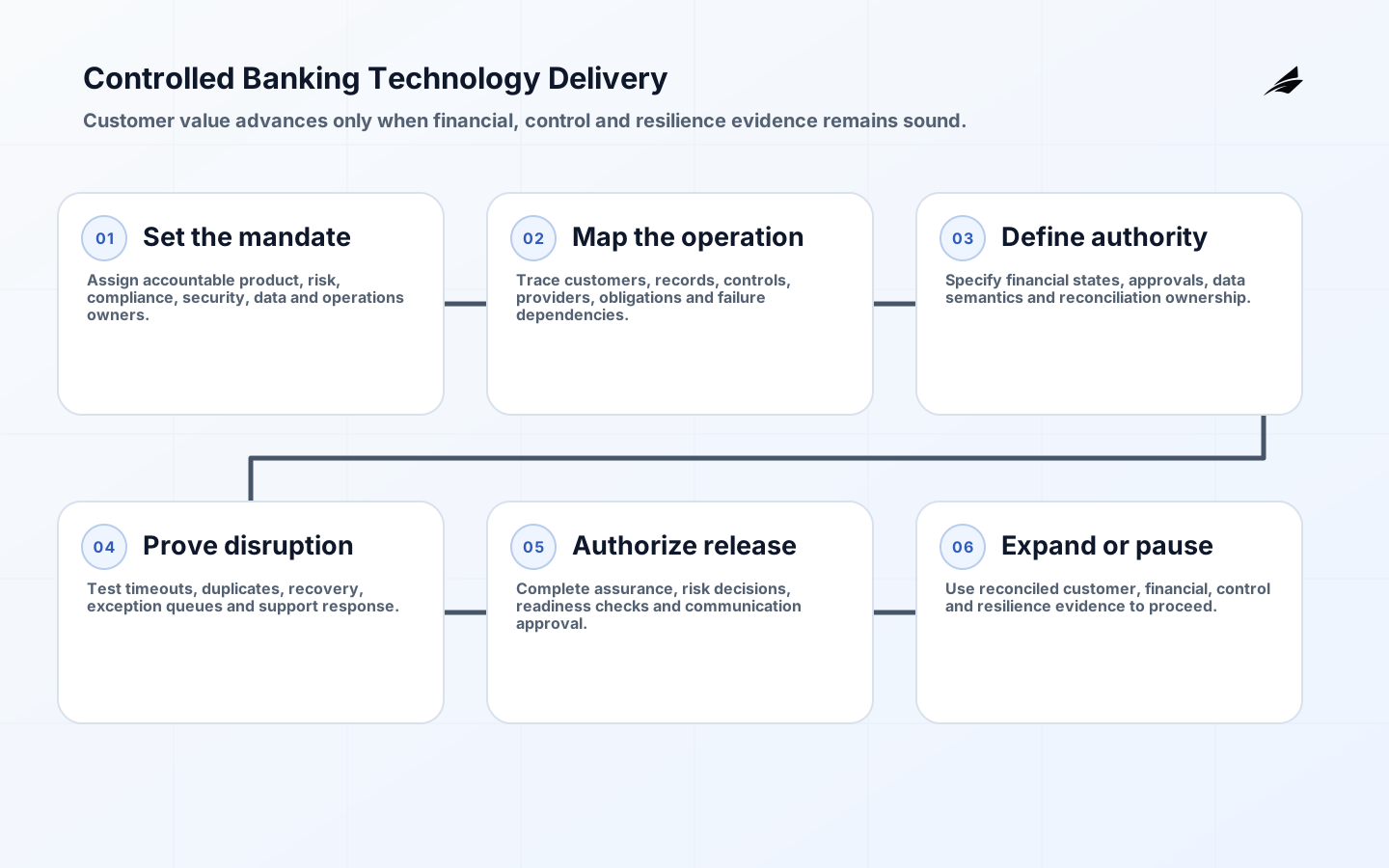
Financial services and banking technology is not one product category. It spans customer onboarding, deposits, lending, payments, cards, treasury, finance, risk, compliance, fraud operations, reporting and the channels and integrations around them. A sound delivery plan begins with the regulated entity, jurisdiction, product, customer, critical operation and record of account. Those facts determine which laws, supervisory expectations, industry standards and internal controls apply. General architecture guidance cannot replace review by the institution's legal, compliance, risk and security functions.
Start with a critical operation and an accountable outcome
Avoid scoping a program as 'digital banking transformation.' Choose a bounded outcome such as reducing manual payment investigations, introducing a loan-servicing change or replacing a customer identity component. Map the customer journey and the end-to-end critical operation behind it: people, applications, data, facilities, third parties, telecommunications, manual workarounds and upstream and downstream financial infrastructure. Basel's operational resilience principles center on a bank's ability to deliver critical operations through disruption and assume that disruptions will occur.
Define impact tolerances and recovery priorities through the institution's applicable framework. A component recovery target is not enough if the customer journey still cannot complete, balances cannot be trusted or the operations team cannot reconcile queued transactions. Include peak volumes, cutoff times, settlement windows, customer communication and the point at which delay or data uncertainty becomes intolerable. The board and senior management retain accountability through the governance structures required for that institution.
| Scope dimension | Questions to answer | Required evidence |
|---|---|---|
| Business and customer | Which product, journey, customer groups and outcomes change? | Approved process map, disclosures and acceptance criteria |
| Financial record | Which system is authoritative for balances, status, fees and accounting? | Posting rules, control totals and reconciliation ownership |
| Risk and compliance | Which jurisdictions, obligations, approvals and monitoring apply? | Control mapping and documented risk decisions |
| Technology | Which applications, interfaces, batches, channels and identities change? | Dependency map, contracts and nonfunctional requirements |
| Resilience | How will the critical operation continue or recover through disruption? | Impact tolerance, scenarios, runbooks and exercise results |
| Third parties | Which providers, subcontractors and concentrations support the service? | Inventory, due diligence, contract rights, monitoring and exit plan |
Design architecture around integrity, traceability and controlled authority
Banking architecture must make authority visible. Identify the system of record for each financial state and define how commands, authorizations, postings, reversals and adjustments move through it. Use durable identifiers and idempotency where repeated delivery could duplicate a financial action. Separate a customer's request from approval and from ledger posting. Record who or what initiated each state change, the policy and entitlement used, the time, result and correlation to downstream entries. Protect audit records and sensitive data according to applicable requirements and retention policy.
Real-time channels still need deterministic recovery. Timeouts create an unknown outcome, not automatic permission to retry blindly. Define status inquiry, duplicate detection, compensating action and reconciliation. For asynchronous processing, specify ordering, replay, poison-message handling and cutoff behavior. A manual exception queue is part of the system: it needs role separation, aging, evidence, escalation and capacity planning.
Govern data semantics and reporting from the start
A modern interface does not fix inconsistent business meaning. Establish owners, definitions, lineage, quality rules, correction processes and retention for customer, account, transaction, product and risk data. BCBS 239 emphasizes governance and infrastructure along with accuracy, integrity, completeness, timeliness and adaptability for risk aggregation and reporting, with its formal scope focused especially on systemically important banks. Other institutions can use the principles as a design reference while following their own supervisory requirements.
ISO 20022 provides a common standardization approach, modeling methodology, central dictionary and message repository for financial communications. Using an ISO 20022 message does not by itself create semantic consistency. Communities and market infrastructures publish implementation rules, code sets and usage constraints. Map internal concepts to the applicable scheme, version the mapping, validate messages and retain enough source context for investigation and replay. Do not discard information merely because a legacy destination cannot represent it; make that transformation an explicit controlled decision.
Apply layered security and transaction controls
Start with threat and fraud scenarios for the product: account takeover, unauthorized entitlement, malicious payee change, compromised privileged access, data extraction, transaction manipulation, denial of service and insider abuse. Enforce strong identity, least privilege, separation of duties, transaction limits and step-up controls appropriate to the action. Protect secrets and cryptographic keys through controlled life cycles. Centralize security telemetry while minimizing unnecessary exposure of customer and payment data. Exercise incident response with operations, fraud, legal, compliance, communications and providers.
NIST CSF 2.0 can organize cyber outcomes under Govern, Identify, Protect, Detect, Respond and Recover, but it does not replace sector or jurisdiction-specific requirements. If payment card account data is stored, processed or transmitted, determine PCI DSS scope using the current PCI SSC material and qualified advice where required. Scope reduction through tokenization or segmentation must be validated; calling a service 'tokenized' does not automatically remove connected systems or processes from consideration.
Treat third-party services as part of the banking operation
Cloud, core platforms, payment processors, identity services, data providers and fintech partners can accelerate delivery but do not transfer the bank's accountability. Basel's 2025 third-party risk principles establish a common international baseline while preserving jurisdictional flexibility. U.S. interagency guidance similarly covers planning, due diligence and selection, contract negotiation, ongoing monitoring and termination. Apply the rules and supervisory guidance relevant to the actual institution.
- Maintain an inventory that links each provider and material subcontractor to services, data, critical operations and owners.
- Assess financial condition, security, resilience, legal and compliance fit, geographic exposure, concentration and subcontracting.
- Negotiate audit and information rights, incident notification, service measures, data handling, continuity, change, access and termination obligations.
- Monitor performance, control changes, incidents, financial health and concentration throughout the relationship.
- Design portability, data return or destruction, transition assistance and alternative operating procedures before they are urgently needed.
- Test joint response and exit assumptions; a contract clause is not an exercised recovery capability.
Build the banking technology cost model
Cost reflects assurance and transition as much as feature development. Include regulatory analysis, control design, independent review, data remediation, integration certification, test environments, resilience capacity, migration rehearsals, parallel operations, customer and staff communication, supplier commitments and decommissioning. Separate one-time implementation, recurring run cost and retained legacy cost. Price uncertainty as discovery or contingency tied to named assumptions rather than hiding it in a fixed estimate.
| Cost area | Typical driver | Planning evidence |
|---|---|---|
| Product and control design | Jurisdictions, products, customer types and approval complexity | Requirements and control matrix |
| Integration | Core, network, bureau, identity and reporting dependencies | Certified contracts and dependency schedule |
| Data | Quality, lineage, history, volume and reconciliation | Profile, mapping and migration rehearsal |
| Security and assurance | Threat exposure, data scope and independent testing | Threat model, test plan and findings process |
| Resilience | Impact tolerance, recovery design and scenario exercises | Capacity model, runbooks and exercise criteria |
| Transition and retirement | Parallel run, customer migration, retention and supplier exit | Wave plan and signed decommission checklist |
Example: introducing real-time payment status
Suppose a bank wants customers to see real-time status for outbound payments. The visible feature is a timeline, but scope includes channel authentication, payment identifiers, sanctions or fraud holds, processor acknowledgements, ledger status, notifications, operational queues and customer support. The team defines a canonical status model and maps each external and internal state without implying settlement finality that the underlying scheme has not confirmed. Every displayed state links to an authoritative event and timestamp.
The first release covers employees and a limited set of low-complexity payments. It runs shadow comparisons against existing operations reports, measures missing and out-of-order events, and reconciles status to the ledger and processor. Customer messages are approved before exposure. Rollback disables the new display while preserving received events for investigation; it does not reverse payments. Expansion requires agreed accuracy, timeliness, support readiness, security findings resolved to policy and demonstrated handling of delayed acknowledgements.
Key delivery risks and controls
| Risk | Control | Signal |
|---|---|---|
| Incorrect financial state | Authoritative ledger rules, idempotency, control totals and reconciliation | Unmatched, duplicate or out-of-balance entries |
| Unfair or noncompliant outcome | Legal and compliance review, traceable policy and outcome monitoring | Exceptions, complaints and unexplained segment differences |
| Critical operation disruption | Impact tolerance, graceful degradation, recovery and scenario testing | Journey failure duration and backlog growth |
| Unauthorized action | Strong identity, least privilege, separation, limits and anomaly detection | Privilege exceptions and challenged transactions |
| Third-party concentration | Dependency mapping, concentration assessment and tested alternatives | Multiple critical services share one failure domain |
| Migration divergence | Repeatable migration, immutable source, parallel comparison and sign-off | Record, balance or status mismatch |
A controlled banking technology delivery plan
- Mandate: name the accountable executive and product, risk, compliance, security, data, operations and technology owners.
- Discover: map customer journeys, critical operations, records, controls, dependencies, providers and applicable obligations.
- Design: define authoritative states, architecture, data semantics, service and recovery objectives, controls and evidence.
- Prove: build a representative end-to-end slice in production-like conditions, including failure, reconciliation and support.
- Authorize: complete required risk acceptance, testing, operational readiness, change approval and customer communication.
- Release progressively: use internal, pilot, cohort or transaction boundaries; monitor financial and service outcomes in near real time.
- Stabilize and expand: resolve exceptions, exercise recovery, review provider performance and promote only on approved evidence.
- Retire: close old interfaces, access, data copies, jobs, contracts and procedures after retention and reconciliation obligations are met.

A release dashboard should combine customer completion and complaints, financial reconciliation, control exceptions, fraud and security signals, service indicators, operational backlog, third-party performance and change outcomes. Thresholds and escalation must be approved by the responsible functions. Do not compress these into one score that conceals a severe control failure behind strong adoption. Evidence should support pause, rollback, remediation and expansion decisions.
Banking technology takeaways
- Scope a bounded customer outcome and its complete critical operation.
- Make authoritative financial states, approvals and reconciliation explicit.
- Apply the requirements of the institution, product and jurisdiction involved.
- Treat providers, manual queues and recovery paths as system components.
- Expand only when customer, financial, control and resilience evidence agrees.
Frequently asked questions
Where should a banking technology modernization start?
Start with a bounded customer or operational outcome and map its critical operation, authoritative records, controls and dependencies. Select a slice valuable enough to test the target approach but limited enough to contain impact and reconcile every result.
Can a bank use cloud and fintech providers for critical services?
Potentially, subject to the institution's jurisdiction, risk appetite and applicable requirements. The bank needs proportionate due diligence, contracting, security, resilience, ongoing monitoring, concentration management and exit planning. Outsourcing an activity does not outsource accountability.
Does ISO 20022 make financial integrations interoperable automatically?
No. It supplies a common methodology, dictionary and message definitions. Implementations still need the correct market practice, version, code sets, usage rules, internal semantic mapping, validation, testing and change governance.
How much does a banking technology project cost?
There is no universal figure. Product scope, regulation, integration, data quality, security assurance, resilience, migration, parallel operation and third-party terms drive cost. Use a discovery phase, explicit assumptions and ranges, then refine forecasts from tested slices and migration rehearsals.
How should success be measured?
Measure customer and business outcomes alongside financial integrity, compliance and risk outcomes, security, resilience, operational workload, provider performance and total cost. A faster journey is not successful if it creates unreconciled entries, weakens controls or cannot operate through disruption.
Conclusion
Banking technology delivery succeeds when product value and control evidence advance together. Scope a critical operation, make financial authority and data meaning explicit, design for disruption, govern providers across their life cycle and release through boundaries that allow complete reconciliation. The result should be a better customer or operational outcome without ambiguity about accountability, financial state or residual risk.