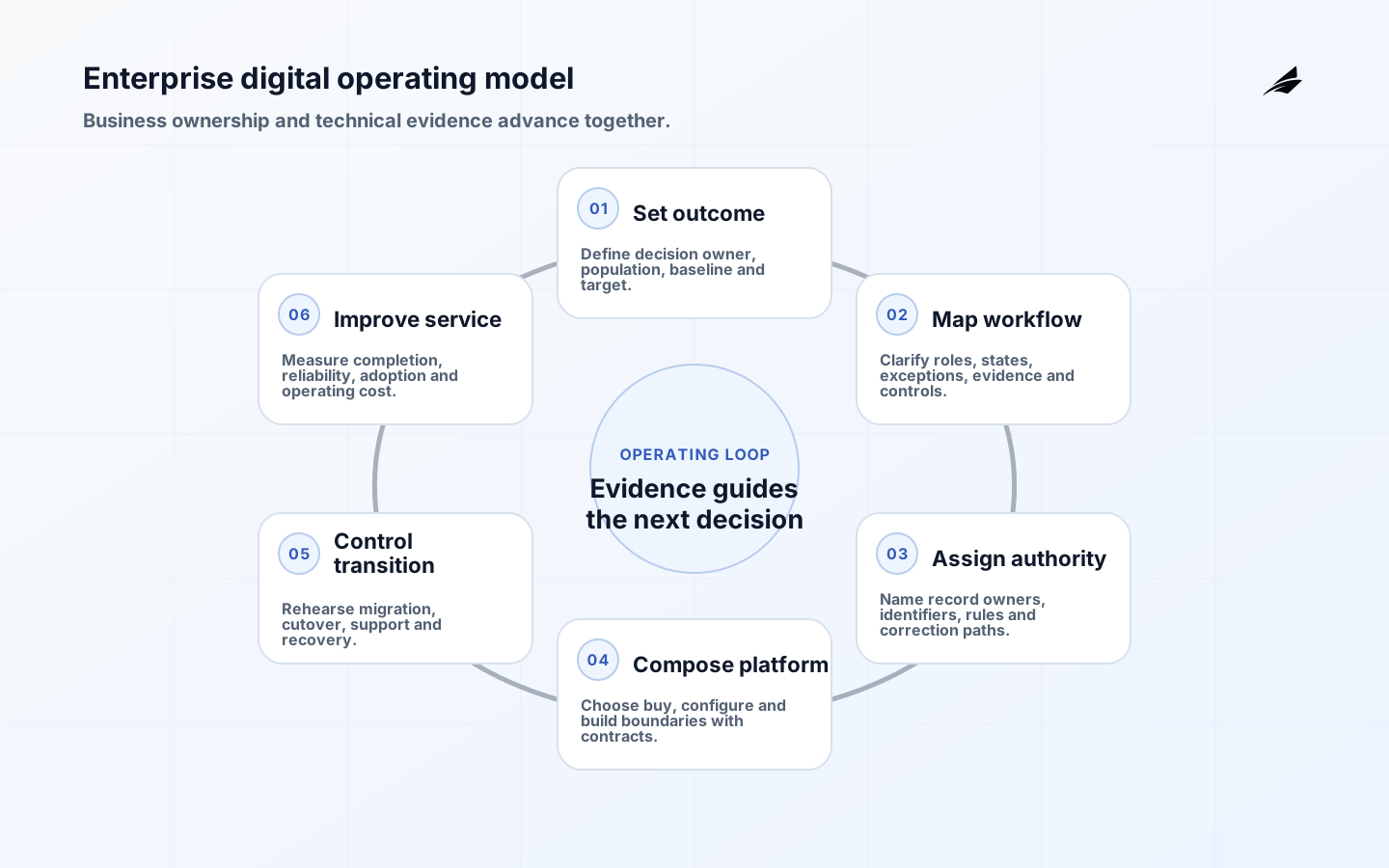
Enterprise digital solutions connect cross-team workflows, authoritative records, integrations and controls into a service people can operate repeatedly. They may include commercial platforms, custom applications, automation and analytics. The difficult work is not digitizing a form. It is deciding who owns each record and decision, how exceptions move, and how the service remains secure and supportable after the project team leaves.
This enterprise digital solutions FAQ complements the enterprise implementation checklist, digital solutions delivery guide and digital solutions implementation checklist. Use the questions to test a proposed operating model, not only a vendor demonstration.
What counts as an enterprise digital solution?
It is a governed capability that enables a material workflow across roles, systems or organizational boundaries. Examples include customer onboarding, procurement, case management, field service and finance approvals. A departmental spreadsheet replacement may become enterprise-wide when it holds shared master data, controls significant decisions or integrates with systems of record. Scope should therefore follow business impact and dependency, not user count alone.
A complete solution includes process ownership, data stewardship, software, integration, identity, monitoring, support, change management and service measures. The interface is only the visible layer. If manual reconciliation, approval policy or exception handling remains undefined, the solution is incomplete even when its screens look polished.
How should the first release be scoped?
Choose one end-to-end outcome with a bounded population, such as onboarding one supplier category in one country. Include the integrations and controls needed to complete that outcome in production. Narrow roles, volume or exception types when necessary, but do not omit authorization, auditability or recovery. Baseline cycle time, handoffs, errors, backlog and manual effort before changing the workflow.
ISO/IEC 38500:2024 frames governing bodies’ role in effective, efficient and acceptable use of IT. Apply that distinction by giving the sponsor authority over value and risk, the product owner authority over priorities, and named owners authority over process, data and service operation. A steering committee where everyone advises but nobody decides is not governance.
| Scope decision | Strong answer | Warning sign |
|---|---|---|
| Outcome | A measurable task and population with a decision owner | A platform launch or feature count |
| Boundary | Named roles, records, markets, channels and exclusions | “All users” or “end-to-end” without a map |
| Authority | One source and owner per record and transition | Multiple systems allowed to overwrite the same state |
| Controls | Applicable access, privacy, audit and recovery criteria | Security review scheduled only after build |
| Operation | Service owner, support route, objectives and funding | Project closes at technical deployment |
Should the organization buy, configure or build?

Compare options against the differentiating workflow, data authority, integration, control and operating requirements. Buy or configure when a platform fits the stable core and the vendor’s lifecycle, security and portability obligations are acceptable. Build when the workflow is strategically distinctive or fit would require brittle customization. Many solutions are composed: a commercial system of record, integration layer and focused custom experience.
Assess total changeability, not feature abundance. Ask how business rules are versioned, how extensions are tested, whether APIs cover required records, how data is exported and what happens when the vendor changes a release. A low-code tool still creates software that needs ownership, environments, testing, security review and retirement. Configuration is code in operational effect even when it is edited through a visual designer.
How should systems and data be integrated?
Assign authority for each entity and state transition. Use stable identifiers, explicit mappings and reconciliation. Request-response APIs suit immediate validation or queries; events suit change distribution and decoupled processing; scheduled files remain appropriate for some partners and volumes. Choose from failure and timing needs rather than fashion. Never let two systems independently decide the same approval or financial state.
The OpenAPI Specification can describe HTTP interfaces for people and tooling, but operational contracts must also cover identity, authorization, idempotency, error behavior, rate limits, version support and objectives. Event contracts need schema, ordering, replay and duplicate handling. Every interface needs a producer and consumer owner, monitoring and a planned response when either side changes.
What quality and accessibility requirements matter?
ISO/IEC 25010:2023 provides a product quality model that can inform requirements throughout a lifecycle. Select relevant characteristics and make them testable: performance for a high-volume task, availability and recovery for a critical service, compatibility for required integrations, maintainability for change, and security for sensitive actions. Functional acceptance alone leaves important failure modes unspecified.
For web interfaces, use WCAG 2.2 as a current accessibility baseline where applicable. Include keyboard paths, focus behavior, labels, error identification, target size, contrast and accessible authentication in design and testing. Test representative tasks with assistive technologies and users. Accessibility improvements made in shared components reduce repeated defects across the solution.
How are security and privacy built in?
Start with data, actors and high-impact actions. Threat-model authorization, delegation, administrative functions, integration trust and bulk export. Apply least privilege, strong authentication for risk, separation of duties, secret management and tamper-evident audit events. Test access by role and object; confirming that a user can open the right menu does not prove they cannot call a prohibited API.
Use the NIST Secure Software Development Framework to integrate software security practices across preparation, protection, production and vulnerability response. The NIST Privacy Framework can help map processing and privacy risk. Minimize collection, define purpose and retention, control derived data and give corrections a governed path through downstream systems.
| Assurance area | Acceptance evidence | Operational owner |
|---|---|---|
| Authorization | Role-and-object tests including prohibited and delegated actions | Product and security owners |
| Integration | Contract tests, replay, reconciliation and degraded-mode test | Integration service owner |
| Data | Migration totals, quality rules, provenance and correction procedure | Domain data owner |
| Reliability | Journey objectives, load evidence, restore and dependency exercise | Service owner |
| Accessibility | Automated and manual WCAG review of critical journeys | Design and product owners |
How should migration and rollout work?
Profile legacy data and in-flight work. Define transformation, duplicate resolution, historical access and reconciliation with business owners. Rehearse migration at realistic volume, then compare counts, amounts, references and sampled records. Decide which system accepts new transactions during cutover and how queued integrations are replayed. Set go/no-go and rollback thresholds before the launch window.
Pilot with a cohort that represents real complexity and has support coverage. Use progressive rollout where tenancy, geography or role boundaries permit it. Feature flags can control exposure but require ownership and cleanup. Communicate changed responsibilities and train people through their work. Monitor completion, errors, exceptions and support demand from the first cohort before expanding.
What determines cost and value?
Cost drivers include workflow variation, data condition, integrations, assurance obligations, migration, licenses, environments, support and change management. Separate one-time build and transition from recurring platform, operations and improvement cost. Include contingency ranges for uncertain legacy behavior. A fixed feature list can hide expensive exception and reconciliation work.
Measure value through the workflow: cycle time, completion, rework, backlog, control exceptions, user effort and service cost. Adoption means intended users complete work in the new operating model, not that accounts were provisioned. Track displaced work; a faster form that creates a larger review queue has moved delay rather than removed it.
Manage enterprise digital solutions as a portfolio, because local projects can create shared identity, data and integration consequences. Maintain a capability map showing which platform owns each business function, which custom extensions are strategic and which applications are candidates for retirement. Review duplicated workflows and records before funding another tool. Portfolio governance should make reuse visible without forcing every team into a shared component that cannot meet its service or regulatory needs.
Set architecture guardrails with an exception process. Guardrails may cover identity federation, audit events, API policy, data classification, supported hosting and observability. They reduce repeated decisions and make assurance scalable. An exception should state the unmet requirement, business reason, affected services, compensating control, owner and expiry. Review recurring exceptions as evidence that a guardrail, platform capability or team enablement needs to change.
Plan vendor and technology lifecycle from the start. Record support windows, release cadence, extension compatibility, data-export procedures and contract renewal dates. Test upgrades in a representative environment and reserve capacity for mandatory changes. Where a platform is deeply embedded, rehearse a limited export and replacement of one integration. Exit readiness is not an intention to leave; it is a control against operational surprise and commercial lock-in. Include archived configuration and dependency evidence so a later team can reproduce the transition decision.
Key takeaways
- Scope enterprise digital solutions around an end-to-end outcome and explicit operating boundary.
- Choose platform composition from workflow fit, authority, control and changeability.
- Make integrations contractual and reconcile business state across failures.
- Treat accessibility, security, privacy and recovery as product acceptance criteria.
- Fund service ownership and continuous improvement beyond the launch project.
Frequently asked questions
Does the ERP need to own every enterprise record?
No. It may own finance, procurement or inventory records while CRM, HR or domain systems own others. Define authority per entity and transition, then synchronize through governed contracts. Centralization is useful only when the system can enforce the required meaning and lifecycle.
Do APIs eliminate integration risk?
No. APIs make interfaces explicit, but identity, semantics, availability, change, duplicates and partial failure still require design. Contract tests, observability, reconciliation and owner coordination remain necessary.
Why do technically successful rollouts struggle with adoption?
They often preserve unclear workflow, omit exceptions, reduce user visibility or add duplicate entry. Observe real work, involve affected roles, communicate changed accountability and measure completed outcomes. Training cannot repair a solution that makes the job harder.
Conclusion
Enterprise digital solutions become durable when governance, process, data and technology form one operating model. Bound the first outcome, assign authority, compose platforms deliberately and prove transition under realistic conditions. The measure of success is reliable work and accountable change, not the presence of a new interface.