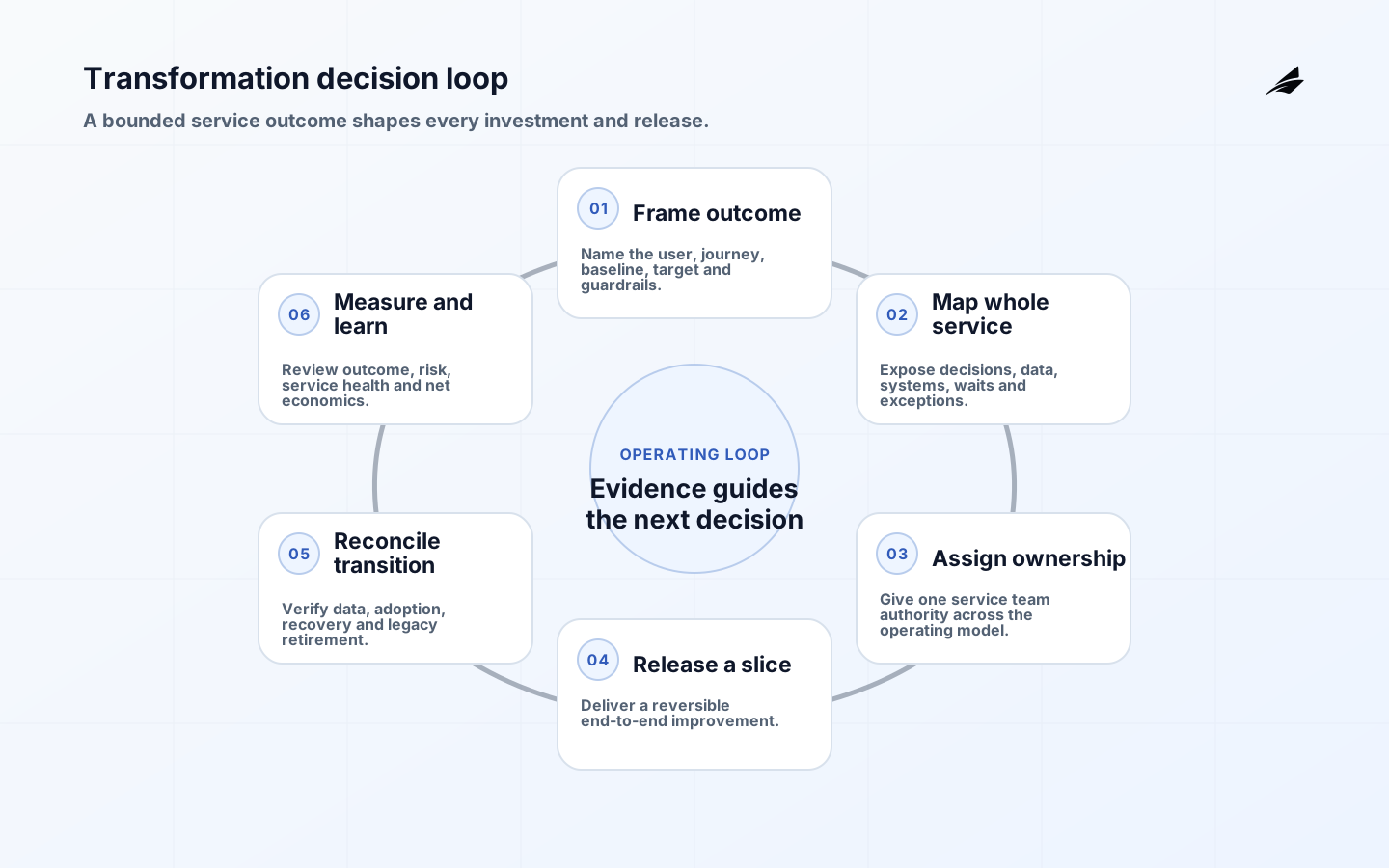
Digital transformation changes how an organization serves customers, runs operations and learns from evidence by redesigning work, data, technology and accountability together. It is not a synonym for buying cloud software or digitizing a form. This digital transformation FAQ gives leaders concrete answers for setting scope, choosing an operating model, modernizing legacy dependencies and proving value without treating the program as one irreversible technology replacement.
Use the digital transformation guide to frame the business outcome, then apply the digital transformation implementation checklist to delivery gates. The digital transformation services plan helps structure external support, while the enterprise digital solutions guide covers broader application choices.
What does digital transformation actually include?
A useful scope connects a user or operational outcome to a redesigned journey, authoritative data, changed policy or decision rights, enabling technology and a team that operates the result. Examples include reducing the time to approve a small-business account, giving field staff a reliable offline workflow, or reconciling inventory across stores and suppliers. Scanning a paper request into an image may be digitization; removing unnecessary approvals and making status observable is transformation.
The UK Government Digital Service Service Standard is a strong general reference because it joins user understanding, whole-service design, multidisciplinary ownership, security, performance and iteration. Commercial teams can adapt those principles without copying a public-sector process. Define the full service boundary, including call centers, spreadsheets, exceptions, suppliers and manual recovery. Otherwise the digital front end may simply push delay and rework into less visible teams.
Where should a digital transformation start?
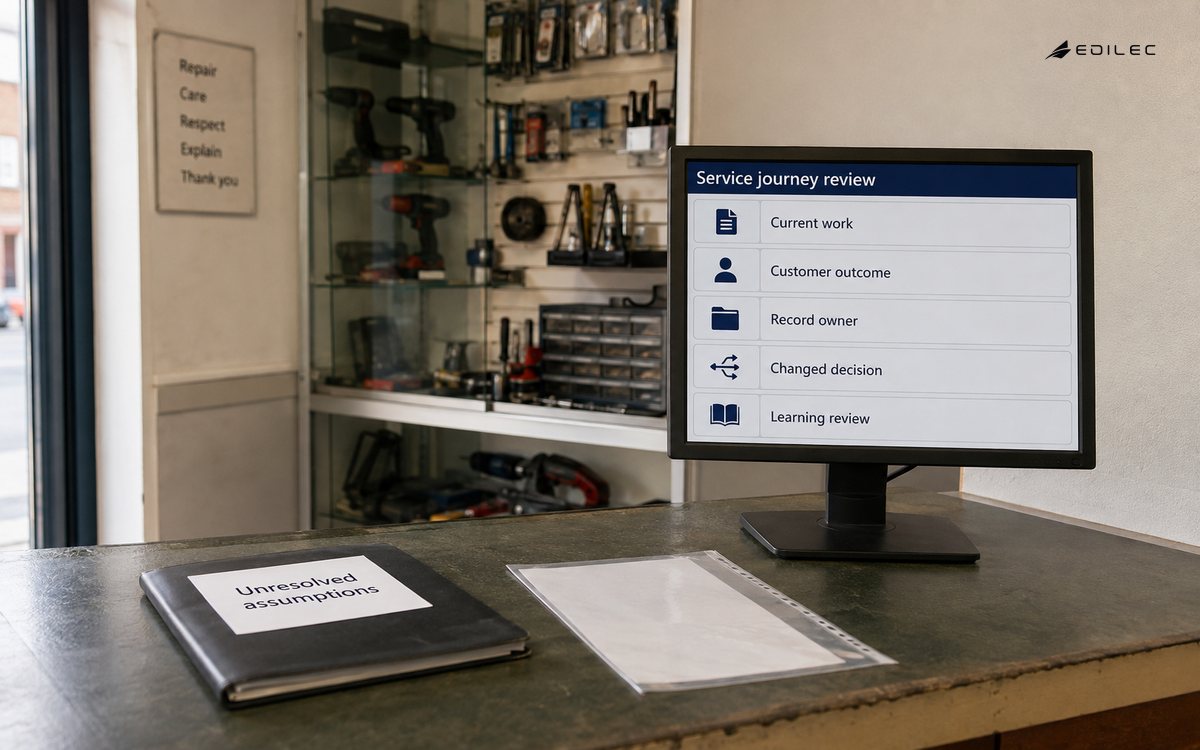
Start with one consequential journey or operational constraint where the organization can measure a baseline and an accountable owner can change the surrounding work. Map the trigger, people, decisions, systems, data, wait states, failure paths and support burden. Choose a slice that reaches a real user and can be released within a planning horizon. A transformation portfolio can contain many slices, but each should have an outcome rather than an architectural milestone as its unit of progress.
For example, a distributor may target order exceptions rather than replace the entire order platform. The first increment can detect mismatched product and delivery data, route the case to an authorized role, show the customer a truthful status and record the resolution reason. Measure exception age, repeat contacts, manual touches and fulfillment outcome before and after. The legacy system remains temporarily, but the decision flow and evidence improve immediately.
| Starting signal | Good first scope | Baseline evidence | Guardrail |
|---|---|---|---|
| Customers cannot see case status | One case type from request to resolution | Contacts, elapsed time, abandonment | No increase in incorrect disclosure |
| Staff rekey supplier data | One high-volume supplier and document flow | Touch time, errors, correction age | Financial reconciliation remains exact |
| Release changes are slow | One customer-facing service path | Lead time, failure, recovery | Security and availability objectives hold |
| Legacy outage blocks field work | One offline-capable field task | Outage impact, backlog, re-entry | No unresolved record conflicts |
| Reporting definitions conflict | One executive decision and metric family | Reconciliation effort, decision delay | Metric authority is documented |
Who should own the transformation?
A senior sponsor should own the business outcome and remove policy or funding barriers, but a durable service owner must control priorities after launch. The core team needs product, operations, design, engineering, data, security, finance and change capability. Name who approves data definitions, process exceptions, production risk and benefit claims. Vendors can provide capacity and expertise; they should not become the only people who understand the operating model or evidence.
Fund a persistent team against a service or value stream where possible. Project funding that ends at go-live creates predictable gaps in monitoring, backlog ownership and adoption. Establish a monthly outcome review and a separate technical health review. The outcome review asks whether users succeed and operating effort falls; the health review examines reliability, security, maintainability and cost. Both feed one prioritized backlog, preventing business and technology scorecards from drifting apart.
Does digital transformation require replacing legacy systems?
No. A team can retain, encapsulate, replatform, replace or retire each capability. Decide from business fit, change frequency, reliability, security, data authority, integration cost and exit constraints. A stable ledger may remain authoritative while new APIs and workflows reduce coupling around it. A heavily customized platform with unsupported components and inaccessible data may justify replacement. Make the choice per capability instead of declaring every old system a liability.
Use incremental seams: place a controlled interface around a legacy function, route one segment to a new capability, reconcile results, then expand. Keep rollback and dual-operation windows explicit. Avoid uncontrolled two-way synchronization; define which system owns each record and how conflicts are resolved. Retirement is a deliverable that includes data retention, access removal, contract closure, knowledge transfer and cost removal. Without it, modernization adds another platform while the original risk persists.
How should security, privacy and resilience be handled?
Treat them as design inputs to the transformed service. The NIST Cybersecurity Framework organizes cybersecurity outcomes around Govern, Identify, Protect, Detect, Respond and Recover, making it useful for assigning decisions and evidence across leaders and operators. Map identities, data, suppliers, privileged actions and failure scenarios early. Test degraded service, incident communication and recovery during the pilot, not after a wide release.
Data minimization, purpose and user impact also need explicit ownership. The NIST Privacy Framework provides a risk-based structure for connecting data processing with individual and organizational consequences. Record which data is necessary for the service outcome, where it travels, who can correct it and when it is deleted. Transformation can create new inference and monitoring capability; approval should address those effects rather than assume that existing consent or policy automatically covers them.
Should delivery use agile methods, a roadmap or a large program plan?
Use all three at appropriate levels. The roadmap expresses outcome sequence and capability dependencies. Short increments discover whether the service works and expose assumptions. The program plan handles constraints such as procurement, regulatory review, data migration, training and retirement. Avoid labeling a fixed multi-year specification agile because teams hold daily meetings. Conversely, do not let local iteration obscure a required enterprise dependency or a date-bound transition.
Define release gates around evidence: representative user tasks succeed; critical data reconciles; access is approved; observability works; support can diagnose failure; rollback or recovery is exercised; and operating ownership accepts the service. DORA’s software delivery performance metrics describe delivery throughput and instability measures that can help teams observe change. Use them alongside service outcomes, because rapid deployment of an ineffective workflow is not transformation success.
How is digital transformation value measured?
Build a measurement tree from the target outcome. A customer-retention outcome may depend on faster issue resolution, fewer repeat contacts and better first-time accuracy. Add guardrails for harm, security, reliability, workforce load and cost. Define calculation, population, source, owner and cadence before changing the service. The GDS guidance on setting performance metrics recommends a small balanced set, baseline comparison and measures that support decisions rather than reporting volume.
Separate adoption from benefit. Login count or training completion shows exposure, not improved work. Observe whether target users complete the changed journey, whether exceptions move faster and whether an old channel or task can be retired. Attribute carefully: release waves, comparison groups or time-series analysis can strengthen a claim, but outside demand and policy changes may also affect results. Record assumptions and calculate net benefit after product, migration, support and transition costs.
| Evidence layer | Example measure | Decision it supports | Warning sign |
|---|---|---|---|
| User outcome | Successful completion without assisted contact | Improve or expand the journey | Page views rise while completion falls |
| Operations | Median and tail exception age | Remove a bottleneck or change staffing | Average hides a stuck segment |
| Delivery | Lead time and failed-change recovery | Improve release capability | More releases without outcome change |
| Risk | Unauthorized attempts and recovery exercise result | Adjust controls and resilience | Compliance checklist has no scenario test |
| Economics | Cost per completed service outcome | Fund, redesign or retire capability | Savings exclude support and legacy overlap |
| Adoption | Target work completed through new path | Plan migration and channel retirement | Accounts created but old process persists |
When should external transformation services be used?
Use a provider for missing specialist skills, independent challenge, temporary delivery capacity or experience with a bounded transition. Contract around outcomes, artifacts, knowledge transfer and operating acceptance, not a list of roles alone. Require access to architecture decisions, repositories, configurations, data mappings, test evidence and runbooks. Define intellectual-property rights, subcontractors, security responsibilities and a transition plan before work starts.
Evaluate providers with one real scenario. Ask each team to explain how it would map the current journey, expose assumptions, design a reversible increment and measure benefit. Check who will actually perform the work and how client employees gain capability. Commercial milestones should reward usable increments and evidence. Retain internal authority over priorities, risk acceptance and production release; outsourcing those decisions weakens accountability precisely when the operating model is changing.
Key takeaways
- Define transformation through a user or operating outcome, not a technology purchase.
- Start with a bounded end-to-end service slice and a measured baseline.
- Give a durable service owner authority across process, data and technology.
- Modernize legacy capabilities incrementally and make retirement explicit.
- Build security, privacy, resilience and recovery into release evidence.
- Measure adoption, outcome, delivery health, risk and net economics together.
Additional digital transformation questions
How long does digital transformation take?
A useful service increment can reach users within weeks or a quarter, while portfolio change continues across planning cycles. Set dates for bounded outcomes, migrations and retirements rather than promising a moment when the whole organization becomes transformed.
Can a smaller organization pursue digital transformation?
Yes. A small team often benefits from narrower scope and simpler governance. Choose one costly or customer-critical journey, use managed capabilities where appropriate, preserve data portability and invest in operating ownership before adding more platforms.
Is artificial intelligence required?
No. AI is one possible method when the task, data, evaluation and human authority justify it. Many valuable transformations come from clearer policy, better integration, self-service, accessible design and reliable operational data. Compare AI with simpler rules and workflow changes.
Conclusion
Digital transformation is credible when a real service improves and the organization can operate, measure and change it safely. Begin with one outcome and the complete journey around it. Assign authority, release in reversible slices, reconcile legacy transitions and review evidence that joins customer value, operations, risk and cost. That discipline turns transformation from a broad promise into a continuing management capability.