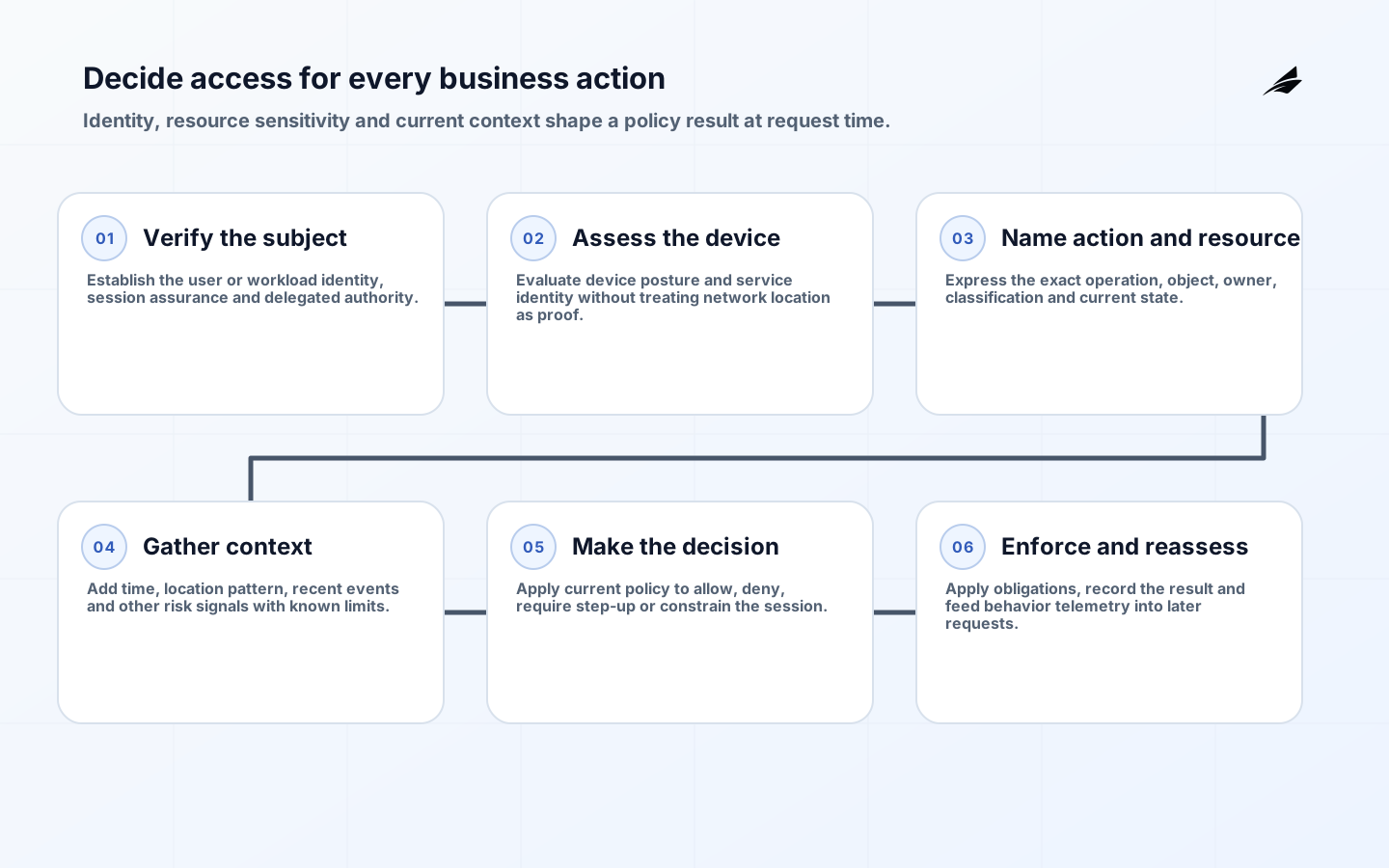
Zero trust replaces implicit confidence based on network location with explicit, risk-informed decisions about each resource request. For a business application, that means authenticating people and workloads, authorizing the requested action on the specific resource, limiting session and credential scope, and using telemetry to reassess access. It does not mean distrusting employees as people, nor does it describe one product.
The first design artifact should state the operating outcome: Reduce unauthorized access and lateral movement while keeping critical business journeys usable and recoverable. Translate that promise into named records, decisions, controls and measures. Tool selection becomes easier when vendors and implementation teams must demonstrate the difficult exception, the unavailable dependency and the recovery path rather than only the happy path.
Define scope in business and risk terms
Bring together application owners, identity teams, endpoint operations, data stewards and support to map high-value resources and current access paths. Trace real requests from a person or workload through authentication, authorization and data access, including remote and partner scenarios. Select a first action where excessive implicit trust is visible, and document telemetry dependencies and availability assumptions before writing policy.
- Inventory protected resources, data sensitivity, users, workloads and existing access paths.
- Express authorization in business actions and objects, not only network zones or broad roles.
- Strengthen identity, lifecycle and recovery according to risk.
- Give services verifiable identities and protect service-to-service calls.
- Collect policy, device, session and resource telemetry without making one signal absolute.
- Migrate one high-value journey with fallback and support before expanding.
Design the lifecycle, decisions and boundaries
Represent access as a decision over subject, workload, device, resource, action and context. Enforcement must occur at the resource-facing layer for each meaningful request, not only at network entry. Give services verifiable identities and narrow permissions. Policy decisions need stable reasons and versions for audit. Define fail, step-up and limited-access behavior when device or risk signals are unavailable.

| Area | Question | Practical design |
|---|---|---|
| Subject | Who or what is requesting? | User, workload, device and session evidence |
| Resource | What exact object or service is involved? | Classification, owner and current state |
| Action | What operation is requested? | Read, approve, export, administer or service call |
| Context | Which conditions change risk? | Device posture, location pattern, time and recent events |
| Decision | What result and obligations apply? | Allow, deny, step up, limit or record |
Resolve implementation details early
Assign owners for resource classification, identity lifecycle, device evidence, authorization policy, enforcement and incident response. Keep test identities and policies isolated from production authority while preserving realistic relationships. Document token lifetime, revocation, policy distribution, telemetry freshness, regional dependencies, privacy limits and emergency access. Recovery objectives must include the policy engine and identity provider, not only the application.
For a finance export, ordinary application access is insufficient. The policy checks an active employee identity, export permission, the requested account scope, managed-device evidence and recent authentication. A high-risk context triggers step-up authentication; the export is watermarked and logged. The decision degrades safely if a telemetry source is unavailable, according to a rule agreed before rollout.
Build security, privacy and accessibility into acceptance
Threat-model stolen sessions, compromised devices, workload impersonation, policy administration and telemetry manipulation. Least privilege should govern business objects and actions as well as network routes. Minimize contextual data and set clear purposes and retention. Privileged support and break-glass access require strong authentication, narrow scope, visible alerts and review; do not create a permanent bypass around the new controls.
Roll out with observable gates
- Baseline the current outcome, delay, failure demand and risk before changing the process.
- Build a thin end-to-end path and test contracts, permissions, telemetry and recovery.
- Run in simulation, shadow or limited-production mode where the control permits it.
- Release to a named cohort with an owner, support coverage, stop conditions and rollback steps.
- Review technical signals and business outcomes together; investigate segment differences.
- Expand only when exceptions are handled reliably and operating documentation matches reality.
- Retire the previous path, credentials, jobs and access after evidence and retention needs are satisfied.
A zero-trust migration gate should compare shadow policy decisions with expected business outcomes before enforcement. Test legitimate high-risk actions, stale device signals, identity-provider interruption, policy-engine latency and emergency access. Expand only when false denies and unexplained allows are investigated. Rollback should restore a reviewed prior policy version, not broad network trust or shared administrative credentials.
Risks and measures
| Risk | Response | Evidence to watch |
|---|---|---|
| Policy lockout | Simulation, shadow decisions and break-glass design | False denies and emergency use |
| Privilege persistence | Lifecycle automation and access review | Stale grants |
| Service impersonation | Workload identity and short credentials | Unidentified calls |
| Signal overreach | Privacy review and proportionate policy | Challenges and exceptions |
| Control dependency | Failure-mode rules and resilience tests | Decision latency and unavailable dependencies |
Track policy allows and denies by reason, step-up success, decision latency, stale signals, dormant privileges, workload identity coverage and break-glass use. A falling denial rate might show cleaner access or an overly permissive rule. Review application outcomes and support cases alongside security telemetry, with privacy-preserving segmentation. Periodic access-path exercises reveal implicit routes that dashboards do not know exist.
Operate the capability after launch
Establish governance around protected resources and access policies, not merely the zero-trust tooling. Review privileged roles, policy exceptions, service identities, signal quality and resources lacking enforcement. Exercise a stolen session, compromised workload, unavailable policy service and urgent emergency action. Use results to refine policy, fallback behavior, telemetry and user communication without weakening all requests.
Operational details that determine reliability
Start policy design with a small set of high-value application actions such as export, approval, privileged configuration and access to regulated records. For each, write subject, resource, action and context rules with an accountable owner. Broad role membership can remain an input, but the final decision should consider object relationship and current state. Keep policy version and decision reason in audit evidence.
Workload identity is essential because modern applications call one another more often than people call each service directly. Give each deployable workload a distinct identity, authenticate both ends where feasible and authorize the specific API operation. Avoid one shared service credential across environments. NIST SP 800-207A describes identity-tier and network-tier policies for cloud-native applications; use both where they add independent protection.
Continuous evaluation does not require interrupting every click. Recheck at meaningful boundaries: session establishment, privilege elevation, sensitive action, context change and token renewal. Define which signals are sufficiently reliable to deny, which trigger step-up and which only inform monitoring. Device posture can be useful, but stale or missing telemetry needs a documented outcome so availability is not decided accidentally.
Break-glass access belongs inside the architecture. Use narrowly scoped emergency identities or procedures, strong authentication, time limits, prominent alerts and retrospective review. Test the path without granting standing privilege. Also test failure of the identity provider, policy engine and telemetry source. Zero trust should reduce implicit access, not create one central dependency whose outage stops every business process.
Procurement and architecture review should use scenario-based evidence for zero trust, application security, identity and access management. Ask each proposed solution to perform the representative case, reject an unauthorized action, survive an unavailable dependency, expose an understandable status, produce investigation evidence and export the owned data. Record configuration and integration work needed to achieve the demonstration. A feature visible in a product list is not proof that the complete control or journey will operate in the organization’s environment.
Acceptance should connect design claims to repeatable evidence. For subject, retain tests or records that show user, workload, device and session evidence. For the risk of policy lockout, assign the response before launch and review false denies and emergency use. Add load, recovery, permission and accessibility evidence in proportion to impact. The release decision should identify residual risks, their owners and the conditions that would pause further rollout.
Key takeaways
- Start from a complete business outcome and the evidence needed to trust it.
- Make identity, authority, state, exception handling and ownership explicit.
- Design failure, recovery and reconciliation before expanding volume.
- Roll out to controlled cohorts with measurable gates and practiced rollback.
- Treat configuration, policy, access and retirement as continuing product work.
FAQ
Should we buy a product or build?
Compare platforms on integration with existing identity, device, workload and application enforcement points; policy expressiveness; decision latency; auditability; resilience; and portability. No product can classify resources or define legitimate business authority for the organization. Include policy export, migration of service identities, signal dependencies, operator skills and coexistence with legacy applications in the selection.
What belongs in the first release?
Start with one sensitive application action and a bounded user group. Inventory the resource, express the per-request rule, run decisions in shadow mode, review differences, then enforce with step-up and support ready. Test service-to-service calls and emergency access as well as the user interface. A network segment change alone is not an application zero-trust pilot.
How should success be measured?
Measure reduction in standing privilege, percentage of priority actions with object-level policy, coverage of workload identity, policy-decision quality, step-up completion, false denies, decision latency and emergency access. Add time to revoke a person or service across the path. Device enrollment or product deployment counts are inputs; they do not show that unauthorized application actions are prevented.
When can the old process be retired?
Retire an implicit access path only after every intended caller uses authenticated and authorized enforcement, policy and identity recovery are tested, and emergency procedures work. Remove broad firewall allowances, shared service credentials, bypass groups and stale tokens. Preserve decision evidence and monitor attempted use of the old path, which may reveal automation or partners omitted from discovery.
Conclusion
Zero trust for business applications is a continuing access-control discipline centered on resources and individual requests. Strong human and workload identity, explicit object-level policy, proportionate context and resilient enforcement reduce the value of network location as a shortcut. A staged migration with shadow decisions and measured exceptions can improve protection without making legitimate work depend on untested signals.