Manufacturing AI workflow automation services should improve a bounded operating decision without taking uncontrolled authority over equipment, material, quality or worker safety. Useful projects include maintenance triage, quality-review prioritization, document classification, schedule-exception routing and operator assistance. Each combines software with industrial context, integration and a changed way of working. This delivery plan explains what belongs in scope, where cost accumulates, which risks must be controlled, and how to move from discovery to a monitored plant release.
The economic case is not model accuracy in isolation. Value appears when a recommendation arrives before the decision closes, uses trustworthy plant context, reaches an accountable role and changes an outcome such as downtime, scrap, energy, delay or investigation effort. NIST's AI Risk Management Framework is useful for governance, while NIST OT guidance and ISA-95 address the physical and enterprise-control boundaries that ordinary business automation does not face. The project must bring those disciplines together.
Use the manufacturing AI implementation checklist for production gates, the manufacturing AI FAQ for architecture answers, and the startup automation scope guide to compare lower-consequence workflow patterns.
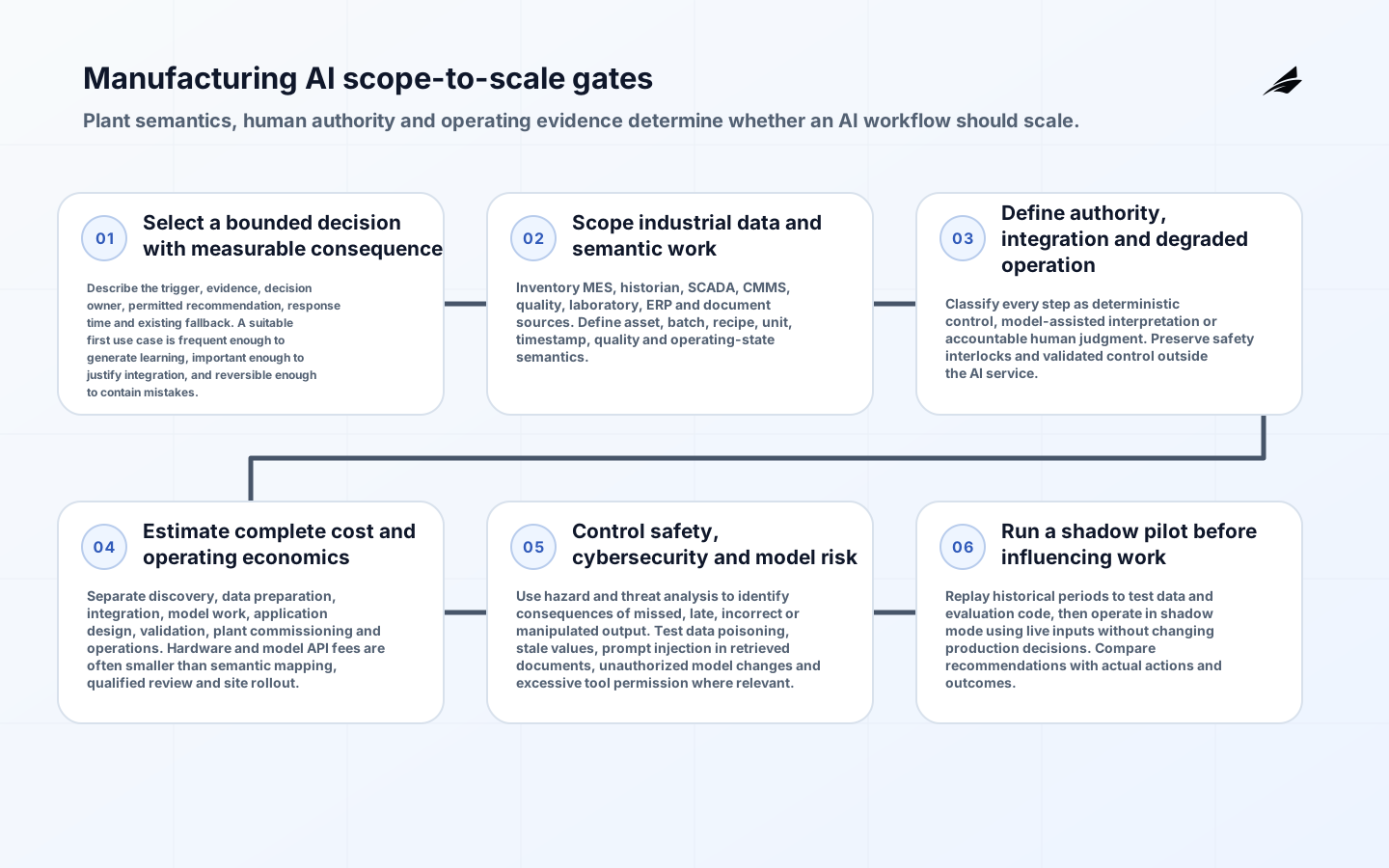
Select a bounded decision with measurable consequence
Describe the trigger, evidence, decision owner, permitted recommendation, response time and existing fallback. A suitable first use case is frequent enough to generate learning, important enough to justify integration, and reversible enough to contain mistakes. Maintenance triage may rank work orders but should not override protection systems. Quality assistance may prioritize images for review but should not release a batch unless validated authority is explicitly designed.
Observe representative shifts and sites before fixing scope. Record product changes, manual workarounds, planned downtime, alarm floods and local procedures. Establish baseline volume, effort, delay, misses and outcome. Reject use cases where labels are unknowable, action is rare, or value depends on autonomous control that the organization is not prepared to validate. Narrow scope reduces both model uncertainty and organizational ambiguity.
| Use case | Useful first boundary | Avoid initially |
|---|---|---|
| Maintenance | Rank inspection candidates with evidence | Directly change machine protection |
| Quality | Prioritize review and explain signals | Automatically release safety-critical product |
| Scheduling | Route exceptions and compare options | Replace all dispatch logic at once |
| Documents | Classify controlled records for review | Publish unreviewed procedures |
Scope industrial data and semantic work
Inventory MES, historian, SCADA, CMMS, quality, laboratory, ERP and document sources. Define asset, batch, recipe, unit, timestamp, quality and operating-state semantics. Budget for mapping and correcting data rather than assuming existing tags are ready for learning. A sensor history can be technically complete yet analytically misleading when maintenance overrides, changeovers and shutdown states are not represented.
Separate data needed for model development, live inference, evaluation and audit. Establish lawful and contractual use, retention, access and site boundaries. Keep provenance from source through transformations and model input. Price annotation by the people qualified to interpret events, including disagreement and review. For generative workflows, define approved retrieval sources and prevent uncontrolled plant or personal data from entering external services.
Define authority, integration and degraded operation
Classify every step as deterministic control, model-assisted interpretation or accountable human judgment. Preserve safety interlocks and validated control outside the AI service. Define confidence, abstention, escalation and expiry. Recommendations should show relevant evidence and current data quality. If the model, network or source is unavailable, the plant must retain an understood manual or local path.
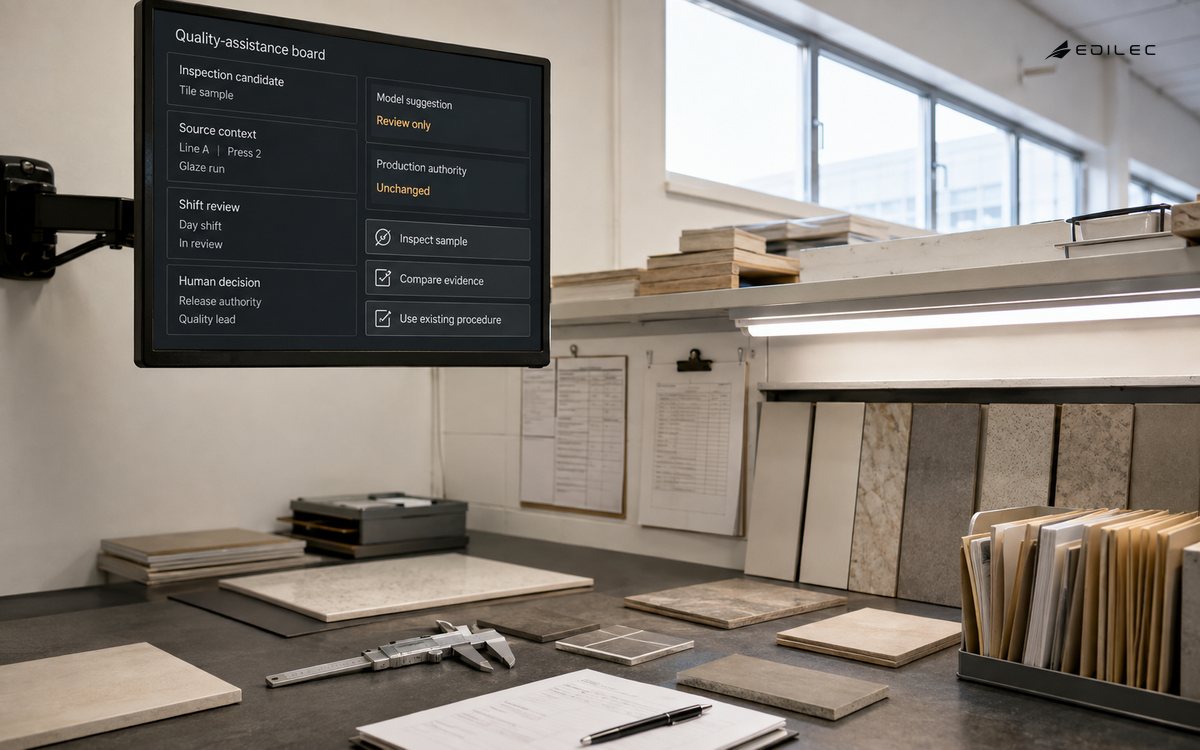
Place services in suitable network zones with authenticated least-privilege interfaces. Use governed event or OPC UA contracts where appropriate and validate controller load. Make commands idempotent and prevent duplicate work orders. Trace each recommendation to source values, model version, prompt or retrieval configuration, reviewer action and outcome. The architecture needs independent health signals so missing telemetry is not interpreted as normal equipment behavior.
| Boundary | Scope artifact | Acceptance question |
|---|---|---|
| Operational authority | Decision-rights matrix | Who may act when confidence is low? |
| OT integration | Approved flows and protocol contracts | Does collection preserve control performance? |
| AI service | Versioned model and evaluation set | Can output be reproduced and challenged? |
| Workflow system | Idempotency and audit trail | Can retries create duplicate consequences? |
Estimate complete cost and operating economics
Separate discovery, data preparation, integration, model work, application design, validation, plant commissioning and operations. Hardware and model API fees are often smaller than semantic mapping, qualified review and site rollout. Include edge devices, network changes, security review, labeling, retraining, observability, support, vendor licenses and downtime for commissioning. Price each additional site and asset class rather than extrapolating from one pilot.
Model benefit from a verified baseline and conservative adoption. For avoided downtime, use constrained production loss that the workflow can actually influence, not total plant revenue. For quality, distinguish earlier detection from prevented scrap. Include false-positive investigation cost and the probability that operators follow a recommendation. Define the scale threshold before the pilot so a promising demonstration is not evaluated with changing criteria.
| Cost group | Often underestimated work | Economic measure |
|---|---|---|
| Data | Context mapping and qualified labels | Cost per usable evaluated event |
| Integration | OT approvals and failure handling | Supported sites and interfaces |
| Operations | Monitoring, review and model maintenance | Monthly cost per useful decision |
| Change adoption | Training and procedure updates | Recommendation use and outcome rate |
Control safety, cybersecurity and model risk
Use hazard and threat analysis to identify consequences of missed, late, incorrect or manipulated output. Test data poisoning, stale values, prompt injection in retrieved documents, unauthorized model changes and excessive tool permission where relevant. Keep credentials and administrative paths out of model context. Apply change control to prompts, features, thresholds, models and integrations because any can alter production behavior.
Evaluate across products, sites, shifts, seasons, maintenance states and rare faults. Report false negatives and false positives in operational units, not only aggregate score. Set drift and data-quality triggers that lead to review, fallback or suspension. Document known limits in procedures and training. Human review is a control only when the reviewer has time, authority, evidence and a clear way to reject the recommendation.
Run a shadow pilot before influencing work
Replay historical periods to test data and evaluation code, then operate in shadow mode using live inputs without changing production decisions. Compare recommendations with actual actions and outcomes. Investigate disagreement by category: missing context, label ambiguity, model error, policy difference or process change. Confirm latency, queue behavior, data freshness and support alerts under real shift patterns.
Advance to assisted operation only after acceptance thresholds and operating procedures are approved. Start with trained users and a limited line or product. Capture use, override reason, time saved and downstream outcome. Keep a disable path and review incidents quickly. A pilot should test the whole workflow, including notification, decision, work-system update and evidence, not simply an offline model.
Roll out by asset class, line and site
Treat each new site as a local commissioning event. Verify data mappings, network, equipment behavior, procedures, roles, language, support and legal constraints. Reuse validated templates, but do not assume a tag or alarm has identical meaning elsewhere. Expand only when the local baseline and acceptance evidence are complete. Maintain a configuration inventory that shows which model and rules operate at each line.
Create operational ownership for service health, model evaluation, data quality, cybersecurity, incident response and improvement. Review false alerts, abstentions, overrides and business outcomes on a fixed cadence. Retire unused workflows and stale models. Scaling should reduce cost per supported decision while preserving evidence quality; a rapidly growing device or prediction count is not a success metric.
Structure partner scope and acceptance
A statement of work should name the use case, included sources, sites, integrations, decision authority, evaluation data, acceptance thresholds, deliverables and operating transition. Distinguish reusable platform work from per-site engineering. Define ownership of data, code, prompts, model artifacts, infrastructure and telemetry. Require disclosure of external model and software dependencies and how changes are controlled.
Use milestone evidence: validated process map, data-quality report, threat and hazard analysis, shadow results, assisted-operation results, runbooks and handover exercise. Avoid payment tied only to model completion or dashboard delivery. Include exit rights and export formats. The manufacturer should be able to disable the service, access its records and continue the underlying operation without one supplier.
Key takeaways
- Select one reversible production decision with a verified baseline.
- Budget semantic mapping, integration, validation and site commissioning, not only model work.
- Keep deterministic control and safety authority outside the AI service by default.
- Evaluate the complete workflow in shadow mode before assisted operation.
- Scale through local commissioning and evidence, not by copying a pilot configuration.
Frequently asked questions
What usually drives project cost?
Industrial data mapping, OT integration, qualified evaluation, application workflow, security review and site commissioning usually dominate. Model consumption may be a smaller recurring item.
How long should a pilot run?
Long enough to cover representative shifts, products and operating states and to observe meaningful outcomes. Calendar duration matters less than event diversity and evidence quality.
Can AI control production equipment?
That requires a formal safety, control, cybersecurity and validation case. A safer initial scope keeps AI advisory and preserves deterministic interlocks and accountable human authority.
When should another site be added?
After the first site meets outcome, reliability and risk thresholds and the next site's mappings, network, procedures and support readiness are independently verified.
Conclusion
Manufacturing AI workflow automation creates value only when a recommendation becomes a safe, timely and measurable operating action. A disciplined scope connects plant semantics, human authority, OT security, evaluation and economics from the beginning. That makes the pilot a test of a production service rather than a model demonstration and gives leaders credible evidence for scaling or stopping.