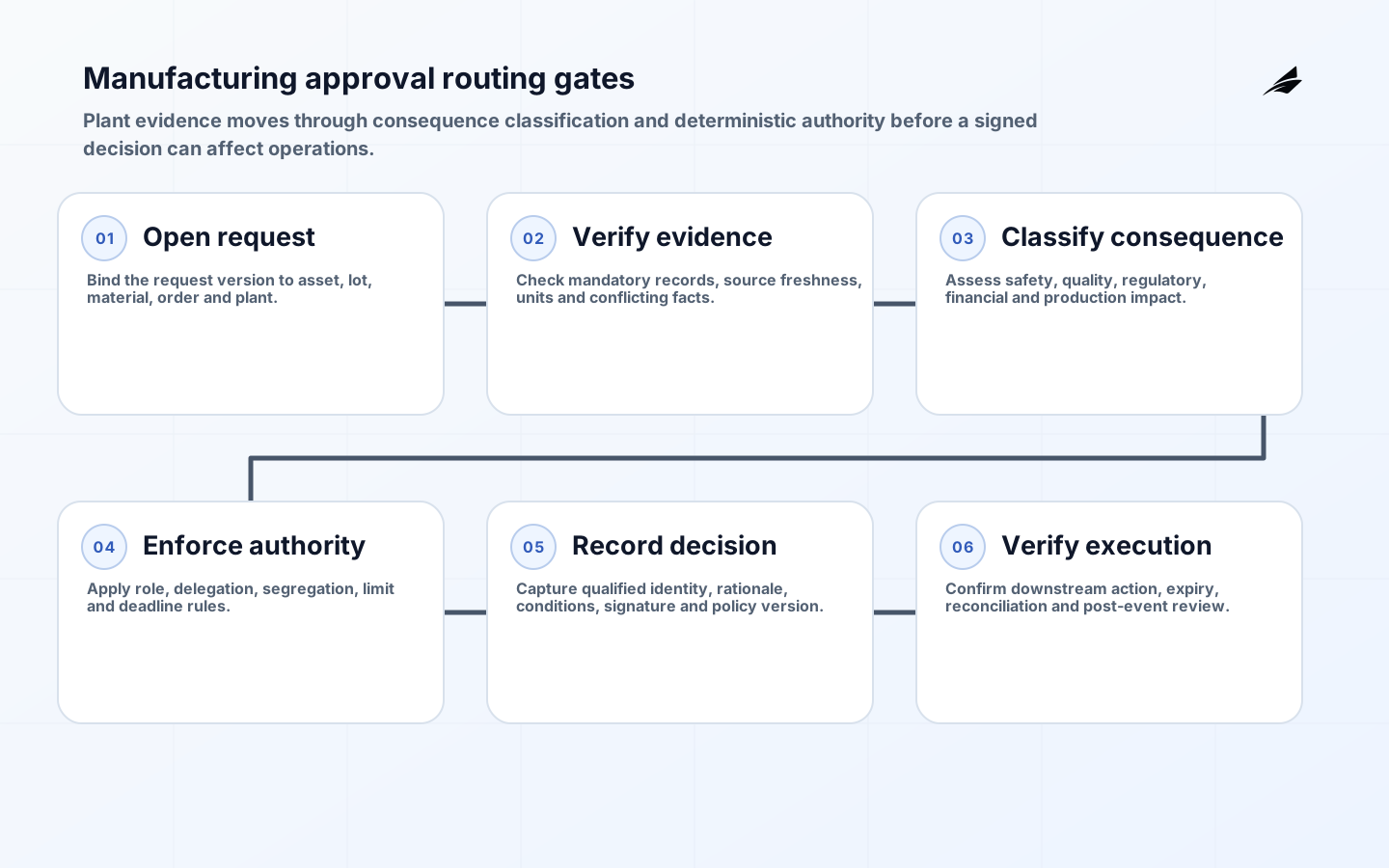
AI approval routing automation for manufacturing should help the correct person reach a timely decision; it should not manufacture consent. Manufacturing approvals can authorize deviations, maintenance, material substitution, schedule changes, quality disposition or production release. The evidence and authority differ for each, and some decisions can affect safety, compliance and product traceability.
This checklist keeps the model in an assistive role: classify the request, identify required evidence, recommend a route and summarize context. Conventional workflow software owns state, deadlines, segregation, signatures, records and escalation. Human approvers remain accountable for consequential decisions unless a narrowly deterministic rule has been separately authorized.
1. Inventory approval classes and consequences
List current approval types by plant and process. Capture trigger, requester, affected asset or material, evidence, approver role, deadline, downstream action and record retention. Separate information acknowledgement from authorization. A supervisor viewing a downtime notice is not the same as approving a temporary process deviation.
Classify consequence using safety, quality, regulatory, financial and production impact. Identify decisions that must follow validated procedures or electronic-signature requirements. Mark prohibited automation and minimum human roles. Include emergency and off-shift paths, because an elegant daytime workflow can fail during the event that matters most.
| Approval | Required context | Authority | Automation boundary |
|---|---|---|---|
| Quality disposition | Lot, defect, specification and inspection | Quality role | Summarize; never invent disposition |
| Maintenance deferral | Asset condition, risk and production window | Maintenance and operations | Route by consequence |
| Material substitution | Material identity, recipe and validation | Engineering or quality | Require compatibility evidence |
| Schedule override | Orders, capacity, labor and constraints | Operations planning | Suggest within approved rules |
| Process deviation | Procedure, limits, duration and affected product | Named technical authority | Mandatory human approval |
2. Encode authority outside the model
Define roles, delegation, plant, line, product, value or risk limits and separation of duties in a policy service. Resolve the current approver from identity and organizational records. Do not ask the model to infer authority from job titles in messages. Delegation needs start, expiry and scope, with no circular approval.
Require step-up authentication or a controlled signature where policy demands it. Bind approval to the exact request version and evidence set. If a requester changes material, quantity, duration or affected lot, invalidate the prior approval. Preserve who decided, when, under which role and policy version.
3. Connect plant records with stable identifiers
Link requests to asset, equipment class, work order, material, lot, recipe, product, location and production order through authoritative IDs. ISA-95 provides models and terminology for exchanges between enterprise and manufacturing operations layers; use the applicable concepts to avoid ambiguous free-text references between ERP, MES, quality and maintenance systems.
Capture timestamps, units, revision and source. A model summary must not convert units or merge records without validation. Define freshness and outage behavior for each dependency. If the quality system is unavailable, the workflow should hold or use an approved contingency, not approve from a cached fragment whose status is unknown.
4. Bound the AI task and output
Specify whether AI classifies request type, detects missing evidence, recommends approvers, summarizes history or estimates urgency. Use a typed output with allowed classes, source references and uncertainty. Validate every output before it can affect workflow state. The model should not send a request to an arbitrary address or create new authority.
Treat attachments and comments as untrusted. A supplier document or operator note can contain instructions that should not control the system. Retrieve only approved sources, scan files and separate content from system instructions. Limit tools to read operations until a specific action has been risk-assessed and independently enforced.
5. Build routing and escalation rules
Use deterministic rules for mandatory approvers, segregation, thresholds and deadlines. AI can rank likely expertise when several qualified reviewers exist, but policy decides who may approve. Define parallel versus sequential review, quorum, rejection, request-for-information and withdrawal. A timeout should escalate to a named role, not silently convert into approval.

Design for shift changes and absence. Show request age, production impact and evidence status without using urgency to bypass controls. Emergency routing should identify temporary authority and require post-event review. Test daylight-saving changes, plant calendars and cross-region handoffs.
| Scenario | Expected route | Evidence to retain |
|---|---|---|
| Incomplete quality evidence | Return to requester | Missing fields and rule |
| High-risk deviation | Technical and quality approval | Risk class and signatures |
| Approver absent | Scoped delegate | Delegation and expiry |
| Request changed | Invalidate and reroute | Version difference |
| Deadline exceeded | Escalate without approval | Age, notifications and owner |
6. Evaluate routing, summaries and human use
Create cases from representative approval history, including rare high-consequence requests. Label correct class, required evidence, authorized route and safe fallback. Measure routing precision and recall, missing-evidence detection, summary faithfulness, unsupported statements and latency. Break results down by plant, approval type and shift.
Observe the human interface. Approvers should see source records, changes since the prior version, AI uncertainty and the consequence of each action. Test whether time pressure causes rubber-stamping. NIST AI RMF guidance calls for defined human roles and evaluation in deployment context; record corrections and appeals as risk evidence.
7. Secure the approval control plane
Use federated identity, MFA for sensitive actions, least privilege and short-lived service credentials. Protect workflow configuration, model endpoints, prompts and integration secrets. Log policy changes and administrative use. Segment connections to manufacturing systems according to plant architecture and do not expose control networks for convenience.
Threat-model impersonation, malicious attachments, manipulated sensor evidence, approval replay and compromised delegates. Preserve an independent audit trail. Prepare to disable AI assistance while the deterministic workflow continues. Cybersecurity response must coordinate with production safety and continuity.
8. Release through controlled operating stages
Run offline evaluation, then shadow classification without changing routes. Introduce summaries to a small approver cohort before AI recommendations influence routing. Compare decisions, handling time, rework and missed deadlines against baseline. Expand one approval class or plant at a time.
Set pause criteria for unauthorized route, unsupported summary, excessive correction, workflow outage or adverse quality event. Version rules, model, prompt and evidence schema. Reconcile open requests during rollback. Train requesters and approvers on evidence, override and escalation rather than merely demonstrating the interface.
9. Operate and review the approval system
Monitor route corrections, evidence returns, approval age, delegation, overrides, rejected recommendations and downstream outcomes. Sample approved and rejected cases. Investigate whether faster approval creates more deviations or rework. Review policy and organizational changes before they produce routing failures.
Maintain owners for workflow policy, manufacturing data, AI evaluation, security and plant adoption. Exercises should cover identity outage, missing MES data and emergency approval. Retire obsolete routes and expired delegates. The operating objective is a defensible decision under production pressure, not maximum automated throughput.
10. Operate data-quality and policy change controls
Assign quality rules to every routing field: valid asset, active material, plant, request class, risk level and approver relationship. Monitor missing, stale and contradictory values at the source and workflow boundary. Route a data defect to its owner rather than teaching the model to compensate. Trend requests returned because of bad master data, since that is an operational improvement opportunity.
Policy changes need an effective date, approver, impact review and regression cases. Test requests opened before and after the change, including those still pending. Keep prior policy versions with signed records. Update training and delegation in the same release. A model should not infer that a new pattern of human decisions has replaced policy.
Schedule independent sampling for high-consequence approval classes. Review the original request, source records, recommendation, policy route, human rationale and execution. Look for automation bias, repeated overrides and conditions ignored downstream. Close corrective actions with the plant owner and use the findings to adjust forms, policy, integration or evaluation according to the actual cause.
Publish a concise control register for plant teams that names each approval class, mandatory evidence, authorized roles, fallback and review owner. Keep it synchronized with workflow configuration. This gives supervisors and auditors a readable reference and makes unauthorized configuration drift easier to detect before it affects production decisions.
Related reading
See AI Approval Routing Automation for the general control model, AI Approval Routing Implementation Checklist for platform foundations, and AI Workflow Automation for Manufacturing for broader plant workflow planning.
Frequently asked questions
Can AI approve a manufacturing deviation? The safer default is no. AI may organize evidence and recommend a route, while authorized people and deterministic policy control consequential approval.
What should happen when the recommended approver is unavailable? Use a pre-authorized, scoped delegation or escalation path with expiry. The model should not nominate a new authority dynamically.
How is summary accuracy tested? Compare every material statement with source records, include changed and conflicting evidence, and measure unsupported or omitted facts by approval class.
Can the workflow continue if AI is unavailable? Yes. The deterministic request, policy, approval and audit path should operate without AI assistance, perhaps with slower manual classification.
Key takeaways
- Inventory approval consequences before automating routing.
- Keep authority, segregation and signatures in deterministic policy.
- Bind decisions to stable plant records and exact request versions.
- Evaluate human use and unsupported summaries, not routing accuracy alone.
- Preserve a complete non-AI path for production continuity.
Conclusion
Manufacturing approval automation is trustworthy when it clarifies evidence and finds accountable authority without weakening the decision. Stable plant identifiers, deterministic rules, inspectable AI assistance and staged evaluation let teams reduce delay while preserving quality, safety and traceability. The strongest implementation makes refusal, escalation and manual continuity as deliberate as the happy path.