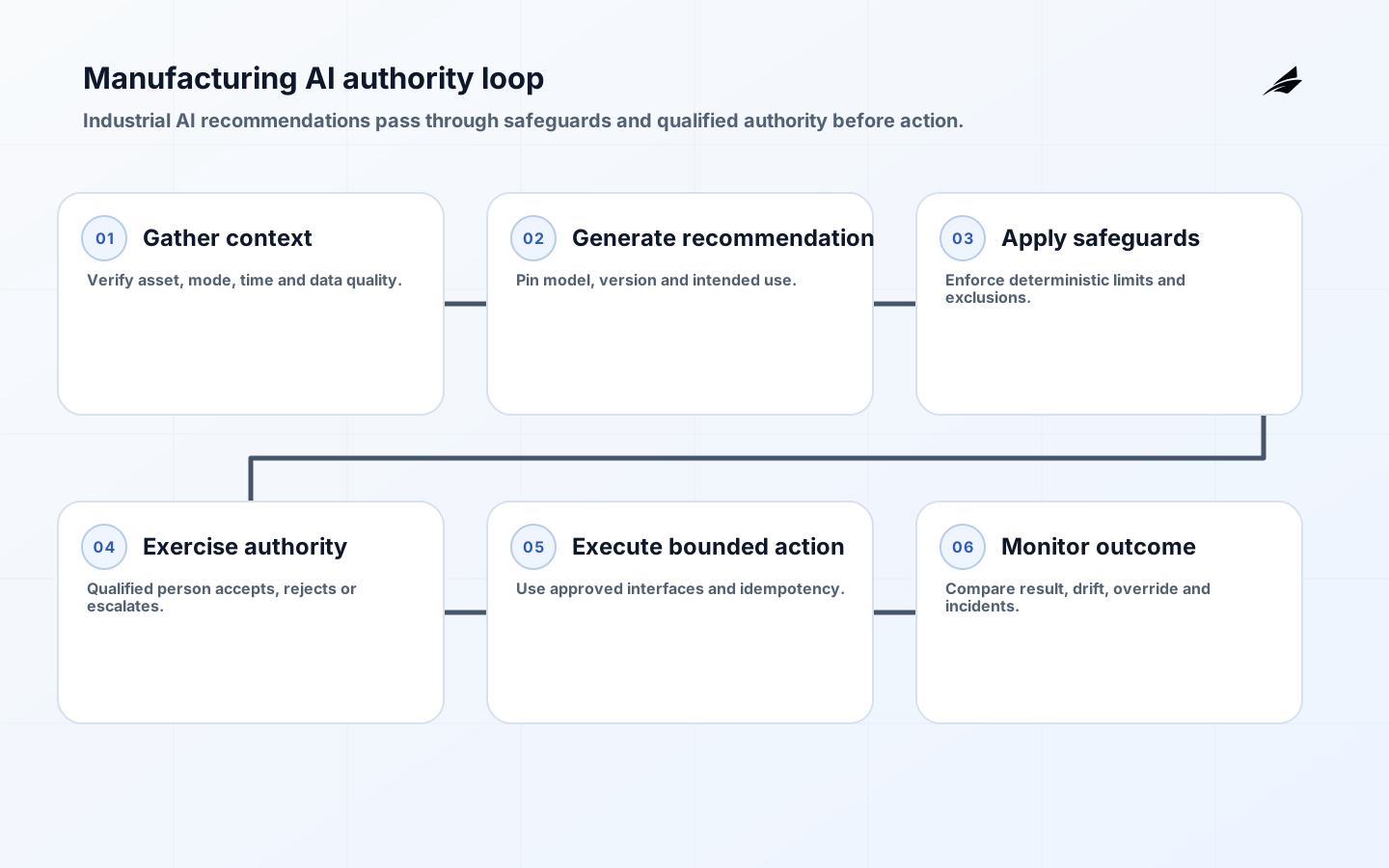
AI workflow automation services for manufacturing should improve a bounded operational decision without obscuring safety, quality or accountability. Useful applications include inspection triage, maintenance prioritization, production-document review, schedule recommendations and exception routing. The AI component may classify, forecast or recommend, but the surrounding workflow must verify identity, collect context, apply deterministic limits, obtain the right human decision and preserve evidence. A model output alone is not a production process.
This FAQ uses the NIST AI Risk Management Framework and Playbook for trustworthiness and risk activities, NIST SP 800-82 Rev. 3 for operational-technology security, NIST's 2026 smart-manufacturing AI roadmap for current industrial context, ISO's explanation of AI management systems and NIST SSDF for secure software development. Plant safety, quality, labor and regulatory requirements remain specific to the operation and jurisdiction; qualified owners must approve any use that can affect equipment, product release or people.
Which manufacturing workflows are suitable for AI automation?
Begin with a decision that has observable inputs, an accountable owner and a recoverable outcome. Inspection image triage can prioritize human review; a maintenance model can rank work orders; document extraction can reduce manual entry while a specialist verifies critical fields. Avoid starting with vague goals such as “autonomous factory.” NIST's 2026 roadmap highlights industrial data complexity, heterogeneous sensing, integration and the need for trustworthy operation. Those constraints favor narrow, evidence-rich use cases.
Map consequence before benefit. If a false negative could release a defective product or expose a worker to danger, the workflow needs stronger independent controls and perhaps should not delegate that decision to AI. Separate advisory, approval and automatic action modes. State excluded equipment, products and environmental conditions. Measure the current process, including error, delay, rework and review effort. The project should improve a real operational outcome rather than merely produce a high offline model score.
| Use case | Appropriate initial role | Essential boundary |
|---|---|---|
| Visual inspection | Prioritize or flag images for qualified review | Do not silently release product on uncertain output |
| Predictive maintenance | Rank assets and explain contributing signals | Maintenance authority approves work and shutdown |
| Schedule recommendation | Compare feasible options under constraints | Planner retains authority for production commitment |
| Document processing | Extract fields and route exceptions | Critical values are validated before posting |
How should human authority and safety be designed?
Define who may accept, reject or override an AI recommendation and what evidence they need. Place the decision at the point where the user can still act. Avoid “human in the loop” as a label without time, competence and authority. A reviewer who receives hundreds of low-value alerts cannot provide meaningful control. Set confidence or risk bands according to consequence, but do not present probability as certainty. Route uncertain and out-of-scope cases to a safe manual process.
Keep deterministic safeguards independent where possible: equipment interlocks, operating envelopes, quality hold rules and access control should not depend solely on the model. For an automated action, require explicit preconditions, bounded scope, rate limits and a reversible or safe-stop path. Record the input version, model version, policy, recommendation, human disposition and resulting command. Review overrides as learning evidence without pressuring workers to agree with the system.
What data preparation is required?
Industrial data must preserve asset identity, units, sampling, event time, operating mode, maintenance state and quality. A sensor value without context can mislead a model. Build a lineage map from device and historian through transformation to feature and prediction. Separate event time from ingestion time. Detect clock drift, gaps, duplicate signals and calibration changes. Label data under qualified process knowledge rather than assuming historical outcomes are unambiguous.
Avoid leakage from future events or post-decision information into training. Split evaluation by time, site, asset or product family according to deployment. Rare faults require careful sampling and uncertainty reporting. Document excluded conditions and data coverage. Protect sensitive process and worker data with purpose, access and retention controls. A model trained on one line or season should not be presented as fleet-ready until representative validation supports that claim.
How should AI connect to MES, ERP and OT systems?
Use a bounded workflow service between the model and systems of record. The service gathers approved context, invokes a versioned model, applies policy, routes review and writes an attributable result. It should not allow a model to call arbitrary plant tools. Define contracts for assets, work orders, quality records and production schedules, including idempotency and conflict behavior. Reconcile every consequential write with the authoritative system.

Respect OT zones and conduits. NIST SP 800-82 advises security designs that consider safety, reliability and performance. Prefer outbound, brokered or carefully mediated data flows from protected operations where appropriate. Do not open broad inbound access for model troubleshooting. Define how the workflow behaves when the model, network, historian or enterprise system is unavailable. A safe manual route and visible stale state prevent automation from becoming a single point of operational failure.
| Workflow stage | Control | Evidence |
|---|---|---|
| Context collection | Approved sources, freshness and quality checks | Input snapshot and data-quality status |
| Inference | Pinned model and configuration | Model identifier, latency and output |
| Decision | Policy, role and escalation | Reviewer, reason and override |
| Execution | Bounded command and idempotency | Target, authorization and completion |
| Follow-up | Outcome and reconciliation | Actual result, exception and corrective action |
How should manufacturing AI be validated?
Evaluate the complete workflow, not only the model. Use representative data across products, shifts, sites, environmental conditions, equipment ages and failure modes. Report false positives and false negatives in operational terms. For ranking systems, measure whether qualified users find important cases earlier. For forecasts, examine calibration and decision value. Compare with the current process and simple baselines. Preserve an independent test set and review how labels were created.
Run shadow mode before automatic effect: produce recommendations without changing operations, then compare with qualified decisions and outcomes. Simulate sensor loss, drift, delayed data, out-of-range values and model-service outage. Test the interface for automation bias: users should see relevant evidence and limitations. Define acceptance and rollback thresholds before the pilot. A strong average can hide unacceptable performance for one critical product or operating condition.
What cybersecurity controls are needed?
Threat-model poisoned data, compromised edge devices, manipulated model artifacts, stolen service credentials, unauthorized workflow changes and misuse of output. Apply NIST SSDF to the software and model delivery chain: protected source, reviewed changes, dependency management, build integrity, testing and vulnerability response. Sign artifacts, restrict deployment authority and preserve provenance. Separate development, validation and production access.
Monitor unusual input, model invocation, permission denial and command volume without collecting unnecessary process secrets. Rotate credentials through rehearsed procedures. Restrict vendor and support access to purpose, time and individual identity. Test recovery after a compromised model or gateway. Because availability matters in manufacturing, include denial-of-service and resource exhaustion in the design. Security action should preserve safe operation, not create an uncontrolled stop.
How do NIST AI RMF and ISO 42001 help?
NIST AI RMF organizes activities around Govern, Map, Measure and Manage. For a manufacturing workflow, governance establishes policy and accountability; mapping defines context, affected people and harm; measurement evaluates performance and trustworthiness; management prioritizes treatment and monitoring. The Playbook provides suggested actions rather than a certification checklist. Use it to ask better questions and preserve decisions appropriate to the use case.
ISO/IEC 42001 describes an organizational AI management system and a continual-improvement approach. It can help align inventory, risk assessment, roles, supplier management and lifecycle review across multiple AI systems. Neither framework proves one model safe. Connect organizational governance to concrete workflow evidence: data lineage, validation report, authority matrix, incident path, change approval and monitoring. Keep an inventory of deployed models, owners and intended use.
How should a manufacturing AI workflow be piloted?
Choose a representative but bounded line, product or asset cohort. Prepare operators and supervisors with the intended use, limitations, override path and support contact. Run shadow mode, then advisory mode, before any bounded automation where consequence supports it. Coordinate with maintenance, quality, safety, cybersecurity, IT and operations. Record baseline and seasonal conditions. Do not launch immediately before a critical production peak.
Review recommendations and exceptions daily during the pilot. Measure operational outcome, model error, review burden, override, latency, availability and data quality. Investigate disagreement rather than treating override as user resistance. Define stop conditions for unsafe recommendation, unexplained drift, authorization failure or missing evidence. Expand by cohort only after the operating team can diagnose, disable, roll back and recover the workflow.
What monitoring is required after launch?
Monitor input coverage, drift, output distribution, calibration where applicable, override, actual outcome and workflow service reliability. Segment by site, asset, product and operating condition without hiding small critical groups. Data drift is a signal to investigate, not automatic proof of model failure. Schedule review after process, sensor, supplier, material or maintenance changes. A model can become unsuitable even when its code has not changed.
Maintain an incident process that can identify affected decisions, suspend the model, restore a prior version and communicate with operations. Preserve enough evidence to review product and safety impact. Revalidate before broadening intended use. Retire models and remove credentials when workflows end. Fund monitoring and review as part of the service; an unowned model in a production workflow is an unmanaged operational dependency.
Key takeaways
Manufacturing AI delivers value through a controlled decision workflow, not an isolated prediction. Keep safety and authority explicit, preserve industrial context in data, mediate system actions, validate by operating condition and monitor the full lifecycle. Frameworks help organize the work, but production acceptance depends on use-case evidence.
- Choose a narrow decision with measurable outcome and recoverable failure.
- Keep independent safety and deterministic policy controls.
- Validate across sites, products, shifts and operating conditions.
- Use shadow and advisory modes before bounded automation.
- Monitor outcome, drift, override, service health and incidents together.
Frequently asked questions
Can AI control manufacturing equipment directly?
Only after rigorous safety, control, authorization and validation work appropriate to the consequence. Many valuable deployments remain advisory or route work to qualified people.
What accuracy is required?
There is no universal threshold. Evaluate false outcomes, uncertainty and decision consequence for each operating condition, then compare with the current process and independent safeguards.
Is a digital twin required?
No. A twin may help simulation or context, but a bounded workflow can use verified historian, MES and asset data. Add complexity only when it improves the decision or validation.
Conclusion
AI workflow automation services for manufacturing should make operations more informed without making responsibility less visible. A dependable solution can explain the data and model used, the authority applied, the action taken and the actual outcome. Start with a bounded use case, protect OT and safety boundaries, validate in representative conditions and operate the model as a versioned production dependency. That discipline creates a path from promising experiment to trustworthy industrial service.