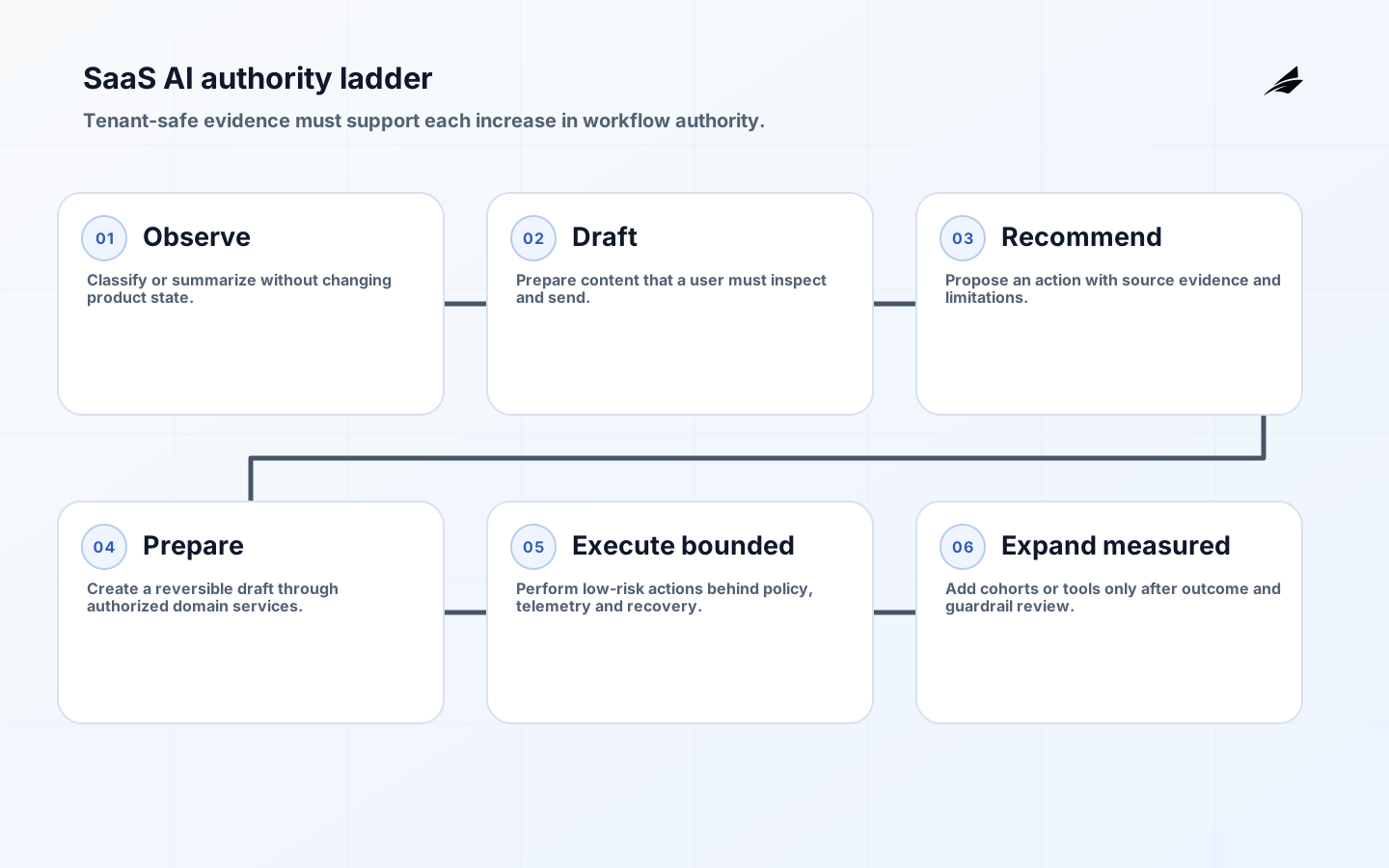
AI workflow automation for SaaS companies should improve a specific user or operating task without weakening tenant isolation, product reliability or customer control. Useful targets include support triage, document intake, account setup, renewal preparation, quality review and internal operations. The model is only one component. A production system also needs identity, tenant context, allowed tools, deterministic policy, state, queues, approvals, telemetry and recovery. Scope becomes credible when it states which action may occur, whose data supports it, how the result is verified and what happens when confidence or a dependency fails.
This delivery plan separates discovery, foundation, controlled release and expansion. The companion SaaS automation implementation checklist and practical SaaS automation FAQ cover detailed acceptance questions. The plan avoids assuming that a conversational interface needs autonomous authority. Many valuable products use AI to extract, rank, draft or recommend while ordinary application code controls permissions and state changes. That distinction reduces risk and makes behavior easier to test.
Define scope as a bounded product capability
Write the target task as an observable contract: actor, starting state, allowed data, proposed output, permitted actions, approval conditions and completion evidence. “Add an AI agent” is not scope. “Classify an authenticated tenant's inbound support request, retrieve only that tenant's approved knowledge, draft a response and require an agent to send it” is testable. Identify excluded topics, data classes and tools. Add a visible handoff when the request is ambiguous, high impact or outside policy. The user should know whether content is generated, which records will change and how to correct the result.
Select one workflow with enough volume to evaluate and enough reversibility to learn safely. Establish a baseline for handling time, completion, quality, escalation and customer satisfaction. Map the unhappy path: unavailable model, invalid tool output, stale retrieval, duplicate event, cancelled request, permission change and user correction. Treat every tool call as a normal application command with server-side authorization and validation. The model may propose an action name and arguments; it should not possess broad credentials or bypass the domain service that enforces business rules.
| Scope decision | Evidence required | Boundary |
|---|---|---|
| User outcome | Baseline task and measurable completion | No feature count as a proxy for value |
| Data | Tenant, purpose, retention and retrieval rules | No cross-tenant or unapproved source access |
| Authority | Action allow-list and approval policy | No direct unrestricted credentials |
| Recovery | Idempotency, queue and correction path | No silent retry of consequential actions |
Build a tenant-safe automation architecture
Resolve tenant identity before retrieval, prompt construction or tool selection and carry it through every trace. Enforce isolation in data access and service authorization, not with a text instruction. Minimize prompt content, redact secrets and sensitive fields, and prevent customer content from becoming training data unless an explicit agreement and control model allows it. Treat retrieved documents and user input as untrusted because embedded instructions can attempt to redirect the model. Validate structured output against a schema, then re-check permissions and business invariants at execution.
Keep orchestration state outside the model. Record workflow identifier, step, actor, tenant, input references, model and prompt version, proposed action, policy result, approval and outcome. Use bounded retries with idempotency keys for side effects. Add timeouts and circuit breakers around providers. Queue work that can wait and make queue age visible. For real-time interactions, define a graceful response when generation is unavailable. A deterministic fallback may provide search results or create a human task; pretending the model succeeded creates harder recovery and undermines trust.
Model total cost and unit economics
Separate build cost from recurring cost. Build includes workflow discovery, data preparation, integration, evaluation, security, interface, release and operational readiness. Recurring cost includes model input and output, embeddings, retrieval, storage, queues, observability, moderation, support, evaluation and provider minimums. Estimate by task unit, not only monthly tokens: cost per resolved request, reviewed document or completed onboarding. Include retries, long contexts, failed calls and peak concurrency. A cheap inference path can be expensive if it creates review or correction work.
Connect product packaging to controllable usage. Decide whether the capability is included, metered, limited by plan or sold as an add-on. Provide customers with understandable limits and preserve safety when quotas are reached. Route simple cases to rules or smaller models where evaluation supports it. Cache only when privacy and freshness permit. FinOps practice is strongest when engineering, product and finance share unit measures and decision authority. Track realized margin after support and exception labor, not theoretical provider discounts.
| Cost driver | Planning unit | Control |
|---|---|---|
| Generation | Requests, input and output by workflow | Context limits, routing and response caps |
| Retrieval | Documents indexed and queries served | Selective indexing, lifecycle and cache policy |
| Human review | Minutes and exceptions per completed task | Risk tiers, clear evidence and reason codes |
| Operations | Incidents, evaluations and changes | Release cadence, observability and provider governance |
Control model, security and product risks
Create an AI system record covering purpose, owner, users, affected parties, data, providers, evaluations, known limitations and incident path. NIST AI RMF and its generative AI profile provide a useful structure for governing, mapping, measuring and managing risk. Test unsupported claims, prompt injection, sensitive information disclosure, excessive agency, poor refusals and harmful bias relevant to the task. Evaluate by tenant and meaningful cohort where possible. Do not claim that a generic benchmark proves the customer workflow is safe or useful.
Secure the software supply and provider relationship. Pin model or endpoint versions where available, detect changes, protect secrets, scan dependencies and log administrative access. Define data location, retention, subcontractors, incident notification, service limits and deletion in supplier agreements. Create a customer-facing control surface for enabling the feature, selecting data sources, restricting actions and reviewing history where the use warrants it. Provide a truthful explanation of limitations. Human approval is not an adequate control if reviewers cannot inspect evidence or are expected to accept hundreds of outputs without time.
Deliver in four funded phases
Discovery should end with a selected workflow, baseline, data and authority map, architecture decision, evaluation plan, risk register and cost range. Foundation then builds tenant-safe access, a versioned prompt or model interface, workflow state, policy gates, evaluation harness and telemetry. A production slice connects one end-to-end path with a human review or narrow authority. It must include support, deletion, observability and failure handling. Expansion adds cohorts, tools or autonomy only after operating evidence supports the next risk level.
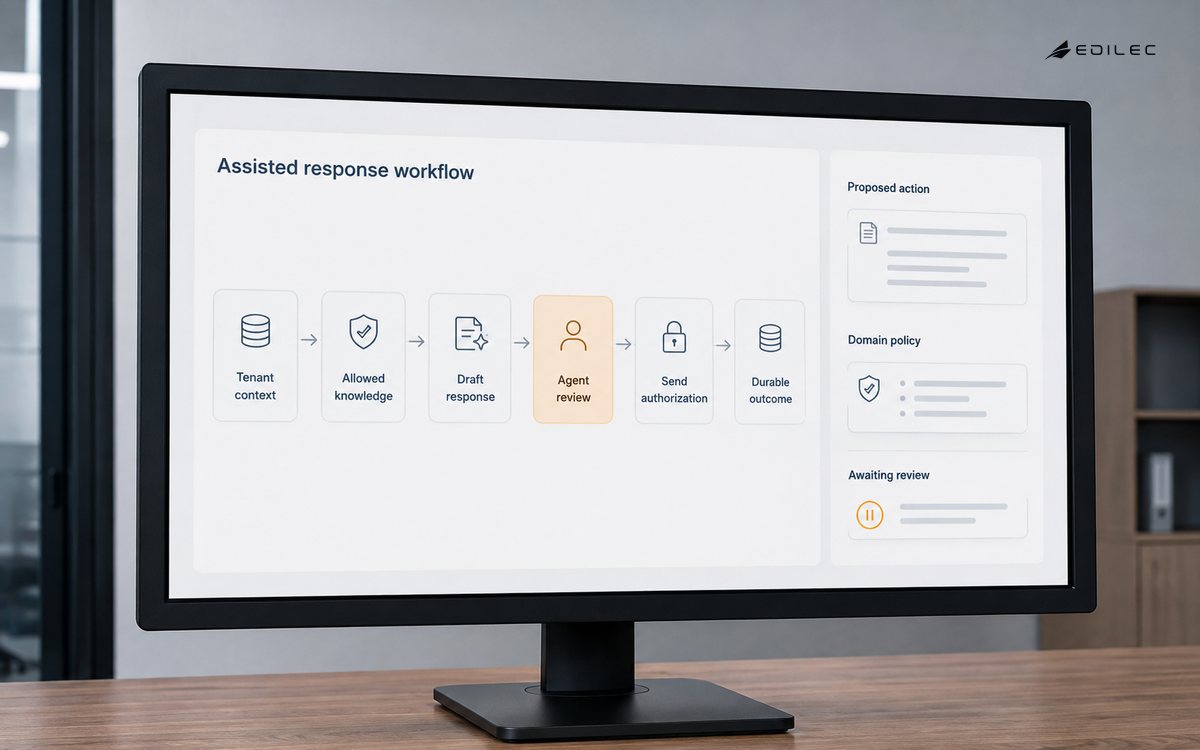
Use acceptance gates rather than a single launch date. Gate one proves data and tenant isolation. Gate two proves task quality against the baseline. Gate three proves policy, security and recovery under adversarial and dependency failures. Gate four proves operations through a canary cohort and incident rehearsal. Gate five evaluates unit cost, review capacity and customer outcome. Preserve a kill switch independent of the model provider. Roll back configuration and exposure without losing workflow state or hiding actions that already occurred.
Operate the capability as part of the product
Instrument model calls and ordinary workflow signals. Correlate tenant, task and version without recording sensitive content unnecessarily. Measure completion, correction, escalation, unsupported output, latency, provider error, queue age, review time and cost per accepted outcome. Page for conditions requiring immediate action, such as cross-tenant access, unsafe execution or widespread failure. Route quality trends to scheduled review. OpenTelemetry signals can connect traces, metrics and logs across orchestration, retrieval and tools, but the team must still define meaningful attributes and owners.
Assign a product owner, engineering owner, data or model owner, security contact and support path. Review provider changes and evaluation results before promotion. Sample production cases under approved privacy controls and incorporate corrections into test sets without leaking customer data. Publish relevant release notes and customer controls. Revisit the business case quarterly: a capability may remain technically accurate while customer use, provider pricing or support burden changes. Retire or narrow it when value no longer justifies the operating risk.
Plan customer communication before exposure. Explain the capability, material limitations, data use, available controls and route for reporting an incorrect result. Support teams need diagnostic context and correction authority without seeing unrelated tenant data. Feed recurring correction reasons into evaluation and product design, but do not use customer content for training by default. Trust improves when users can understand what occurred, challenge it and continue the task through a reliable alternative.
Key takeaways
- Scope one testable workflow and state its authority explicitly.
- Enforce tenant isolation and tool permissions outside the model.
- Measure cost per accepted task including review and support.
- Release through evidence gates with rollback and a kill switch.
- Expand tools or autonomy only after production outcomes justify it.
Frequently asked questions
How long does the first production workflow take?
Timeline depends on data rights, integrations, risk and workflow clarity. A bounded use case with existing APIs may reach a controlled release in weeks; unresolved tenant data or authority can take longer. Estimate after discovery and include evaluation, support and failure rehearsal, not only model integration.
Does the product need an autonomous agent?
Usually not at first. Extraction, ranking, drafting and recommendation can deliver value with deterministic workflow control. Add iterative tool use only when the task requires it, the state is observable and each action remains bounded, authorized and recoverable.
How can vendor lock-in be reduced?
Keep workflow state, domain rules, evaluation cases and telemetry under product control. Isolate provider APIs behind a narrow interface, document model-specific behavior and test a degraded or alternative path. Portability is not free, but these boundaries prevent the whole product workflow from becoming provider-owned.
Conclusion
SaaS AI automation is a product capability, not a model endpoint. Bound the task, isolate tenants, constrain authority, evaluate the complete workflow and fund expansion through evidence. That approach creates a capability customers can understand and the product team can support, price and improve without turning every model change into an uncontrolled production experiment.