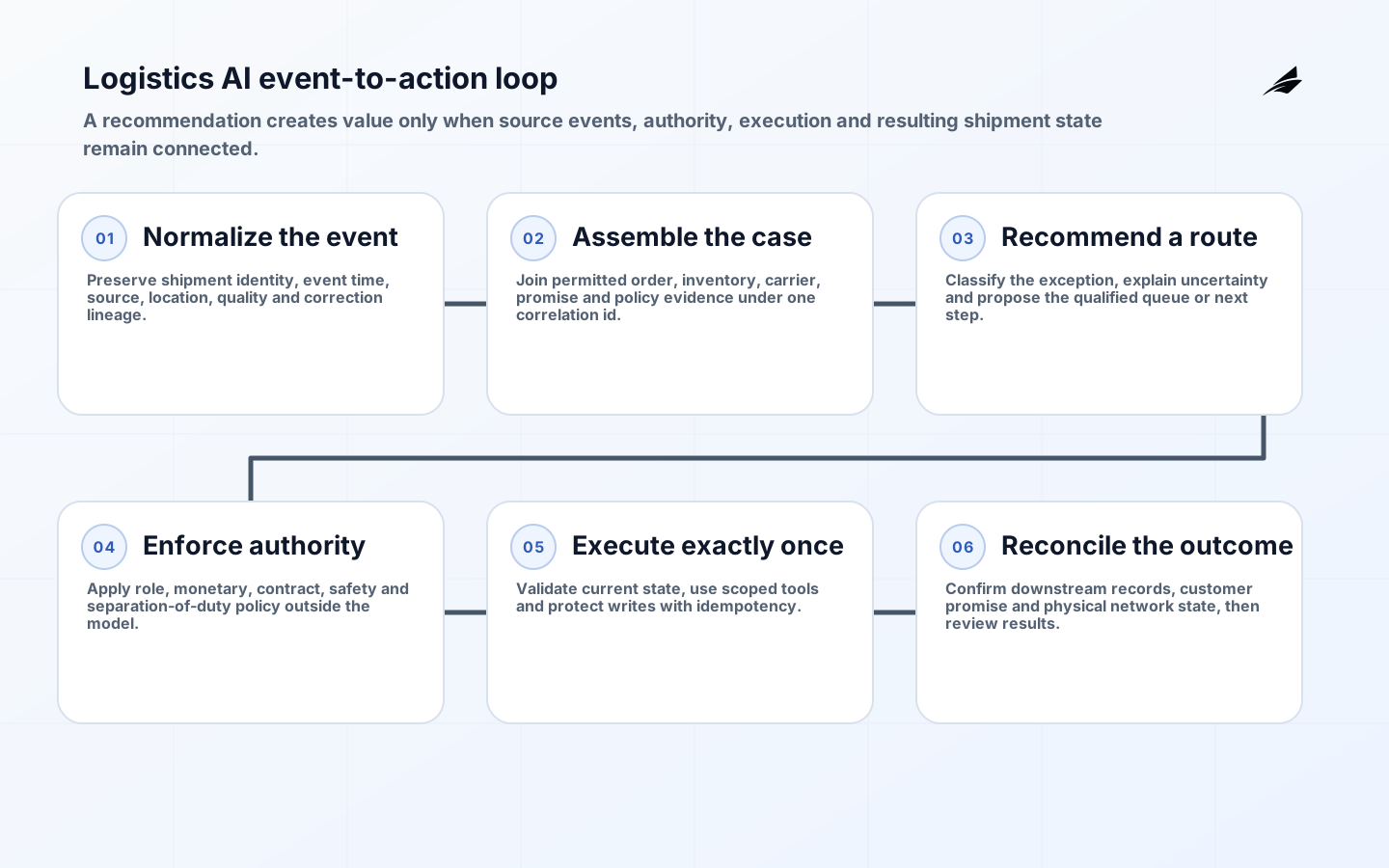
AI workflow automation services for logistics should begin with a specific operational decision, not a promise to automate the supply chain. A useful first scope might classify shipment exceptions, assemble evidence for a reroute, draft a customer update, or route a customs-document problem to the right specialist. Each case has a different consequence and authority boundary. The system may summarize facts quickly, but it should not invent a location, silently change a delivery commitment, or execute a high-cost reroute without the required approval. The implementation therefore joins event quality, workflow design, model evaluation, deterministic policy, integration engineering and operations.
Logistics teams can use this plan alongside the implementation checklist and logistics automation FAQ. The related manufacturing automation delivery guide is useful when the workflow crosses warehouses, production assets or operational technology. The objective is not maximum autonomy. It is a measurable reduction in avoidable delay and manual reconstruction while preserving a truthful shipment record and a recoverable action path.
Choose a logistics decision with a clear authority boundary
Start by observing one exception from detection to closure. Record who notices it, which systems they consult, what evidence changes the decision, who may authorize the response, and how the resulting state reaches carriers, warehouses, customers and finance. A late scan, temperature excursion and denied customs entry are all exceptions, but they cannot share one generic automation rule. Define the completed state in operational terms: a qualified owner accepted the case, the permitted action was executed once, downstream records agree, and the customer promise was updated when required.
Separate advisory work from consequential action. Summarizing tracking events or drafting a case note is usually reversible. Tendering a load, changing a destination, releasing inventory or approving an accessorial charge can create contractual and physical effects. For each action, document monetary limits, separation of duties, restricted goods rules, service commitments and timeout behavior. If the model is uncertain or a required event is missing, the safe result is an owned queue with the evidence packet intact, not a confident guess.
| Candidate workflow | Evidence required | Safe automation boundary |
|---|---|---|
| Shipment exception triage | Event time, location, milestone, carrier status and customer promise | Classify and route; keep reroute or refund approval separate |
| ETA communication | Recent trusted events, route state and confidence range | Draft an update; suppress unsupported precision |
| Document review | Document type, shipment identity, required fields and rule version | Extract and flag gaps; send legal decisions to qualified staff |
| Warehouse task prioritization | Order priority, inventory state, labor capacity and cutoff | Recommend queue order; preserve supervisor override and safety rules |
Build automation on attributable logistics events
A model cannot repair an ambiguous source of truth. Create a canonical event envelope with shipment or asset identity, event identifier, event time, capture time, business step, location, source system, confidence or quality status, and correction relationship. GS1 EPCIS is relevant because it represents business events and supports event history rather than treating every update as an unqualified current value. Preserve the original carrier or device payload where policy allows, but normalize the fields the workflow needs. Deduplicate retries without deleting legitimate repeated events.
Define how corrections work. A scan received late should not masquerade as a current physical observation; a corrected event should remain linked to the assertion it replaces. Reconcile shipment, order, inventory and customer-service records after an automated action. Where operational technology contributes signals, respect its safety, availability and network constraints rather than polling or commanding equipment as though it were an ordinary web service. Event freshness and lineage belong in the decision packet shown to a reviewer.
Design the logistics AI workflow as controlled components
Keep orchestration, policy and execution outside the model. An event service assembles current facts; retrieval supplies approved procedures and contract terms; the model classifies or drafts; a policy service checks authority, limits and required evidence; a workflow engine creates approval tasks; and scoped connectors execute permitted writes. Every component receives a correlation identifier. Tool credentials should expose only the operation needed for the case, and parameters should be validated against current shipment state immediately before execution.
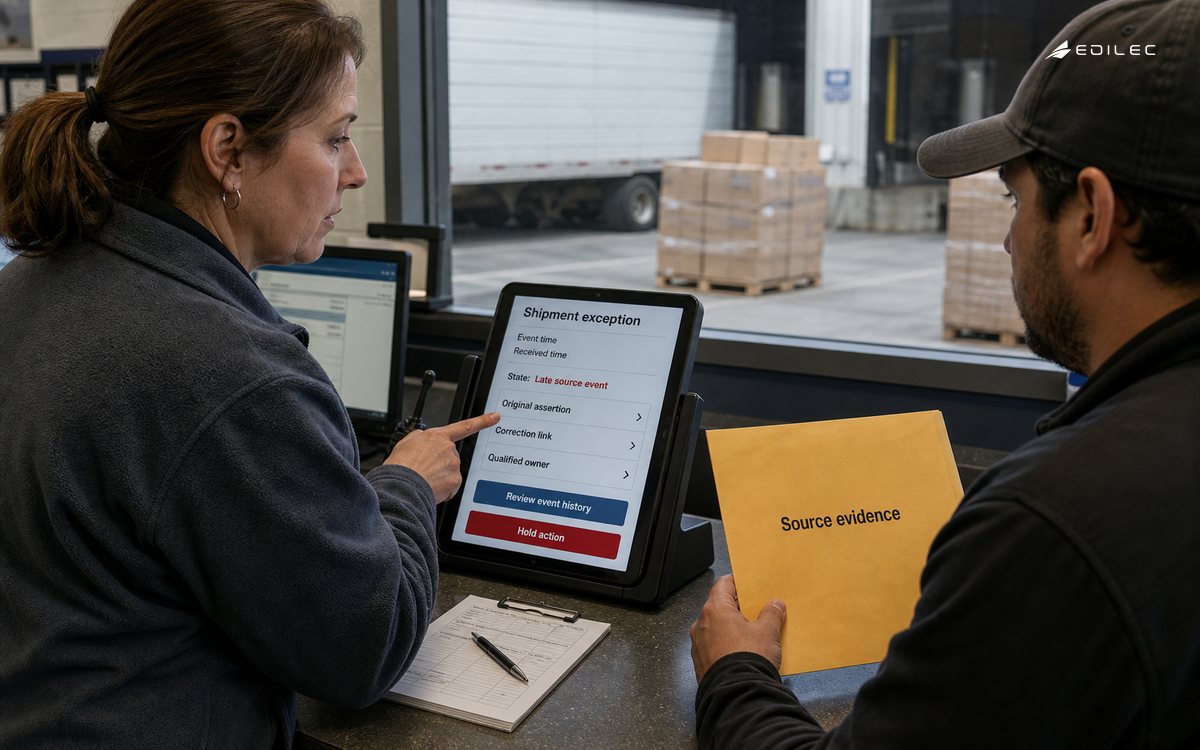
Design for retries, concurrency and partial failure. A carrier API timeout must not create two tenders. A stale approval must not execute after a dispatcher has already changed the route. Use idempotency keys, optimistic state checks, durable queues and explicit terminal states. Record the model and prompt version, retrieved sources, policy result, reviewer decision, connector response and resulting business event. That evidence supports incident reconstruction without requiring unrestricted retention of every sensitive message.
Deliver an end-to-end exception slice before expanding
A credible pilot uses representative live-like events and one complete exception family. Begin in shadow mode: the system builds packets and recommendations while people continue normal work. Compare route, priority, evidence completeness and time to decision. Then allow assisted drafting, followed by low-consequence actions with deterministic checks. Expand only when failure handling is as visible as the successful path. Include duplicate events, out-of-order scans, missing documents, conflicting locations, carrier outages, policy changes and a case that exceeds every automated limit.
Acceptance should involve dispatch, warehouse operations, customer service, security, finance and whoever owns the affected contract. Test accessibility and clarity of the review interface under time pressure. Rehearse rollback of rules and model versions, not just application code. A logistics workflow remains operationally useful only if a person can understand why a case was routed, correct the source state, stop an unsafe action and continue work during provider failure.
Model cost against exception volume and consequence
Price the service by completed workflow, not model calls alone. Include event integration, data cleanup, evaluation sets, orchestration, review time, observability, carrier sandbox access, security testing and ongoing rule maintenance. A startup pilot may use managed components, while a high-volume network may justify dedicated event processing or model routing. Forecast normal and peak exception volumes, context size, tool calls, review rate and retry rate. The expensive failure is often not inference; it is a wrong or duplicate operational action.
| Risk | Early control | Operating evidence |
|---|---|---|
| Incorrect source event | Quality flags, lineage and contradiction checks | Rate of cases paused for stale or conflicting evidence |
| Unauthorized action | Role, amount, lane and customer policy outside the model | Denied executions and approval overrides by reason |
| Duplicate execution | Idempotency key and state precondition | Connector reconciliation and duplicate-attempt count |
| Automation drift | Versioned evaluations and progressive rollout | Correction, escalation and outcome trends by version |
| Provider outage | Durable queue and manual fallback | Backlog age, recovery time and lost-action count |
Measure logistics outcomes, not automation activity
A high automation rate can hide poor service. Track exception age, time to qualified owner, time to safe resolution, manual evidence-gathering time, duplicate action rate, correction rate, customer promise accuracy, missed cutoff, cost per resolved case and downstream reconciliation failures. Segment by carrier, lane, facility, exception type and consequence. Compare with a stable baseline and review cases where the system abstained; frequent abstention may indicate weak data rather than a model problem.
Review a sample of successful cases as carefully as failures. Verify that the recorded outcome occurred in the physical network and that savings did not shift effort to another team. Monitor subgroup effects where routing or service policy could disadvantage regions, customers or shipment types. NIST's AI risk guidance emphasizes continuous governance, mapping, measurement and management; use that cycle to decide whether the workflow earns broader authority or needs a narrower scope.
Treat rule and model changes as logistics releases. Before promotion, compare recommendations on a frozen case set, replay recent exceptions, verify carrier and warehouse connector contracts, and review changed approval volumes. Roll out by facility, lane or customer cohort so operators can distinguish a workflow defect from a network disruption. Preserve the prior configuration and the cases affected by each version. This change discipline is essential when a new policy, carrier status mapping or model update can alter physical work across several organizations.
Procurement should require evidence for data handling, service availability, model changes and incident notification from every provider in the path. Map where shipment, driver, customer and trade data are processed and retained. Confirm export and deletion behavior and establish a transition route before a critical workflow depends on one vendor. Commercial resilience matters because logistics decisions continue during contract disputes, provider outages and acquisitions; the manual or alternate path must preserve queue priority and event history.
Key takeaways
- Automate a named logistics decision with an explicit owner and completed state.
- Preserve event identity, time, lineage and correction semantics before adding a model.
- Keep policy, authority and connector validation outside generative components.
- Test duplicate, stale, conflicting and unavailable-source conditions before execution rights expand.
- Judge value by safe resolution and network outcomes, not by the percentage of cases touched by AI.
Frequently asked questions
| Question | Answer |
|---|---|
| What is the best first workflow? | Choose a frequent, evidence-rich exception where classification or packet assembly is slow but the final action can remain human-approved. |
| Should AI predict exact arrival times? | Only when the product can express uncertainty, validate inputs and avoid presenting an unsupported point estimate as a promise. |
| Can the model execute carrier actions? | Grant execution only to narrowly scoped connectors after deterministic policy, current-state checks and idempotency protection. |
| How long should a pilot run? | Long enough to include representative peaks, outages and exception types; use evidence coverage rather than a calendar alone. |
| What should stop rollout? | Untraceable events, unresolved duplicate actions, weak recovery, material correction rates or no measurable improvement in resolution outcomes. |
Conclusion
AI workflow automation services for logistics create durable value when they shorten the path from trustworthy event to safe operational decision. Begin with one exception family, preserve source truth, separate recommendation from authority, execute through bounded tools and reconcile the resulting state. Expand only when the team can show better resolution outcomes, controlled residual risk and a fallback that operators can actually use.