AI workflow automation services for ecommerce can reduce catalog cleanup, order exceptions, repetitive support, return triage, and operational reporting. AI adds value where the work contains language, images, or ambiguous classifications. It also adds risk when a fluent recommendation is allowed to alter prices, publish claims, refund money, expose customer data, or change order state without a reliable policy boundary.
A sound engagement starts with one end-to-end commerce outcome and the systems that own it. This guide explains scope, architecture, delivery, cost, and controls for teams considering AI automation, API integration, or a wider ecommerce engineering program.
1. Scope automation around a complete commerce outcome
Choose a workflow whose start and end are observable: enrich a supplier product record until it is ready for review; resolve a late-shipment exception; draft a return decision with evidence; classify a support case and propose a response; or investigate a payment-risk alert. Name the business owner, customer consequence, source systems, volume, baseline effort, and exception rate.
Do not combine unrelated use cases into an 'AI operations platform' before one workflow works. Catalog, order, payment, marketing, and support data have different ownership and retention. The initial release should improve a measurable queue while preserving the existing system of record.
| Workflow | Strong AI role | Keep deterministic or human | Primary measure |
|---|---|---|---|
| Catalog enrichment | Extract and normalize supplier attributes | Approve claims, regulated fields and publication | Accepted records and correction rate |
| Order exception | Summarize events and suggest next step | Change fulfillment state or promise compensation outside policy | Resolution time and repeat contact |
| Returns | Classify reason and assemble eligibility evidence | Authorize high-value or policy-exception refunds | Cycle time, leakage and appeal rate |
| Support | Route intent and draft grounded replies | Disclose account data or make irreversible changes | First-contact resolution and quality review |
| Fraud operations | Summarize signals and related activity | Final adverse action under accountable policy | Review time, false positives and confirmed loss |
2. Define authoritative commerce state and event contracts
Orders are state machines, not text documents. The order management system, payment processor, warehouse, carrier, customer platform, and returns system may observe different moments. Define canonical identifiers and allowed transitions for order, line, shipment, payment, refund, and return. Every automation request should carry an idempotency key and current version so retries cannot duplicate a refund or fulfillment action.
Product data needs the same discipline. GS1's Global Data Model and product identification standards provide a common basis for the identifiers and attributes used to list, order, store, move, and sell products. Preserve supplier source, approval state, locale, channel, units, and effective dates. AI-generated copy must never overwrite the factual product record.
| Contract element | Purpose | Failure if omitted | Required control |
|---|---|---|---|
| Stable identifiers | Join records across channels and services | Wrong order, SKU or customer is changed | Validate namespace and ownership |
| Version or timestamp | Detect stale proposals | Action uses superseded price, policy or state | Optimistic concurrency and re-evaluation |
| Idempotency key | Make retries safe | Duplicate refund, message or fulfillment request | Persist result for the business operation |
| Source and reason | Explain automated decisions | Operations cannot reconstruct a change | Immutable event and decision log |
| Allowed transition | Protect business invariants | Automation skips required state or approval | Policy-enforced state machine |
3. Separate evidence, policy, AI and action
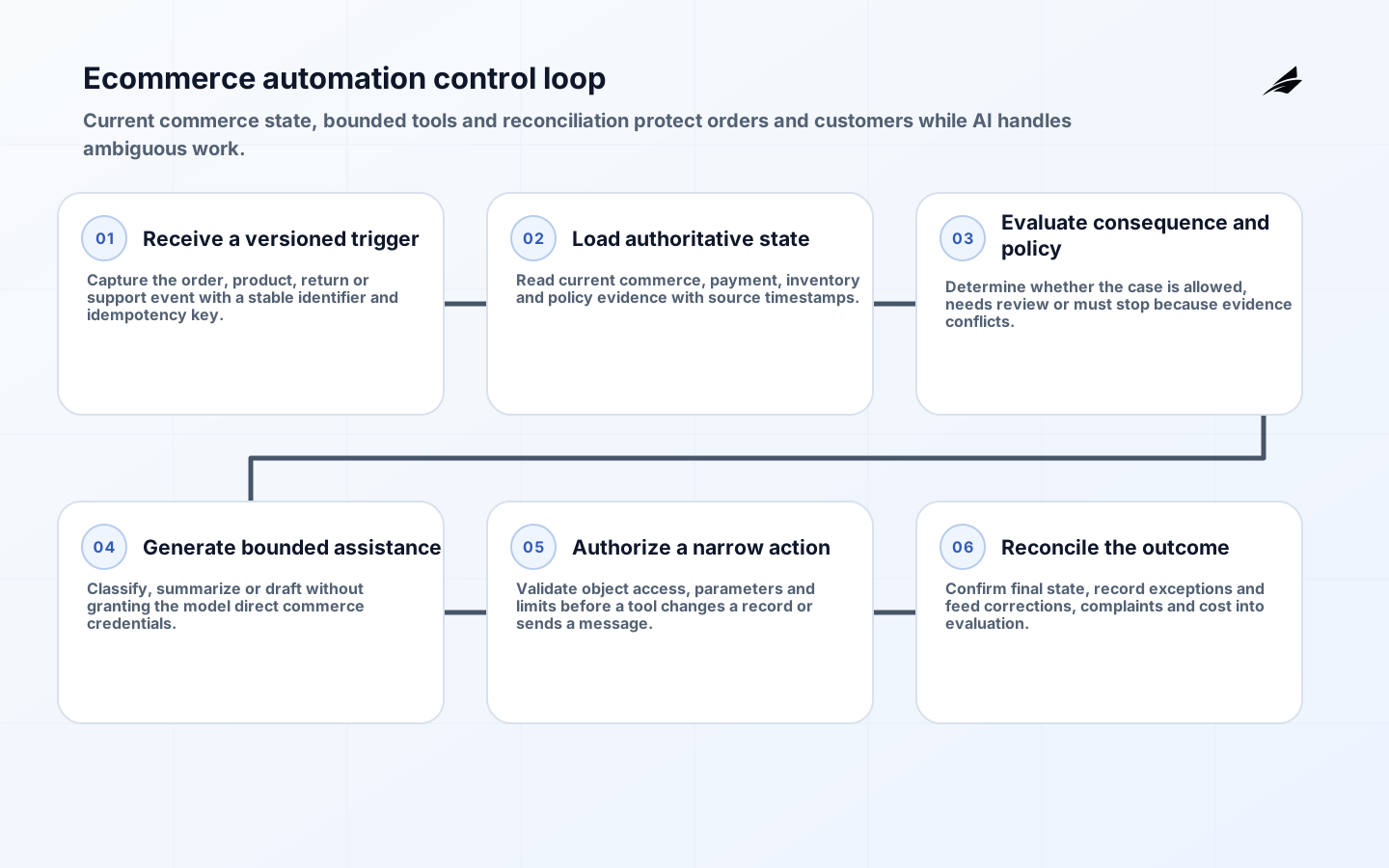
Use an orchestrator to receive an event, fetch current evidence, evaluate deterministic policy, request an AI classification or draft, and call a narrow action interface. The model should not hold broad commerce credentials. Tools should expose specific operations such as create-return-draft or add-case-note, with server-side authorization, validation, limits, and audit logging.

OWASP identifies unrestricted access to sensitive business flows as an API risk because automated access can harm inventory, purchasing, reservations, or account creation. Review the API Security Top 10 against both public endpoints and internal automation tools. Rate limits, abuse detection, object-level authorization, schema validation, timeouts, and safe handling of third-party responses remain necessary even when the caller is an internal AI service.
Keep card data outside prompts, logs, and vector stores. Determine whether each integration can affect the cardholder data environment and apply the current PCI DSS requirements. Tokenized references and processor-hosted payment components can reduce exposure, but they do not remove every security obligation.
4. Design review and exception paths before automation
Review thresholds should reflect consequence, not only model confidence. A low-value goodwill credit within policy may be eligible for automatic processing; a high-value refund, regulated product claim, suspected fraud action, or account restriction needs accountable review. Show reviewers the original evidence, applicable rule, proposed action, uncertainty, and customer impact.
Every workflow needs a meaningful stop state. If the carrier API is unavailable, policy conflicts, a product identifier is ambiguous, or the order changed during review, route the case with a clear reason. Do not let the model improvise around missing evidence. Measure how often and why the fallback is used; that backlog is a source of process improvement.
5. Deliver one workflow through discovery, shadowing and controlled action
| Phase | Work | Exit evidence |
|---|---|---|
| Discovery | Observe cases, map state and exceptions, establish baseline | Approved workflow contract and representative test set |
| Foundation | Build identity, integrations, event log, policy and monitoring | Threat model, safe retries and operational dashboard |
| Shadow mode | Generate routes or drafts without acting | Measured quality by case type and reviewed failure modes |
| Assisted release | Agents approve or edit proposals | Acceptance, correction and escalation outcomes |
| Bounded automation | Enable narrow actions within consequence limits | Stable controls, rollback, reconciliation and ownership |
Run historical cases through the complete pipeline, not just the prompt. Include cancelled orders, partial shipments, split tenders, duplicate events, cross-border policies, malicious customer text, and stale inventory. For direct customer communication, test tone, factual grounding, accessibility, localization, and the route to a person.
6. Estimate cost from workflow complexity and run volume
Implementation cost is driven by system discovery, API quality, data cleanup, policy formalization, evaluation, security, and change management. Runtime cost includes model calls, retrieval, orchestration, monitoring, storage, and human review. A cheaper model is not cheaper overall if it sends more cases to manual correction or creates customer recovery work.
| Cost driver | What increases it | How to control it |
|---|---|---|
| Integrations | Legacy interfaces, inconsistent identifiers, missing events | Start with one source-of-truth path and stable contracts |
| Model use | Long context, repeated calls, large volumes | Route simple cases to rules or smaller models and cache safe evidence |
| Human review | Low trust, poor evidence, broad consequence | Improve source quality and narrow the automation boundary |
| Exceptions | Policy variants, regions, carriers and payment methods | Launch with a bounded market and explicit exception taxonomy |
| Operations | Frequent catalog and policy changes | Automate tests, source freshness checks and release comparison |
Avoid universal price claims. A credible proposal provides a range with assumptions: monthly volume, integrations, environments, service levels, data sensitivity, review rate, and rollout markets. Re-estimate after discovery and shadow-mode results.
7. Measure customer, operational and control outcomes
Track cycle time, backlog, first-contact resolution, correction rate, refund leakage, order-state mismatches, repeat contacts, customer complaints, unauthorized action attempts, and cost per completed case. Segment results by workflow, market, channel, and consequence. Average automation rate can hide a weak long tail.
For catalog and storefront work, ensure automation does not make products undiscoverable. Google notes that crawlers generally follow links and do not click load-more buttons; its ecommerce pagination guidance is relevant when automated merchandising changes category navigation or incremental loading.
Key takeaways
- Scope one complete outcome with an authoritative state owner.
- Use versioned, idempotent contracts for every consequential action.
- Keep model recommendations separate from policy and execution.
- Protect commerce APIs against business-flow abuse and object-level authorization failures.
- Introduce action authority only after shadow and assisted evidence.
- Measure recovery work and customer outcomes, not automation percentage alone.
Frequently asked questions
Which ecommerce workflow is best to automate first?
Choose a high-volume, bounded queue with stable evidence, a clear owner, reversible outcomes, and known exceptions. Catalog attribute normalization or support routing is often safer than autonomous refunds, repricing, or fraud action.
How long does an ecommerce automation take?
A narrow assisted workflow may reach a controlled pilot in several weeks, while multi-system action automation usually takes months. The estimate depends on integration readiness, test data, policy clarity, review requirements, markets, and release controls.
Does AI workflow automation replace the commerce platform?
No. Commerce, order, payment, and customer systems remain authoritative. AI assists interpretation and workflow decisions around them. Replacing core systems is a separate architecture and migration decision.
Data retention deserves its own design. Customer conversations, order records, product images, fraud signals, and generated outputs can have different purposes and lifetimes. Minimize what is sent to a model, redact where practical, control training or provider use contractually, and define deletion across prompts, traces, caches, vector indexes, and case records. Test access and deletion rather than relying only on a policy document.
Operational ownership should cover busy and unusual periods. Peak sales, promotions, carrier disruption, and large catalog imports change volumes and error patterns. Set capacity assumptions, queue limits, provider rate limits, degraded modes, and an incident route. Rehearse disabling automated action while preserving manual order and support work. A workflow that performs well only under average traffic is not ready for ecommerce production.
Ownership must continue after release. Commerce operations owns the outcome and policy; engineering owns workflow and integrations; security owns control assurance; data owners maintain source quality; and customer teams review real effects. Establish a regular review of exception categories, action limits, model changes, source freshness, and customer complaints. Retire automations whose process or economics no longer justify their risk.
Conclusion
Effective ecommerce AI automation respects commerce state. It reads current evidence, applies policy, proposes or performs a bounded action, and reconciles the result. Teams that design that control loop before optimizing the prompt can reduce operational effort without trading away payment security, customer trust, or the integrity of orders and product data.