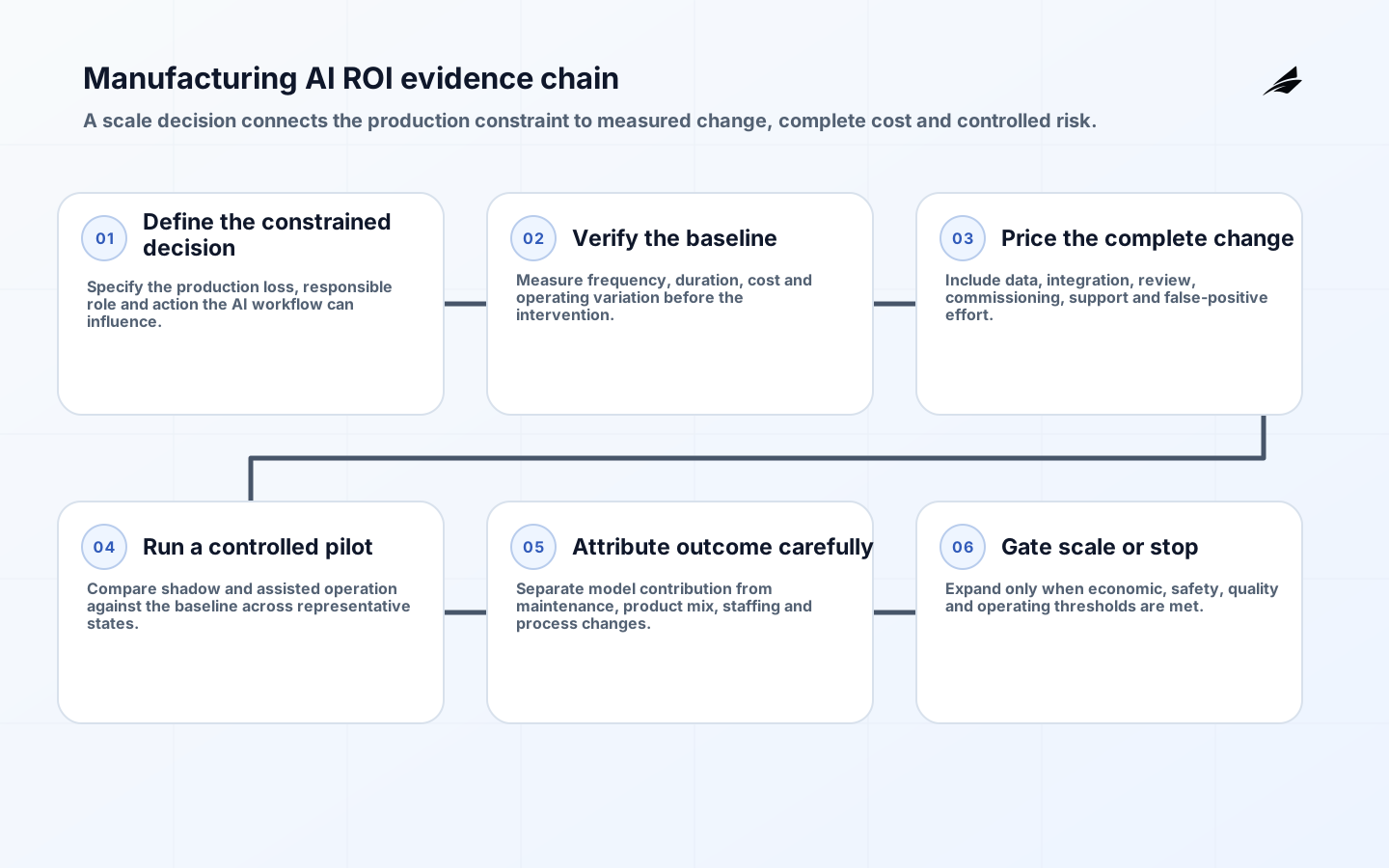
Manufacturing AI earns investment when it improves a defined production decision without weakening safety, quality or recoverability. The business case cannot rest on model accuracy alone. It must connect a measurable plant constraint to the people, sensors, controls and maintenance practices that determine whether a recommendation changes the result.
This checklist treats ROI planning as an engineering discipline. It starts with a verified baseline, prices the complete operating change, tests the AI under real production conditions and requires evidence before scale. The approach applies to predictive maintenance, visual inspection, scheduling, energy optimization, process control and operator assistance, although the acceptable risk and proof differ for each use case.
1. Define the production outcome and decision
Name the exact decision the system will support: inspect a unit, adjust a schedule, request maintenance, change a set point or alert an operator. Record who acts, how quickly, and what happens when no action is taken. A target such as “reduce downtime” is too broad; “identify bearing degradation early enough for the maintenance planner to schedule work before the next campaign” is testable.
Protect adjacent outcomes. A faster line that increases scrap, unsafe interventions or unplanned cleaning has not created value. Write acceptance conditions for throughput, first-pass yield, safety, energy, labor and customer quality. Classify the AI as advisory, approval-gated or automatically acting. Automatic control deserves stronger validation, bounds and fallback than a planning recommendation.
| Use case | Operational decision | Primary value | Essential guardrail |
|---|---|---|---|
| Predictive maintenance | When to inspect or service an asset | Avoided disruption and better maintenance timing | No automatic shutdown without validated control logic |
| Visual inspection | Accept, reject or route a unit | Lower escape and rework cost | Measured false-accept rate by defect class |
| Production scheduling | Which job runs on which resource | Throughput and delivery performance | Feasible plans under labor and material constraints |
| Energy optimization | When and how equipment consumes energy | Lower energy per good unit | Quality and equipment limits remain enforced |
2. Establish a trustworthy baseline
Measure current performance over a representative period that includes product mix, shifts, changeovers, maintenance cycles and seasonal conditions. Confirm how downtime, scrap and cycle time are coded. A baseline assembled from inconsistent reason codes can make a pilot look successful while merely changing classification. Reconcile plant reports with historian, maintenance and quality records.
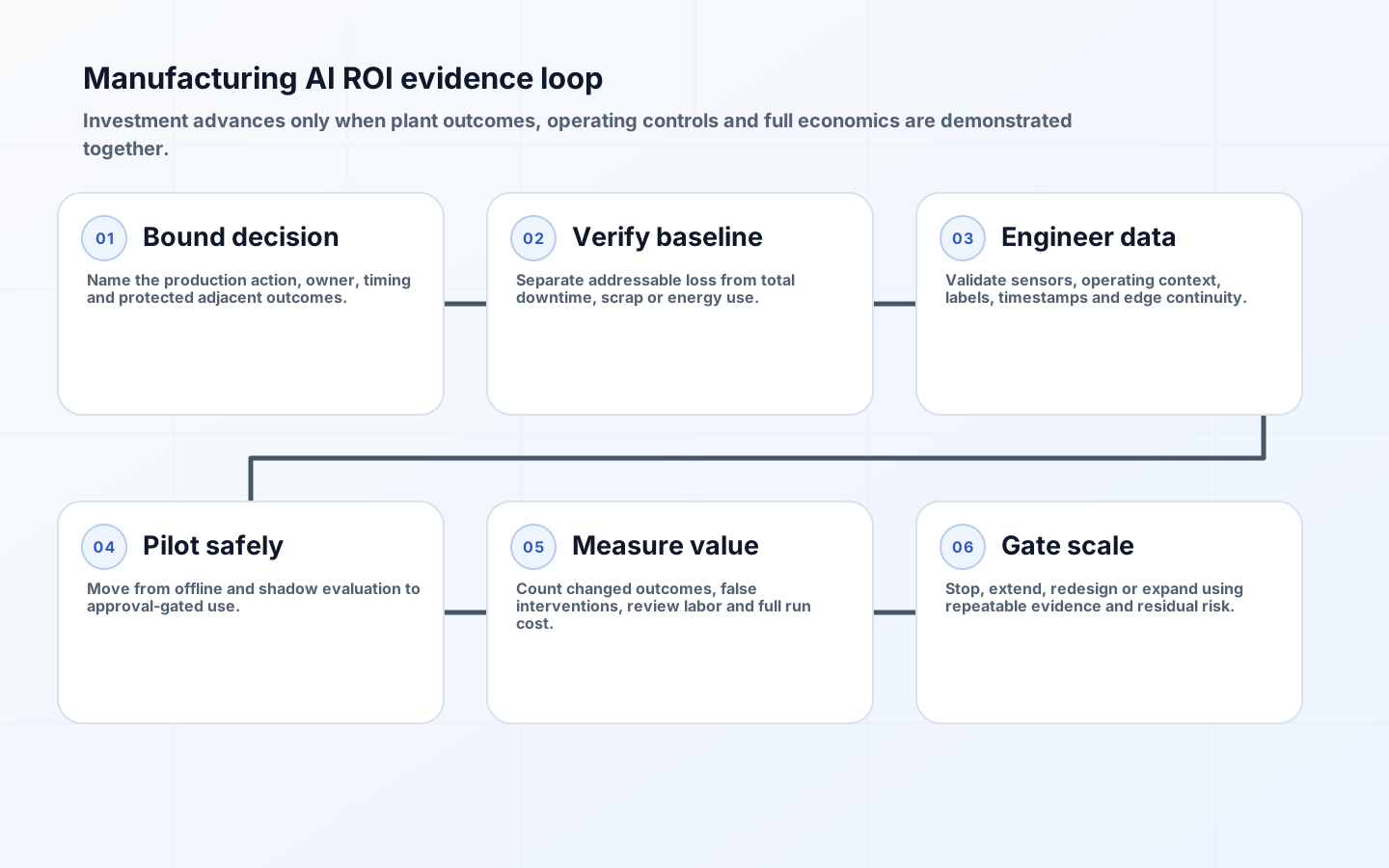
Separate addressable loss from total loss. A model cannot recover time caused by unavailable material if its scope is equipment health. Estimate the frequency, duration and economic consequence of only the events the proposed intervention can influence. Keep confidence ranges visible; a low-frequency failure may require a longer observation window than the budget assumes.
3. Audit data and integration readiness
Trace each required signal from physical process to model input. Document sensor range, calibration, sampling, timestamp, unit, missing-value behavior and equipment context. Join measurements to asset, product, batch, recipe and maintenance events with stable identifiers. A high-volume time series is not automatically useful if labels are delayed or operating states are missing.
Assess whether historical data represents the future operating envelope. Equipment upgrades, recipe changes and maintenance policies can invalidate old patterns. Plan for edge buffering, network interruption and clock drift. Decide which inference and control functions must remain local when a cloud service is unavailable. The data contract should define validity checks and ownership, not just field names.
4. Model complete economics
Calculate benefit from changed outcomes rather than alerts produced. For maintenance, count avoided lost contribution, reduced secondary damage and better labor or spare-part timing, then subtract unnecessary interventions. For quality, value prevented escapes, rework and inspection labor while pricing false rejects. Use a range for uncertain adoption and event rates.
Include sensors, installation, connectivity, storage, labeling, integration, validation, cybersecurity, licenses, model monitoring, operator training and support. Add the cost of planned retraining and line changes. Discounted cash flow may be appropriate for a multi-year program, but a pilot gate should also show payback, annualized net benefit and sensitivity to the assumptions most likely to move.
| Measure | Calculation | Evidence owner | Common error |
|---|---|---|---|
| Addressable loss | Eligible events × verified consequence | Operations and finance | Using all downtime |
| Realized benefit | Changed outcomes × unit value | Process owner | Counting recommendations |
| Run cost | Infrastructure + support + review + retraining | Product owner | Pricing only the pilot |
| Risk adjustment | Expected cost of false action and failure | Quality or safety owner | Ignoring rare severe outcomes |
| Adoption | Eligible decisions actually influenced | Area supervisor | Assuming universal use |
5. Design a controlled pilot
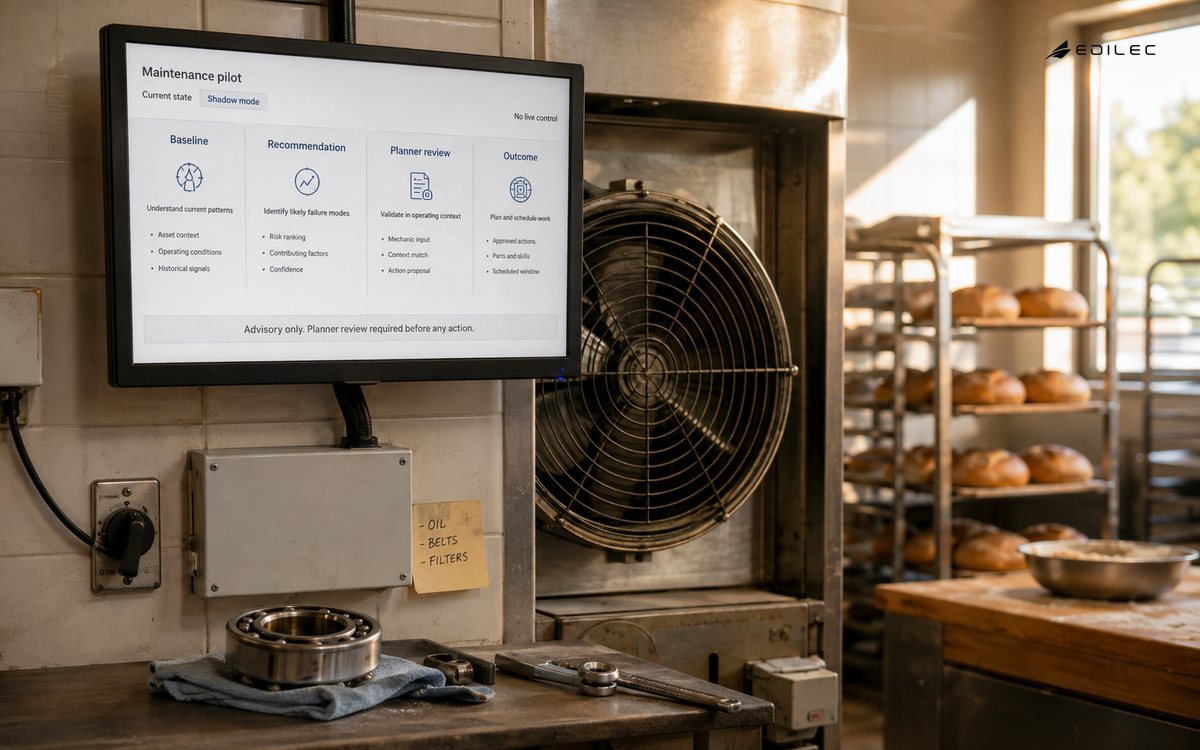
Choose a line or asset with enough events to learn, available domain experts and manageable production risk. Freeze the baseline and success criteria before looking at pilot results. Shadow mode is useful: generate recommendations without acting, then compare them with outcomes and operator decisions. Follow with approval-gated use before any bounded automation.
Compare like with like. If randomization is impractical, use matched periods or assets and document confounders such as maintenance campaigns and product mix. Report uncertainty and every excluded event. Capture latency from signal to decision to action, because a technically correct prediction that arrives after the planning window has no operational value.
6. Govern safety, quality and AI risk
Use the NIST AI RMF functions—Govern, Map, Measure and Manage—to assign policy, context, evaluation and response. Identify affected workers and failure modes. Define prohibited actions, approval thresholds, access controls and an independent path to stop or bypass the system. Preserve the source data, model version, recommendation, human decision and resulting action for material events.
Test across product variants, shifts, lighting, wear states and environmental conditions. Measure false positives and false negatives by operationally meaningful class, not only a blended score. Threat-model sensors, model endpoints and update channels. A safe fallback must be practiced, documented and usable when data quality degrades or the model service is unavailable.
7. Build the operating model before scale
Name owners for the production outcome, data pipeline, model, controls and on-shift response. Define how an operator challenges a recommendation and how that feedback is investigated. Monitoring should cover input validity, drift, latency, alert burden, adoption, false action and the original business result. A model may stay statistically stable while the process around it changes.
Release by asset, line or cohort with explicit pause criteria. Maintain versioned deployment records and a tested rollback or disable path. Standardize reusable components only after the first implementation proves which interfaces and controls are stable. Scaling an unresolved exception process multiplies cost rather than benefit.
Example: predictive maintenance on a constrained line
A plant identifies an oven fan as a recurring source of campaign interruption. Twelve months of records show which failures were detectable and their true production impact. Vibration and temperature streams are joined with operating state and maintenance history. The model first runs in shadow mode; maintenance engineers review alerts and record whether an inspection was justified.
The scale gate requires lead time sufficient for scheduling, a bounded false-alert burden, no missed high-consequence events during the agreed test, and net annual value after sensors and review labor. The first rollout remains advisory. Only after evidence across product campaigns does the plant consider integrating work-order creation, still with planner approval.
Make the scale decision from evidence
The scale review should compare the pilot with its frozen baseline and explain every material difference. Show eligible events, actions taken, avoided loss, false interventions, review labor, model and integration cost, safety or quality incidents and adoption by shift. Include confidence ranges and scenarios for lower event frequency or higher operating cost. Finance validates valuation, while operations validates whether the changed outcome was caused by the intervention.
A successful pilot is not automatically reusable. Confirm that sensors, product mix, maintenance practice, network and operator workflow are comparable at the next site. List the adaptations and revalidation required. The scale package should contain a reference architecture, data contract, evaluation suite, rollout procedure, training, ownership and shutdown criteria. Reusable components reduce effort only when local context remains visible.
Choose among stop, extend, redesign and scale. Stopping is correct when addressable loss is too small or controls make the service uneconomic. Extension is appropriate when evidence is promising but too sparse. Redesign addresses a failed workflow or data path. Scale requires repeatable value and acceptable residual risk, not enthusiasm for the model.
Document the decision in language operators and finance can revisit: expected annual outcome, acceptable range, required review effort, control limits, owner and next validation date. This prevents a pilot's best month from becoming a permanent forecast and makes later sites accountable to the same economic logic.
Related reading
Use AI Automation ROI Planning for portfolio economics, AI Workflow Automation for Manufacturing for delivery scope, and the Manufacturing Automation Checklist for execution controls.
Frequently asked questions
How long should a manufacturing AI pilot run? It should cover representative products, shifts, operating states and enough target events to support a decision. Rare failures may require historical validation plus a longer prospective period; a fixed number of weeks is not evidence by itself.
Can avoided downtime be counted as ROI? Yes, but only for events the intervention can plausibly prevent. Use verified production economics and subtract false interventions, review labor, integration and operating cost. Keep uncertainty visible.
When can AI act automatically on a production process? Only after the action is bounded, validated across the operating envelope, protected by independent limits and paired with a practiced fallback. Advisory or approval-gated operation remains appropriate for many uses.
What should trigger revalidation? Sensor or line changes, new recipes, drift, unusual false actions, security events, degraded outcomes and any change to the model, data contract or action policy should trigger risk-based review.
Key takeaways
- Tie AI to one production decision and protect adjacent safety and quality outcomes.
- Use verified addressable loss, not total downtime, as the economic baseline.
- Price integration, review, monitoring and change management as operating costs.
- Pilot in shadow and approval-gated modes before bounded automation.
- Scale only when outcome evidence, fallback and ownership are repeatable.
Conclusion
Credible manufacturing AI ROI is produced by a controlled change in work, not an impressive model demonstration. Define the decision, verify the loss, engineer the data path, price the whole service and test under real operating conditions. When plants preserve human authority, safety boundaries and outcome evidence, they can distinguish durable automation from experiments that merely move cost elsewhere.