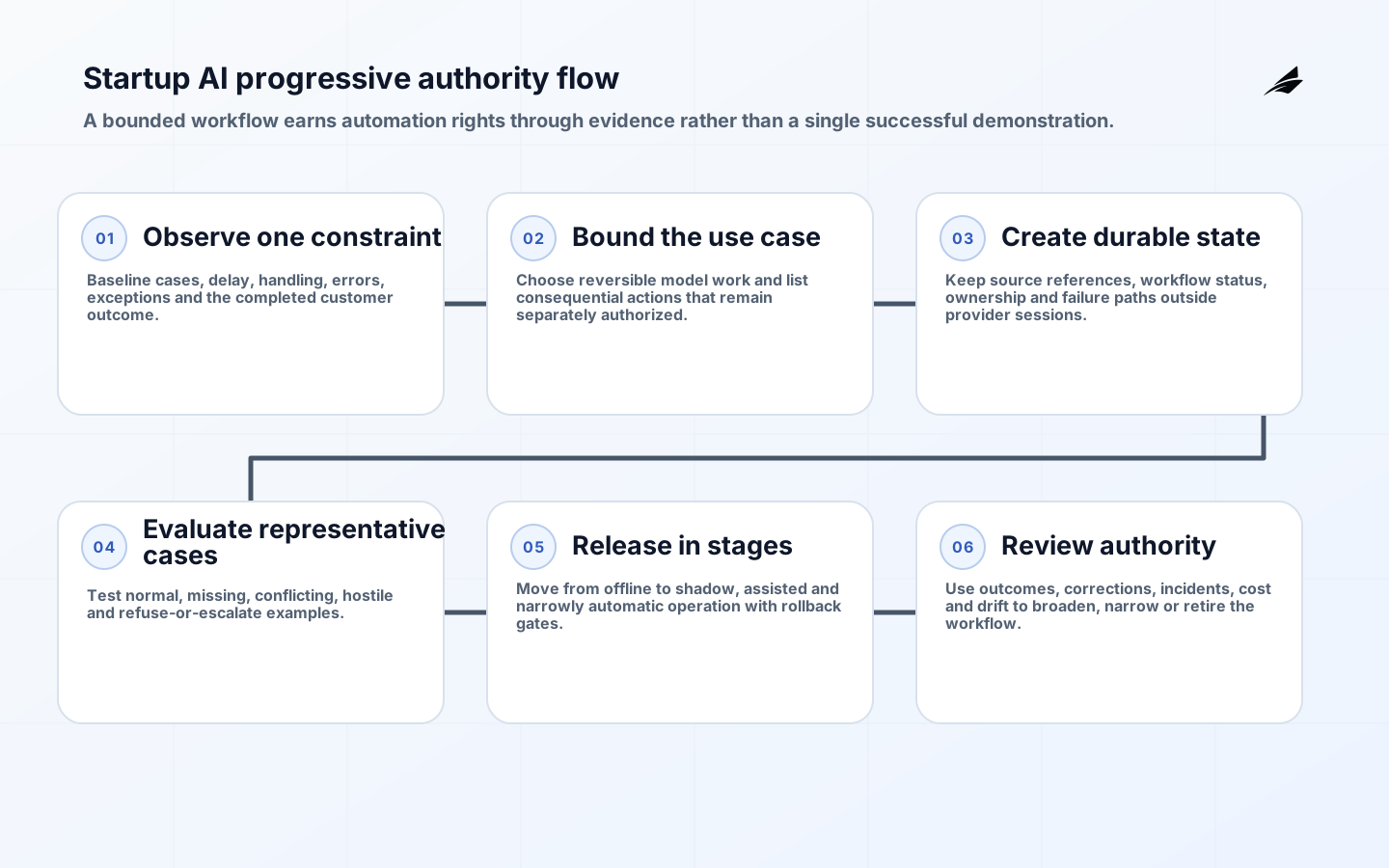
AI workflow automation services for startups are most useful when they remove one measurable operating constraint without creating a second system that nobody can support. A founder may see repeated sales research, support triage, document intake or onboarding checks and conclude that a model should handle all of it. The better starting point is narrower: identify the decision, authoritative records, exception owner and customer outcome for one workflow. Automation can then assist with classification, extraction, drafting or routing while deterministic software and people retain authority over consequential actions.
Use the startup implementation checklist to turn this plan into release evidence and the startup automation FAQ for procurement questions. Teams operating in regulated settings should also compare the healthcare automation delivery plan. The goal is not to mimic an enterprise platform. It is to build a small, inspectable system whose operating cost and authority can grow with evidence.
Select the workflow by evidence and consequence
Observe the work for at least a representative cycle. Count cases, waiting time, handling time, rework, escalations and abandoned outcomes. Record the source systems and the decisions people make when data is incomplete. A good first candidate is frequent enough to measure, bounded enough to test and reversible enough to contain mistakes. Drafting a response from approved sources is usually safer than issuing a credit; extracting fields for review is safer than updating the billing ledger without confirmation.
Define a baseline before promising savings. If support staff spend eight minutes gathering context and two minutes deciding, retrieval and summarization may help; a sophisticated autonomous agent may not. Name the business owner, technical owner and exception owner. State which outcomes are outside scope. This prevents a pilot from quietly expanding from 'suggest a category' to 'change an account' simply because the model can produce a plausible tool call.
| Workflow trait | Favorable first scope | Warning sign |
|---|---|---|
| Input quality | Versioned records with stable identifiers | Important facts live only in private conversations |
| Decision consequence | Reversible suggestion or draft | Irreversible financial, legal or access change |
| Evaluation | Past cases have reviewable outcomes | Success depends on subjective impressions alone |
| Exception ownership | A queue and accountable person already exist | Failures disappear into a shared inbox |
| Integration | One or two documented systems | Many brittle tools with unclear record ownership |
Define what the model may know and do
Draw the workflow boundary before choosing a provider. Identify the system of record, retrieval sources, personal or confidential data, model input, generated output, permitted tools and retained evidence. Minimize context to the case purpose and enforce user permissions before retrieval. Treat external documents and user messages as untrusted content; instructions inside them must not override system policy. OWASP guidance on prompt injection and sensitive information disclosure is directly relevant when the model can search records or call tools.
Move authority into ordinary software. Schema validation, account checks, spending limits, separation of duties, idempotency and approval routing should not depend on the model deciding to obey a prompt. Give each connector the smallest credential and operation set it needs. Require a current-state precondition before a write. Log the input references, model version, route, policy result and final action while avoiding unnecessary retention of sensitive text.
Build a small but operable automation architecture
A startup does not need dozens of services, but it needs clear components. An intake adapter normalizes the case; a workflow store keeps durable state; retrieval returns approved records; a model service performs a bounded task; policy code decides whether the output can proceed; a human queue resolves exceptions; and an action adapter writes to the system of record. Correlation identifiers connect every step. This separation makes it possible to swap a model without rewriting business rules or losing audit history.
Design the unavailable path on day one. If retrieval, the model or a downstream API fails, preserve the case and show the operator what remains undone. Set retry limits and use idempotency keys. Provide an off switch that disables model-assisted actions while keeping manual work available. Monitor queue age, provider latency, token use, tool errors and policy denials. These controls cost less when included in the first thin slice than when added after customers depend on hidden automation.
Release authority in measured stages
Create an evaluation set from representative historical and synthetic edge cases. Include missing data, contradictory records, malicious instructions, unusual customer language and cases that must be refused. Begin with offline evaluation, then shadow production where staff cannot see the recommendation, then assisted work where they can accept or correct it. Low-risk automatic actions come last. Each stage needs acceptance thresholds, rollback criteria and a named decision maker.

Avoid a demo built only from handpicked examples. Test current permissions, actual document formats and realistic dependency failures. Review corrections for patterns: a high error rate in one customer segment may signal missing context or a harmful rule. Store approved prompts, retrieval configuration, policy and model versions together with release evidence. When any of them changes, rerun the cases that protect material outcomes.
Budget the whole workflow, not only inference
The delivery budget includes discovery, integration, data cleanup, evaluation, security review, operator interface, observability and support. Ongoing cost includes model and embedding use, storage, workflow execution, review time, provider minimums and maintenance when source systems change. Estimate low, expected and peak case volumes. Model the percentage that reaches a human and the time saved or added there. A cheaper model is not economical if corrections erase the saving.
| Cost area | Planning question | Control |
|---|---|---|
| Case processing | What is the distribution of context, retries and tool calls? | Set per-stage limits and inspect expensive traces |
| Human review | Which cases require authority or uncertainty resolution? | Measure review minutes and improve the evidence packet |
| Integration | How often do source schemas or permissions change? | Version contracts and monitor failed mappings |
| Quality | What does a wrong answer cost downstream? | Use consequence-weighted evaluation and rollback thresholds |
| Operations | Who responds when the queue or provider fails? | Fund ownership, alerts, runbooks and manual continuity |
Use lightweight governance that can survive growth
NIST organizes AI risk work around govern, map, measure and manage. A startup can apply that cycle without bureaucracy: maintain a one-page use-case record, data map, evaluation report, change log and incident owner. Review provider terms, retention, training use, regional processing and deletion capability. Record why an automated action is allowed and when that approval expires. Customers should be able to understand when AI materially affects a service and how a person can correct the result.
Schedule a monthly operating review while the workflow is young. Examine failures, abstentions, overrides, complaints, privacy events, drift, cost and business outcomes. Remove unused data and permissions. Reconfirm that the workflow still solves the original constraint; a product change may make the automation unnecessary. Governance is effective when it changes scope, controls or rollout decisions, not when it merely produces documents.
Plan provider portability before usage grows. Put model calls behind a service contract, keep prompts and evaluations in company-controlled repositories, and avoid depending on a provider-specific conversation state as the workflow record. Test the approved fallback for rate limits, regional outage and a model retirement notice. Portability does not mean every model produces identical text; it means the startup can preserve business rules, evidence, customer continuity and a controlled migration path when commercial or risk conditions change.
Customer communication also belongs in the release plan. Explain when automation materially shapes a response or action, provide a practical route to human review, and train staff to describe limitations without overpromising intelligence. Track whether customers understand the outcome and can correct wrong data. A transparent experience often reduces support effort because users know which evidence was considered, what remains pending and who owns the next decision.
Keep evaluation ownership independent from delivery pressure. The engineer who tunes a prompt can prepare results, but the workflow owner should approve cases and thresholds that reflect customer consequence. Review both false acceptance and false escalation: excessive caution can destroy value by creating a larger queue, while permissive automation can hide harmful errors. Record disagreements and update the test set when policy or product behavior changes. Include at least one person who understands the affected customer or operational context in threshold reviews.
Key takeaways
- Choose one frequent, bounded and measurable workflow.
- Keep permissions, policy and consequential actions outside the model.
- Build durable case state, failure handling and an off switch into the first release.
- Expand from offline evaluation to assistance and then limited automation.
- Compare full workflow cost with completed outcomes and correction effort.
Frequently asked questions
| Question | Answer |
|---|---|
| How long should discovery take? | Long enough to observe representative work and establish a baseline; for a bounded workflow this is often measured in days or a few weeks, not months. |
| Should a startup build its own model? | Usually start with a managed model behind a provider-neutral service boundary; invest in proprietary modeling only when data, economics and differentiation justify it. |
| Can a no-code tool be production-ready? | Yes for low-consequence workflows if identity, permissions, data handling, retries, evidence and ownership are still explicit. |
| What is a useful first metric? | Measure time and correction effort per successfully completed case against the pre-automation baseline. |
| When should the team stop? | Stop or narrow scope when source data remains unreliable, harmful errors cannot be controlled, or operating cost exceeds demonstrated value. |
Conclusion
AI workflow automation services for startups work best as disciplined product delivery, not a shortcut around process design. Bound the decision, preserve authoritative records, release authority gradually and fund the unglamorous operating controls. A small automation that staff can understand, correct and support is a stronger foundation than an ambitious agent whose value and risk cannot be measured.