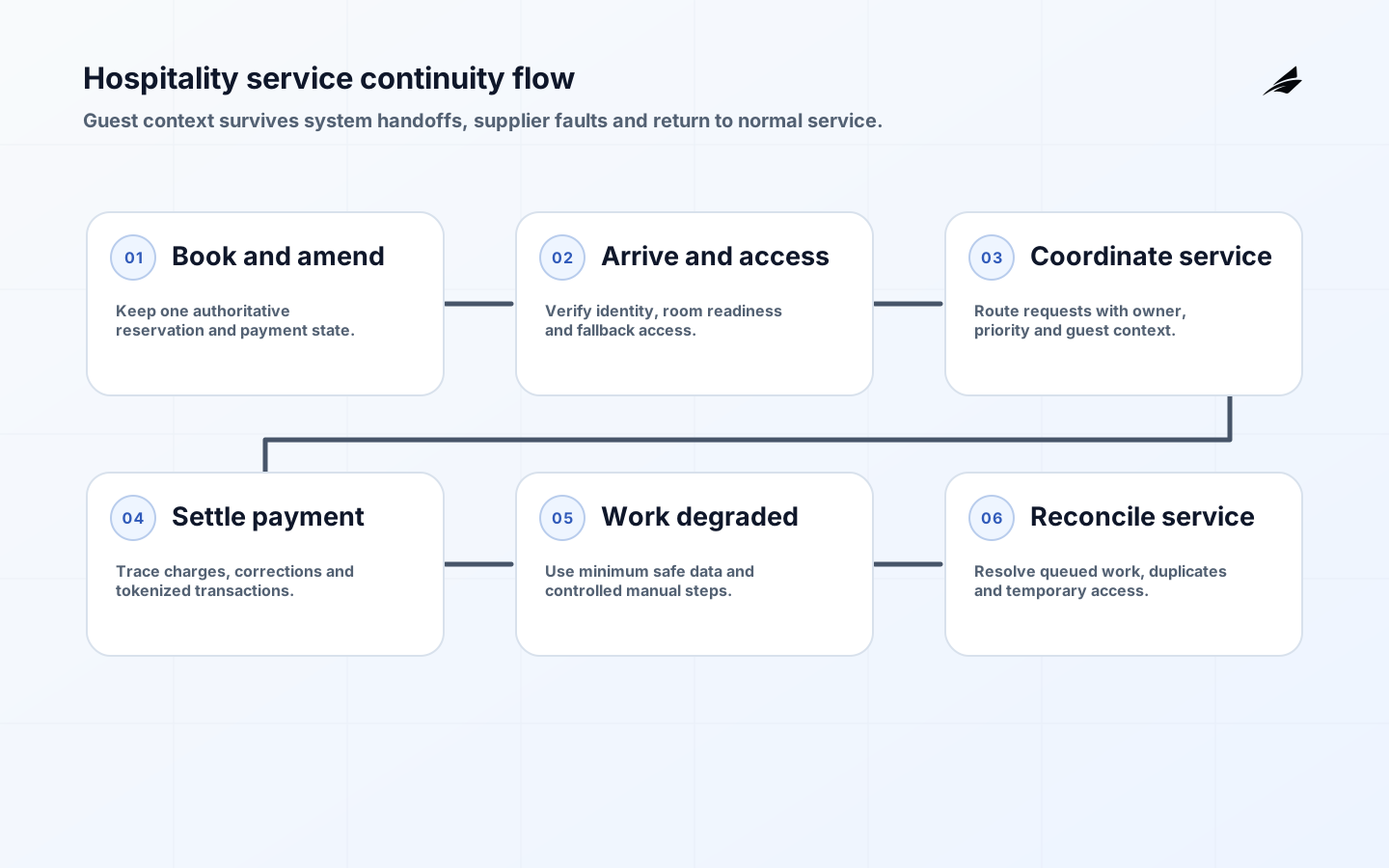
Hospitality technology services connect reservations, guest identity, rooms, payments, food and beverage, maintenance, messaging and management reporting. The goal is not to replace hospitality with automation. It is to give staff reliable context, remove avoidable handoffs and recover gracefully when a device, integration or supplier fails. This hospitality technology FAQ helps hotel, resort and service operators decide what to modernize, how to protect guest and payment data, and which operational evidence matters. Use it with Edilec's hospitality implementation checklist, business process controls guide and business process services FAQ.

Key takeaways
- Map complete guest and staff journeys before selecting systems.
- Treat the property-management system as a system of record, not the only workflow tool.
- Minimize payment and identity data exposure across integrations and devices.
- Design offline and manual continuity for front-desk, access and service operations.
- Measure guest outcomes, staff workload, data quality and recovery together.
What belongs in a hospitality technology scope?
Start with journeys: discover and book, amend or cancel, arrive, access the property, request service, pay, depart and resolve a later dispute. Map the staff journey beside each guest step because the same event can cross reservations, front desk, housekeeping, engineering, food service, finance and loyalty operations. Record the authoritative system, required data, timing, fallback and owner at every handoff. A new mobile experience cannot compensate for an inaccurate room state or a reservation update that never reaches the property.
Separate core records from channels and operational workflows. The property-management or reservation platform may hold the booking and folio, while a service platform coordinates tasks and a customer platform manages permitted communications. Avoid copying complete guest profiles into every tool. Define stable identifiers, event contracts and reconciliation. Include kiosks, door systems, point-of-sale terminals, telephony, Wi-Fi and staff devices in the scope because failures at these edges are experienced as one service by the guest.
| Journey | Systems involved | Failure question |
|---|---|---|
| Book or amend | Booking engine, CRS, PMS, payment | Can staff see one authoritative reservation state? |
| Arrive and access | PMS, identity, kiosk, door system | What works when a device or network is unavailable? |
| Request service | Messaging, tasking, rooms, staff device | Is ownership and guest context preserved? |
| Depart and dispute | PMS, POS, payment, finance | Can every charge and correction be traced? |
How should privacy, payments and accessibility be handled?
Collect the minimum guest data needed for a stated purpose and retain it only as long as justified. NIST's Privacy Framework provides a risk-management structure for identifying and governing data processing. Map what is collected at booking, check-in, Wi-Fi access, messaging, loyalty and physical access, including data handled by suppliers. Give staff role-based views rather than broad profile access, log sensitive actions and provide a clear route for correction, export or deletion where applicable law and policy require it.
Payment design should reduce the environment in which card data can appear. The PCI Security Standards Council document library identifies PCI DSS v4.0.1 as the current standard and provides validation material. Use approved payment devices and hosted or tokenized flows where suitable, segment payment functions, and prevent card details from entering notes or chat. Digital booking and service interfaces should also be designed and tested against WCAG 2.2, including keyboard operation, clear errors, accessible authentication and alternatives to drag-only interaction.
What makes hospitality integrations dependable?
An interface contract should define event meaning, required fields, ordering, duplicate handling, retry behavior, time zones and ownership. Reservation and room-state events are especially sensitive to delayed or repeated messages. Use idempotent updates where possible and retain correlation identifiers so staff can trace a booking across systems. Reconcile important totals and states rather than assuming a successful API response proves business completion. Monitor queue age, rejected records and mismatches, not only endpoint availability.
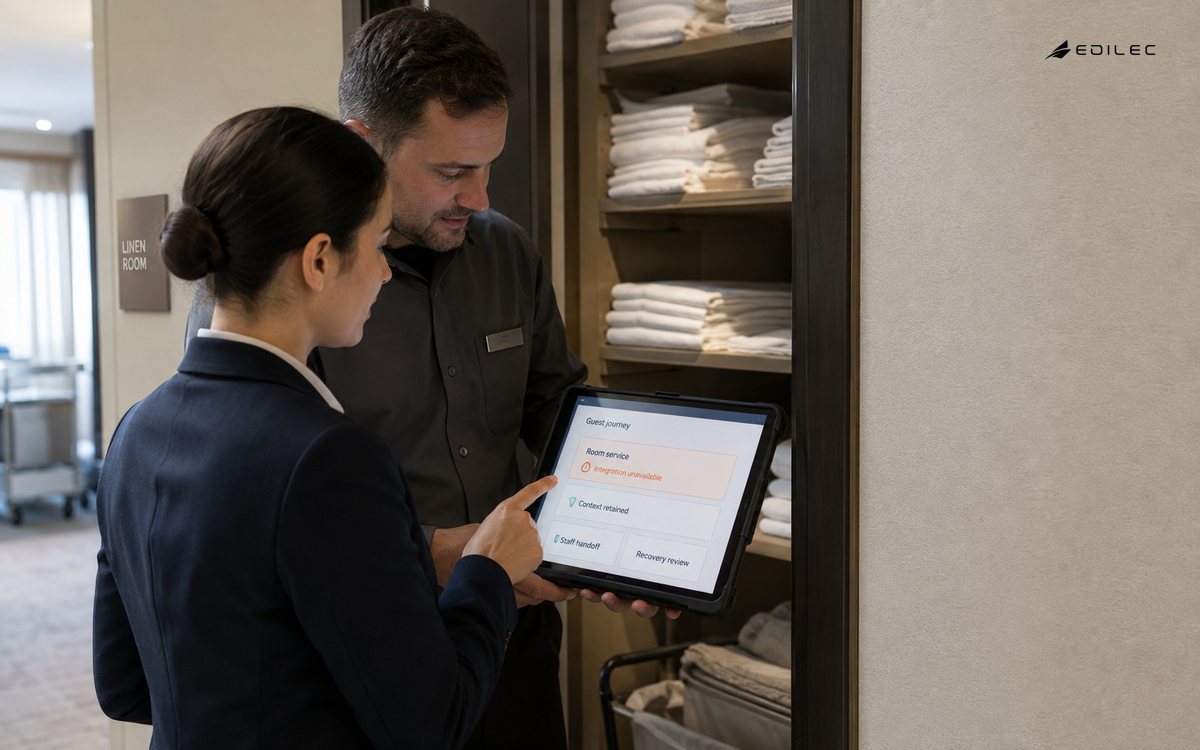
Properties need continuity plans for internet, supplier and device failure. Decide how staff verify a reservation, issue access, post essential charges, record consent and protect later reconciliation when a system is unavailable. Cache only the minimum safe data and define expiry. Practice restoring normal service: import queued work, resolve duplicates, review temporary access and communicate corrected records. CISA Secure by Design reinforces that suppliers should take responsibility for customer security outcomes; procurement should ask about safe defaults, vulnerability handling and supported lifetimes.
| Risk | Control | Evidence |
|---|---|---|
| Duplicate or delayed event | Idempotency, queue monitoring and reconciliation | Matched records and aged-exception report |
| Excess guest access | Role views and sensitive-action logging | Access review and sampled audit events |
| Payment-data spread | Tokenized flow and segmented devices | Data-flow review and scan or assessment result |
| Supplier outage | Degraded procedure and return-to-service plan | Exercise record and reconciled backlog |
How should a hospitality rollout be delivered?
Pilot an end-to-end journey at a representative property rather than enabling isolated modules everywhere. Include high occupancy, group bookings, room moves, split payments, accessibility needs, late arrival and service recovery. Test with front-desk, reservations, housekeeping, finance, security and engineering staff on the devices they actually use. Establish baseline measures before the pilot so speed improvements do not hide more corrections or poorer guest outcomes.
Roll out by property or bounded capability with explicit entry and exit criteria. Prepare training by role and shift, local support coverage, supplier escalation, data migration reconciliation and rollback. Do not schedule a major cutover solely around technical readiness; consider occupancy, events and staffing. The OWASP Application Security Verification Standard can help teams state testable application security requirements for custom portals and integrations. Record deviations and turn successful local workarounds into reviewed operating guidance.
How should operators compare suppliers and results?
Compare suppliers with operational scenarios, not feature counts. Ask candidates to demonstrate a reservation amendment, identity correction, room move, failed payment, interface outage and privacy request. Inspect audit history, export options, role design, API limits, release practices and exit support. Confirm data ownership and how records can be retrieved in usable form. A supplier that supports ordinary demonstrations but cannot explain reconciliation or degraded operation may transfer substantial hidden work to property teams.
Measure the joined service: booking completion, check-in time, room-ready accuracy, service-response time, first-contact resolution, payment exceptions, integration backlog, manual corrections and guest complaints attributable to technology. Segment by property, channel and accessibility path before drawing conclusions. Review staff workload and unsafe workarounds alongside guest metrics. The financial services implementation checklist offers additional control ideas for payment-sensitive workflows, but hospitality thresholds must reflect each property's service model.
Ownership after deployment should mirror the guest journey. Name a product owner for each major capability and a local operational owner at every property or service cluster. Central technology teams can maintain integration standards, identity, device baselines and supplier management, while property leaders validate that workflows still fit staffing and service commitments. Establish a route for staff to report a data mismatch or unsafe workaround without filing a vague infrastructure ticket. Triage should preserve the reservation, room, folio or service-request identifier while avoiding unnecessary guest details. Review recurring corrections as product evidence; repeated manual repair often identifies a flawed state model, training gap or supplier contract rather than individual error. Confirm the same support route works overnight, when staffing, supplier availability and guest tolerance are different from daytime conditions.
Procurement should include lifecycle and exit conditions. Confirm supported device and browser versions, upgrade notice, API compatibility, maintenance windows, data export format, deletion evidence and assistance when a property changes operator or brand. Ask how the supplier handles vulnerability reports and emergency fixes, and whether security controls are included in the base product or sold as optional features. For connected rooms and physical devices, inventory firmware, network dependency and replacement lead time. Test decommissioning on a pilot property: revoke integration credentials, remove staff access, preserve records that must be retained and prove the old endpoint no longer receives events. These steps keep a technology change from becoming a guest-service or privacy incident months after the visible cutover. Include housekeeping and engineering dispatch in acceptance because room readiness depends on accurate task state, priority and completion evidence. Verify that supervisors can reassign work, reopen a prematurely closed task and distinguish a guest-facing delay from an internal maintenance backlog. For multi-property groups, test local configuration without allowing property-specific codes and workflows to make consolidated reporting meaningless. Define a controlled master-data process for room, outlet, package, tax, staff-role and service-category changes, then sample those mappings after every major release.
Frequently asked questions
Should a hotel replace its PMS first?
Not automatically. Start from the operational constraint and journey. A PMS replacement may be justified when the record model, interfaces or support lifecycle blocks improvement, but many problems come from weak process design, duplicated data or unclear integration ownership.
Can guest messaging be fully automated?
Routine status and information can be automated when identity, consent, approved content and escalation are reliable. Complaints, safety concerns, accessibility requests and ambiguous or high-impact actions need a clear human route.
What data should a hospitality dashboard show?
Show measures tied to a role and decision: room-state exceptions for operations, unresolved service requests for supervisors, payment exceptions for finance and material journey trends for leaders. Include freshness and affected-property context.
How should seasonal properties plan cutover?
Use the low-risk period for migration and training, but exercise peak-volume scenarios before opening. Confirm supplier coverage, local fallback materials, device spares and reconciliation ownership before demand returns.
Conclusion
Hospitality technology services should make the guest journey more coherent and staff work more recoverable. Map real handoffs, limit sensitive data, specify integration behavior and keep practical continuity for property operations. Pilot whole journeys, compare suppliers through failure scenarios and measure whether the system improves service without creating hidden correction work. Technology earns its place in hospitality when it gives people reliable context and more time to deliver care, judgment and recovery.