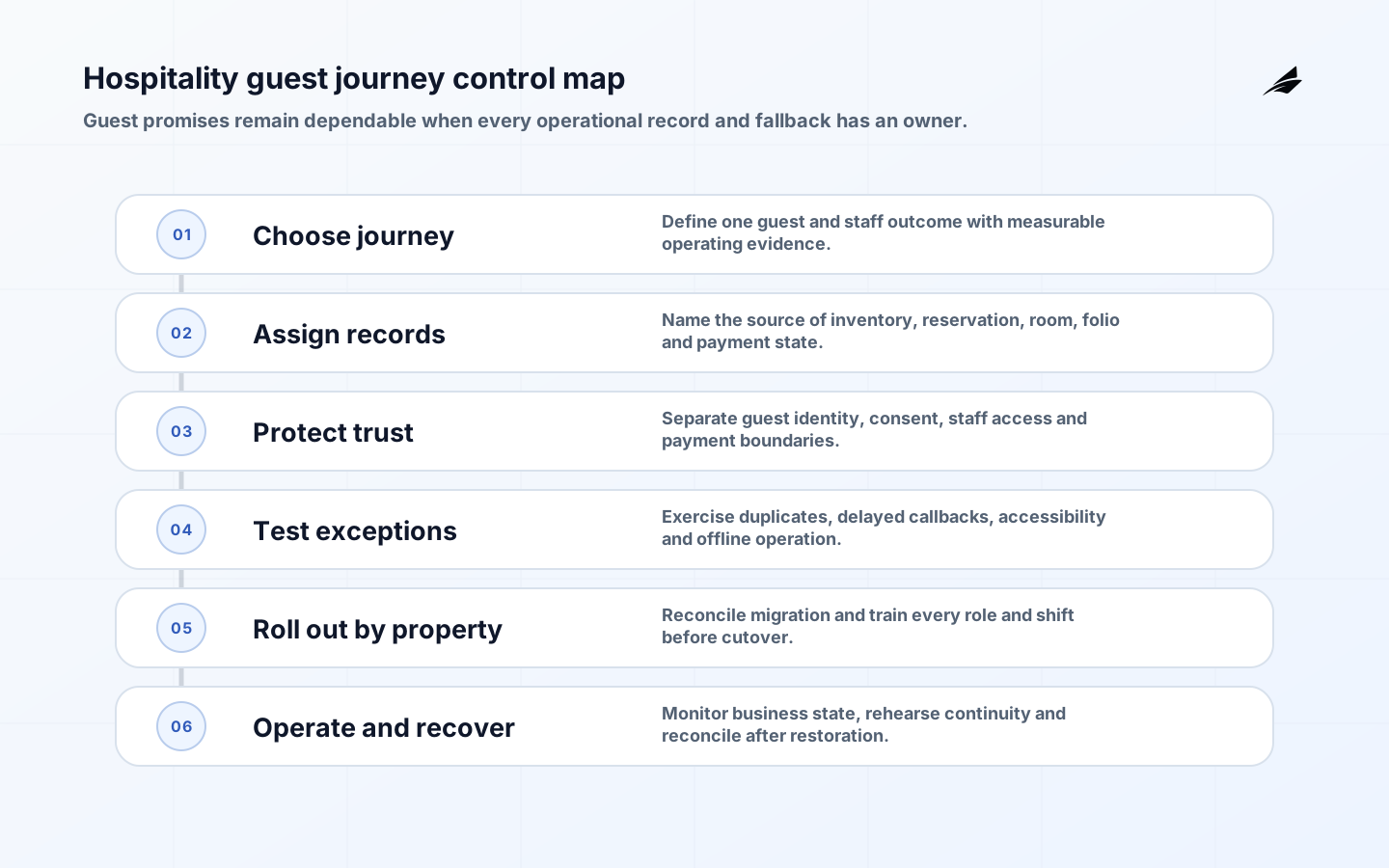
Hospitality technology connects a guest promise to a physical operation. A reservation may begin on a marketplace, pass through a central reservation system, update a property-management system, authorize a payment, change housekeeping work and later feed loyalty and finance records. A successful implementation therefore cannot be judged by whether the new screen works. It must preserve inventory, rate, identity, payment and service state across channels while staff can still operate during network, provider or device failures.
This checklist is for hotels, serviced properties and multi-location service businesses replacing or integrating reservation, property, point-of-sale, guest, workforce and reporting systems. Use it with the hospitality technology FAQ and the business process implementation checklist. The implementation should follow real guest journeys and operating shifts, not a vendor feature list.
Define guest and operating outcomes before selecting systems
Choose a bounded journey such as direct booking to check-out, group reservation to invoice, or service request to completion. Name the guest, front-desk, reservations, housekeeping, food-and-beverage, finance and support decisions in that journey. Baseline conversion, check-in time, room-ready accuracy, payment exceptions, service-response time and reconciliation effort. These measures prevent the program from becoming a broad modernization promise with no accepted operational result.
Document nonfunctional constraints early: seasonal peaks, twenty-four-hour operations, multilingual content, accessibility, regional tax, identity rules, cardholder-data scope and property connectivity. A workflow used at a city hotel may fail at a remote property with intermittent links. Distinguish capabilities that must continue locally from those that can wait for central services. Agree which manual fallback is safe and how later synchronization avoids duplicate reservations or charges.
| Journey moment | Authoritative record | Acceptance question |
|---|---|---|
| Search and quote | Inventory and rate service | Is availability consistent across channels? |
| Booking | Reservation record | Can retries avoid duplicate bookings? |
| Arrival | Property-management system | Can staff verify identity and room state? |
| Stay request | Service workflow | Is ownership and escalation visible? |
| Checkout | Folio and payment records | Do charges, tax and settlement reconcile? |
Map systems of record and integration contracts
For every field, name the owner and synchronization direction. Inventory, rate, restriction, reservation, guest profile, room status, folio, payment token, loyalty balance and invoice often belong to different systems. Do not let an integration silently become a second master. Use stable identifiers and explicit mappings for property, room type, rate plan, guest, reservation and transaction. Record the source timestamp and version so stale updates can be detected rather than applied blindly.
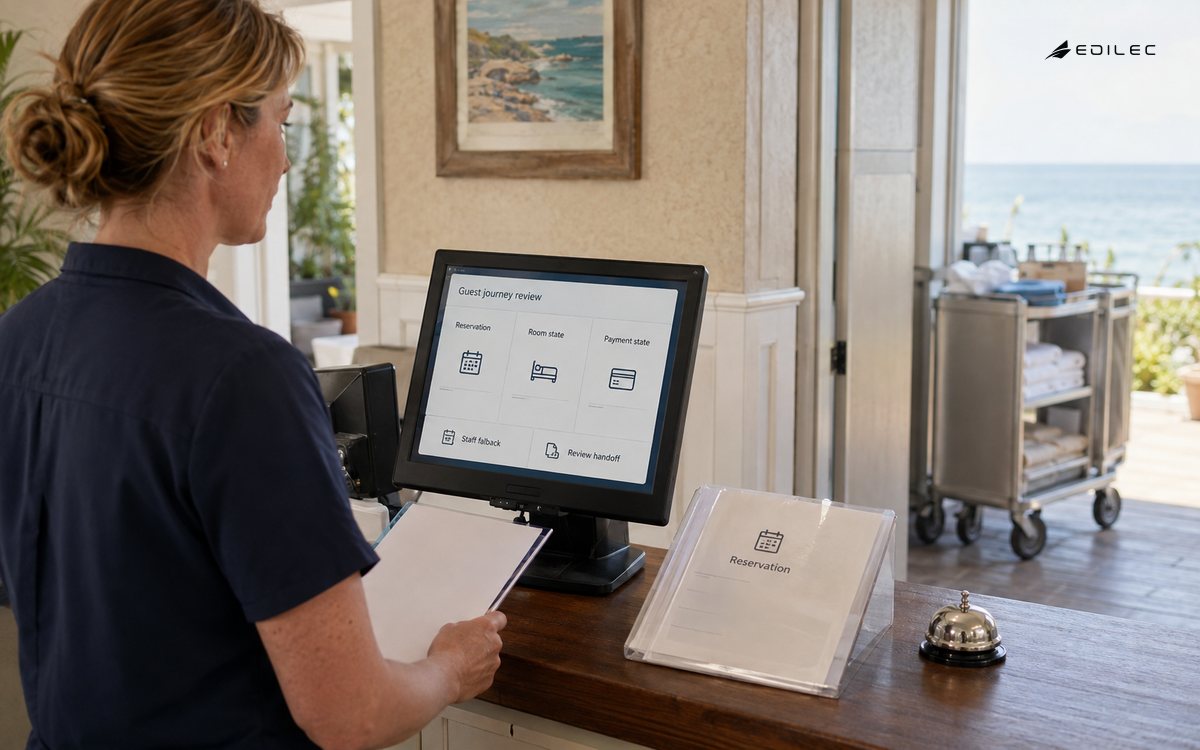
OpenTravel specifications provide shared hospitality messages, but a standard schema does not remove local meaning. Document required and optional fields, time zones, currencies, taxes, cancellation terms and code translations. Define idempotency for create and modify operations, acknowledgement semantics, retry limits and dead-letter handling. A timeout is an unknown outcome until the receiving system is queried. Operators need an exception queue with the business context required to repair records safely.
Protect guest identity, consent and payment boundaries
Collect only data needed for the stay, service and lawful obligations. Separate booking contact, staying guest, payer, loyalty member and corporate account; they may be different people. Define consent and preference sources, retention and deletion rules, and who may merge profiles. Avoid exposing passport, payment or special-request details to roles that only need operational status. Support staff should see enough context to help without receiving unrestricted database access.
Reduce cardholder-data scope by using payment-provider tokens and hosted or certified payment components where appropriate. Never place full credentials in reservation notes, logs, analytics or test data. PCI DSS responsibilities depend on the actual payment flow and service providers. Protect refunds, manual entries, device pairing and payment-link changes with strong authentication and approval. Reconcile authorization, capture, adjustment, refund and settlement as distinct states.
Test the complete guest experience across devices and channels
A booking path must work for keyboard, screen-reader, zoom, mobile and low-bandwidth users. WCAG 2.2 provides testable accessibility criteria, but automated scans cannot judge every label, focus sequence or error message. Test dates, occupancy, room selection, add-ons, account creation, payment failures and confirmation with representative assistive technologies. Keep prices, mandatory fees, cancellation terms and availability understandable at the point of decision.
Test channel consistency. A direct website, mobile app, call center and marketplace may each cache inventory or terms differently. Use contract tests for integration payloads and end-to-end tests for a small set of high-value journeys. Include late arrival, room move, partial cancellation, split folio, offline terminal, no-show and duplicate provider callback. Confirm that guest communication reflects the authoritative state, not merely the request the interface attempted.
| Test scenario | Expected operating behavior | Evidence |
|---|---|---|
| Duplicate booking request | One reservation and one confirmation | Shared idempotency reference |
| Property link unavailable | Safe local workflow and queued sync | Offline drill plus reconciliation |
| Payment callback delayed | Status remains pending until verified | Provider lookup and no duplicate capture |
| Room moved after check-in | Housekeeping, access and folio agree | Cross-system state trace |
| Guest requests data action | Identity verified and records located | Completed request audit |
Roll out by property with rehearsed cutover controls
Prepare data migration as an operational event. Profile reservations, profiles, rates, room inventory, folios, deposits and future groups. Define which history moves, which remains read-only and how staff retrieve it. Reconcile counts and financial totals before and after migration. Freeze risky configuration changes near cutover and establish a command center with named authority for go, pause and rollback decisions.
Pilot a representative property rather than the easiest one. Train by role and shift using actual scenarios, including night audit, failed integrations and guest complaints. Run old and new reports in parallel where discrepancies would affect finance or service. Rollout gates should include staff readiness, interface health, reservation reconciliation, payment settlement, support coverage and restoration evidence. A calendar date alone is not a readiness criterion.
Build security and resilience into daily operations
Use the NIST Cybersecurity Framework to assign governance, asset, protection, detection, response and recovery work. Inventory property devices, servers, integrations, vendor access and internet-exposed services. Segment guest, payment, corporate and operational networks. Require individual administrative identities, multifactor authentication, time-bounded vendor access and centralized logging. Patch plans must account for systems that cannot be stopped during a shift.
Define recovery by guest consequence. Losing a marketing report is different from losing room access, reservation lookup or payment capability. Test local continuity, backup restoration, alternate communications and provider escalation. During an outage, staff need a short approved procedure, current contacts and a method to capture actions for later reconciliation. After restoration, compare reservations, room state, folios and payment events before declaring recovery complete.
Accept the service with measurable ownership
Create one service map that names business owner, technical owner, vendor, hours, dependencies, monitoring, runbook and escalation for each critical capability. Dashboards should show booking failures, synchronization lag, stale room state, payment exceptions, device health and support queue age. Avoid a single availability percentage that hides incorrect inventory or financial mismatch. Review recurring exceptions with product and property leaders, not only IT.
Acceptance requires staff to complete representative journeys without project-team intervention. Reservations should resolve an oversell or channel mismatch; front desk should handle a payment exception; housekeeping should recover a stale task; finance should reconcile a day; support should trace a failed message; and technology teams should restore a service. Record unresolved risks with owners and expiry instead of calling them future enhancements.
Use a shift-ready acceptance checklist
Before each property goes live, verify future reservations, in-house guests, deposits, room status, rates, packages, users, devices and open service work. Confirm that direct and partner channels receive the intended inventory and terms. Complete a booking, modification, cancellation, arrival, room move, service request, split folio, refund and checkout. Reconcile reservation counts and financial control totals. Record every mismatch with an owner and decide whether it blocks launch rather than accepting unexplained differences as normal migration noise.
Acceptance should cover every staffed shift and a period with supplier support available. Night audit, housekeeping and finance often reveal different gaps from daytime front desk. Confirm accessible guest flows, local outage materials, emergency contacts, spare devices and credential recovery. The cutover lead should know the point after which rollback would create more data conflict than forward repair. A signed checklist is useful only when it links to observed results, not self-attested task completion. Retain the reconciliation workbook, issue decisions and system timestamps as the launch evidence set.
Key takeaways
- Implement around complete guest journeys and operating shifts.
- Assign one authoritative system to every important hospitality record.
- Treat identity, payment and vendor access as explicit security boundaries.
- Pilot with real failure scenarios and reconcile before each property rollout.
- Measure correct inventory, payment and service state, not uptime alone.
Frequently asked questions
Should a hotel replace every system at once?
Usually not. Sequence changes around stable interfaces and one measurable journey. A property-management replacement may require coordinated reservation, payment and access work, but loyalty, marketing or reporting can often move separately if ownership and reconciliation are explicit.
How long should parallel operation continue?
Long enough to cover the business cycles that matter, such as daily settlement, month-end or a high-demand event. Parallel work should compare defined totals and exceptions; running two systems without a reconciliation plan merely doubles effort.
What proves a property is ready to go live?
Reconciled migrated records, trained staff on every shift, healthy integrations, tested payment and outage scenarios, current runbooks, staffed escalation and a demonstrated restoration path are stronger evidence than completion of configuration tasks.
Conclusion
Hospitality implementation succeeds when technology preserves the guest promise through every operational handoff. Clear record ownership, safe payment boundaries, accessible journeys, property-level resilience and rehearsed cutover turn a collection of systems into a dependable service. The best rollout makes exceptions visible and gives staff a safe action when a provider, network or record does not behave as planned.