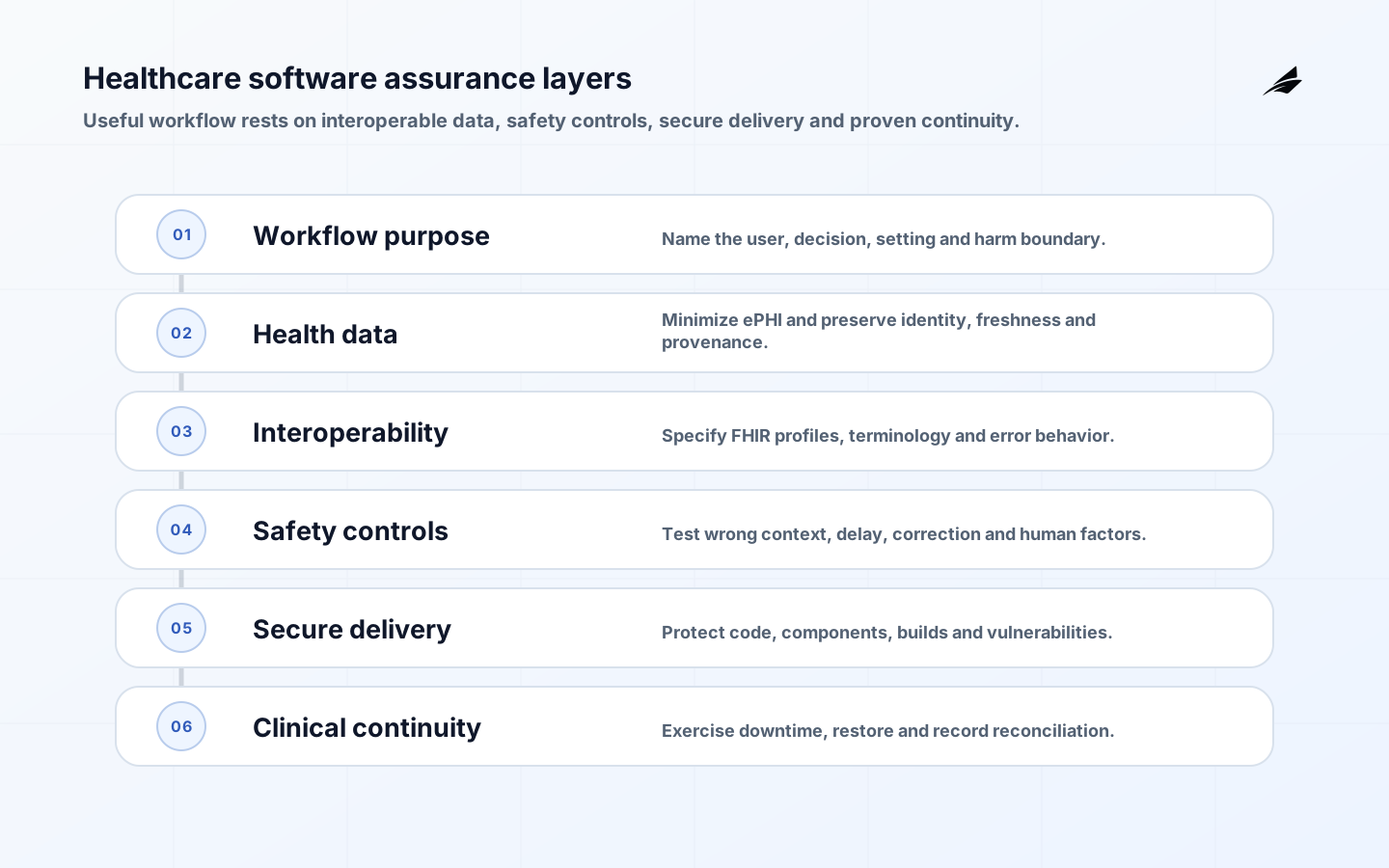
Custom software development services for healthcare must improve a clinical or administrative workflow without weakening safety, privacy, interoperability or continuity. The useful starting point is a bounded user need and the health information required to meet it, not a broad promise to build a platform. This FAQ explains how healthcare organizations should scope a custom product, assign regulated responsibilities, use standards, validate clinical risk and operate the result. It extends Edilec's healthcare software scope and delivery guide, healthcare implementation checklist and manufacturing software implementation checklist for teams comparing rigorous system delivery.
Key takeaways
- Define the care or operational decision, user and harm scenario before features.
- Map every ePHI flow and regulated party, including cloud and support suppliers.
- Use implementation guides and conformance tests rather than claiming generic FHIR support.
- Validate workflow safety, security, accessibility and downtime behavior with real roles.
- Retain product ownership, evidence and an exit path even when development is outsourced.
What should a healthcare software scope contain?
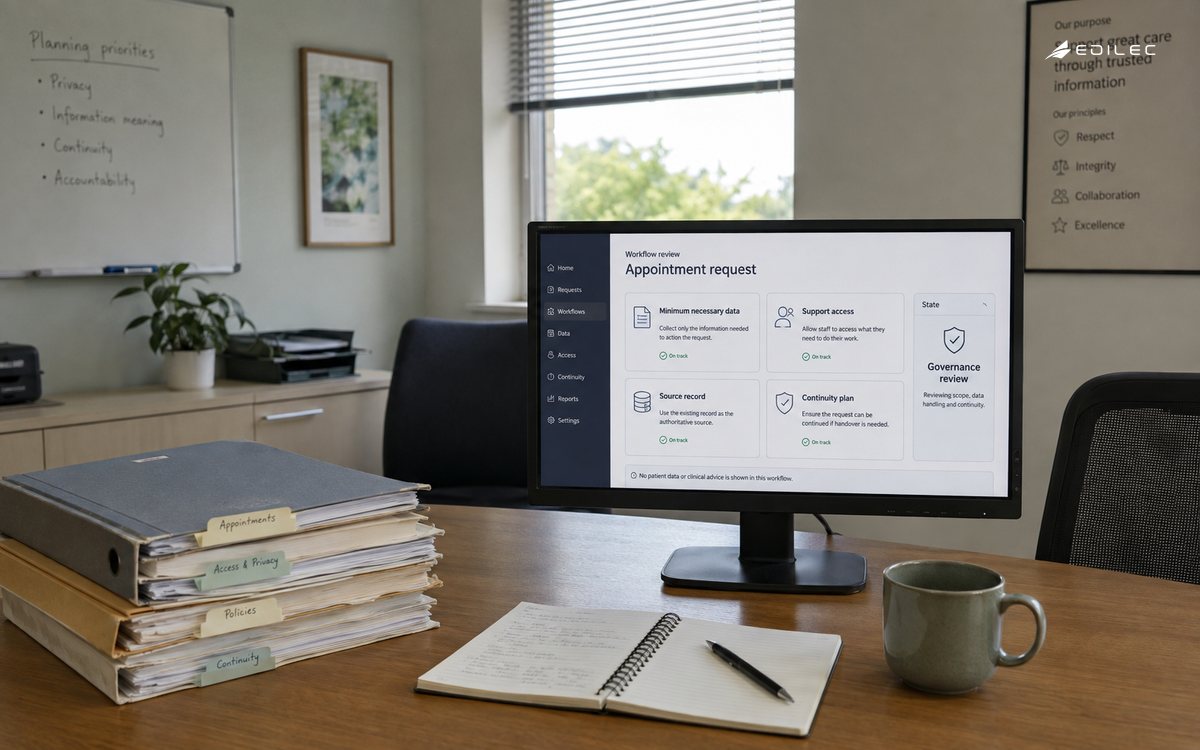
Describe the user, setting, decision and current failure. A medication reconciliation aid, referral queue and patient scheduling service have different evidence and safety needs even if all integrate with an electronic health record. Map normal and exceptional workflows, including corrections, late data, duplicate patients, unavailable dependencies and after-hours escalation. Define what the product will not decide. Clinical, privacy, security, accessibility and operations representatives should review the boundary before architecture is fixed.
Classify the software's role and jurisdiction with qualified legal, compliance and clinical owners. Do not assume every healthcare application has the same regulatory status. Identify covered entities, business associates or corresponding local roles; establish contracting and permitted-use constraints before realistic data enters development. The HHS Security Rule summary explains that regulated entities need administrative, physical and technical safeguards for ePHI, while the applicable rule text and organizational advice govern the specific implementation.
| Scope element | Question | Acceptance evidence |
|---|---|---|
| Workflow | Which user and decision improve? | Observed scenario with named owner |
| Information | Which data is necessary and authoritative? | Reviewed flow, classification and reconciliation |
| Safety | What plausible failure could cause harm? | Hazard controls and simulated failure |
| Operations | How does service continue and recover? | Downtime and restore exercise |
How should health data and interoperability be designed?
Create a data-flow inventory covering collection, import, derivation, storage, display, export, logs, analytics, support and deletion. HHS risk-analysis guidance says the scope includes all ePHI an organization creates, receives, maintains or transmits and that analysis should be ongoing. Use minimum necessary data, separate production from lower environments, synthesize test records where feasible and define who can inspect support telemetry. Verify backups and exports preserve the context needed for safe interpretation.
HL7 FHIR R5 is a healthcare data-exchange standard, not a guarantee that two products share the same workflow meaning. Specify FHIR version, implementation guide, resource profiles, terminology bindings, search behavior, subscriptions, error handling and capability statements. Test against representative records and the receiving system. Map identifiers and provenance, handle partial or late information and define reconciliation. The FHIR security and privacy module describes building blocks such as consent, audit events, provenance and security labels while leaving deployment controls to implementers.
How are safety, security and accessibility verified?
Maintain a hazard-oriented risk register. Consider wrong-patient selection, stale data, unit or time-zone error, hidden alert, inaccessible control, automation bias, duplicate action and delayed result. For each, define prevention, detection, containment and recovery. Clinical safety review should examine whether presentation and workflow can lead a reasonable user to act incorrectly, not only whether calculations are accurate. Human-factors sessions need realistic interruption, workload and device conditions. Record residual risk and the accountable person who accepts it.
Use a secure development lifecycle. NIST SP 800-218 organizes practices around preparing the organization, protecting software, producing well-secured software and responding to vulnerabilities. Translate those practices into repository controls, threat models, dependency review, security tests, protected builds, release provenance and a vulnerability-response agreement. Design patient and workforce interfaces against WCAG 2.2 and test with assistive technology and keyboard use. Automated scanning cannot establish complete accessibility or workflow safety.
| Risk | Design response | Verification |
|---|---|---|
| Wrong patient or context | Persistent identity cues and confirmation | Usability test with similar records |
| Stale clinical data | Freshness, provenance and warning state | Delayed-interface scenario |
| Excess ePHI access | Role policy and audited sensitive actions | Representative-account access test |
| Dependency compromise | Verified components and protected build | Dependency and release evidence |
What should delivery and acceptance look like?
Deliver a thin end-to-end workflow into a controlled environment early. It should exercise identity, authorization, representative data exchange, the main user action, audit evidence and an error path. Use clinician and staff time carefully by preparing realistic scenarios and recording decisions. Acceptance criteria should cover data correctness, response time under expected load, role access, audit events, interoperability, accessibility and recovery. A feature demonstration is not acceptance if the team has not tested failed dependencies and corrected records.
Release by site, role or bounded cohort with a monitored rollback. Reconcile source and target records, establish support staffing and give users a visible way to report unsafe behavior. Observe near misses, workarounds and abandoned tasks, not only uptime. Downtime procedures must state what users may do, how temporary records are protected and how work is reconciled later. Practice a restore and a supplier outage before broad use. Keep deployment records and the exact configuration needed to reproduce the released product.
How should a healthcare development partner be governed?
Select a partner through evidence. Ask for a walkthrough from requirement to test and release, a sample threat model, dependency policy, accessibility practice, incident process and healthcare integration example. Clarify ownership of repositories, cloud accounts, designs, test assets and documentation. Contract for business-associate or other required obligations where applicable, security incident reporting, subcontractor transparency, vulnerability handling, continuity, data return and secure deletion. Certifications can support due diligence but do not replace product-specific review.
Govern the product with a cross-functional owner and a regular risk review. Examine safety events and near misses, unresolved vulnerabilities, access exceptions, interface failures, data-quality defects, support themes, availability, restoration evidence and user outcomes. Change control should scale with harm: a text correction and clinical-rule change should not follow identical review. Preserve the ability to change partners through current architecture records, automated deployment, usable exports and documented operational access. Healthcare accountability remains with the organization even when specialist engineering is purchased.
Support design deserves the same rigor as build. Define severity using patient, clinical and operational impact, not only technical component status. Give first-line support safe diagnostic views that reveal version, interface state and correlation identifiers without broad ePHI access. Establish direct escalation to engineering and clinical ownership for suspected harm, wrong-patient behavior or corrupted data. Preserve relevant logs and configuration under an incident hold, communicate known limitations to users and track affected records that may require correction. A service can be technically restored while unsafe outputs or missing work remain; closure therefore needs a business and clinical validation step. Record who performed that validation and which patient or operational cohorts were checked.
Plan maintenance over the full product life. Track language and framework support, third-party components, certificates, interface versions, terminology releases, browser and device compatibility and supplier dependencies. Budget for security updates, conformance regression, accessibility remediation and changes in clinical workflow or regulation rather than treating launch as the end of investment. When retiring the product, identify records that must move, the provenance needed to interpret them, active users and integrations, legal retention, export validation and credential revocation. Rehearse the exit before a vendor dispute or unsupported component creates urgency. A maintained retirement path is part of patient-safety and continuity engineering, not a procurement footnote. Data migration needs clinical validation as well as row counts. Sample active, amended, merged and historical records; verify units, time zones, status, authorship and links to source documents. Reconcile totals and exception queues, then retain the mapping rules and unresolved limitations. If old and new systems operate in parallel, declare which one is authoritative for each record type and how corrections propagate. Give users a visible warning when information is read-only, delayed or sourced from the legacy product, and remove dual-write paths as soon as the approved transition allows.
Frequently asked questions
Is HIPAA compliance a product feature?
No. HIPAA obligations apply to regulated entities and their activities. Software can support required safeguards and evidence, but organizational policies, contracts, risk analysis, configuration and operation determine how it is used.
Should a custom application store a copy of EHR data?
Only when the use case and operating requirements justify it. Minimize fields and retention, define synchronization and correction, protect backups and logs, and make stale or partial data visible. Sometimes a time-bounded cache or on-demand retrieval is safer.
Which FHIR version should a project use?
Use the version and implementation guide required by the target ecosystem and jurisdiction. Confirm the receiving systems' capability statements and test actual profiles and terminology. A decision to use R4, R4B or R5 should be explicit, not inferred from generic support claims.
What belongs in healthcare software acceptance?
Include representative workflow and data correctness, role access, privacy and audit behavior, interoperability errors, accessibility, performance, downtime, restore and support readiness. Acceptance should produce retained evidence, not only stakeholder approval.
Conclusion
Custom software development services for healthcare are credible when they join useful workflow design with demonstrable safety, privacy, interoperability and recovery. Scope one decision and its harm scenarios, minimize health-data movement, specify standards precisely and validate with the people who perform the work. Retain evidence and ownership throughout delivery. A successful custom product is not merely deployed; it remains understandable and supportable when records are incomplete, dependencies fail and patient or workforce needs do not match the happy path. That standard should remain visible in every release and operating review.