A financial services software implementation connects customer journeys, ledgers, payment or policy records, identity, compliance, operations and third parties. A technically successful deployment can still fail if balances do not reconcile, customer communications are wrong, access cannot be revoked or support teams cannot restore service. This financial services software implementation checklist helps banks, insurers, payment firms and fintech teams turn obligations into architecture, tests and accountable production decisions. Legal and regulatory specialists must tailor it to the institution and jurisdiction.
Pair the checklist with Edilec's financial services scope and delivery plan, financial services software FAQ and banking technology delivery guide. Together they connect procurement and architecture choices to implementation evidence.
1. Define the service outcome and regulated boundary
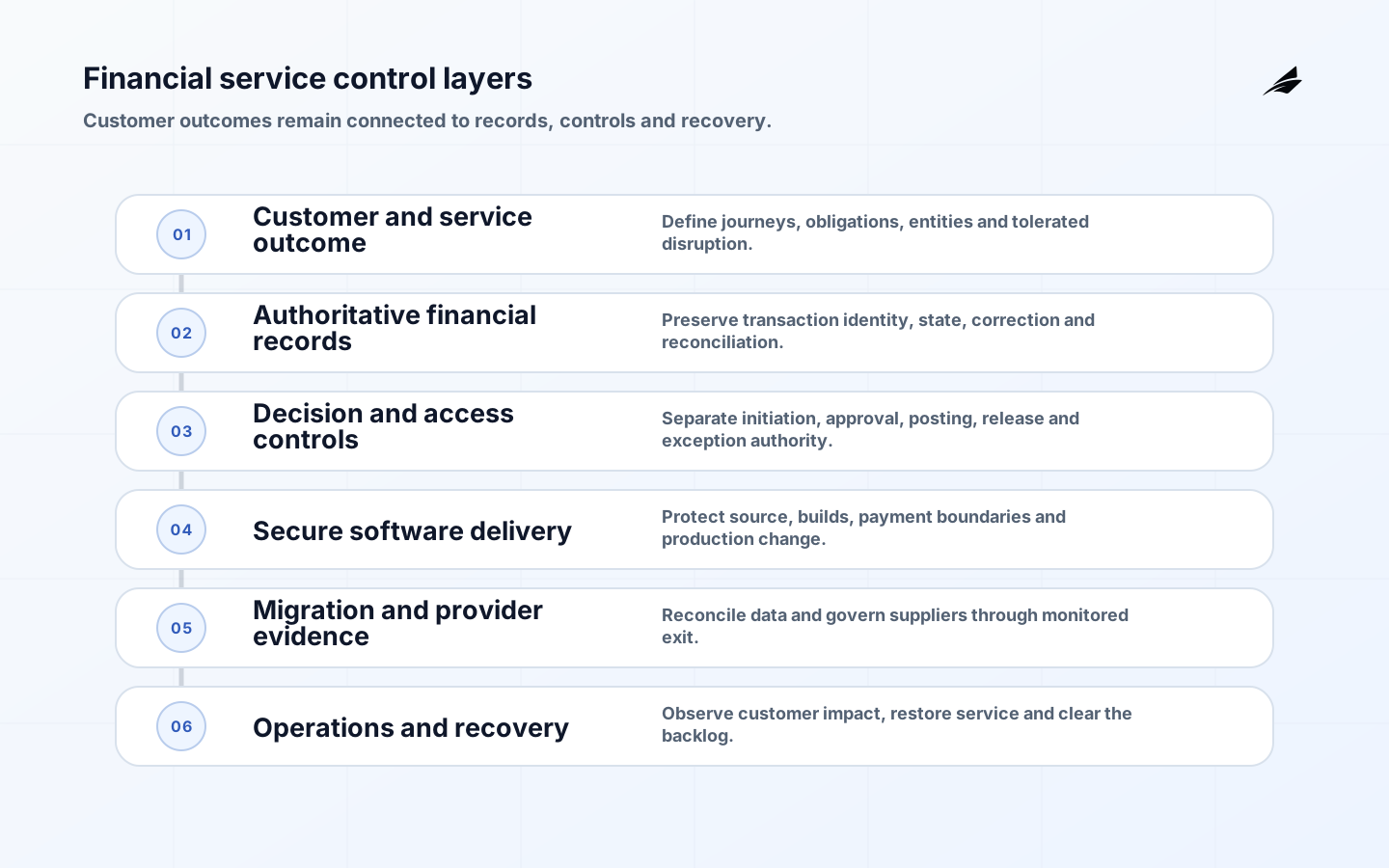
Name the customer or employee journey, legal entities, products, channels, jurisdictions, books of record, data classes and business owners in scope. Document how a transaction enters, is authorized, posted, corrected, reported and retained. Identify material services, maximum tolerable disruption, recovery objectives and manual fallback. Avoid describing scope only as modules or integrations: the implementation must preserve complete business events across system boundaries.
Translate obligations into approved requirements with a source, interpretation owner, effective date and evidence. Distinguish law, regulation, supervisory guidance, card-network requirement, contract and internal policy. The OCC bulletin for the FFIEC Architecture, Infrastructure and Operations booklet emphasizes governance, architecture, infrastructure, operations, interconnected assets and third-party providers. Those dimensions should be visible in the program plan, not assigned to a late compliance review.
| Control domain | Implementation question | Owner | Acceptance evidence |
|---|---|---|---|
| Transaction authority | Who may initiate, approve, post and reverse? | Business control owner | Authorized and denied journey tests |
| Data integrity | How are records balanced and corrected? | Data or finance owner | Source-to-ledger reconciliation |
| Customer treatment | Which disclosures, notices and choices apply? | Compliance and product | Approved content with journey evidence |
| Resilience | What service and data loss is tolerable? | Service owner | Timed recovery and backlog processing |
| Third parties | Which duties and dependencies are external? | Vendor and service owner | Due diligence, contract and monitoring record |
2. Design controls into records and workflows
Model transaction identity, amount, currency, value date, parties, account, product, channel, status, approvals and correction lineage. Use idempotency and explicit state transitions where repeated messages could duplicate financial effects. Preserve the original event and represent corrections as traceable actions rather than overwriting history. Define which system is authoritative at every transition and how downstream services learn about late or reversed events.
Separate duties by business consequence. The same identity should not create a beneficiary, approve a payment and suppress the resulting alert without an independently governed exception. Apply least privilege, strong authentication, time-bounded administrative access and dual control to high-impact operations. Retain logs that connect actor, decision, record, code or rule version and outcome, while protecting sensitive content. Test revoked, stale, duplicate and emergency identities, not only ordinary access.
Use the NIST Cybersecurity Framework 2.0 to connect governance with Identify, Protect, Detect, Respond and Recover outcomes. Tailor a profile to the implemented service, supplier environment and threat model. A compliance mapping is useful only when each selected outcome has an owner, implemented control, evidence source and treatment for gaps; the framework itself does not certify the system.
3. Secure software delivery and payment boundaries
Protect source, dependencies, build workers, artifacts, deployment identity and production configuration. The NIST Secure Software Development Framework gives organizations a common vocabulary for preparing, protecting software, producing well-secured releases and responding to vulnerabilities. Incorporate those practices into product delivery and supplier acceptance. Record the exact artifact and configuration released, verify segregated approvals where required and maintain a tested urgent-change path.
If the service stores, processes, transmits or can affect payment account data, establish the cardholder-data environment and consult the current PCI DSS resource. PCI DSS 4.0.1 is the active standard listed by the Council in 2026, but scope and validation method require qualified interpretation. Minimize account data, segment applicable systems, manage payment-page changes and scripts, and test that unrelated application services cannot cross the payment boundary.
| Scenario | Expected safeguard | Test | Evidence retained |
|---|---|---|---|
| Duplicate request | Idempotent transaction decision | Replay same business key | Single effect and duplicate response |
| Unauthorized release | Segregated approval and deploy identity | Attempt bypass through alternate path | Denied event and alert |
| Partial posting | Atomic or compensating workflow | Fail downstream dependency | Balanced recovery and exception queue |
| Data correction | Traceable adjustment | Correct a closed-period record | Original, reason, approval and new state |
| Service outage | Fallback and controlled catch-up | Recover after missed events | Timed restore and reconciled backlog |
4. Migrate data with financial reconciliation
Profile source records, ownership, quality, retention, legal hold, dormant accounts, open items and historical corrections. Define mapping and transformation rules with business approval. Rehearse extract, load, validation, delta capture, cutover and rollback using production-like volume. Protect test data with masking or synthetic alternatives appropriate to the purpose. Control who can run migration tooling and preserve versions, logs and approvals as implementation evidence.
Reconciliation should operate at several levels: record counts and hashes, control totals by product and currency, balances and positions, open transactions, customer entitlements and representative end-to-end journeys. Set tolerances and exception ownership before cutover. A zero aggregate difference can hide offsetting record errors, so sample complete cases and high-consequence populations. Keep the old system available according to the rollback plan, then remove duplicate write authority after acceptance.
5. Govern providers across their full lifecycle
Inventory cloud, software, data, identity, fraud, payment, support and subcontractor dependencies. Evaluate financial condition, legal authority, expertise, security, resilience, data use, locations, incident notification, audit rights, concentration and exit. The U.S. banking agencies' interagency third-party guidance covers planning, due diligence, contracting, ongoing monitoring and termination, with practices tailored to the relationship's risk and complexity.
The institution remains accountable for its service. Put service levels, security duties, data access, change notice, recovery, evidence, remediation, subcontracting and termination support into the contract. Validate provider controls against the specific service rather than accepting a general report without scope review. Maintain a customer-owned exit inventory and test export, credential revocation and continuity when the provider is unavailable or the relationship ends.
6. Release, recover and monitor customer impact
Use progressive exposure by internal users, product, channel, region or transaction limit where the architecture permits it. Define health, stop and rollback thresholds before release. Monitor authorization, posting, reconciliation, exception queues, customer contacts, latency, fraud signals, control overrides and provider health. Technical availability alone can look healthy while transactions are delayed, duplicated or misclassified. Give operations one route from an alert to affected records and decision authority.
Exercise cyber, technology and data scenarios: identity compromise, unavailable provider, corrupted message, delayed batch, region failure and restoration from a protected copy. Measure detection, decision, recovery, backlog clearing and customer communication. Reconcile records after technical recovery. Capture temporary access and manual work introduced during the event and close it. Review service outcomes and open risks after 30 and 90 days before extending product or transaction scope.
Build an assurance pack the operating team can use
Maintain a navigable evidence index linking scope, obligations, architecture, threat model, data mappings, control designs, releases, tests, exceptions, reconciliations, provider records, incidents and remediation. Mark every artifact with owner, version, approval and applicable service population. Protect sensitive evidence by role, but ensure reviewers can trace a claim to implementation and result without relying on the project team. Supersede old records visibly instead of silently replacing them.
Independence should match consequence. Product teams can execute unit and integration tests, while control owners validate design and operation, and internal audit or qualified external assessors may review selected obligations. Define sampling populations and periods before testing. A screenshot of a configured control is weaker than evidence that it operated across the intended population and that failures were investigated, corrected and retested.
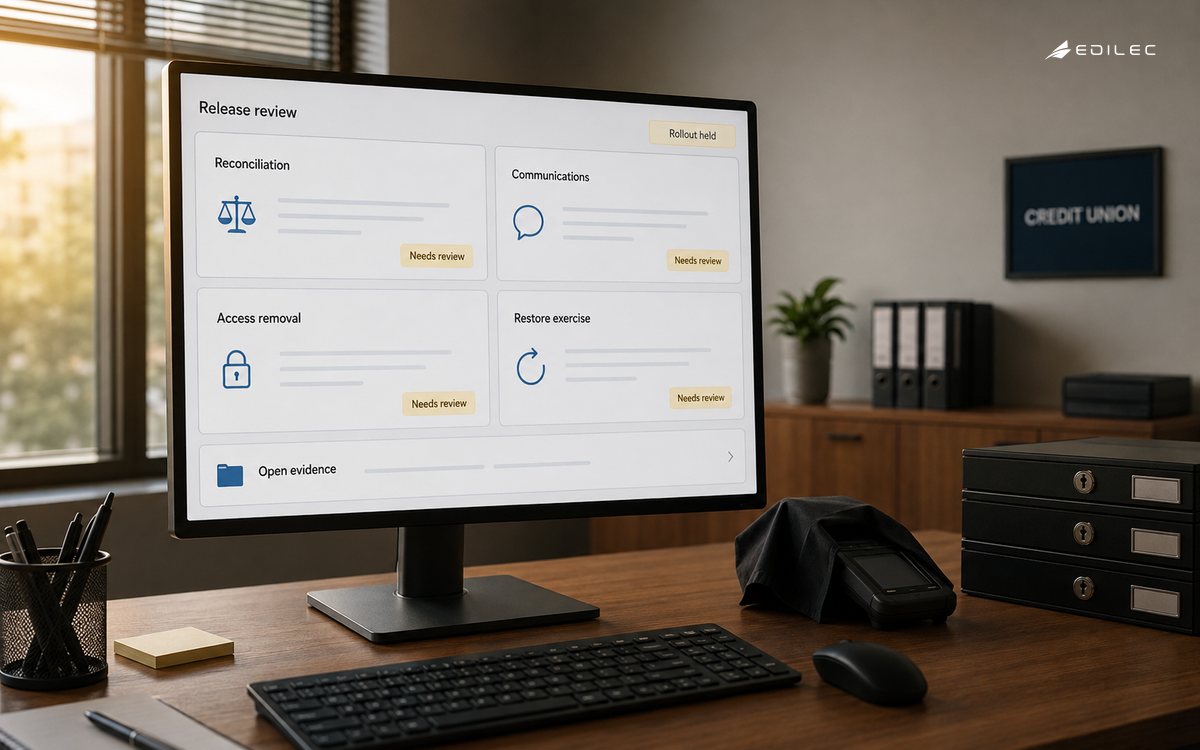
Run an acceptance forum with business, operations, security, compliance, finance, data and supplier owners. Walk through a successful customer case, denied transaction, correction, privileged change, supplier outage and recovery. Record residual risk and the person authorized to accept it. Production approval should expire or trigger reassessment when transaction scale, jurisdiction, product, supplier, architecture or model behavior changes materially.
Prepare customer and workforce communications before cutover. State what changes, when it takes effect, which records or balances may look different, how to obtain help and how suspected errors will be corrected. Train service teams on the implemented journeys and evidence they can inspect. Monitor complaints and contact reasons by cohort after release. A technically correct migration can still create conduct and reputation risk when people receive inconsistent explanations or cannot challenge a result.
Key takeaways
- Frame scope around complete financial journeys and authoritative records.
- Translate obligations into owned controls and evidence before development.
- Preserve transaction identity, correction lineage and segregation of duties.
- Reconcile migration at totals, records and end-to-end customer cases.
- Manage providers from planning through monitored exit.
- Accept production only after release, denial, recovery and backlog tests.
Financial services implementation FAQ
Can a regulated financial implementation use agile delivery?
Yes. Iterative delivery can improve feedback, provided requirements, risk decisions, approvals, tests and release evidence remain traceable. Build compliance and control owners into the cadence rather than adding a final gate.
How long should old and new systems run in parallel?
Long enough to execute defined comparisons and meet rollback obligations, but no longer by default. Parallel write paths add ambiguity and cost. Set acceptance criteria, owner and retirement date before cutover.
Does a provider certification transfer to the institution?
No. Certifications can inform due diligence, but the institution must review scope, exclusions and complementary controls, then govern how the service is configured and used within its own obligations.
Conclusion
Financial services implementation is the controlled movement of customer and financial truth through technology. Define the journey, protect authority, reconcile every transition, govern suppliers and prove recovery with business records. That discipline supports innovation without making customers or operators absorb unexplained risk.