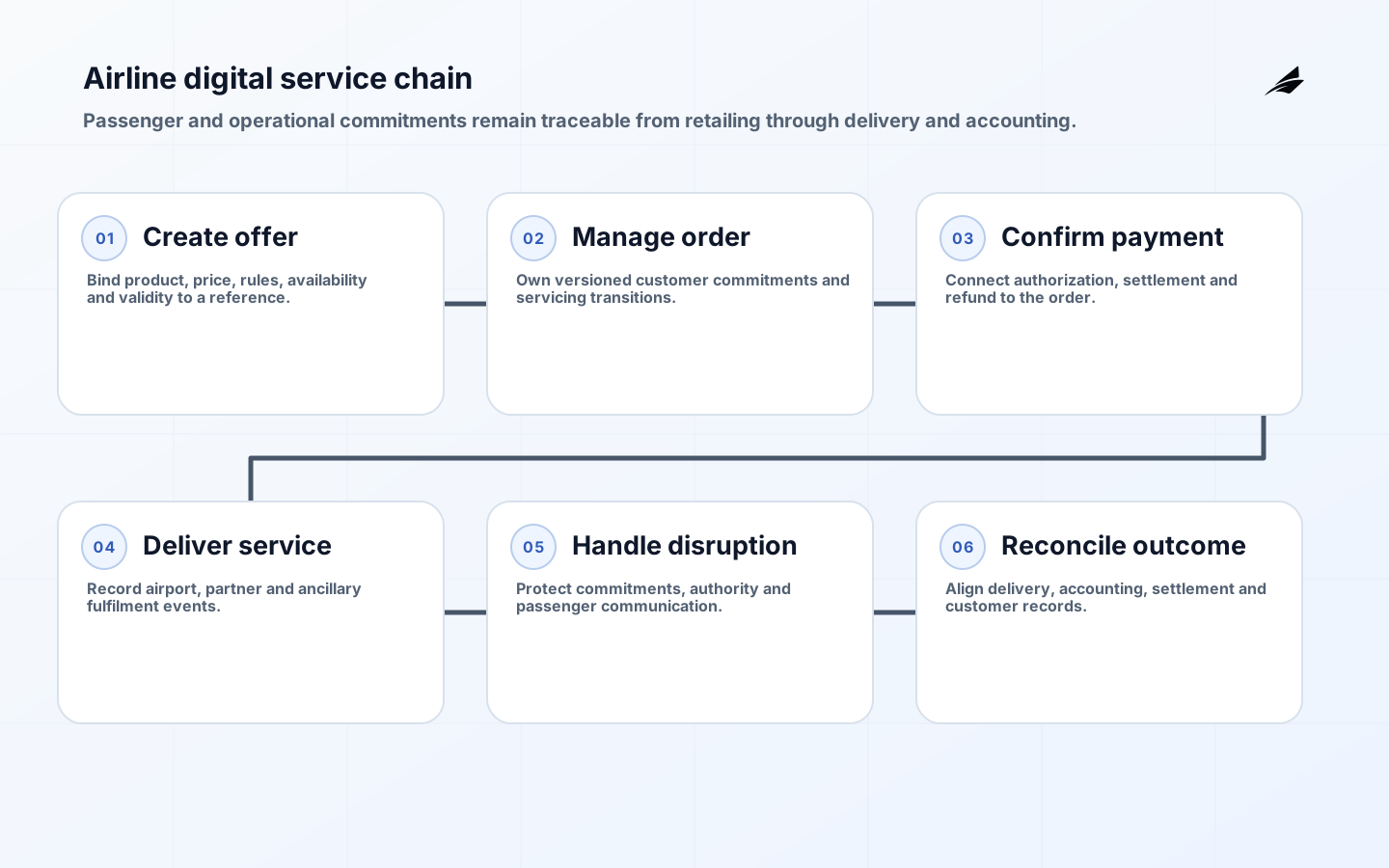
Technology solutions for airlines operate across retailing, reservations, orders, payment, departure control, airport handling, flight operations, disruption, loyalty, accounting and regulatory exchange. These systems are tightly connected but do not share the same availability, safety or change constraints. A good modernization program therefore starts with a passenger or operational journey and authoritative records, then establishes contracts between systems. Replacing visible interfaces without resolving identity, event and ownership problems usually creates a newer layer over the same reconciliation burden.
This FAQ addresses the architecture and delivery questions airline business and technology leaders should settle before procurement or build. For a sequenced program, use the airline technology scope and delivery plan and airline technology implementation checklist. Industry standards are essential interoperability inputs, but each airline still needs explicit product ownership, transition controls and operating evidence for its network, partners, regulatory jurisdictions and service model.
Which airline systems should be modernized first?
Prioritize a business capability where current fragmentation causes measurable customer, revenue or operational harm. Examples include servicing voluntary changes, managing irregular operations, reconciling ancillary fulfilment, tracking baggage events or giving airport staff one trusted order view. Map the journey, source records, partner messages, manual work and failure recovery. Choose a slice that can be accepted end to end without requiring a simultaneous replacement of every core platform. Avoid ranking systems only by age; a stable legacy service behind a controlled interface may be lower risk than an undocumented integration hub. Add regulatory reporting, airport cutover windows, schedule seasons and partner certification to the dependency map. These constraints often determine the safe sequence more than development speed and should be visible in the investment plan.
Use outcome and dependency together. A capability with high value but unresolved interline, accounting or departure-control dependencies may need a preparatory data or interface phase. Establish current measures such as service time, call transfer, failed fulfilment, revenue leakage, reconciliation effort, airport delay and recovery time. Identify peak and disruption conditions. The first release should improve one observable decision while preserving operational continuity. An airline cannot pause daily operations while a target architecture is completed.
How do Offers and Orders change the architecture?
IATA’s modern retailing direction uses Offers and Orders, with NDC supporting offer and order communication and ONE Order aiming to simplify fulfilment around an integrated order record. The practical change is not merely adopting a message schema. Product creation, pricing, order state, payment, delivery, servicing and accounting need consistent identifiers and lifecycle rules. Define which component owns each state transition and what partners may request or confirm. Preserve message version, correlation and business context so a disputed transaction can be reconstructed.
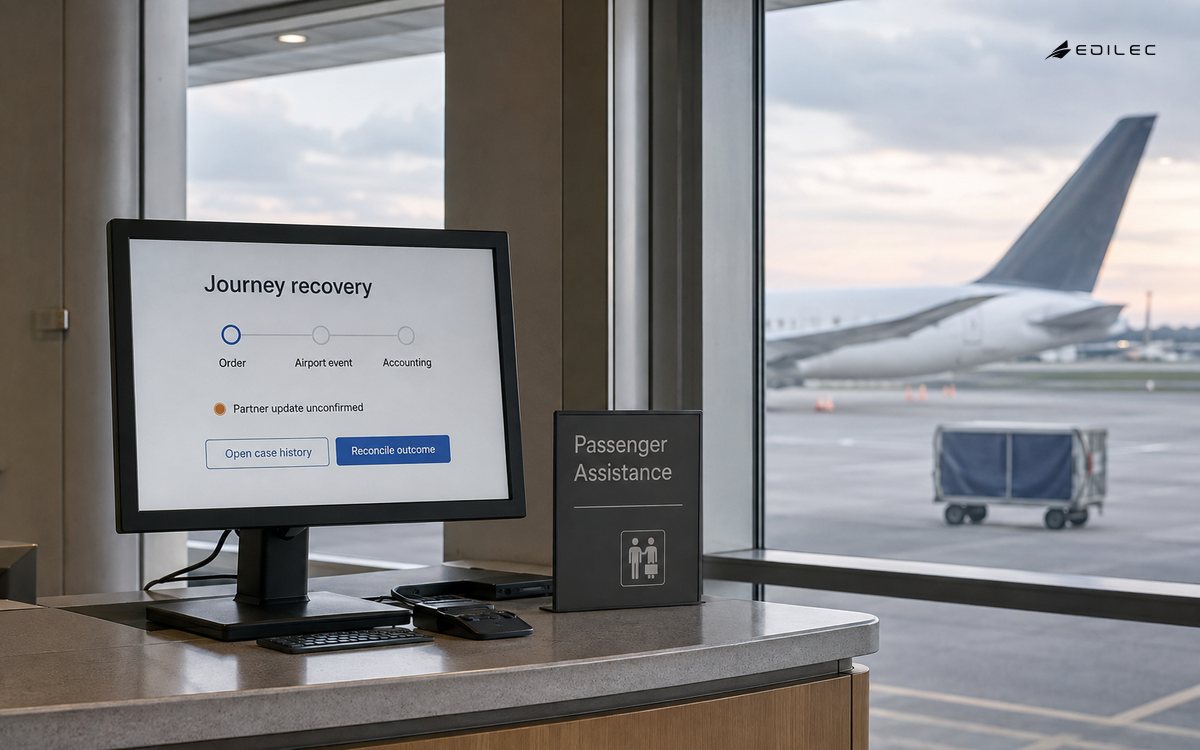
Modernization should accommodate coexistence with PNR, ticket and EMD processes during transition. Build anti-corruption interfaces that translate explicitly and expose unsupported states rather than silently losing meaning. Reconcile old and new records using durable references. Test split journeys, partial fulfilment, schedule change, refund, no-show, interline and ancillary cases. Treat the order as a business aggregate with audit history, not a mutable document copied between systems. Migration completes only when servicing, revenue accounting and operational delivery agree on the same outcome.
| Capability | Authoritative record | Critical interface | Acceptance scenario |
|---|---|---|---|
| Retailing | Offer with rules and validity | Channel or seller | Price expires and offer is rebuilt |
| Order | Versioned order state | Payment and servicing | Partial change with retained services |
| Fulfilment | Delivered service event | Airport and partners | Ancillary accepted then disrupted |
| Accounting | Financial event and settlement reference | Revenue accounting | Refund reconciles to original payment |
How should operations and airport integration be designed?
Operational systems require event semantics that remain useful during delay, diversion and degraded connectivity. Define flight, leg, movement, passenger, baggage, crew and resource identifiers; event source; occurrence and receipt time; confidence; correction behavior; and retention. Separate planned state from actual state. Consumers should tolerate duplicate, late and out-of-order events. Airport and ground-handler interfaces need explicit service-level, security and fallback agreements. A real-time display without provenance can spread one faulty event rapidly across customer, crew and station decisions.
Design disruption as a primary journey. Identify who declares the event, which recommendations are automated, how inventory and customer commitments are protected, and how staff override decisions. Provide one visible case history across digital and assisted channels. Test volume surges, unavailable partners and inconsistent airport messages. Staff need a bounded offline or degraded mode for essential work. Measure customer reaccommodation, handling time, unfulfilled commitments and reconciliation after recovery, not just system uptime.
What should govern passenger identity and data?
Separate account identity, traveller identity, travel-document evidence, loyalty identity and operational passenger references. Link them only for defined purposes and with appropriate authority. Minimize copies of passport and sensitive travel data; record verification results and provenance where that is sufficient. Define consent, retention, correction, access and disclosure across jurisdictions and partners. ICAO’s Public Key Directory supports verification of electronic travel-document signatures, but identity architecture still requires controlled enrolment, matching, exception handling and human resolution.
Build data products around decisions rather than one unbounded passenger profile. A disruption service may need contact preference, itinerary and service status, not every historical interaction. Establish data owners and quality contracts for high-impact fields. Detect duplicate and conflicting identities without forcing uncertain merges. Log access to sensitive records and test bulk-export controls. Explain material automated decisions and preserve the data and rule versions used. Personalization value should be evaluated against privacy, security and passenger trust, not assumed to justify unlimited collection.
How are resilience and cybersecurity built into airline platforms?
ICAO treats aviation cybersecurity as a cross-cutting safety, security and efficiency concern. Map business services across airline, airport, telecommunications, cloud and supplier dependencies. Segment access by application profile, protect privileged identities, authenticate system-to-system communication, manage secrets and record material actions. Threat-model retailing fraud, account takeover, partner compromise, data manipulation and operational denial. Security controls must account for stations, contractors and intermittently connected environments rather than assuming a uniform corporate network.
Define recovery for each journey. Establish recovery time and data-loss tolerance, protected backups, alternative communication, manual procedures and reconciliation. Exercise loss of identity provider, order service, airport link, payment processor and cloud region. Verify that queued events do not create duplicate fulfilment after restoration. Incident command should connect technology, operations, safety, security, legal, communications and partners with explicit authority. Availability percentages cannot replace a demonstrated ability to operate and recover during peak disruption.
| Failure | Continuity action | Recovery proof | Owner |
|---|---|---|---|
| Order service unavailable | Read-only view and controlled case capture | Cases replay without duplicate action | Retailing operations |
| Airport link interrupted | Station degraded procedure | Events reconcile in order | Airport technology |
| Identity provider outage | Restricted emergency access | Access is reviewed and revoked | Security |
| Partner message corruption | Quarantine and manual verification | Affected records are identified | Integration owner |
How should delivery and supplier governance work?
Organize work around capabilities with one accountable product owner, architecture boundary and service measure. Contract interfaces and test examples before parallel teams build. Use representative partner sandboxes and production-like volume, while acknowledging that certification does not cover every operational case. Release behind controlled routing, reconcile outputs against existing records and maintain a tested rollback. Expand by journey, market or station only after operational acceptance. Keep business and station staff in design and simulation, not only final training.
Supplier agreements should define data ownership, interface version support, service targets, security evidence, incident notification, change notice, audit access, subcontractors, export and transition assistance. Retain airline control of critical identifiers, schemas, decision history and observability. Measure providers against journey outcomes and interface quality, not ticket closure alone. Design exit at onboarding and periodically export authoritative records and configuration. A modular architecture is valuable only when components can be changed without losing operating knowledge or disrupting the journey. Include operational readiness in acceptance: named support across relevant time zones, access to production evidence, tested severity routing, known maintenance windows and authority for containment. Commercial service credits do not restore a disrupted passenger journey, so corrective action and recovery capability should remain the primary governance focus.
Key takeaways
- Modernize one customer or operational journey with measurable harm and clear ownership.
- Treat Offers and Orders as lifecycle and record changes, not only new messages.
- Design disrupted, interline and degraded cases as primary requirements.
- Separate passenger identities and minimize sensitive-data replication.
- Prove continuity, reconciliation and supplier exit before broad rollout.
Frequently asked questions
Must an airline replace its passenger service system first?
Not necessarily. Many programs introduce controlled capability and interface layers while legacy records coexist. The decision depends on target journeys, constraints and vendor support. Translation and reconciliation must be explicit during coexistence.
Does adopting NDC complete modern retailing?
No. NDC supports standardized communication, while retailing also requires product, pricing, order, payment, fulfilment, servicing, accounting, operating and organizational changes. Adoption should be measured by working journeys and outcomes.
What is the most important integration test?
Test a state-changing journey that crosses airline and partner boundaries under disruption, then reconcile every record and financial event. Happy-path schema validation alone does not prove operational interoperability.
Conclusion
Airline technology modernization works when every customer and operational commitment has an authoritative state, a responsible owner and a tested recovery path. Industry standards reduce translation and enable broader ecosystems, but they do not decide the airline’s product boundaries, operational authority or transition sequence.
Before scaling, trace one difficult journey across offer, order, payment, delivery, disruption and accounting. Ask each team and supplier to show its record, action and evidence. Where the story diverges, fix identifiers, contracts and ownership first. That discipline creates a platform that can evolve without compromising daily operation.