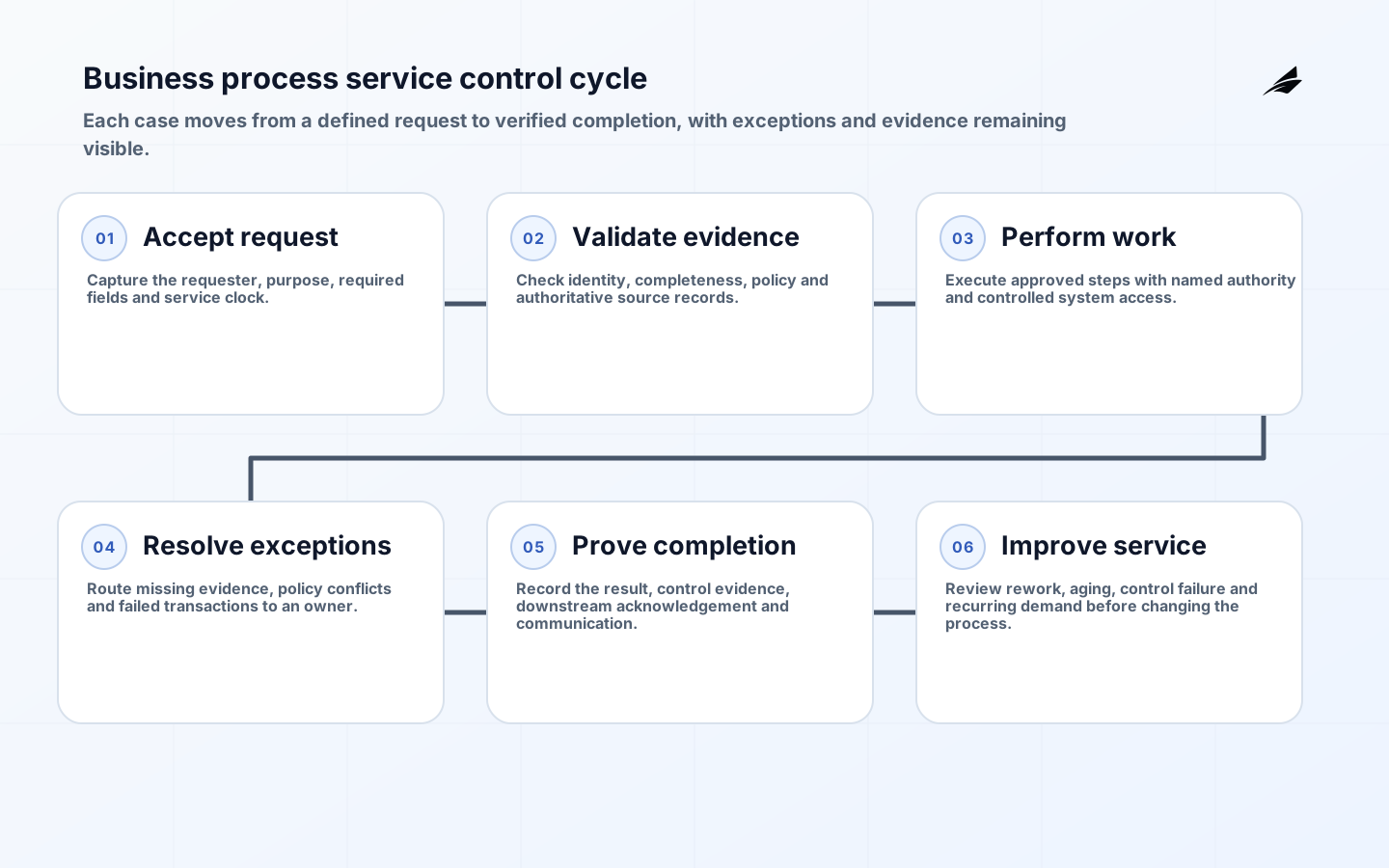
Business process services are the people, workflow, technology and operating controls used to run a repeatable business outcome on behalf of an organization. The outcome might be supplier onboarding, claims intake, order exceptions, employee access, invoice validation or customer case resolution. The useful unit of design is not a department or a software screen. It is the complete path from a valid request to a verified result, including the uncomfortable cases that do not follow the happy path.
A strong service makes ownership visible. It says which record is authoritative, who may decide, what evidence must be retained, when a case is late and how work recovers from missing data or a failed integration. Outsourcing or automation does not remove those responsibilities. It changes where work is performed and therefore makes the service boundary more important.
Define the service around an outcome
Begin with one sentence: who needs what outcome, by when, under which policy? A vague label such as “back-office operations” hides multiple services with different data, risk and timing. Supplier onboarding, for example, may include identity checks, tax records, bank-detail verification, approval and ERP creation. Each stage has a different owner and failure mode.
Document the start event, completion evidence and excluded work. A service that starts when an email arrives will behave differently from one that starts only after a validated form is submitted. Likewise, “vendor created” is weaker completion evidence than “approved vendor record created, requester notified and duplicate check passed.” These definitions prevent reporting from counting activity instead of outcomes.
| Decision | Useful question | Evidence |
|---|---|---|
| Boundary | What event creates a valid case? | Intake rule and sample cases |
| Outcome | What proves the work is complete? | Acceptance criteria and final record |
| Authority | Who may approve, reject or override? | Role matrix and decision log |
| Time | Which deadlines matter to the customer or business? | Service clock and pause rules |
| Exception | Where does incomplete or disputed work go? | Named queue, owner and escalation |
Map roles, records and handoffs
A process diagram is valuable when it exposes decisions and handoffs rather than decorating a presentation. BPMN can provide a shared notation for events, tasks, gateways and participants, but the notation is not the objective. The objective is to let an operator, process owner, auditor and engineer point to the same state and agree what should happen next.
For every stage, name the input record, actor, allowed action and output. Show where the workflow waits on a customer, third party or internal approver. Waiting states need clocks and reminders; otherwise they disappear from operational reporting. Separate a business decision from a technical retry. A failed API call may be retried automatically, while a conflicting bank account requires human investigation.
- Start and completion events with validation criteria
- Named roles, queues and segregation-of-duty points
- Authoritative records and downstream systems
- Approval, rejection, correction and cancellation states
- Timers, escalation and customer communication
- Technical retry and business exception paths
Design controls into daily work
Controls should appear where operators make decisions. Least-privilege permissions limit which cases and actions a role can access. Approval rules determine which changes need independent review. Audit events record the actor, source evidence, previous value and result. Change control protects workflow rules, integrations and templates from silent drift.

Do not equate more approvals with stronger control. Duplicate review can add delay without detecting a different risk. Use an independent check where the consequence justifies it: changing payment details, releasing funds, overriding eligibility or deleting a regulated record. Lower-risk, reversible steps may use automated validation plus sampling. The process owner should be able to explain why each gate exists.
Treat exceptions as part of the service
Real processes encounter missing documents, duplicate records, policy conflicts, unavailable systems and unusual customer circumstances. If the design only covers normal work, operators create side channels in email and spreadsheets. That destroys traceability and makes cycle-time reports look better than the customer experience.
Create a small exception taxonomy based on the action needed, not a long list of symptoms. “Need requester evidence,” “need policy decision,” “need technical recovery” and “suspected duplicate” are operationally useful because each has an owner and next step. Keep the original service clock visible even when a case moves to a specialist queue.
| Exception class | Owner | Recovery evidence | Signal |
|---|---|---|---|
| Missing evidence | Requester or intake team | Required record attached and validated | Age waiting on requester |
| Policy ambiguity | Business owner | Decision and rule clarification | Repeated policy referrals |
| Integration failure | Technical operations | Successful replay with idempotency | Retries and dead-letter age |
| Suspected duplicate | Data steward | Merge, link or separate decision | Duplicate rate by source |
| High-risk override | Authorized approver | Reason, scope and expiry | Override frequency and outcome |
Choose technology that preserves the operating model
Workflow software should make states, ownership and evidence easier to see. Evaluate case management, low-code workflow, custom applications and automation platforms against the same requirements. Can the system model long-running cases? Can it enforce role boundaries? Does it support idempotent integration, versioned rules, searchable audit history and exportable operational data?
Avoid making the workflow engine a new master record for every subject. Keep customer, employee, product or finance data in the appropriate system of record and store references plus workflow-specific state. Define API contracts and replay behavior before integrating. A process can be logically correct and still create duplicate payments or accounts if retries are not controlled.
Measure flow, quality and customer outcome
Volume and average completion time are not enough. Use percentiles to reveal long-tail cases. Separate active work from waiting time, and report rework, exception aging, first-pass yield and customer-visible misses. A faster process is not better if it creates more corrections or shifts effort to another team.
Review metrics by service version, channel and exception class. Pair quantitative signals with sampled cases. The process owner should regularly inspect completed, rejected, overridden and overdue work. This turns measurement into a decision about training, policy, data quality or system change rather than a dashboard ritual.
- End-to-end completion time at median and tail percentiles
- First-pass completion without correction
- Age and recurrence of exception classes
- Approval and override patterns
- Failed integration and manual replay volume
- Customer or requester effort and reopened cases
Transition without losing control
When moving work to a service provider or a new platform, baseline the current process with real case samples. Transfer decision knowledge, not only procedure documents. Run parallel or shadow processing for high-risk services, reconcile outputs and define who can stop the transition. Access should be provisioned by role and removed when the transition period ends.
The commercial agreement should align with the operating model. Specify service boundaries, data handling, subcontractors, continuity, evidence access, exit assistance and material change notification. Price incentives should not encourage premature case closure. Retain enough internal capability to govern policy and recover the service if the delivery arrangement changes.
Example: supplier onboarding as a managed service
A requester submits supplier details through a validated form. The service checks for duplicates, verifies required tax and bank evidence, and routes risk-based approvals. The ERP adapter creates the supplier only after approval and returns the new identifier. A bank-detail mismatch moves to a fraud-aware review queue rather than being corrected informally.
The service reports time to approved supplier, cases waiting on the requester, duplicate prevention, bank-detail overrides and failed ERP writes. A weekly review may reveal that one business unit repeatedly omits a required document. The best improvement may be a better intake form or policy explanation, not more staff or automation.
Run a governance cadence that improves the process
Establish weekly operational review for volume, aging, exceptions and control failures, then a monthly service review for outcomes, capacity, change and risk. The people who own upstream demand and downstream consequences should attend, not only the processing team. Review a small sample of completed and reopened cases to test whether dashboards reflect actual quality. Decisions, owners and due dates belong in a durable improvement log.
Changes to policy, forms, automation or source systems should enter the same controlled backlog. Assess their effect on controls, evidence, training and service levels before release. A provider can recommend improvements, but the business owner should approve changes to customer commitments and risk acceptance. This cadence turns the service from labor substitution into a managed operating capability.
Related operating guides
Use Business Process Digitization for Service Businesses to frame system boundaries, Business Process Exception Handling to design recovery, and Business Process Automation: Choosing What to Automate to separate valuable automation from hidden work.
Frequently asked questions
What is included in business process services? A defined service may include intake, validation, decisions, transaction processing, exception handling, reporting, controls and continuous improvement. The exact boundary should identify systems, data, authority, hours, volumes and exclusions rather than rely on a broad label.
Should a company standardize a process before outsourcing it? The process should be understood well enough to map outcomes, controls and exceptions, but transition can include redesign. Hiding variation to make documentation look simple usually moves risk to the service team. Preserve necessary judgment and remove avoidable inconsistency deliberately.
How should service quality be measured? Combine timeliness with first-time-right completion, exception age, rework, control effectiveness and the business outcome. A fast case that is reopened or creates a downstream correction is not a successful completion.
Who owns risk after a provider takes over? The business remains accountable for its obligations and customer outcomes. The provider owns agreed execution and evidence, while named business owners approve policy, material exceptions and residual risk.
Key takeaways
- Define a business process service by its verified outcome, not its department or tool.
- Keep roles, authoritative records, service clocks and exceptions visible in one operating model.
- Place controls at consequential decisions and avoid approvals that do not test a different risk.
- Measure tail latency, rework and customer effort as well as volume.
- Retain governance and recovery capability even when delivery is outsourced.
Conclusion
Business process services create value when repeatable work becomes easier to operate, explain and improve. The durable design is a controlled service chain: valid intake, trusted context, explicit authority, dependable execution, visible exceptions and evidence-led review. Start with one bounded outcome and real cases. If the organization can explain who owns each state and how a bad result is corrected, it has a foundation that can support automation, outsourcing and scale without losing accountability.