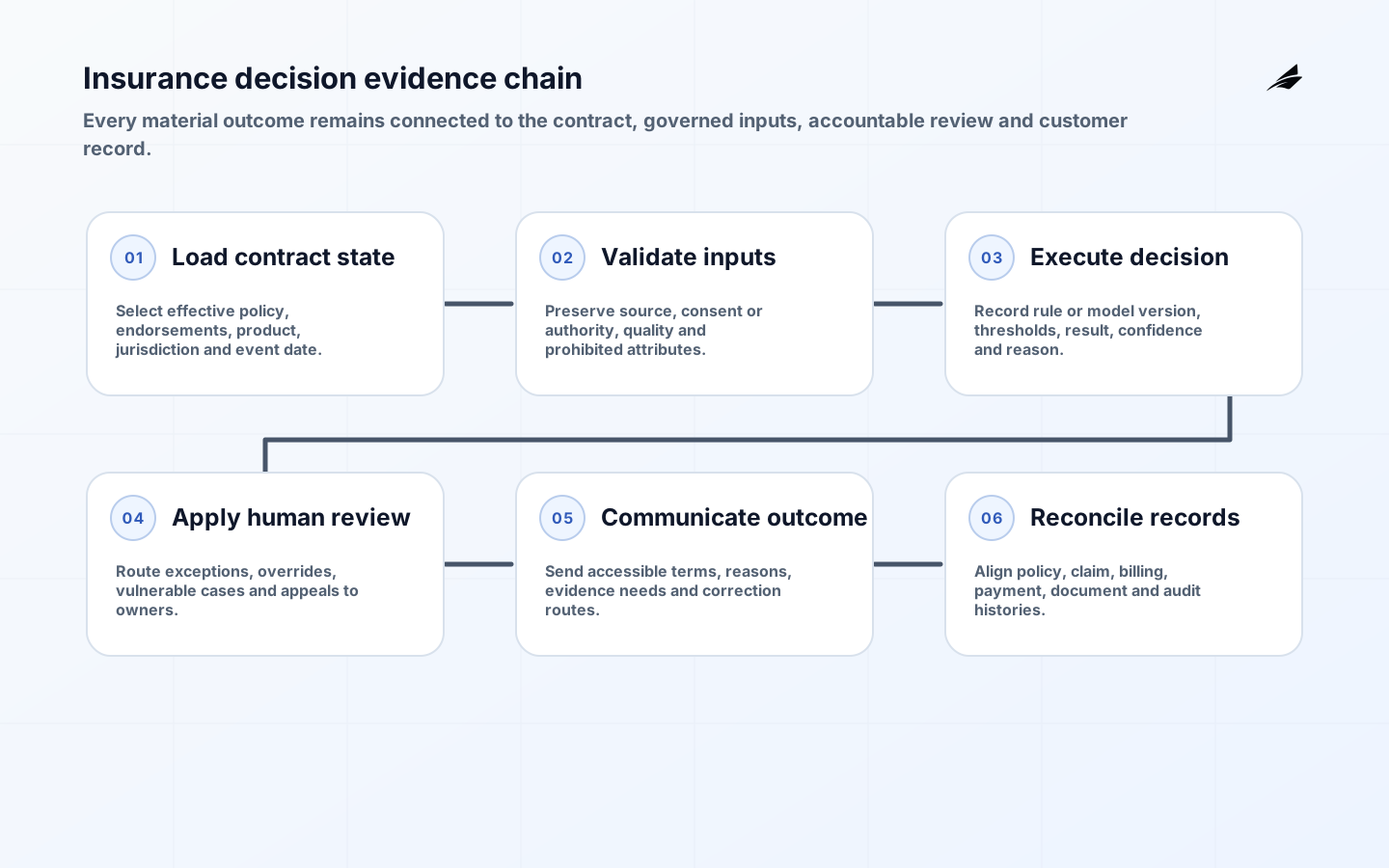
Digital engineering for insurance must preserve contractual truth while improving how customers, agents, underwriters, claims teams and regulators work. A polished portal is not modernization if policy records disagree, decision reasons disappear, adjusters create spreadsheets to handle exceptions, or an outage prevents urgent claims. The implementation unit is an end-to-end insurance capability with accountable decisions, reconciled records and operable controls.
This checklist applies to policy administration, distribution, underwriting, billing, claims and service modernization. Use it with the insurance digital engineering business guide, the insurance engineering FAQ and the Digital Transformation Services Implementation Checklist. Insurance duties vary by product and jurisdiction; compliance, actuarial, legal and consumer-protection owners must approve applicable requirements.
Select an insurance outcome and cohort
Choose a measurable service outcome such as reducing incomplete first-notice-of-loss submissions, issuing endorsements without duplicate entry, or explaining underwriting referrals faster. Define the product, jurisdiction, channel, customer cohort and operational team. Record baseline completion, cycle time, leakage, rework, complaints, accessibility barriers, error and cost. Avoid starting with “replace the core” because it hides which customer or business result funds the change.
Map the complete journey from quote or event through identity, consent, evidence, rules, decision, payment, communication, amendment, dispute, retention and reporting. Include brokers, third-party administrators, repair networks, data providers and manual controls. Observe real exception handling. A claim with multiple coverages, fraud referral and partial payment is a better architecture test than the happy path used in a product demonstration.
| Capability | Authoritative record | Critical decision | Acceptance evidence |
|---|---|---|---|
| Quote and bind | Versioned offer and application | Eligibility, price and disclosure | Reproducible accepted terms |
| Policy service | Policy and endorsement history | Effective change and authority | Before-and-after contract state |
| Billing | Ledger and allocation records | Amount due, receipt and reversal | Financial reconciliation |
| Claims | Claim, exposure and payment history | Coverage, reserve and settlement | Attributable decision timeline |
| Communication | Approved content and delivery event | Notice requirement and channel | Rendered artifact plus delivery status |
Model domains and contractual state
Separate policy, party, product, billing, claim, document and communication concepts even if the current core stores them together. Define stable identifiers, effective dates, transaction dates, versioning, currency, provenance and correction behavior. Insurance state is temporal: a policy valid on the loss date may differ from today’s view. Preserve the accepted application, wording, endorsements, rating inputs and decision evidence needed to reconstruct what was promised.
Create canonical contracts only where they reduce real translation, and allow product-specific extensions. An enterprise model that erases important differences between commercial and personal lines creates hidden fields and manual work. Use event names for completed business facts, include idempotency and correlation identifiers, and state ordering rules. Reconciliation must compare business totals and states, not merely API success responses.
Create a resilient integration boundary
Place modern channels behind services that protect the core from bursts, retries and untrusted input. Use queues for work that can complete asynchronously, timeouts and circuit breakers for remote calls, and idempotency for payments, submissions and document generation. Keep a durable work state so staff can see whether a request is pending, failed or completed. Do not report success to the customer before the authoritative system accepts the commitment.
Inventory every batch, file, API, message, desktop automation and human handoff. Define schema ownership, service windows, retry and replay, duplicate handling, data quality, security and supplier escalation. During coexistence, avoid uncontrolled dual writes. Choose one system of record per state and propagate through versioned events or an orchestrated workflow. Reconcile counts, amounts, coverage and status daily until migration evidence is stable.
Govern analytics and AI-supported decisions
Inventory models and rules used in marketing, underwriting, pricing, claims, fraud, service and operations, including third-party data and models. For each, document purpose, affected people, inputs, prohibited attributes, owner, version, validation, performance thresholds, explanation, human review, appeal and retirement. The NAIC’s current artificial intelligence topic summarizes regulatory work; adoption and legal effect vary by state and must be checked.

The NAIC AI Model Bulletin announcement describes expectations for a written AI systems program, governance, risk management and accurate outcomes that comply with applicable law. Use NIST’s AI Risk Management Framework to organize context, measurement and controls. Test by relevant segments, monitor drift and overrides, and retain the information required to explain a consumer-affecting outcome. AI may support a professional; it does not absorb the insurer’s accountability.
| Decision control | Design requirement | Runtime evidence | Escalation |
|---|---|---|---|
| Eligibility or pricing | Approved factors and effective version | Inputs, rule/model and reason | Unexplained or prohibited factor |
| Fraud referral | Threshold and non-adverse routing | Signal provenance and reviewer action | Systematic cohort disparity |
| Claim triage | Priority logic and service safeguard | Queue age and reassignment | Urgent case delayed |
| Document extraction | Field confidence and source location | Human corrections and sample quality | Critical field below threshold |
| Customer assistant | Approved knowledge and action limits | Conversation, handoff and outcome | Advice, commitment or sensitive action |
Protect consumers and accessible journeys
Give customers clear status, required evidence, decision reasons, correction routes and access to a person. Keep assisted, phone and agent channels synchronized with the same case state. Apply WCAG 2.2 as required, and test identity, document upload, signatures, timeouts, payment and generated notices with keyboard, screen reader, zoom and representative users. Claims often occur under stress; error messages and saved progress are operational safeguards.
Minimize personal and sensitive data, separate consent from contractual or legal processing where applicable, and restrict role access by purpose. Protect free text and attachments because they may contain medical, financial or third-party information. Define retention and legal holds by record class. Test correction, access and deletion workflows across analytics and vendors where law permits. Never use production claim documents as convenient development prompts or test fixtures.
Engineer operational resilience
Set service objectives from customer and financial impact. Identify minimum viable service during outage: receive a loss notice, identify vulnerable customers, record evidence, prevent duplicate payment and communicate status. Test core, identity, payment, document, contact-center and supplier failure. Back up data, configuration, keys, rules, templates and integration state; restore them in dependency order and reconcile queued work before normal automation resumes.
The EU Digital Operational Resilience Act has applied since 17 January 2025 to covered financial entities and addresses ICT risk, incidents, testing and third-party risk. The underlying EU regulation defines scope and duties. Other jurisdictions use different frameworks. Maintain a jurisdiction matrix and contract for supplier evidence, notification, audit, continuity, data return and exit.
Build security into delivery and operation
Threat-model account takeover, agent impersonation, quote manipulation, payment diversion, document malware, excessive adjuster access, API abuse, vendor compromise and data exfiltration. Federate workforce identity, use strong customer authentication proportionate to risk, enforce server-side authorization, scan uploads, isolate document processing and monitor privileged actions. Map program outcomes with the NIST Cybersecurity Framework, then select controls for the actual service and obligations.
Embed dependency, secret, code and configuration checks in delivery; protect build provenance and production credentials. Separate development, test and production data. Give support time-limited access with reason and audit. Define incident roles across insurer, platform, cloud and service providers, including consumer and regulatory notification decisions. Exercise ransomware, credential compromise, corrupted rules and compromised supplier updates, not only infrastructure loss.
Release by product and operational cohort
- Baseline one product, jurisdiction, journey and operational team.
- Prove data, rules and integration behavior with representative historical cases.
- Build one vertical path including decision evidence, notices, support and recovery.
- Shadow decisions or run read-only reconciliation before changing authoritative state.
- Release to a bounded cohort with feature controls, manual fallback and daily review.
- Expand only after consumer, financial, control, reliability and support acceptance.
For migration, compare policy counts, premiums, balances, claims, reserves, payments, documents and effective-dated states. Sample complex cases and replay representative transactions. Establish discrepancy thresholds and a signed owner for residual items. Keep cutover and rollback decision rights explicit. After launch, measure completion, cycle time, leakage, complaints, overrides, accessibility, reliability, security, reconciliation and staff effort. A faster claim that creates more appeals is not a better outcome.
Key takeaways
- Modernize a complete insurance outcome for a defined product, cohort and jurisdiction.
- Preserve effective-dated contractual state and reconcile business records across coexistence.
- Govern rules, models and third-party data with versions, testing, reasons and human recourse.
- Make accessibility, minimum service, supplier resilience and recovery part of acceptance.
- Scale after consumer, actuarial, financial, security and operational evidence agrees.
Frequently asked questions
Must an insurer replace the core platform first?
No. Many programs start with an integration boundary and one product journey while improving data and operational controls. Replace or modernize the core when its constraints block outcomes and the organization can migrate contractual history safely. Avoid permanent workarounds without an owner and retirement condition.
Can AI make underwriting or claim decisions automatically?
Capability does not establish legal permission or good design. Determine applicable law, impact and risk; validate data and outcomes; preserve reasons; provide qualified oversight and recourse; and monitor after release. High-impact or novel decisions usually justify stronger review and narrower automation.
How can historical insurance data be migrated safely?
Profile source data, map effective-dated semantics, retain provenance, rehearse at production scale and reconcile counts, amounts and states. Sample complex policies and claims with business owners. Quarantine exceptions rather than coercing them silently, and keep source access until retention and acceptance are resolved.
Conclusion
Digital engineering for insurance works when faster journeys remain anchored to contractual state, governed decisions and resilient operations. Deliver a bounded outcome, reconcile every important record, protect consumer recourse and prove the service under failure. That discipline allows modernization to increase speed without weakening the trust on which insurance depends.