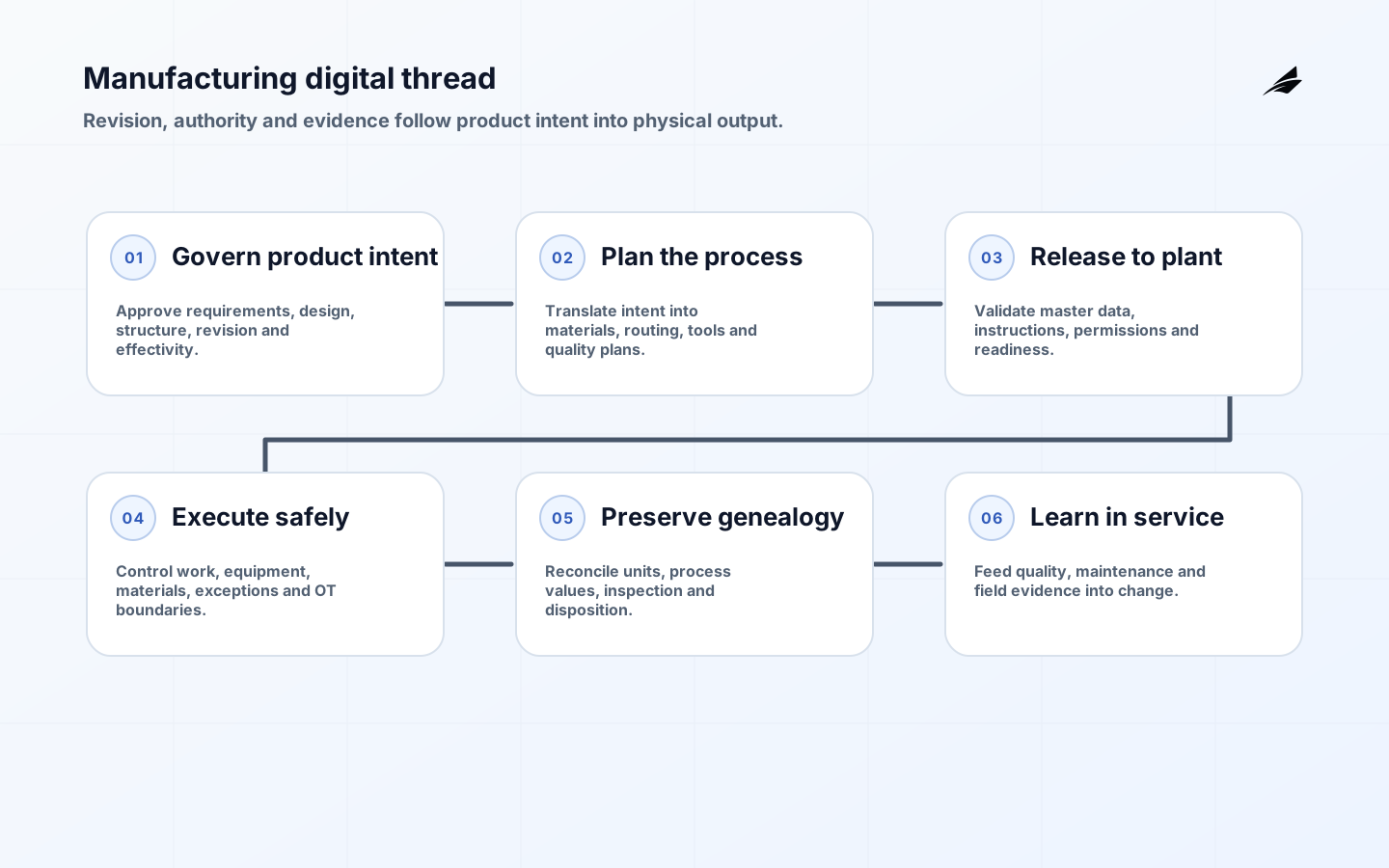
Engineering and manufacturing systems connect product intent with physical production. Product lifecycle management, enterprise planning, manufacturing execution, quality, maintenance, warehouse and operational technology each hold a different part of that truth. Integration succeeds when changes preserve identity, revision, material, process, equipment state and authority across the chain. This FAQ explains the architecture and delivery decisions business, engineering, plant and technology teams need to make together.
Use the engineering and manufacturing practical guide, manufacturing systems implementation checklist and manufacturing AI workflow delivery plan for deeper planning. Technology should improve safe, conforming output; a digital project that interrupts production or obscures engineering authority has missed its purpose.
Which engineering and manufacturing systems do what?
PLM commonly governs product structures, documents, revisions and engineering change. ERP governs commercial demand, inventory valuation, procurement and enterprise orders. MES coordinates plant execution, work instructions, material genealogy and production state. Quality systems manage specifications, inspections and nonconformance. Maintenance systems manage assets, work and spares. Control systems and equipment execute physical processes. Boundaries vary, so define authority per object and state instead of relying on product-category labels.
A single physical item may have engineering, manufacturing and service views. Keep stable identifiers and controlled mappings among engineering bills, manufacturing bills, routings, recipes, resources and effectivity. Record which system may create or change each field and how downstream acknowledgement works. Avoid uncontrolled spreadsheets as integration bridges for safety, quality or traceability data. They may support analysis, but production changes require governed approval and reconciliation.
| Record | Likely authority | Critical handoff |
|---|---|---|
| Product design and revision | PLM or controlled engineering repository | Released structure and effectivity to planning |
| Order and material plan | ERP | Authorized demand and supply to plant |
| Work execution and genealogy | MES | Completion, consumption and quality status |
| Process control state | OT control system | Validated values and alarms to operations |
| Nonconformance | Quality system | Disposition and corrective action across records |
What is a practical digital thread?
A digital thread is traceable continuity across product requirements, design, process plan, production, quality and service. It is not a data lake containing copies of everything. Begin with a decision or traceability question, such as which shipped units used a changed component or whether an inspection result came from the effective plan. Define identifiers, revision rules, timestamps and relationships needed to answer it, then test the chain with representative exceptions.
Preserve event time and processing time because plant connectivity may delay records. Use immutable event identifiers and idempotent consumers where possible. Reconcile quantities and state transitions; a technically successful message can still be duplicated or applied to the wrong revision. Keep source evidence and transformation versions. Digital twins and analytics should reference authoritative configuration and uncertainty rather than creating a visually persuasive parallel truth.
How should ERP, PLM, MES and OT integration be designed?
Use explicit contracts for schema, units, revision, sequence, acknowledgement, timeout, retry and error ownership. Introduce an integration layer where it clarifies orchestration and monitoring, but do not hide business authority in opaque transformations. Buffer safely during outages and define how production continues, how queued records are reconciled and when an interface must stop. Test late, duplicate, missing and out-of-order messages, not only the happy path.
Separate enterprise and OT trust zones according to process risk. Use controlled conduits, allowlisted communication and monitored remote access. Do not expose controllers directly for convenient integration. NIST's OT security guide emphasizes unique performance, reliability and safety requirements. Architecture and maintenance windows must respect deterministic operations and validated equipment, so an enterprise patch routine cannot be copied blindly onto the plant floor.
| Integration failure | Operational control | Reconciliation evidence |
|---|---|---|
| ERP unavailable | Approved local production horizon and order cache | Orders executed versus later enterprise state |
| MES link delayed | Store-and-forward with sequence checks | Missing and duplicate event report |
| Wrong revision | Effectivity validation before release | Unit, order and revision trace |
| Unit mismatch | Canonical units and boundary conversion test | Source value, conversion and consumer value |
| Equipment gateway failure | Safe local control and manual escalation | Downtime, buffered data and recovery sign-off |
How is manufacturing cybersecurity different from office IT?
OT interacts with physical processes, so safety, availability, timing and equipment life constrain security changes. Asset inventory must include controllers, human-machine interfaces, engineering workstations, historians, gateways, safety systems and vendor access. Categorize criticality and document communication. The NIST Manufacturing Profile provides a risk-based roadmap tailored to manufacturing goals, while ISA's IEC 62443 series overview spans asset owners, service providers, systems and components.
Prioritize remote access control, network segmentation, secure configuration, backups, removable media, vulnerability handling and incident readiness. NIST describes security segmentation as grouping assets by communication and security needs. Test controls in a representative environment and coordinate with process safety. Unsupported assets require compensating controls and a replacement plan, not silent acceptance.
How should engineering change reach production?
An engineering change needs reason, affected items, effectivity, approved disposition and downstream acknowledgement. Validate manufacturability, tooling, instructions, quality plan, inventory and supplier impact before release. Decide how work in progress and service stock are treated. The receiving plant must confirm that the effective revision is available at the workstation and linked to the correct order. Publishing a revision from PLM is the start of the transition, not proof of execution.
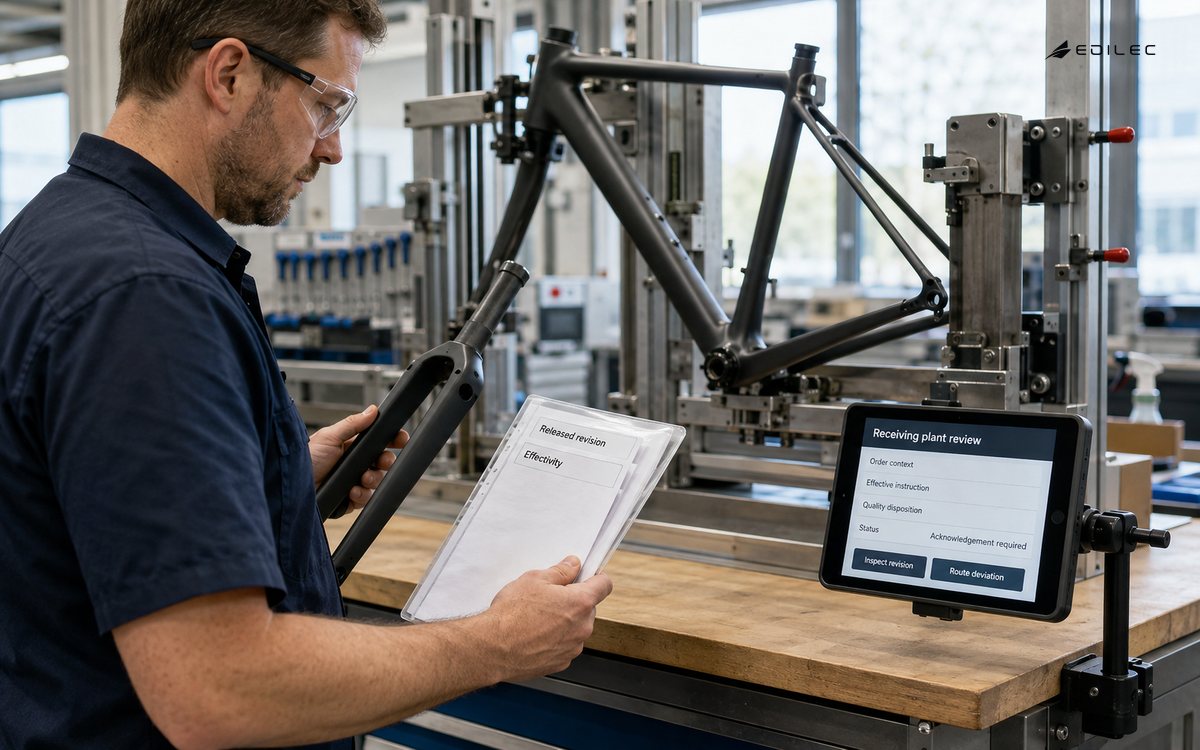
Use a closed-loop exception process. If production cannot execute the released plan, record a deviation with scope, authority, duration and affected units. Feed valid lessons back to engineering without normalizing unauthorized local changes. Measure change lead time, first-pass acceptance, revision-related defects and overdue acknowledgements. Fast change is useful only when it preserves product conformity and traceability.
How should a manufacturing systems rollout be delivered?
Select a representative product family, line or site with meaningful value and manageable risk. Baseline throughput, quality, schedule adherence, downtime, manual entry and traceability effort. Build a production-like integration test environment and include operators, engineers, quality, maintenance, security and support. Rehearse migration, cutover, degraded operation and rollback. Avoid choosing only the newest plant if the architecture must later support legacy equipment and constrained networks.
Validate technical and procedural controls. Reconcile master data, orders, inventory, genealogy and quality records. Confirm work instructions, labels, interfaces, permissions, backups and disaster recovery. Train by role and exception. Run hypercare around actual shifts and supplier windows. Scale after stable operating evidence, then manage site variation explicitly. Copying configuration without understanding local process creates a standardized-looking system with hidden operational differences.
Which outcomes demonstrate value?
Use a balanced set: schedule adherence, throughput, first-pass yield, scrap, downtime, change lead time, genealogy completeness, manual corrections, safety events and support demand. Define denominators and data sources. Overall equipment effectiveness can aid diagnosis, but one composite number can hide availability, performance and quality tradeoffs. Do not reward output that increases rework or bypasses safety. Compare representative periods and explain mix, maintenance and demand changes.
Measure digital reliability as well: integration delay, rejected messages, master-data defects, stale instructions, unauthorized access, restore success and time to resolve plant-impacting incidents. Review at line, site and enterprise levels. NIST's smart manufacturing cybersecurity work explicitly considers security controls alongside performance, reliability and safety, a useful reminder that plant outcomes must be evaluated together.
Where do analytics and AI fit in manufacturing systems?
Use analytics when data and intervention timing can change an operational decision: predict a failure early enough to plan maintenance, detect process drift before scrap grows or identify a likely quality issue for inspection. Establish ground truth and account for product mix, operating mode and maintenance history. A model trained on one line or stable period may not transfer to different equipment, materials or operator practice. Begin in advisory mode with domain review.
Keep safety interlocks and validated control independent unless the AI system has been engineered and assured for that authority. Define latency, confidence, fallback and operator presentation. Prevent maintenance feedback from becoming an unreviewed label loop. Monitor sensor health, data delay, model performance, overrides and actual avoided downtime or defect. Preserve the model, data and decision evidence needed to investigate a production event.
Generative tools may help find manuals, summarize shift records or draft instructions, but restrict sources by revision and equipment context. Require citations and human approval before controlled documents change. Protect proprietary process data and vendor remote-access paths. The useful pattern augments engineers and operators with traceable evidence; it does not let fluent text bypass engineering change, quality disposition or safety authority.
Before scaling, compare the AI-assisted workflow against a stable baseline across representative shifts and products. Include operator workload, false alarms, maintenance response and safe fallback, not only model accuracy. Stop expansion when the intervention cannot be executed reliably.
Key takeaways
- Assign record and state authority across PLM, ERP, MES, quality, maintenance and OT.
- Build the digital thread around traceability questions and stable identifiers.
- Test integration ordering, retry, unit, revision and degraded-operation behavior.
- Adapt cybersecurity to physical safety, reliability and equipment constraints.
- Close engineering change through plant acknowledgement and controlled deviation.
- Scale only after production, support, security and reconciliation evidence is stable.
Frequently asked questions
Does every manufacturer need an MES?
No. The need depends on execution complexity, traceability, quality, regulation, volume and existing capability. Define required plant decisions and records first. A lighter workflow may be enough, while complex regulated production may justify a full MES.
Can manufacturing systems run in the cloud?
Many planning, analytics and coordination services can, but architecture must account for latency, connectivity, safety, local autonomy, data obligations and recovery. Keep time-critical safe control local where required and test loss of cloud connectivity.
Conclusion
Engineering and manufacturing systems create value when product intent arrives at the right process and the resulting evidence returns intact. Clarify authority, design resilient contracts, respect OT constraints and validate on the plant floor. The result is not merely connected software; it is a safer, more traceable and more adaptable production system.