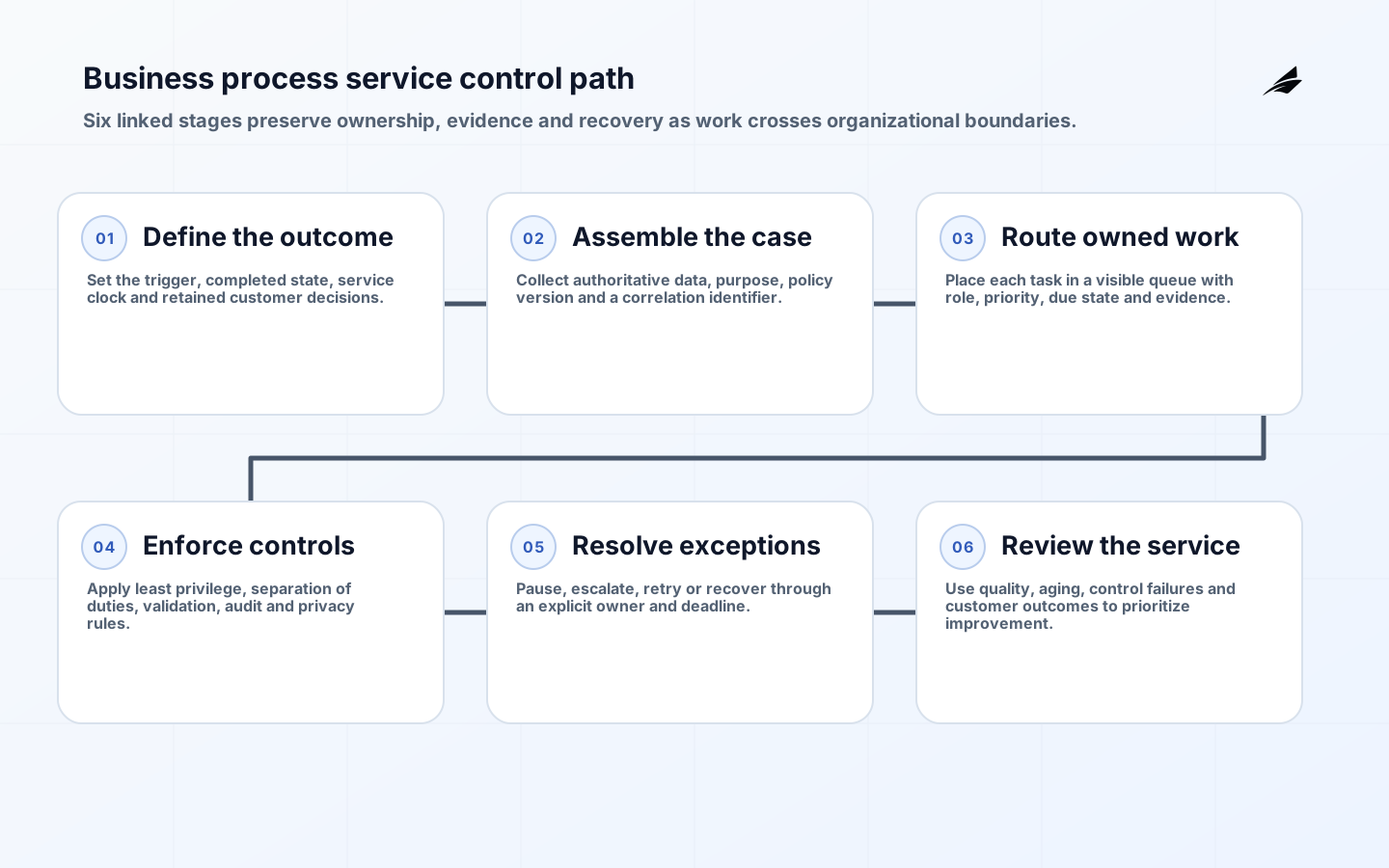
A business process service is successful when work can move between people and systems predictably, not merely when a supplier starts performing tasks. The implementation must preserve who owns each decision, which record is authoritative, how exceptions are handled, and what evidence proves the service is operating correctly. That is why a business process services implementation checklist should begin with the operating model rather than staffing numbers or automation promises. The Business Process Model and Notation specification provides a useful common language for events, tasks, gateways and handoffs, but the diagram is only the start. The service also needs enforceable access, data, continuity and review controls.
This guide is for teams moving finance, customer operations, procurement, claims, employee services or another repeatable workflow into a managed delivery arrangement. It complements a broader business process services scope and cost plan and the shorter business process services FAQ. Use it to produce a transition backlog, an acceptance test and an operating review that both the customer and provider can understand.
Define the service outcome before transferring tasks
Describe the outcome in business terms: an invoice is validated and posted, a customer case is resolved with an auditable decision, or a supplier is onboarded with the required approvals. Then identify the event that starts the process, the state that means it is complete, the records created along the way and the conditions that stop normal processing. Avoid defining the service as a list of clicks. Click-level instructions become obsolete when an interface changes and rarely explain why a decision matters.
Set the boundary explicitly. A provider may prepare a payment but not release funds; classify a case but not approve a regulated exception; update a CRM record but not change consent. Record these distinctions in the workflow and contract. Include volume ranges, operating hours, supported languages, expected turnaround and the customer dependencies that affect performance. When upstream data arrives late or an approval owner is unavailable, the service-level clock needs a defined status rather than a private spreadsheet adjustment.
| Definition item | Question to settle | Acceptance evidence |
|---|---|---|
| Trigger and completion | Which event starts work, and which recorded state closes it? | Event log and completed record agree on timestamps and status. |
| Decision authority | Which decisions stay with the customer, provider or automated rule? | Role matrix and sampled approvals show the correct decision maker. |
| Service level | Which clock applies during waits, exceptions and rework? | Dashboard separates active work, customer wait and provider wait. |
| Data boundary | Which fields may be viewed, changed, exported or retained? | Access tests and data lineage match the approved purpose. |
| Exception path | What leaves the standard flow, and who owns recovery? | Exception queue includes reason, owner, due time and resolution. |
Map the operating model and every handoff
Create one end-to-end process map with customer, provider, system and third-party lanes. Mark system-of-record writes, approvals, timers, policy checks, notifications and exception queues. A handoff is not complete because an email was sent; it is complete when the receiving role has a visible work item, sufficient context and a due state. Name the owner of each queue and the rule used to prioritize it. This prevents urgent work from becoming an informal escalation channel.

For each automated step, document the input contract, decision rule, idempotency behavior and fallback. If the same message arrives twice, the workflow should not create two payments or two customer cases. If an integration is unavailable, define whether the item waits, retries with a cap, moves to manual processing or stops. Maintain a correlation identifier across systems so an operator can reconstruct one case without searching by customer name across several tools.
Build controls into the workflow, not around it
Treat the service as part of the customer's risk environment. The NIST Cybersecurity Framework 2.0 adds explicit emphasis on governance and supplier relationships, while NIST SP 800-53 provides control families for access, audit, contingency, incident response and system integrity. Translate relevant outcomes into workflow behavior: least-privilege roles, separation of duties, immutable event history, approved retention, monitored exports and tested recovery.
Use named accounts and role-based access rather than shared credentials. Separate preparation from authorization where one person should not complete the entire transaction. Log material field changes with the prior value, new value, actor, time and reason. Protect service accounts as production identities with credential rotation and scoped permissions. Review privileged and dormant access on a schedule, and revoke it as part of offboarding rather than waiting for a quarterly audit.
| Control area | Implementation check | Failure signal |
|---|---|---|
| Access | Roles match task and data purpose; privileged actions require stronger approval. | Shared accounts, broad exports or unexplained privilege growth. |
| Data quality | Required fields, reference values and duplicate checks run before posting. | Rising rework, overrides or unmatched records. |
| Audit | Events connect source, decision, actor and resulting system state. | A case cannot be reconstructed from retained records. |
| Continuity | Queues, integrations and manual fallback have tested recovery procedures. | Backlog grows without a visible recovery estimate. |
| Privacy | Collection, use, retention and disclosure match the declared purpose. | Data is copied into local files or retained without an owner. |
Prepare people, data and systems for transition
Inventory the current process before designing the future one. Sample normal, complex, urgent and failed cases. Measure demand by type, arrival pattern and effort rather than relying on a monthly average. Identify undocumented work performed by experienced staff, especially judgment calls and reconciliation steps. These are often the controls that disappear during a rushed transition. Convert them into explicit rules, review points or training cases.
Clean reference data and resolve ownership before migration. A new workflow cannot compensate for duplicate suppliers, ambiguous customer identifiers or contradictory status values. Reconcile open work to a signed baseline, then decide which items move, finish in the old process or require manual treatment. Run role-based training using real but protected scenarios. Operators should practice exceptions and recovery, not only the straight-through path.
Pilot with controlled volume and explicit acceptance gates
Start with a representative cohort that is important enough to reveal real constraints but small enough to recover safely. Run the old and new controls in parallel where the cost is justified, and reconcile outputs rather than comparing only totals. The pilot should include permission failures, missing data, duplicate events, unavailable integrations, disputed decisions and peak-volume behavior. Assign one person to decide whether a defect blocks expansion.
Acceptance must cover outcome accuracy, control operation, performance, usability and recoverability. Set thresholds before the pilot so commercial pressure does not redefine success after results appear. Keep unresolved defects, manual workarounds and accepted risks in one release record with owners and dates. Expand by process segment or volume band only after the previous cohort is stable.
Govern the service with evidence and improvement decisions
An operating review should explain what changed and what decision is needed. Combine demand, completion time, first-pass quality, exception age, customer effort, control failures and continuity events. Averages alone conceal stalled work and repeat errors, so show distributions and aging bands. Link each material variance to cases that can be inspected. The NIST Privacy Framework is useful when the process handles personal data because it connects governance, processing and individual impact.
Maintain a joint improvement backlog. Each item should identify the observed problem, affected outcome, likely cause, proposed change, control impact and measure of success. Do not automate a step simply because it is repetitive; first remove unnecessary approvals, duplicate data entry and unclear ownership. A smaller, well-controlled process is usually easier to automate and less expensive to operate.
Key takeaways
- Define the completed business outcome and retained decision authority before transferring tasks.
- Map queues, handoffs, system writes, timers and exceptions in one operating model.
- Embed access, audit, privacy and continuity controls in the workflow.
- Pilot difficult and failed cases, not only normal transactions.
- Use operating evidence to improve the process rather than merely report activity.
Frequently asked questions
How long does a business process services transition take?
Duration depends on process variation, data quality, integration work, regulatory controls and the number of open cases. A bounded process with stable systems may transition in several weeks; a multi-region process with fragmented records can require phased work over months. Estimate discovery, control design, configuration, migration, training, pilot and stabilization separately. A short transition is not successful if hidden work reappears as exceptions after launch.
Does outsourcing transfer accountability to the provider?
No. The provider can own defined operational activities, but the customer remains accountable for business purpose, legal obligations, risk acceptance and retained decisions. Contracts should assign responsibilities without creating gaps. The customer also needs enough access to evidence, incidents, subcontractor information and continuity testing to govern the service.
Should automation be completed before transition?
Not always. Stabilizing a process first can reveal which steps are unnecessary and which exceptions need human judgment. However, required integrations, access controls and audit records should not be deferred if manual work would create unacceptable risk. Sequence changes according to outcome and control risk, and preserve a tested fallback for every automated dependency.
Conclusion
Business process services work when the operating model is explicit enough to run, inspect and improve. Define the outcome, preserve decision ownership, build controls into each handoff, test difficult cases and govern with evidence. That foundation supports reliable service delivery whether the work is performed by an internal shared service, an external provider or a combination of people and automation.