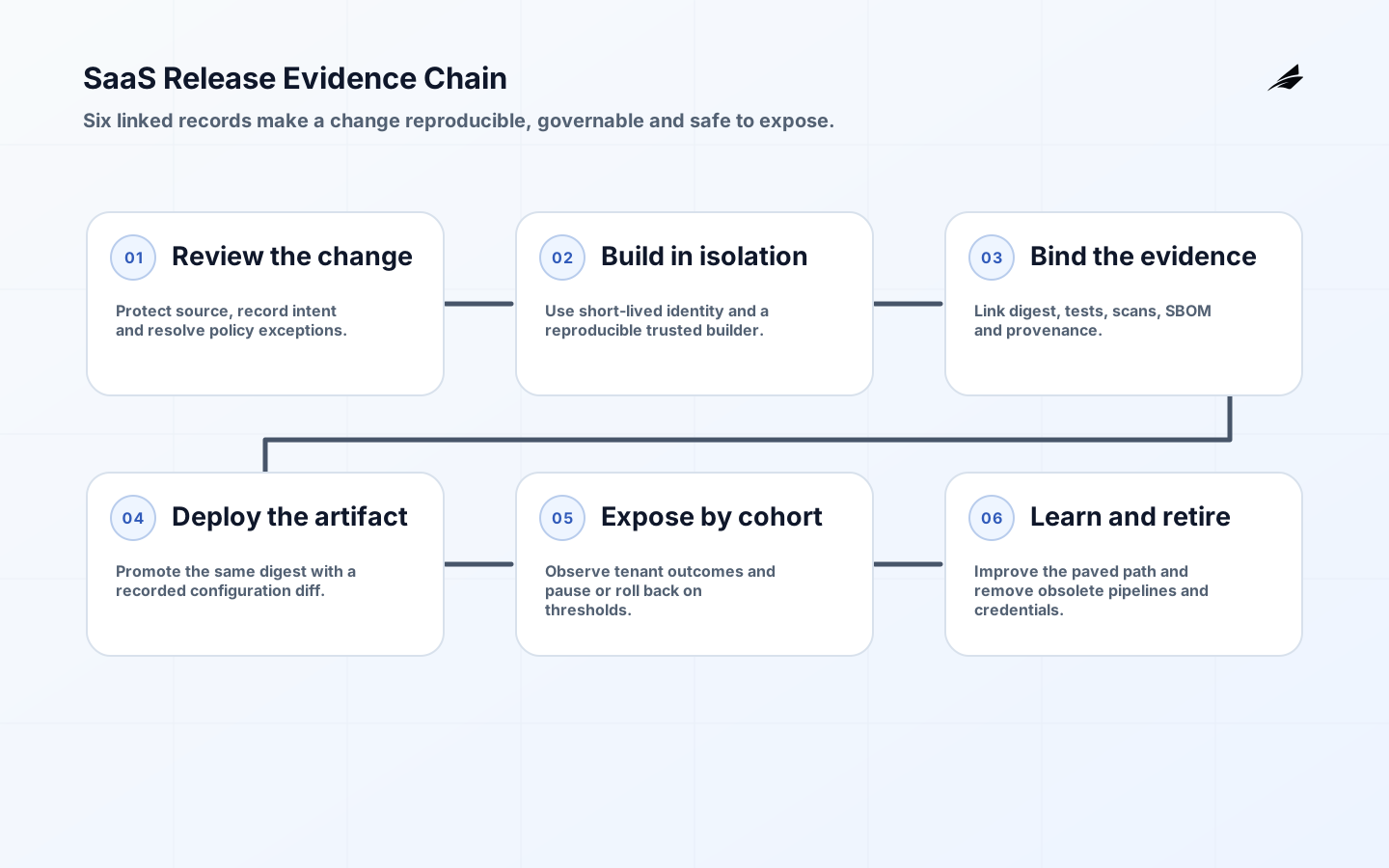
CI/CD modernization for SaaS companies is the redesign of how a change becomes a trusted production release. Replacing a pipeline tool without improving review, test evidence, artifact integrity, deployment safety and recovery simply relocates the old constraints. This FAQ focuses on decisions a SaaS engineering organization must make while customers, tenants and compliance obligations remain live.
For sequencing and acceptance detail, use the SaaS CI/CD delivery plan, modernization implementation checklist, SaaS cloud DevOps plan and SaaS DevOps checklist. Modernize one representative service path before imposing a universal template.
What should CI/CD modernization change?
It should shorten trustworthy feedback, make builds reproducible, reduce standing privilege, preserve provenance, separate deployment from customer exposure, and make rollback or forward repair routine. Inventory repositories, build systems, runners, registries, environments, credentials, release calendars, manual approvals and tenant-specific variants. Measure current lead time, queue time, failure rate, recovery time and manual touches before redesign so the team can prove improvement.
The DORA continuous-delivery guidance describes the ability to release changes safely and quickly on demand, supported by version control, deployment automation, continuous integration, test automation and related practices. A modern system does not require every commit to reach every customer immediately. It requires each releasable artifact to move through a controlled, repeatable path when the business decides.
| Observed constraint | Modernization response | Proof |
|---|---|---|
| Long shared build queue | Right-size isolated runners and cache safely | Queue percentiles by workload |
| Environment drift | Version environment and deployment definitions | Drift and recreation test |
| Manual release assembly | Build once and promote immutable artifact | Same digest across stages |
| Risky global rollout | Decouple deploy from exposure | Cohort and rollback record |
| Unknown dependency exposure | Generate and retain component inventory | Artifact-linked SBOM |
Where should a SaaS company start?
Choose a service that represents normal complexity but has bounded blast radius. Map change from issue and code review through build, test, artifact, deployment, flag, migration and customer exposure. Mark trust boundaries and manual waits. Fix source control protections, artifact immutability and production identity before optimizing cosmetic pipeline syntax. These controls define what is being released and who can release it.
Create a paved path with supported build steps, test reporting, secret access, artifact publishing, deployment strategy and telemetry. Allow documented extensions where service needs differ. A template should expose meaningful decisions such as runtime, migration policy and rollout cohort; it should not hide dozens of unowned defaults inside a central script that application teams cannot debug.
How should security be built into the pipeline?
The NIST Secure Software Development Framework groups practices around preparing the organization, protecting software, producing well-secured software and responding to vulnerabilities. Translate relevant outcomes into pipeline and process controls: protected repositories, reviewed changes, hardened build services, dependency review, secure release storage, vulnerability handling and retained evidence. Risk determines blocking thresholds; a scanner's presence alone is not a control.
Use ephemeral, isolated runners for untrusted or high-risk builds where feasible. Grant workload identity per job, restrict network egress, avoid secrets in pull-request contexts and prevent build logs from exposing credentials. Sign or attest artifacts and verify policy at deployment. The SLSA 1.2 specification provides a framework for increasing confidence in artifact provenance and build integrity; select a target level that matches threat and capability.
What evidence should travel with an artifact?
Retain source revision, review status, build definition, builder identity, dependency lock state, test results, scan results, component inventory, artifact digest, provenance, deployment record and approver or policy decision. Bind evidence by digest rather than mutable filename or tag. CISA's SBOM resources describe SBOM as a nested inventory of software components; generate it during the trusted build and keep it queryable for vulnerability response.
Assess important open-source dependencies beyond a one-time vulnerability scan. OpenSSF Scorecard automates checks for risky practices in open-source projects. Treat scores as investigation signals, not automatic judgments: combine maintenance activity, release integrity, dependency criticality, license, exploitability and available alternatives. Record accepted risk and a replacement or containment plan for critical dependencies.
How should deployments protect SaaS tenants?
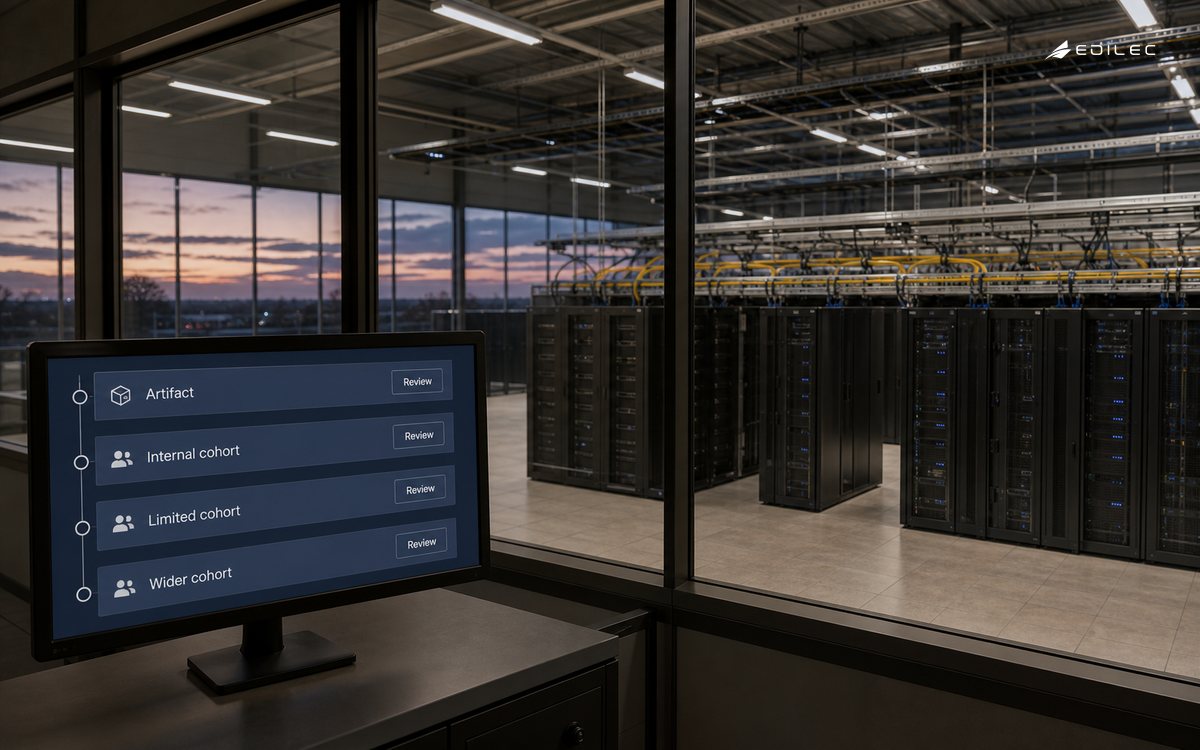
Build once, promote the same artifact, and separate deployment from exposure with flags, routing or configuration where appropriate. Start with internal or low-risk tenants, observe user-facing indicators, then expand cohorts. Define automatic pause and rollback conditions before launch. Preserve tenant isolation during canaries; a global shared database migration can defeat an otherwise careful application rollout.
Use backward-compatible database changes: expand the schema, deploy code that tolerates old and new forms, migrate data with observability, switch reads, then contract later. Put destructive operations behind separate approval and backup validation. Rollback is not credible if old code cannot read the migrated schema. Test restore and forward repair for data changes whose effects cannot be reversed safely.
| Gate | Automated evidence | Human decision when needed |
|---|---|---|
| Change | Review, policy and test status | Risk or architecture exception |
| Build | Digest, provenance, SBOM and scans | Critical finding disposition |
| Deploy | Target identity and configuration diff | High-consequence environment approval |
| Expose | Cohort health and error budget | Customer or regulatory timing |
| Complete | Outcome, incident and rollback record | Close or continue rollout |
How do you migrate while delivery continues?
Run old and new paths only long enough to compare evidence and build confidence. Freeze new features in shared pipeline libraries during critical migration windows, not in product repositories for months. Move services by cohort, starting with the representative pilot. Use adapters for artifact metadata and deployment events so dashboards can compare both systems. Set a retirement date and owner for the legacy path.
Do not copy all historical exceptions into the new platform. Classify each as required, temporary, obsolete or unsafe. Teams requesting an exception should state the service need, risk, owner and expiry. This prevents modernization from becoming an archaeological preservation project and makes the supported path measurably easier than custom alternatives.
Which metrics and owners matter?
Measure lead time from commit to production, deployment frequency, change failure, recovery time, queue time, build duration, flaky-test rate, rollback success and percentage of releases using the paved path. Segment by service type and avoid ranking individuals. A faster median can hide a severely delayed tail, so inspect distributions and blocked time. Link delivery measures to availability and customer outcomes.
A platform team owns the supported path and its reliability; application teams own service tests, deployment behavior and production outcomes; security defines and reviews risk policy; operations shapes incident and recovery evidence. Product leadership decides exposure timing. Publish service levels for the CI/CD platform itself, including runner availability, artifact durability and support response.
Worked example: migrating two SaaS services
A multi-tenant SaaS product has one API built in a shared mutable runner and one worker released from a developer laptop. The API is selected as the pilot because it has good automated tests and supports tenant cohorts. The new path uses protected review, an ephemeral runner with workload identity, locked dependencies, one container digest, an SBOM and provenance. Deployment first reaches an internal tenant, then five low-risk customer tenants, then broader cohorts based on error and latency indicators.
The team runs old and new API pipelines in parallel for three releases and compares artifact contents, test results and deployed configuration. A backward-compatible database column is introduced in an expand step; exposure remains off until both code versions tolerate it. One injected smoke-test failure confirms that promotion stops, while one elevated cohort error pauses expansion and returns routing to the prior digest. The release record links commit, review, builder, artifact, evidence, target and cohort decision.
The worker migrates second using a different template because it has batch scheduling and no tenant routing. Its old laptop credentials are revoked immediately after the first proven production recovery. Platform acceptance requires both teams to investigate a failed build, rotate deployment identity and use a documented rollback. The legacy runner is deleted on a dated retirement ticket; retaining it as an unofficial fallback would preserve the highest-risk path and undermine the modernization.
Modernization acceptance evidence
- Baseline delivery metrics with definitions and distributions, not only averages.
- Protected source and environment policy with named exception and expiry handling.
- Reproducible artifact linked by digest to provenance, SBOM, tests and scans.
- Short-lived build and deployment identity with unauthorized-path tests.
- Tenant-cohort release record including pause, rollback and database compatibility evidence.
- Platform runbook used by an application team to diagnose a failed release.
- Legacy runner, credential, registry and pipeline retirement inventory with completion dates.
- Post-migration review of speed, failure, recovery, platform reliability and developer effort.
Key takeaways
- Modernize the trust and feedback path, not only the pipeline interface.
- Build once, identify by digest and promote immutable artifacts with linked evidence.
- Use short-lived workload identity and isolate untrusted build execution.
- Separate deployment, data migration and customer exposure.
- Retire legacy paths on a dated, evidence-based service migration plan.
Frequently asked questions
Should every repository use one pipeline?
Use one governed delivery contract and a small set of supported templates, not one inflexible file. Different runtimes may need different implementation, while evidence, identity, artifact and deployment policies remain consistent.
Are manual approvals incompatible with continuous delivery?
No. Approval can be appropriate for high-consequence changes, regulated timing or customer exposure. Make it risk-based, informed by evidence and prompt. Routine low-risk changes should pass policy automatically so human attention is reserved for real judgment.
When is modernization complete?
It is complete when target services use the supported path, release evidence is queryable, production identity is controlled, teams can deploy and recover, metrics improve without harming reliability, and legacy credentials, runners and pipelines are retired.
Conclusion
A modern SaaS CI/CD system creates a defensible chain from reviewed change to measured customer outcome. Reproducible artifacts, protected build identity, staged exposure and clear ownership let teams increase delivery speed without asking customers to absorb uncontrolled risk.