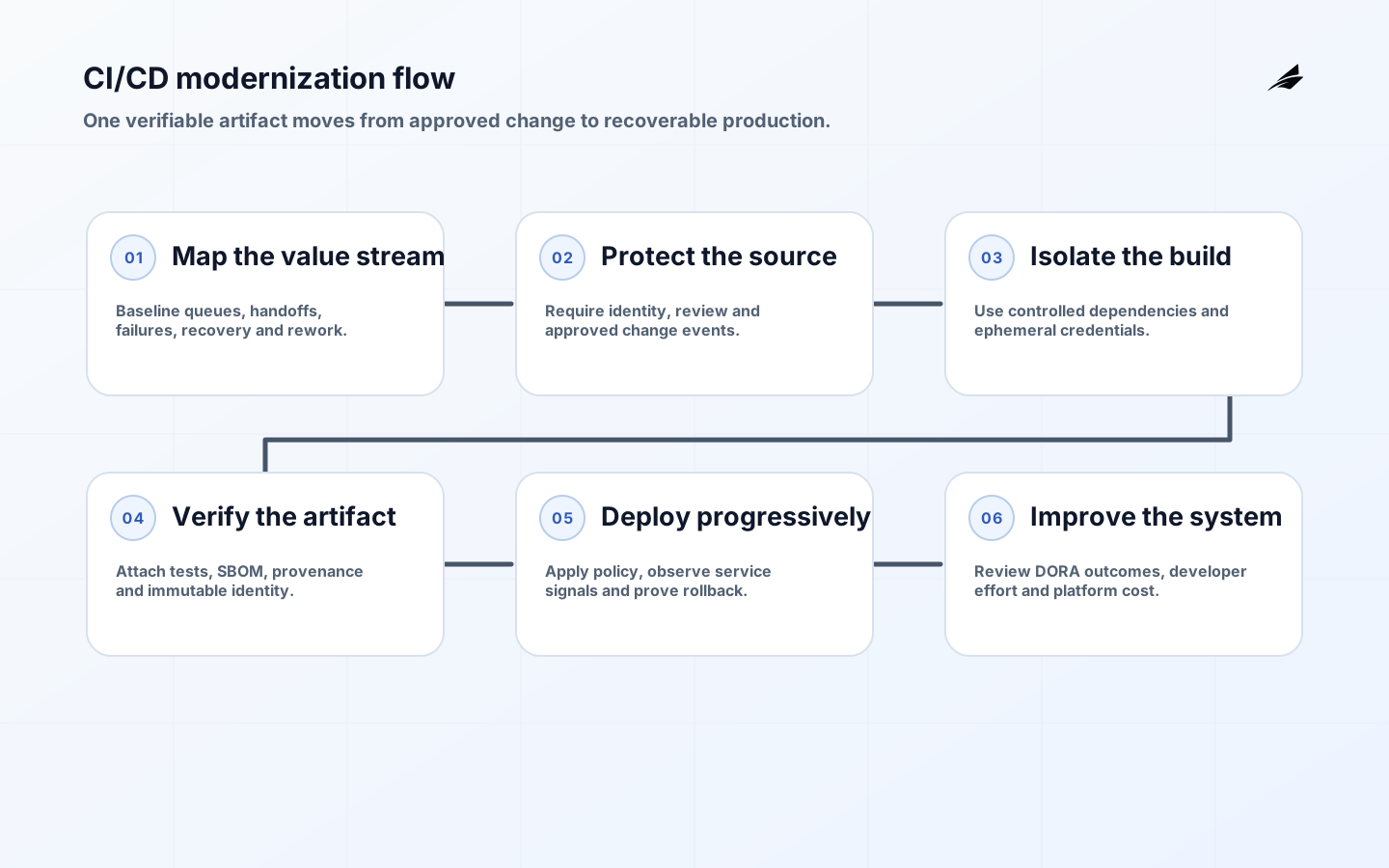
CI/CD Modernization Services FAQ helps teams turn a broad technology initiative into a bounded operating capability. Start with the workflow, accountable owner, unacceptable failure and baseline evidence; then make architecture, controls, support, recovery and exit explicit before scaling.
Use Edilec's CI/CD modernization scope, the CI/CD modernization checklist, reliable CI/CD pipelines for adjacent decisions. The current primary references used throughout this guide are DORA's software delivery performance metrics, Secure Software Development Framework (SSDF) Version 1.1, SLSA Specification v1.2, Security for GitHub Actions. Apply each source according to the service context and applicable obligations rather than treating a framework name as proof of implementation.
What buyers need to decide
A buyer usually arrives with symptoms: releases take too long, Jenkins or another server is difficult to patch, every repository has different YAML, production credentials are long-lived, rollback is manual, or deployment evidence is assembled before an audit. The purchase decision is not simply hosted versus self-hosted CI. It is whether the organization needs remediation of a few pipelines, a reusable delivery platform, or a broader operating-model change across development, security and operations.
- Which applications are in scope, and which release paths are explicitly excluded?
- What business outcome has priority: shorter lead time, safer changes, lower maintenance effort, stronger evidence, or all four in a staged order?
- Which controls must be mandatory for every team, and where can product teams choose their own implementation?
- Who will own templates, runners, secrets, environments, policy exceptions and production support after handover?
- What baseline and acceptance measures will prove that modernization improved delivery rather than merely moving it?
Define the modernization scope
Start with an inventory at the application or service level. Capture repository, build technology, artifact destination, deployment target, environments, trigger, average run duration, runner type, secret sources, approvals, rollback method, release frequency and owner. Include scheduled jobs, database migrations, infrastructure repositories and mobile release workflows; they often sit outside the obvious application pipeline while carrying significant risk. Map the value stream from accepted change to production and record queues, handoffs and repeated manual work.
| Service level | Typical deliverables | Use when | Boundary to state |
|---|---|---|---|
| Pipeline remediation | Fixes to selected workflows, tests, caching, credentials and deployment steps | The platform is viable but a small set of pipelines is unreliable | No organization-wide template or operating-model change |
| Platform foundation | Reusable workflows, runner model, artifact registry, environment controls, policy and telemetry | Many teams repeat the same delivery work with inconsistent controls | Application refactoring remains owned by product teams |
| Estate migration | Inventory, archetypes, pilot, migration waves, decommissioning and enablement | A legacy platform or fragmented toolset must be retired | Name applications that will stay on the old path and why |
| Managed operation | Service ownership, upgrades, incident response, capacity, support and improvement backlog | Internal teams need sustained platform capacity after launch | Define support hours, severity model and shared responsibilities |
Design a paved delivery path
The target should separate concerns. Product repositories describe application-specific build and test behavior. Versioned reusable workflows or templates implement common controls. A runner layer supplies isolated compute with documented network reach. An artifact registry stores immutable build outputs. Deployment automation promotes the same identified artifact through environments instead of rebuilding it. Environment configuration and infrastructure changes remain versioned, reviewed and traceable. Telemetry connects commits, workflow runs, artifacts, deployments and incidents.
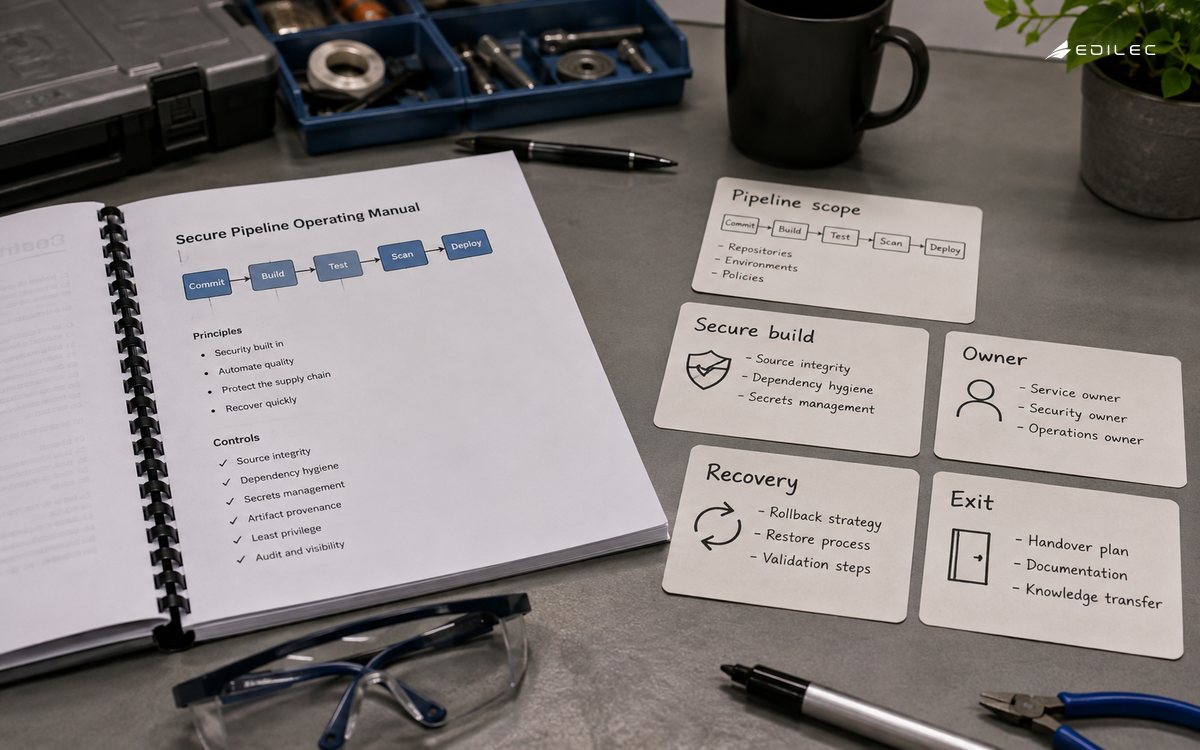
Standardization should remove undifferentiated work without hiding the mechanism. Teams need an escape hatch for legitimate exceptions, with an owner, rationale and review date. Treat templates as products: publish versions, compatibility notes, migration guidance and support channels. A single mandatory template that cannot represent different workload archetypes will be forked or bypassed. Common archetypes usually include container services, serverless functions, static web applications, libraries, infrastructure and scheduled data jobs.
Build security into the release path
NIST's SSDF is intentionally compatible with different lifecycle models, so use it as a control map rather than as a product checklist. Connect each required practice to a pipeline behavior, responsible role and retained record. SLSA adds a useful maturity model for source and build integrity, including provenance that can trace an artifact to the source and process that produced it. Select a target level based on threat and customer obligations; do not claim conformance merely because a tool can emit an attestation.
| Control area | Implementation pattern | Evidence | Failure to test |
|---|---|---|---|
| Identity | Short-lived workload identity with narrow trust conditions; human production access is separate | Cloud audit event tied to workflow, repository and revision | Untrusted branch or fork attempts to request a production token |
| Dependencies | Lock files, controlled registries, update policy and risk-based scanning | Resolved dependency manifest and scan result | Registry outage, malicious package and expired exception |
| Build integrity | Ephemeral isolated runners, immutable output and provenance or attestation | Artifact digest linked to source revision and build identity | Artifact is modified after build or built from an unreviewed revision |
| Deployment | Protected environments, separation of duties where required, progressive rollout and automated rollback signals | Approval, deployment event, health evaluation and final status | Failed health check, unavailable approver and partial rollout |
| Secrets | Central secret manager, least privilege, rotation and no secret values in logs or artifacts | Access log and rotation record | Revoked credential, accidental log output and unauthorized environment request |
GitHub's official guidance is one concrete example: it recommends OpenID Connect for cloud authentication and artifact attestations for build provenance. Equivalent controls exist in other platforms. The architectural requirement is short-lived, constrained identity and verifiable artifact history, not dependence on a particular vendor feature name.
Roll out in evidence-producing waves
- Baseline: instrument the current path for a representative service and record lead time, deployment frequency, failed deployment recovery time, change fail rate and deployment rework rate.
- Foundation: establish identity, runner, artifact, environment and telemetry patterns before migrating many repositories.
- Pilot: choose one useful but non-critical service whose team will actively participate. Run normal releases, rollback, credential failure and recovery drills.
- Archetypes: turn pilot learning into versioned patterns for the workload types actually present in the estate.
- Waves: group applications by archetype and risk. Give each wave entry criteria, migration support, production validation and a defined old-path fallback window.
- Decommission: revoke credentials, archive configuration and evidence, remove triggers, retire runners and confirm that no release dependency remains.
- Operate: assign service ownership, support, capacity, upgrade cadence, exception review and a backlog driven by delivery data and user feedback.
Estimate cost and timeline honestly
A defensible estimate is built from discovery findings, not repository count alone. Two repositories can differ by an order of magnitude in effort if one produces a stateless container and the other coordinates signed binaries, database changes and regional releases. Price the foundation once, then estimate migration by archetype and complexity band. Keep internal participation visible: application owners must validate tests, production behavior and rollback, while security, networking and cloud owners resolve policy and connectivity decisions.
| Cost driver | Questions for discovery | How to control it |
|---|---|---|
| Application diversity | How many build and deployment archetypes exist? | Pilot each archetype and reuse a tested pattern |
| Test readiness | Can automated tests run deterministically with managed test data? | Separate test remediation from pipeline migration and prioritize release-critical coverage |
| Network and runners | Do builds need private dependencies, special hardware or regulated isolation? | Use a documented runner strategy and avoid one-off connectivity |
| Compliance evidence | Which approvals, records, retention periods and segregation rules apply? | Automate evidence capture from the start instead of reconstructing it later |
| Change enablement | How many teams need onboarding, office hours and migration support? | Fund documentation and adoption as delivery work, with named product champions |
Use stage gates rather than a calendar-only promise. Discovery ends when the inventory and baseline are credible. Foundation ends when controls and support ownership are demonstrable. A pilot ends only after production release and recovery scenarios pass. A wave ends when the application owner accepts the new path and the old route is either disabled or covered by a time-bound exception. This makes schedule risk visible without inventing precision before the estate is understood.
Example: modernizing a container service
Consider a customer API built by Jenkins on a persistent shared worker. The job pulls production credentials from a local file, rebuilds for each environment and deploys all instances at once. Modernization begins by making tests repeatable and producing one container image with an immutable digest. A reusable workflow builds on an ephemeral runner, records the revision, scans according to policy and publishes the image. A deployment workflow uses short-lived workload identity, promotes that same digest to staging, runs smoke tests, then performs a canary release to production. Health criteria either continue promotion or trigger rollback. Every event is linked to the revision and artifact.
The success test is not that the YAML is shorter. It is that a routine change reaches users with less waiting, a failed change is detected and recovered predictably, no reusable production secret sits on the runner, and the team can answer who released which artifact from which source. The related Infrastructure as Code Standards guide helps extend the same discipline to environments.
Risks that derail modernization
- Tool-first design: reproducing the old process in a new product preserves queues, manual approvals and unsafe credentials.
- Template overreach: forcing every workload into one workflow creates forks and hidden bypasses.
- Security theater: adding scanners without ownership, thresholds, exception expiry or remediation turns findings into background noise.
- Unbounded dual running: keeping both platforms indefinitely doubles maintenance and leaves teams unsure which path is authoritative.
- Missing application ownership: a platform team cannot validate business behavior, data migration or user impact on its own.
- Measurement misuse: DORA advises applying delivery metrics in application context and improving over time, not ranking dissimilar teams.
Measure outcomes and acceptance
Use DORA's current five metrics as service-level outcome signals: change lead time, deployment frequency, failed deployment recovery time, change fail rate and deployment rework rate. Pair them with leading indicators such as queue time, flaky-test rate, workflow duration, template adoption, exception age and percentage of deployments using short-lived identity. Review trends for one service before and after a meaningful change. Do not impose a universal deployment-frequency target across systems with different demand and risk.
- A product team can create or migrate a conforming pipeline from maintained documentation and templates.
- The same immutable artifact is promoted through environments and can be traced to reviewed source.
- Production authentication is short-lived, narrowly scoped and tested against an unauthorized request.
- Rollback or forward recovery has been exercised under realistic conditions, not only described in a runbook.
- Pipeline and deployment events reach the agreed telemetry system with enough context for incident review.
- The old path has a dated retirement plan, including credential revocation and configuration archival.
Key takeaways
- Modernize the delivery system and its ownership, not only the CI product.
- Inventory applications and establish a service-level baseline before estimating migration.
- Use reusable, versioned patterns with explicit exceptions for real workload differences.
- Make identity, artifact integrity, recovery and evidence part of the target architecture.
- Migrate by archetype and risk, then decommission the old path deliberately.
- Judge success through safer flow and team operability, not the number of converted files.
Frequently asked questions
What should CI/CD modernization services include? At minimum: estate discovery, value-stream and risk assessment, target architecture, security controls, pilot migration, reusable patterns, wave planning, telemetry, documentation, training and decommissioning criteria. Managed support is a separate scope that should state service hours and responsibilities.
Should we replace Jenkins? Replace or upgrade it when its lifecycle, plugin risk, scaling model or maintenance burden prevents the target outcome. If the main problems are poor tests, unsafe credentials or a manual release design, changing the orchestrator alone will not solve them.
How long does a modernization take? The credible answer follows discovery. Timeline depends on application archetypes, test readiness, deployment complexity, network constraints, compliance evidence and team availability. Use gated phases and estimate migration waves after a representative pilot.
Can regulated teams use continuous delivery? Yes, when controls are risk-based and automated evidence is trustworthy. Protected environments, separation of duties where required, immutable artifacts, traceable approvals and tested recovery can make frequent small changes easier to review than large manual releases.
What is the difference between CI and continuous deployment? Continuous integration validates small changes frequently and keeps the codebase releasable. Continuous delivery makes a release ready through automation but may retain a business decision to deploy. Continuous deployment automatically releases every qualifying change. Choose the model per service and risk.
How should we compare providers? Ask each provider to show the discovery method, target control model, representative migration plan, handover deliverables, exception process, acceptance tests and decommissioning approach. A demo of a pipeline is not evidence that the service can migrate and operate your estate.
Conclusion
A strong CI/CD modernization program creates a maintainable route from reviewed source to observable production. Its value appears in smaller queues, predictable recovery, constrained credentials, verifiable artifacts and teams that understand the path they use. Scope the foundation, migration and operating model separately; connect each control to evidence; and let a representative pilot determine the shape of the wider rollout.