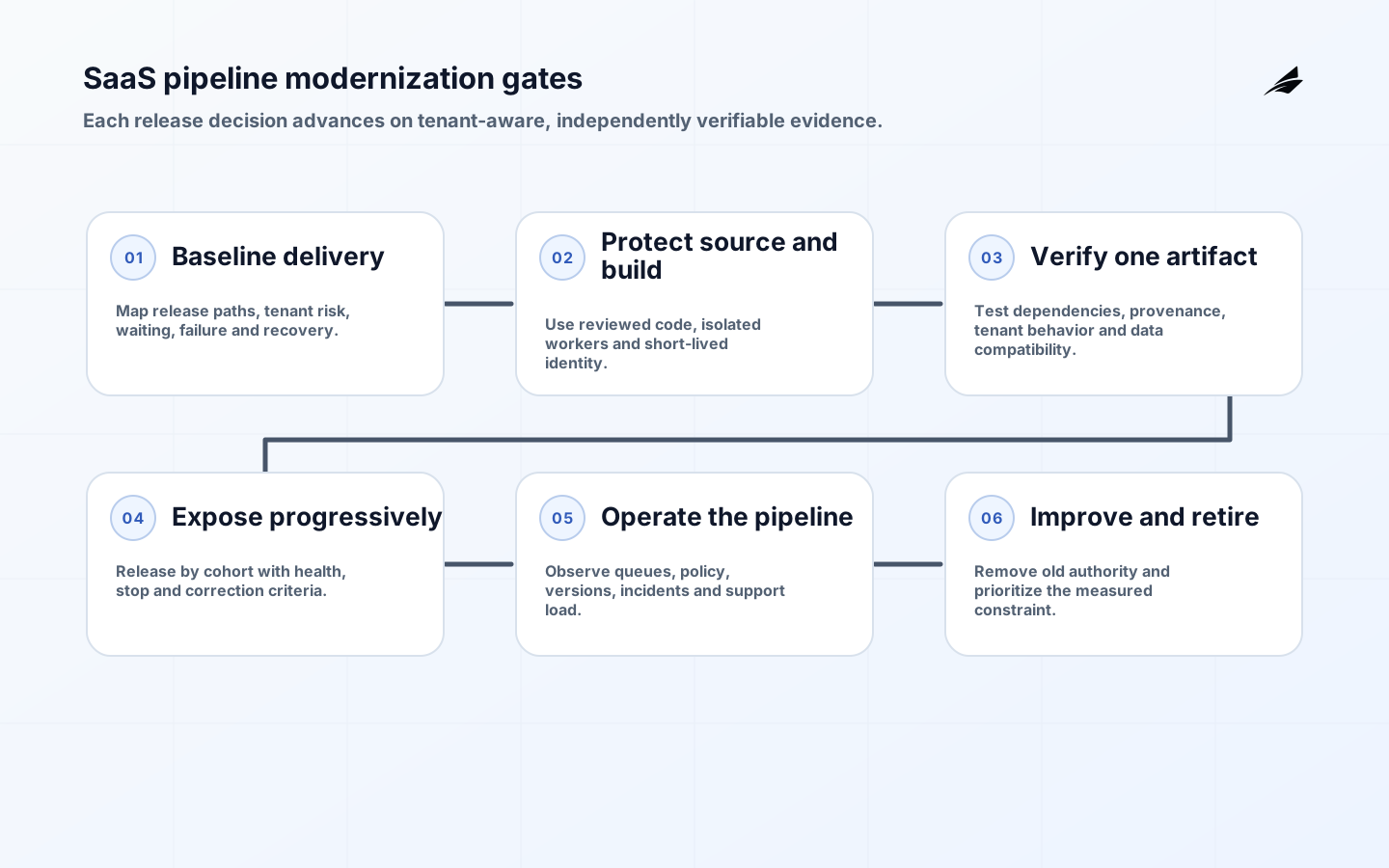
CI/CD modernization services for SaaS companies should improve the path from an approved source change to a tenant-visible outcome. Replacing a build server is only one part. The program must address repository controls, dependencies, build isolation, artifact provenance, tenant-aware testing, database change, progressive exposure, production evidence and recovery. Scope and cost depend less on the number of pipeline files than on the applications, release paths and operating behaviors that must change.
Use the SaaS CI/CD implementation checklist for detailed acceptance and the SaaS CI/CD FAQ for buyer questions. The SaaS cloud DevOps delivery plan covers the wider tenant platform and operating model.
1. Baseline the delivery system and tenant risk
Map every route to production: source repositories, branch and review policy, build workers, package sources, secrets, artifacts, environment promotion, database migration, feature flags, release approval and emergency fixes. Include scripts run from individual laptops and provider consoles. Measure queue time, manual touch time, change lead time, deployment frequency, failed-deployment recovery, change failure and unplanned repair work for each service, not as one portfolio average.
DORA's current five delivery metrics separate throughput into change lead time, deployment frequency and failed-deployment recovery time, and instability into change fail rate and deployment rework rate. Use them to find constraints over time, not to rank teams. Add tenant impact, rollback frequency, pipeline reliability and release-support load. The baseline should distinguish product work from waiting, rework and compliance evidence collection.
| Scope dimension | Discovery question | Cost driver | Risk if omitted |
|---|---|---|---|
| Applications | How many distinct build and runtime patterns? | Migration and test variation | Unsupported release paths |
| Tenancy | How are cohorts, plans and data isolated? | Tenant-aware tests and rollout | Cross-tenant impact |
| Data | How are schemas and backfills changed? | Compatibility and rehearsal | Irreversible deployment |
| Supply chain | Where do source, packages and artifacts originate? | Isolation, signing and scanning | Compromised release |
| Operations | How are versions observed and recovered? | Telemetry and runbooks | Slow or blind recovery |
2. Define the target pipeline and control model
Design a paved path, not one giant pipeline. A service template should cover reviewed source, isolated build, pinned or verified dependencies, tests, policy, immutable artifact, provenance, environment configuration, controlled promotion and deployment evidence. Allow justified variants for mobile, data, infrastructure and legacy services. Define which checks block, which warn and who can approve exceptions. Emergency delivery should be faster through prepared evidence, not through an undocumented bypass.
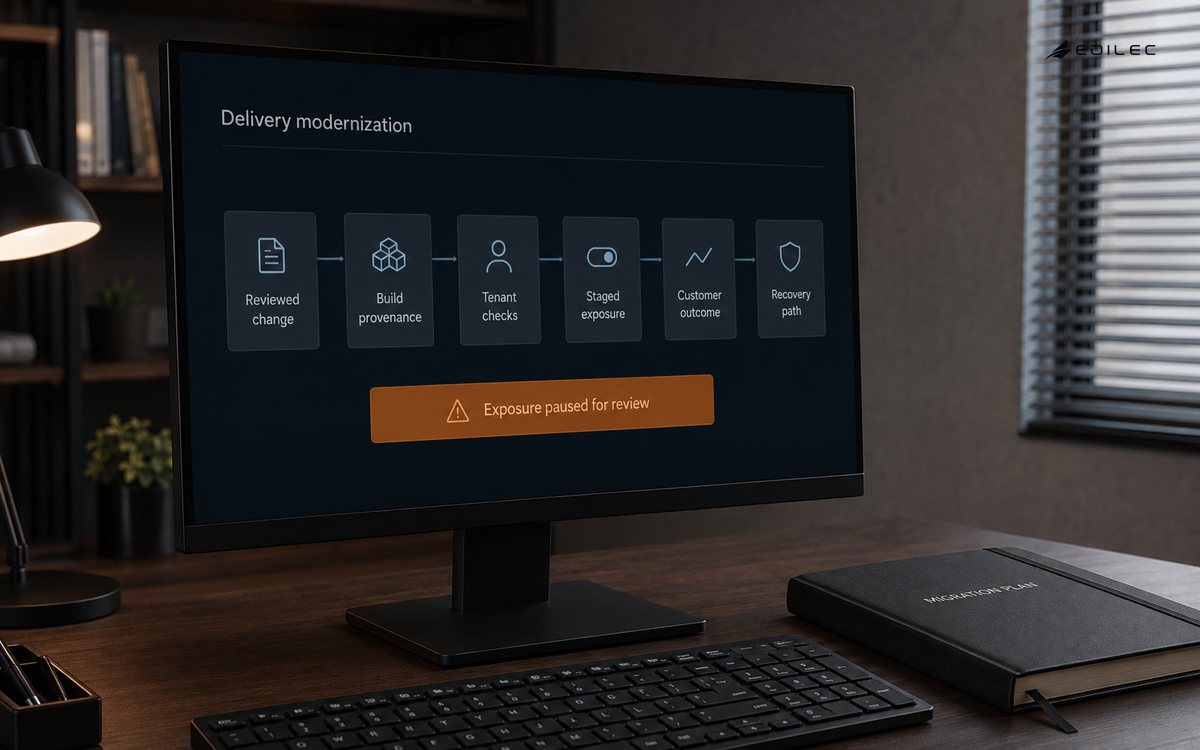
The NIST Secure Software Development Framework provides practices for preparing the organization, protecting software, producing well-secured software and responding to vulnerabilities. NIST's SP 800-204D maps software supply-chain measures into DevSecOps pipelines. Translate those outcomes into controls for the actual repositories, runners, package registries, artifacts and deployment identities in scope.
3. Establish trusted builds and artifacts
Use ephemeral or tightly controlled build workers, short-lived workload identities and restricted network access. Keep production credentials out of builds. Pin critical actions and dependencies, verify checksums or signatures where ecosystems support them, generate dependency inventories and protect package publishing. Build once, assign an immutable digest and promote the same artifact. Rebuilding in each environment creates different inputs and weakens the connection between test evidence and production.
SLSA's Build Track progresses from provenance existing, through signed provenance from a hosted platform, to hardened builds. Choose a level from threat and customer needs rather than using the label as decoration. Verify provenance at promotion, bind it to the artifact digest and retain the policy result. Protect provenance generation itself so a compromised project job cannot assert trust about its own artifact.
4. Verify tenant behavior and progressive release
Test organization creation, authentication, entitlement, quota, billing, data isolation, export and deletion across representative plans. Add contract tests for public APIs and integrations. Database changes should be backward compatible across mixed application versions; rehearse expand, migrate and contract steps with production-scale data. Test retries and duplicate events so a release cannot double-charge or repeat a customer action.
Release by tenant cohort, region, cell or percentage where architecture permits. Define entry criteria, observation window, health signals, stop thresholds and recovery action. Feature flags require ownership, access control, audit, cleanup and behavior when the flag service fails. Rollback is not always safe after data mutation; use forward correction, compatibility layers or restore-and-reconcile plans where necessary.
| Delivery risk | Control | Acceptance scenario | Outcome measure |
|---|---|---|---|
| Untrusted artifact | Verified digest and provenance | Attempt unauthorized substitution | Promotion rejected |
| Tenant regression | Cohort tests and progressive exposure | Release to internal tenant then canary | No objective breach |
| Schema incompatibility | Expand-migrate-contract | Run old and new versions together | Reads and writes remain valid |
| Flag misuse | Role, audit, expiry and fallback | Lose flag provider during rollout | Defined safe behavior |
| Release failure | Version evidence and recovery plan | Inject post-deploy fault | Recovery within objective |
5. Plan delivery waves, cost and change
Sequence work by representative pattern. First establish the platform path with one service, then migrate a small cohort of similar applications, then address exceptional legacy routes. Keep old and new pipelines only as long as needed for controlled migration; parallel systems add maintenance and policy drift. Define exit criteria for the old platform, including archived evidence, revoked credentials, migrated schedules and removed network access.
Cost includes platform licenses, runner compute, artifact and log storage, security services, engineering migration, test repair, application changes, training and dual operation. Estimate by service pattern and migration complexity rather than repository count alone. Include ongoing ownership, upgrades and support. A cheaper tool can be more expensive if teams build custom identity, evidence and recovery functions around it. Contract milestones should pay for accepted delivery capability, not installed components.
6. Operate the pipeline as a production service
Instrument pipeline availability, queue age, stage duration, flaky tests, policy failures, runner saturation, artifact publication and deployment result. Link each deployment to service version and tenant cohort. OpenTelemetry signals provide a common model for traces, metrics and logs; correlate them without placing secrets or tenant-sensitive values in unrestricted telemetry. Page only on conditions with a prepared response.
Accept the modernized path by having a product team make a source and infrastructure change, produce one verified artifact, promote it, expose it to a cohort, observe version-specific health, inject a failure and recover. Test credential revocation and a vulnerable dependency response. Transfer platform source, templates, policy, identities, exception records, dashboards, runbooks, cost model and upgrade ownership. Then compare delivery and tenant outcomes with the baseline.
Material risks and mitigations
Common failures include standardizing before understanding application variation, reproducing legacy approvals in a new tool, making every scan blocking, preserving permanent deployment credentials, losing evidence during platform replacement and promising rollback where data changes make it unsafe. Mitigate them with discovery, representative pilots, risk-tiered controls, short-lived identity, evidence migration and service-specific recovery design. Protect delivery capacity for product work so modernization does not become a year-long release freeze.
Example modernization wave for a SaaS service
A billing service currently builds on a persistent shared worker and deploys from a release account. The modernization team first records its lead time, failure and recovery behavior. It moves the build to an isolated runner with short-lived identity, produces one immutable image and provenance, then verifies the digest at promotion. Existing tests remain in place while new tenant, contract and migration tests are added.
The team introduces a backward-compatible schema expansion, deploys the new application to an internal tenant and then a small customer cohort. Telemetry carries service version and cohort. A simulated callback failure trips the stop threshold; the release pauses while queued billing events remain idempotent. Operators recover without rebuilding the artifact and reconcile invoices before exposure continues. The complete timeline becomes acceptance evidence.
Only after several normal releases does the old pipeline lose deployment authority. Its credentials are revoked, schedules removed, evidence archived and dependencies inventoried for deletion. The team compares the new lead time, recovery, rework, support load and cloud cost with baseline. That measured service becomes the pattern for similar applications, while data-heavy and legacy services receive separate variants instead of forced conformity.
Track developer experience as an operating input without making convenience the only goal. Time a new engineer from repository access to a safe nonproduction deployment, observe where documentation or permissions fail, and count unsupported local workarounds. A paved path should make the secure action the easy action and explain denials clearly. Review requests for exceptions as product feedback: repeated bypasses often reveal a missing platform capability, an unrealistic control or an application pattern that needs an explicit supported variant.
Key takeaways
- Baseline complete release paths and measure services in their own context.
- Create a paved path with justified variants rather than one universal pipeline.
- Build once, preserve artifact identity and verify provenance at promotion.
- Test tenant boundaries, mixed versions, data change and progressive exposure.
- Budget for application migration, evidence and dual operation, not only tooling.
- Operate and accept the pipeline as a production service with tested recovery.
SaaS CI/CD modernization FAQ
How long does modernization take? A representative path can be proven early, but portfolio duration depends on application variation, data migration and old-platform retirement. Should tools be selected first? No; map outcomes, threats and release patterns, then evaluate tools against them. Does every security finding block a release? Use risk, reachability, confidence and policy; route lower-risk findings into owned remediation. Can approval be automated? Repeatable evidence and low-risk decisions can be automated while explicit authority remains for exceptions. What proves success? Better throughput and stability, fewer risky manual paths, trustworthy artifacts, faster recovery and improved tenant outcomes.
Conclusion: modernize the release decision
CI/CD modernization creates value when every SaaS release is easier to understand, verify, expose and recover. Prove one tenant-aware path end to end, migrate patterns in controlled waves and retire the old authority only after product teams can operate the new system with evidence of safer, faster delivery.