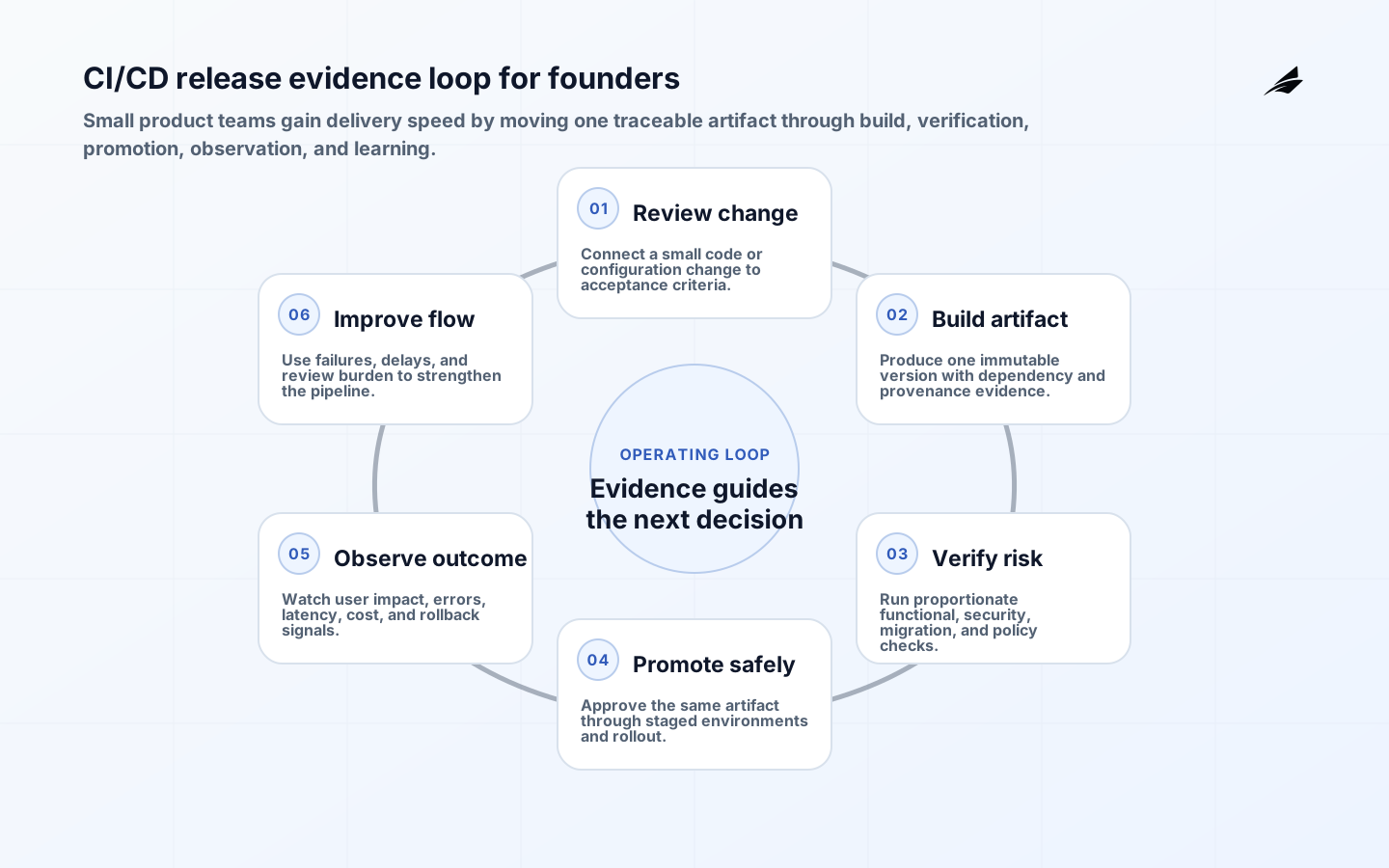
CI/CD meaning for founders is not simply ‘developers deploy more often.’ Continuous integration means small changes are merged into a shared codebase frequently and verified automatically. Continuous delivery means the resulting software remains in a releasable state and can move through controlled environments using a repeatable process. Continuous deployment goes one step further by automatically releasing changes that meet policy. A young SaaS company may choose any of these release policies, but it should not confuse manual approval with manual construction. The build, tests, artifact, configuration, deployment, and rollback should remain reproducible even when a person authorizes production.
For a founder, the business value is shorter and safer feedback. A small feature, fix, or pricing change can reach a limited audience, produce evidence, and be reversed without turning release day into a special event. The DORA research program studies delivery and operational performance, while the NIST Secure Software Development Framework organizes secure development practices around preparing the organization, protecting software, producing well-secured software, and responding to vulnerabilities. Neither implies that a startup needs an elaborate platform. The aim is a dependable path proportional to the product's risk.
Separate integration, delivery, deployment, and release
Integration begins when a developer proposes a change. The pipeline should build it in a clean environment, run fast checks, and give feedback before incompatible work accumulates. Delivery starts after a reviewed change is merged and produces a versioned artifact that has passed the agreed checks. Deployment moves that artifact into an environment. Release determines whether users can access its behavior, which may be controlled separately through configuration or a feature flag. These terms describe different decisions, and separating them makes failure easier to locate.
A pipeline is a product used by engineers and operators. Give it an owner, documented inputs, protected credentials, versioned workflow definitions, resource limits, and a recovery path. Hosted systems such as GitHub Actions can execute workflows, but the team still owns what triggers them, which third-party actions run, how secrets are scoped, and which environment requires approval. Keep production credentials unavailable to pull-request jobs and untrusted code. Pin dependencies and review workflow changes with the same care as application code because a compromised build path can change every release.
| Capability | Founder-level question | Minimum useful evidence |
|---|---|---|
| Continuous integration | Can every proposed change be built and tested promptly? | Repeatable checks tied to a commit |
| Artifact management | Can the exact tested version be identified? | Immutable version, digest, and build record |
| Continuous delivery | Can that version move through environments consistently? | Promotion history and environment policy |
| Release control | Can exposure be limited independently? | Flag, cohort, canary, or approval record |
| Observation | Can the team see user and service impact? | Deployment marker, telemetry, and alert threshold |
| Recovery | Can the previous safe state be restored? | Rehearsed rollback or forward-fix procedure |
Design the first SaaS pipeline around one release path
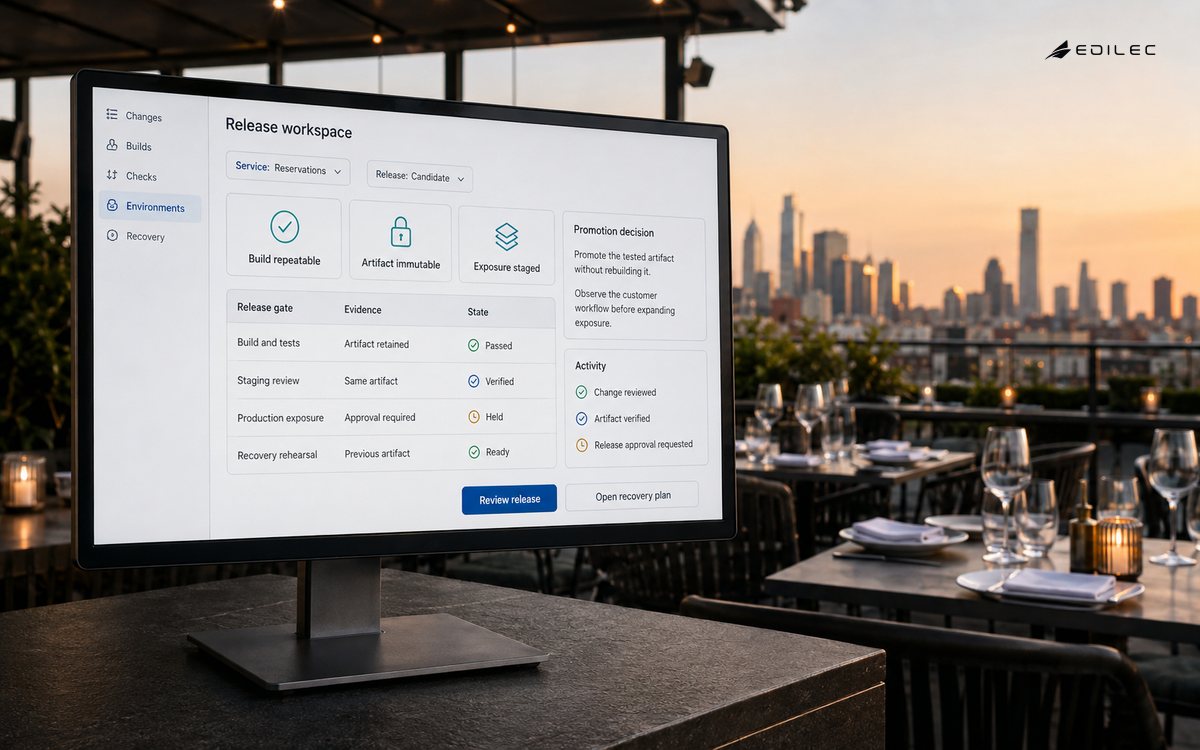
Start with the main service and the production path that currently creates the most uncertainty. Define one command or workflow that installs dependencies, builds the product, runs unit and integration tests, checks formatting and types, scans important dependencies, and packages a deployable artifact. Do not rebuild separately in every environment; promote the same artifact so the version tested is the version released. Put configuration outside the artifact, validate required settings before startup, and store secrets in the environment's secret system rather than the repository.
Choose checks by consequence. A static marketing site may need accessibility, link, visual, and deployment smoke tests. A multitenant SaaS application additionally needs authorization, tenant-isolation, migration, backup, and rollback checks. Payment or health workflows require stronger evidence. Slow end-to-end suites can run after fast merge checks or before production promotion rather than blocking every local iteration. The CI/CD pipelines guide for growing products provides a deeper architecture once the basic path is dependable.
- Keep changes small enough to review and reverse.
- Make a failed check stop promotion by default.
- Protect the default branch and deployment workflow.
- Promote one immutable artifact through environments.
- Treat database migrations as versioned release operations.
- Mark deployments in telemetry so incidents can be correlated with change.
Preserve software supply-chain evidence
A release should answer which source revision, dependencies, workflow, builder, tests, approvals, and configuration produced it. The SLSA v1.2 specification provides a framework for improving software artifact integrity and provenance. A small company does not need to claim a maturity level it has not earned, but it can adopt the underlying habits: isolate builds, protect provenance, identify dependencies, restrict who may modify the pipeline, and verify artifacts before deployment. Store build logs and attestations for a period that supports incident response without retaining secrets.
Third-party packages, container images, actions, and infrastructure modules are part of the delivery boundary. Record direct dependencies, automate vulnerability alerts, and plan updates before a critical disclosure forces an emergency upgrade. Avoid making one scanner a ceremonial gate; findings need severity context, ownership, exceptions, and expiry. For high-impact releases, require independent review of workflow and dependency changes. If the pipeline downloads executable code at runtime, pin a version or digest and validate the source.
| Release risk | Proportionate control | Failure response |
|---|---|---|
| Routine UI change | Build, tests, accessibility, preview | Stop and correct before merge |
| API contract change | Consumer tests and staged compatibility | Keep old contract or roll back |
| Database migration | Backup, rehearsal, compatibility window | Pause promotion and execute recovery plan |
| Authorization change | Negative permission tests and review | Disable path or restore prior policy |
| Dependency update | Integrity verification and focused regression | Revert package and assess exposure |
| Infrastructure change | Plan review, policy checks, limited rollout | Restore known configuration |
Run CI/CD as a release evidence loop
The loop begins with a reviewed change and ends with learning from production. Build evidence should remain connected to deployment evidence; otherwise the team cannot prove which version failed. Observation also belongs inside the loop. OpenTelemetry signals distinguish traces, metrics, logs, and baggage, giving teams complementary ways to correlate a release with request paths, aggregate behavior, and events. Select a small set of user and service indicators, then define when a rollout pauses or reverses.
Release progressively and rehearse recovery
A production deployment should not immediately expose every user when risk is material. Begin with internal users, a canary instance, a small tenant cohort, or a feature flag. Compare error rate, latency, business transactions, support signals, and resource use with the baseline. Set a decision window and accountable owner; a canary that no one watches merely delays a broad failure. Automate obvious stop conditions while preserving human judgment for ambiguous customer impact.
Rollback is not always a button. Application code may be reversible while a destructive data migration is not. Prefer backward-compatible schema changes, separate expansion from contraction, and keep old readers working during transition. Exercise restoration and deployment rollback planning before the incident. Record time to detect, decide, mitigate, and verify recovery. The incident response planning guide helps connect release telemetry to clear ownership and communication.
Measure flow and customer outcomes
Useful measures include lead time from approved change to production, deployment frequency, change failure rate, time to restore service, flaky-check rate, queue time, rollback success, and percentage of releases with traceable artifacts. Segment by service and change class rather than chasing one company-wide target. A slow but consequential migration and a routine copy update should not share the same expected path. Track customer-facing outcomes too: support contacts, conversion, task completion, payment success, or error-free sessions after release.
Do not optimize deployment count at the expense of product judgment. The pipeline removes repetitive risk and creates feedback; it does not decide what customers need. Review blocked releases, false alarms, escaped defects, and manual repair work monthly. Remove checks that produce no decisions, improve tests that fail intermittently, and automate a manual step only after its inputs and failure behavior are understood.
Budget for pipeline continuity. Keep workflow definitions and infrastructure in version control, document how to reproduce a release when the primary runner is unavailable, and know which vendor data must be exported for investigation. Protect administrative accounts with strong authentication and maintain more than one trained owner without sharing credentials. Test restoration of artifact metadata and deployment configuration. A hosted CI service reduces maintenance, but it remains a dependency in the release path; an outage, compromised action, quota limit, or expired billing method needs an explicit response proportional to how quickly the product must ship a security fix.
Key takeaways
- Continuous integration verifies small shared changes frequently.
- Continuous delivery keeps one tested artifact ready for controlled release.
- Continuous deployment is a policy choice, not a requirement for good CI/CD.
- Pipeline code, credentials, dependencies, and artifacts are part of the security boundary.
- Progressive exposure and observable rollback make speed sustainable.
- Founders should measure customer outcomes and recovery, not automation for its own sake.
Frequently asked questions
Is CI/CD worthwhile for a two-person team?
Yes. A small team benefits from one repeatable build, a protected branch, essential tests, an immutable artifact, and a known rollback. Keep the implementation narrow and expand it when repeated risk or delay justifies the next control.
Does continuous delivery remove production approval?
No. It makes the software ready to release through automation. A person or policy may still approve production, especially for high-impact changes. The approval should authorize a specific artifact with visible evidence rather than initiate a manual rebuild.
What should founders automate first?
Automate the build and the fastest tests for the main service, then make deployments repeatable and observable. Add security, integration, migration, and progressive-delivery controls according to actual product risk.
Conclusion
CI/CD gives a growing SaaS company a reliable route from reviewed change to customer evidence. The essential design is modest: integrate small changes, build once, verify proportionately, promote the same artifact, expose it gradually, observe the result, and recover predictably. Protect the pipeline as production infrastructure and improve it using real failures and delays. That is how release automation creates business agility without turning speed into uncontrolled risk.