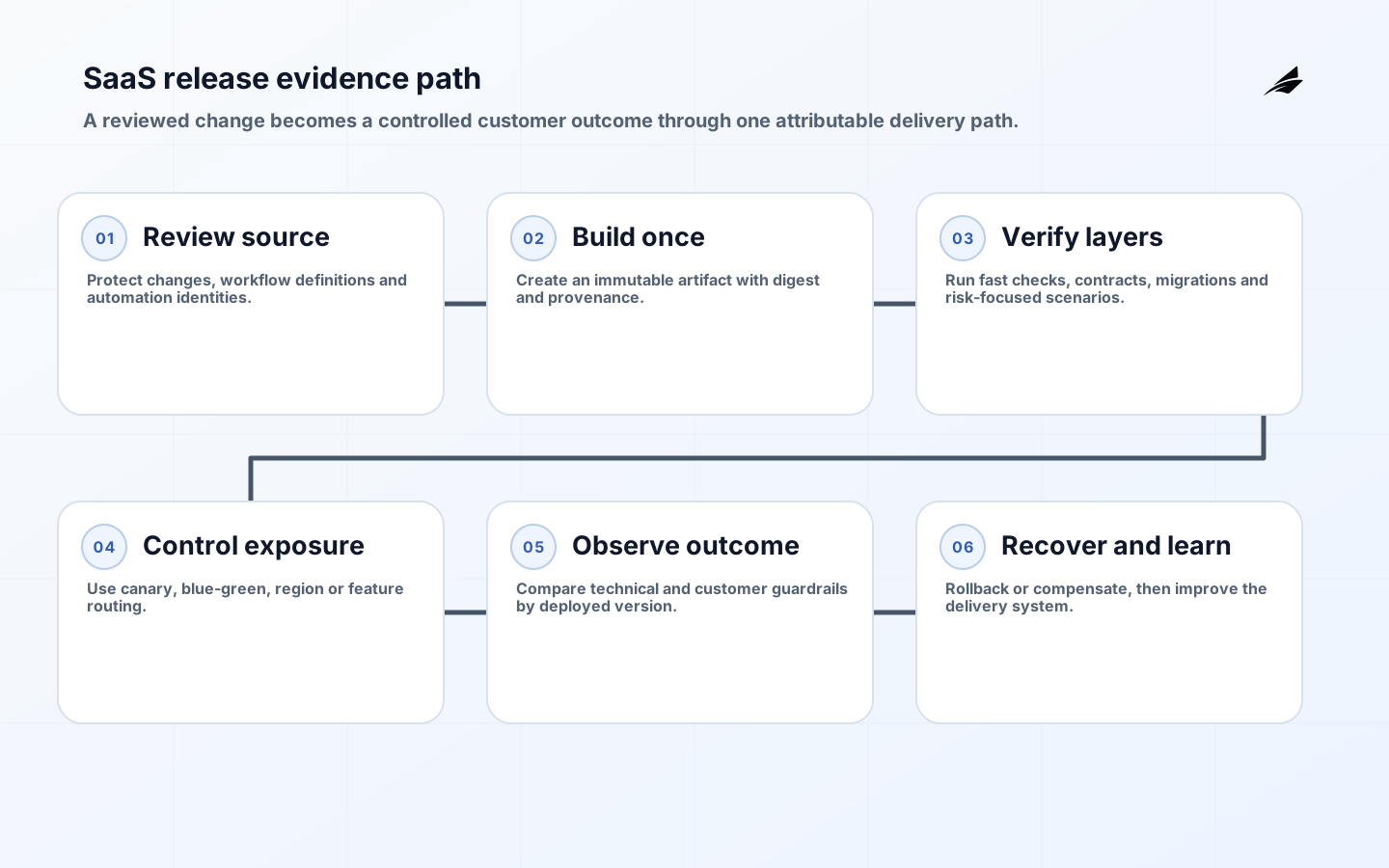
CI/CD pipelines for reliable SaaS releases turn each reviewed change into a traceable artifact, verify it with proportionate evidence, deploy it through controlled environments and observe the customer result. Reliability does not come from adding approval boxes to a fragile script. It comes from small changes, deterministic builds, fast feedback, secure identities, realistic tests, backward-compatible data changes, progressive exposure and practiced recovery. The pipeline should make the safe path easier than bypassing it, including during an urgent fix.
This guide treats continuous delivery as an operating capability rather than a branded toolchain. DORA defines continuous delivery as the ability to release changes on demand quickly, safely and sustainably; continuous deployment, where every suitable change goes to production automatically, is a separate choice. The patterns here complement cloud cost visibility, infrastructure-as-code standards and blue-green deployment. Adapt gates to consequence without creating an unowned manual queue.
Define the release contract and ownership
For each deployable service, name code owner, service owner, production operator and incident authority. Define the artifact, environments, configuration source, customer exposure mechanism, service objectives, data dependencies, required evidence and rollback or forward-fix path. State which changes can deploy automatically and which need risk review. Put production code, infrastructure, policy, database migrations and pipeline definitions under version control. Emergency changes should use the same auditable path with accelerated criteria, not an undocumented administrator session.
Map the value stream from commit to verified production. Measure elapsed and active time, retries, manual waits and changes sent back. DORA recommends examining delays and percentage complete and accurate during value-stream mapping. Use that evidence to remove redundant handoffs and strengthen feedback. An approval that never rejects or improves a change adds delay without control value. A risk-based gate should identify the decision, evidence, authorized role and maximum response time. Automate repeatable checks and reserve human judgment for material ambiguity.
| Change class | Required evidence | Exposure | Recovery expectation |
|---|---|---|---|
| Routine application | Tests, scan and service checks | Progressive | Automated rollback or quick forward fix |
| Database contract | Compatibility and migration rehearsal | Expand before contract | Restore or compensating migration |
| Identity or policy | Authorization and negative tests | Limited tenant or role | Versioned policy rollback |
| Urgent security fix | Focused test and risk approval | Fast staged rollout | Named incident command |
Protect source, build and artifact identity
Require reviewed changes on protected branches, verified contributor identity and least-privilege automation. Restrict who can modify workflow definitions and third-party actions. Pin dependencies and actions to controlled versions, scan for exposed secrets, and prevent untrusted pull-request code from accessing protected credentials. Separate build identities from deployment identities. NIST’s SSDF frames secure practices across preparing the organization, protecting software, producing well-secured software and responding to vulnerabilities; pipeline controls should support those lifecycle outcomes rather than exist as isolated scanners.
Build once in a controlled environment and promote the same immutable artifact. Record source revision, dependency set, builder, parameters and output digest. Sign artifacts and verify identity and policy before deployment where the threat model warrants it. SLSA defines progressively stronger build provenance and isolation expectations that producers and consumers can use when evaluating artifacts. Choose an assurance target based on consequence and supplier exposure. Provenance does not prove software is defect-free; it helps establish what was built, how and by which trusted process.
Create fast, trustworthy feedback layers
Run format, lint, type, unit and focused security checks early enough to guide developers. Keep the first meaningful feedback within minutes by selecting affected work and parallelizing deterministic tasks. Quarantine and fix flaky tests rather than normalizing retries. Later layers cover contracts, integrations, migrations, performance, accessibility and end-to-end journeys. Every test should identify its purpose, owner, input and failure action. A large suite that is routinely ignored is weaker than a smaller trustworthy suite plus targeted risk tests.
Use production-like interfaces and representative data without copying sensitive production records unnecessarily. Consumer-driven and provider contract tests can verify independently deployed services. Test timeouts, retries, duplicate messages and unavailable dependencies, not only happy responses. Database tests should exercise old and new application versions around migration. Include tenant isolation and authorization negative cases. Track test duration, flake, escaped defect and failure-detection stage; optimize for useful early detection rather than the total count of tests.
| Pipeline stage | Purpose | Evidence retained | Stop condition |
|---|---|---|---|
| Commit | Reject obvious defects quickly | Check result and revision | Required fast check fails |
| Build | Create one attributable artifact | Digest, SBOM and provenance | Identity or policy invalid |
| Preproduction | Verify integration and migration | Scenario and performance results | Acceptance threshold missed |
| Production | Control exposure and observe outcome | Deployment, telemetry and decision log | Guardrail or service objective breached |
Version configuration and evolve data safely
Separate artifact from environment configuration and manage configuration through reviewed, versioned changes. Validate schema and policy before deployment. Secrets should be referenced from managed stores, rotated and scoped by environment and workload. Detect manual drift and reconcile intentionally; do not overwrite an emergency correction before it is understood. Render or plan infrastructure changes so reviewers can see impact. Promote configuration with the service where coupling demands it, while preserving environment-specific values and audit history.
Use expand-and-contract for database and message changes. Add compatible structures first, deploy code that can read both forms, migrate data with observable checkpoints, switch consumers, then remove old structures after evidence. Make migrations idempotent or safely resumable and estimate lock and load behavior on production-shaped data. Back up and rehearse restoration for destructive changes. Feature flags can separate deployment from release, but flags need owner, default, expiry and test coverage. Stale flags create hidden state and combinatorial risk.
Control exposure with progressive delivery
Deploy first to an environment or slice that reveals defects without exposing the full population. Strategies include canary by tenant or traffic, blue-green environments, regional waves and feature flags. Choose a unit that matches failure containment and customer obligations. Confirm capacity and state synchronization before shifting traffic. Kubernetes Deployments support controlled rollout and status, but application readiness, schema compatibility and business health still need design. Record who can advance, pause and abort each stage.
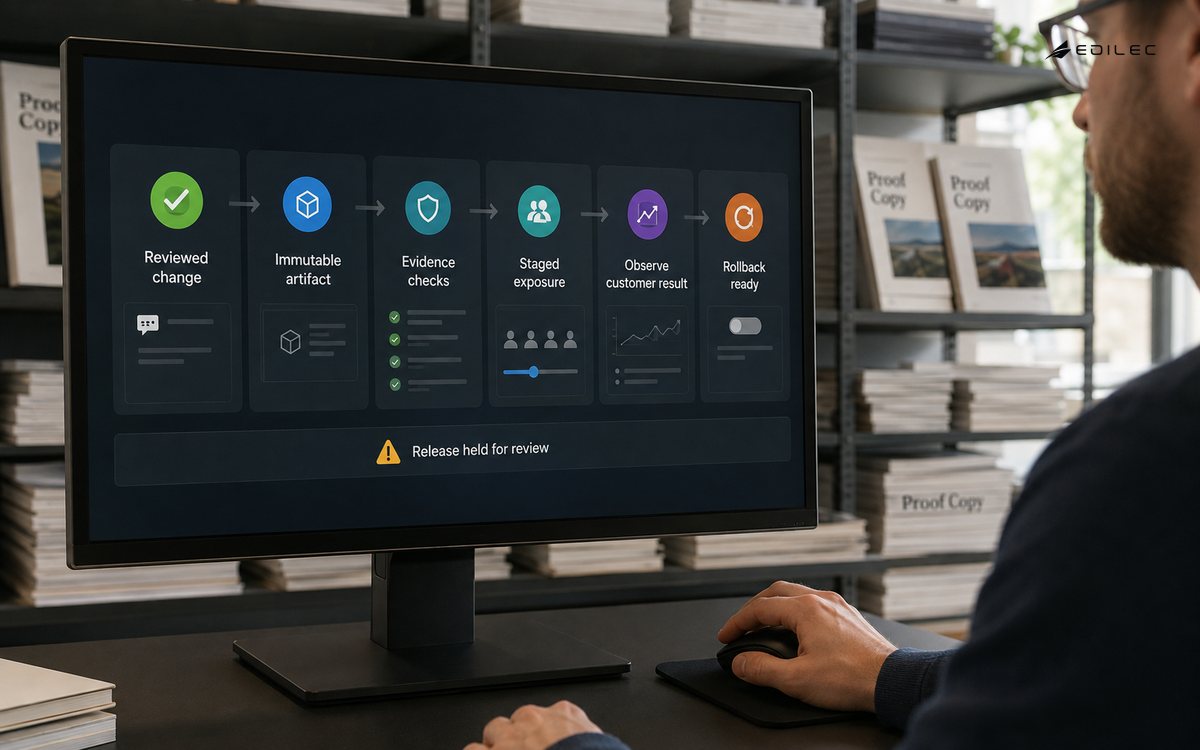
Define automated and human guardrails before rollout: error and latency, saturation, queue age, failed business transactions, support signals and security events. Compare candidate and baseline where possible. Avoid relying only on aggregate infrastructure metrics; one tenant or journey can fail while fleet averages remain healthy. Keep observation windows long enough for relevant behavior but short enough to limit harm. A rollback should restore a compatible application state; when irreversible data has changed, use a tested forward recovery or compensating action.
Connect deployment records to observability and recovery
Attach version, deployment and feature context to logs, metrics and traces. OpenTelemetry provides a vendor-neutral framework for telemetry, but teams must still define useful service and business signals. Dashboards should identify the deployed artifact, environment, exposure and owner. Alert on customer-impacting symptoms and critical dependencies. Annotate releases automatically so responders can correlate changes. Preserve enough deployment and decision history to reconstruct an incident without searching chat and individual laptops.
Rehearse rollback, disablement, credential rotation, restoration and pipeline outage. The team should be able to deploy a known-good artifact even when the main collaboration system is unavailable, without bypassing essential authorization. Define who declares an incident and who communicates with customers. After failure, fix the system that allowed or prolonged it rather than only adding another approval. Track change failure, failed-deployment recovery, lead time, deployment pain and unplanned work by service.
Operate the pipeline as a product
Assign a platform owner and service expectations for runners, caches, artifact stores, secrets and deployment controls. Offer documented paved paths with sensible defaults, templates and local parity. Let teams extend the path through reviewed interfaces. Monitor queue time, critical path, failure categories, cache correctness, cost and adoption. Prioritize reliability and developer feedback over feature count. A pipeline outage can block security and recovery work, so test its backup and restoration like any other production service.
Review exceptions and bypasses. Some indicate an unusual risk decision; repeated bypass usually indicates a broken path. Remove obsolete jobs and dependencies. Upgrade actions and runners through controlled testing. Sample successful releases to ensure evidence remains valid, because a check can pass while silently scanning the wrong artifact. Use retrospectives and value-stream measures to improve daily. Continuous delivery is sustained capability development, not completion of a one-time automation project.
Key takeaways
- Define release evidence and ownership per deployable service.
- Build once, identify the artifact and verify it before every promotion.
- Use fast trustworthy tests plus risk-focused integration and migration scenarios.
- Separate deployment from exposure and observe customer guardrails progressively.
- Practice recovery and improve the pipeline as a production platform product.
Frequently asked questions
Does CI/CD mean every commit reaches production?
No. Continuous integration and continuous delivery keep changes integrated and deployable. Continuous deployment automatically releases suitable changes. Teams can practice reliable delivery while retaining controlled business release decisions.
Should production require manual approval?
Only where judgment adds control value. Define evidence, authorized decision and response time. Automate repeatable checks. Low-risk changes may progress automatically, while consequential changes can require proportionate review.
Is rollback always the best recovery?
No. Backward-compatible application changes often roll back safely, but destructive data or external actions may require a forward fix or compensation. Choose and test recovery during design.
Conclusion
Reliable SaaS delivery is the ability to move a known change through trustworthy feedback, produce an attributable artifact, control exposure and recover without improvisation. Pipeline tools support that system, but architecture, data compatibility, ownership and operational practice determine whether it works.
Before calling the pipeline complete, deploy one representative service through normal and urgent paths, fail a dependency, reject an artifact, pause exposure and recover. Trace the evidence from source to customer signal. If responders can identify and control every stage, the release path is dependable. If not, fix the path before increasing deployment frequency.