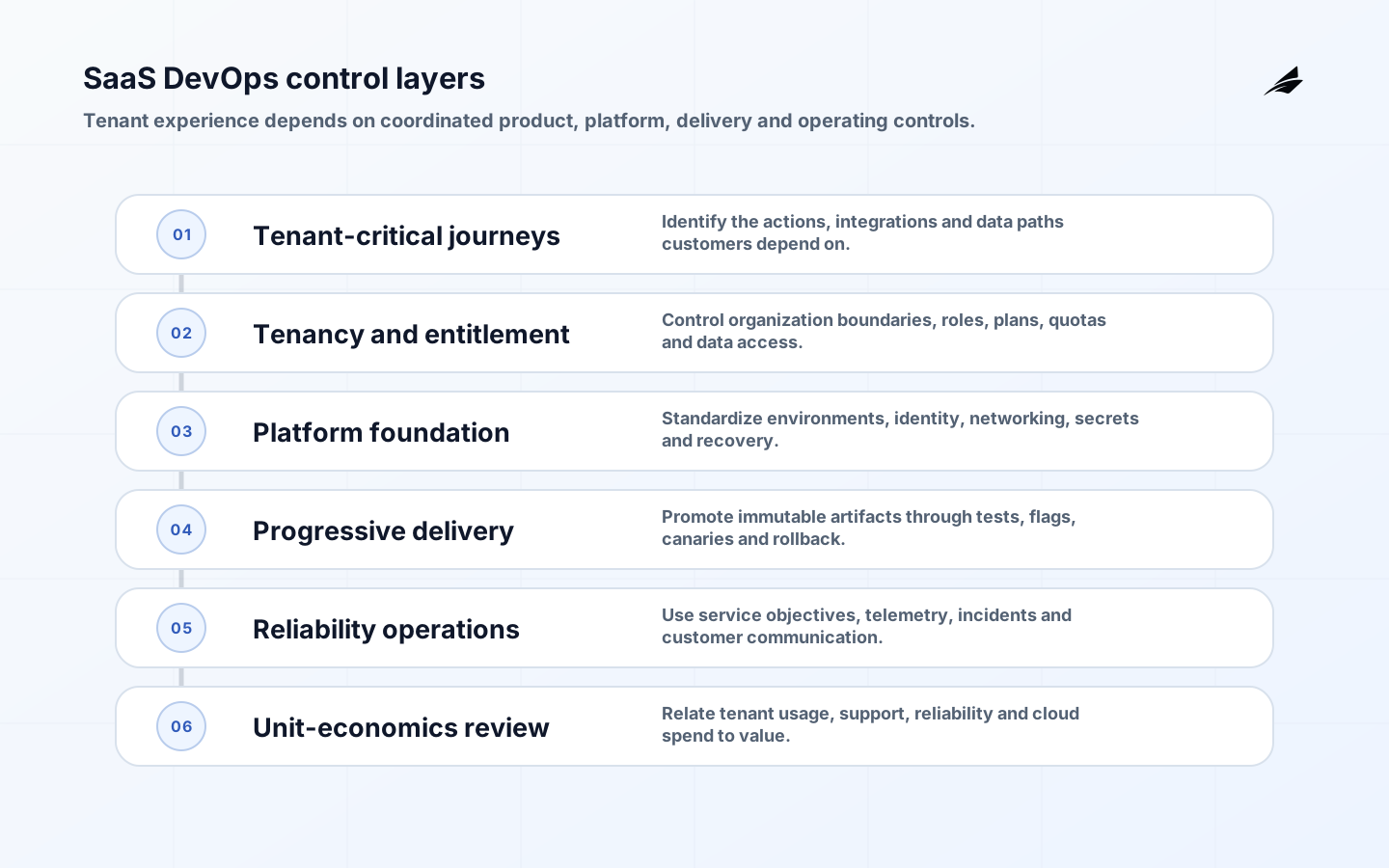
Cloud DevOps services for SaaS companies must protect two things at once: the speed of product learning and the integrity of every tenant's service. A pipeline can deploy successfully while a plan entitlement is wrong, a schema change blocks an older application version, or one tenant consumes a shared queue. This checklist treats tenancy, application delivery, data evolution, reliability, security and cloud economics as one production system.
Use the checklist with the SaaS DevOps scope and delivery plan and SaaS DevOps FAQ. Begin with one representative product journey and one recoverable tenant cohort. A platform pattern earns broader adoption only after the team can release, observe, contain and recover that journey without crossing tenant boundaries.
1. Define tenant-critical outcomes and boundaries
List the tenant journeys that create revenue or trust: signup, invitation, role change, subscription change, import, API call, transaction, export and deletion. For each, state availability, latency, freshness, support and recovery expectations. Identify which failures affect one user, one tenant, a region or the entire service. This impact model guides isolation, telemetry, rollout and incident communication more effectively than labeling every component critical.
Define organization, workspace, user, role, entitlement, plan, quota and data-ownership semantics before automating infrastructure. Decide where tenant identity enters requests, jobs, events, storage and logs. Make authorization server-side and deny by default. Include internal support access, background workers, exports, analytics and backups in the boundary; tenant separation that exists only in the web request path is incomplete.
| SaaS boundary | Decision to document | Acceptance evidence |
|---|---|---|
| Tenant identity | Canonical identifier and propagation across synchronous and asynchronous paths | Trace from user request through job and stored record |
| Authorization | Role, resource and action rules plus support impersonation policy | Positive and negative tests for every material role |
| Entitlement | Plan features, limits, effective time and downgrade behavior | Versioned rules tested across upgrade and cancellation |
| Data isolation | Storage pattern, encryption, export, deletion and backup handling | Cross-tenant test suite and sampled reconciliation |
| Resource isolation | Quotas, queue fairness, rate limits and noisy-neighbor controls | Load test with one abusive or failed tenant |
| Operations | Tenant-aware telemetry, support evidence and communication | Incident drill scoped to affected tenants |
2. Build a platform around the tenancy model
Create governed account, subscription or project boundaries for production, lower environments, security evidence and shared services. Federate workforce identity, separate deployment identities from runtime identities, and issue narrowly scoped credentials to workloads. Version network, compute, databases, messaging, secrets, observability and backup configuration. A platform module should encode required controls while exposing only the decisions a product team genuinely needs to make.
Environment and test-data strategy
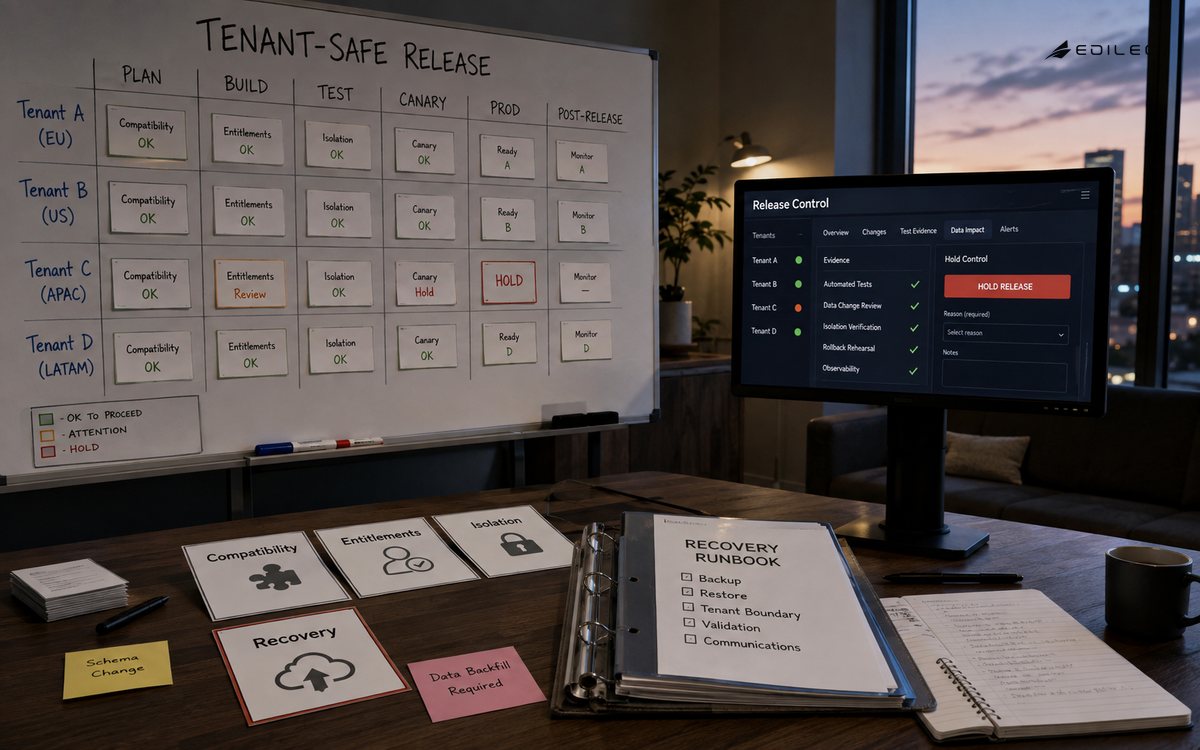
Lower environments should reproduce tenant and integration behavior without becoming uncontrolled copies of production. Generate synthetic tenants for routine tests. When representative production data is necessary, approve the minimum fields, transform identifiers, restrict access, record purpose and remove it on schedule. Give preview environments an owner, expiry, budget and safe external-integration mode. Verify that test webhooks, emails and payments cannot reach real customers.
3. Secure and automate the software supply chain
Protect source branches, review consequential changes and run builds on controlled workers. Declare and verify dependencies, scan for exposed secrets, run authorization and tenant-isolation tests, and create one immutable artifact. NIST's Secure Software Development Framework provides practices for preparing, protecting, producing and responding. Translate those practices into repository settings, pipeline gates, artifact metadata and vulnerability response ownership.
Record provenance that connects an artifact to source, builder, inputs and steps. The SLSA 1.2 specification defines tracks for build and source integrity and requirements for provenance. Adopt a level appropriate to risk rather than claiming a label from partial tooling. Protect provenance and artifacts against tampering, verify them at promotion, and retain evidence long enough to investigate the versions still running for customers.
| Change class | Release control | Tenant safeguard | Recovery path |
|---|---|---|---|
| Application code | Automated tests, progressive exposure and journey checks | Cohort or tenant allowlist | Rollback immutable artifact or disable feature |
| Database schema | Compatibility review, expand-and-contract sequence | Tenant-by-tenant backfill checkpoints | Roll forward fix; restore only with reconciled scope |
| Entitlement rule | Versioned policy and scenario test matrix | Effective-time and plan-cohort validation | Revert policy version and reconcile decisions |
| Infrastructure module | Plan review, policy checks and staged environment promotion | Blast-radius boundary by account or region | Reapply known-good version or fail over |
| Dependency update | Inventory, risk review and regression suite | Observe errors by tenant and journey | Revert dependency and rebuild traceably |
| Emergency change | Named authority, narrow scope and retrospective review | Explicit affected-tenant query | Predefined rollback plus follow-up permanent fix |
4. Make data changes compatible and recoverable
Treat database and event changes as product releases. Add fields before requiring them, allow old and new code to coexist, backfill in bounded batches, measure progress and remove old structures only after every consumer has migrated. Version public APIs and events according to a documented compatibility policy. Test retries, duplicates, late delivery and partial failure. Idempotency keys and checkpoints should prevent a recovery run from creating duplicate invoices, notifications or customer actions.
Define recovery at tenant and system levels. A tenant-specific import error should not require restoring the whole database. Preserve source files, transformation versions, run identifiers and reconciliation totals so a repair can target affected records. For system recovery, restore a representative backup into isolation, apply required configuration and have a product owner complete critical journeys. Measure actual recovery point and recovery time rather than relying on provider configuration status.
5. Operate to tenant-aware reliability objectives
Define service level indicators around complete user journeys, not only host health. The Google SRE guidance on service level objectives connects reliability targets to decisions about engineering work. Segment indicators carefully: an overall success rate can hide a failed region, plan or integration. Set an error-budget policy that names what happens when reliability is consumed, including release restraint, root-cause work and customer communication.
Instrument request, job and event paths with consistent service, environment, version and safe tenant context. OpenTelemetry signals provide common concepts for traces, metrics and logs. Do not place secrets or sensitive customer content in telemetry. Build views for customer impact, release health, queue delay, dependency status and data-change progress. Every alert should identify a response action and route to someone authorized to take it.
Prepare incident operations for tenant scope. Support needs a truthful status, affected cohort, workaround and next update time. Engineering needs the release, dependency and data evidence. Security needs preserved logs and containment authority. Run exercises for cross-tenant authorization, unavailable identity, queue saturation, bad schema deployment and regional loss. Review incidents without turning individual mistakes into the explanation; improve code, controls, tests, runbooks and decision rights.
Test customer-facing operations in the exercise. Create two tenants with different plans and regions, release a feature to only one, degrade a shared dependency and verify that status, support and engineering views agree on scope. Confirm that support can identify the running version and entitlement without viewing unnecessary customer data. Stop the cohort, recover the dependency, reconcile queued work and prove that unaffected tenants did not receive the incident communication or remediation command.
6. Measure delivery and SaaS unit economics
DORA's software delivery performance metrics currently cover deployment frequency, change lead time, failed-deployment recovery time, change fail rate and deployment rework rate. Follow product services over time and interpret throughput with instability. Add escaped tenant defects, customer-impact minutes, support load and objective attainment. A fast pipeline that moves failures to customer support has not improved the system.
Relate cloud spend to product demand. The FinOps Framework emphasizes collaboration, timely data and technology-value decisions. Allocate direct and shared costs by service and environment, then derive useful units such as cost per active tenant, transaction, stored gigabyte or inference. Include observability, support, resilience, egress and commitments. Track unallocated spend and anomalies. Optimization must preserve service objectives and tenant isolation, not simply lower the monthly invoice.
Before wider rollout, have a product team use the platform without privileged help. It should provision an environment, release a compatible change, identify the running artifact, observe a tenant journey, stop a bad rollout, recover data, handle an alert and explain cost. The managed cloud services plan and managed-service implementation checklist help decide which operating duties can move to a provider.
Key takeaways
- Make tenant identity, authorization, entitlement and resource isolation explicit before platform automation.
- Build and promote one immutable, traceable artifact through controlled exposure.
- Sequence schema and event changes for compatibility, bounded backfill and reconciliation.
- Measure reliability by tenant-critical journeys and segment broad averages.
- Join delivery, customer impact, support and unit-cost evidence in operating reviews.
- Scale the platform only after a product team demonstrates release and recovery ownership.
SaaS DevOps implementation FAQ
Does every SaaS company need Kubernetes? No. Choose the simplest managed runtime that meets isolation, deployment, scaling, networking and operational needs. Container orchestration adds useful controls for some products and meaningful complexity for others.
Should every tenant have separate infrastructure? Isolation can be shared, pooled, siloed or hybrid. Decide from risk, scale, customization, cost and operational evidence. Whatever model is chosen, authorization and tenant context still need explicit tests.
Can database migrations be rolled back? Some additive changes can be reversed, but destructive or high-volume data changes often need a tested roll-forward and reconciliation plan. Design compatibility and checkpoints before running the migration.
What is the first useful automation? Automate the narrow path from reviewed source to a safe production release for one critical journey, including artifact evidence, health checks and recovery. Disconnected infrastructure automation delivers less learning.
Conclusion: optimize for trustworthy tenant change
Cloud DevOps for SaaS companies is effective when product teams can change the service while preserving tenant boundaries, data meaning and recoverability. Build the tenancy model into every layer, release in observable steps, test failure and let customer and cost evidence guide the next platform investment.