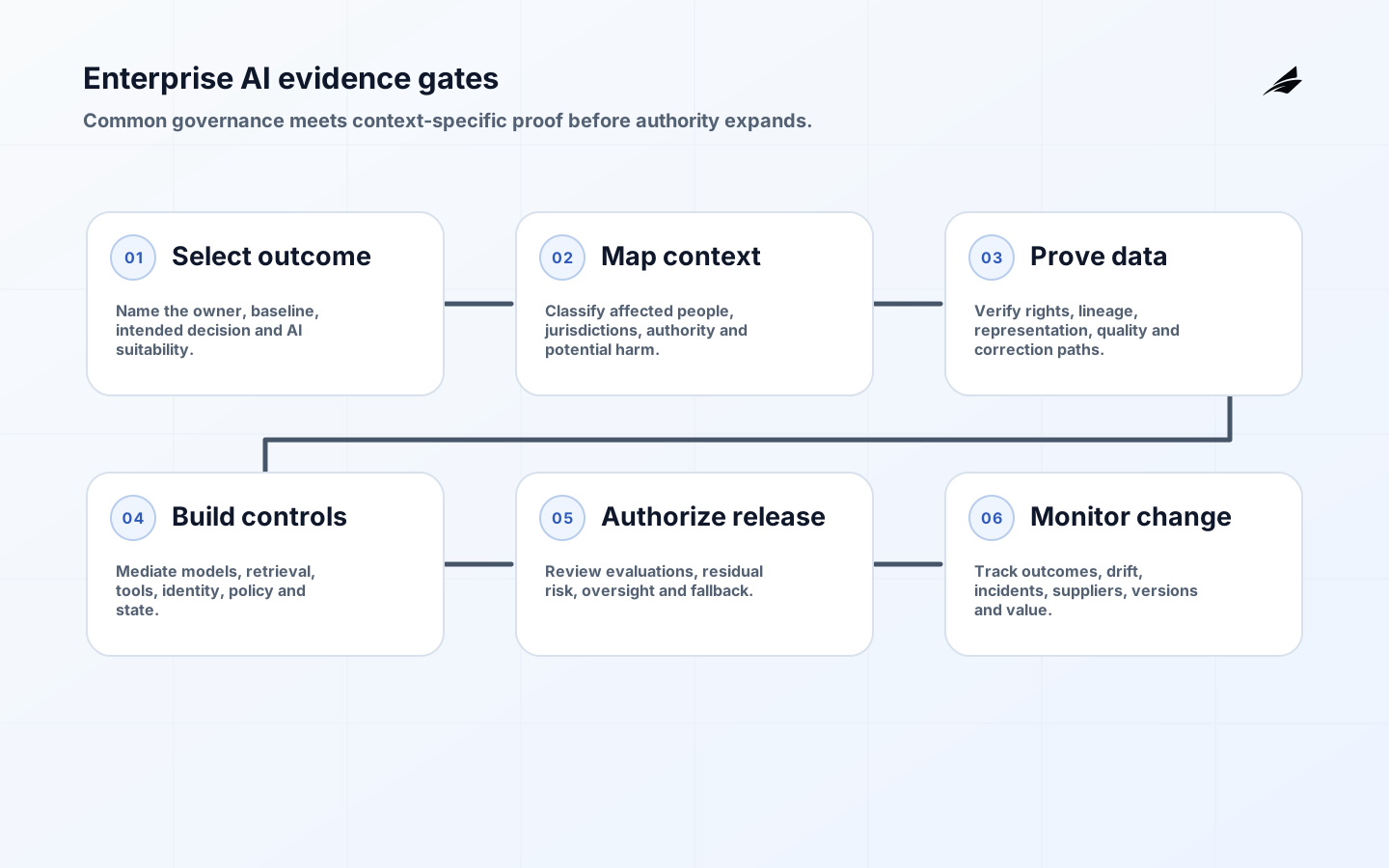
Enterprise AI services help organizations discover, build, integrate, govern and operate AI capabilities across business workflows. Implementation succeeds when each system has a defined purpose, accountable owner, lawful data use, representative evaluation and production controls. A shared platform can accelerate delivery, but it cannot substitute for domain decisions. The implementation checklist must connect organization-wide governance with evidence from each specific use case.
This guide is for leaders moving from isolated experiments to a managed portfolio. Use the enterprise AI services FAQ for concise decisions. Organizations comparing broader service models can review the business services scope plan, business services checklist and business services FAQ alongside AI-specific controls.
1. Govern the use-case portfolio
Create an intake that captures the user, decision or action, baseline process, data, affected people, expected value, risk, dependencies and accountable sponsor. Reject ideas that are only technology demonstrations. Score suitability from evidence availability, outcome verifiability, error detectability, authority, reversibility and operating ownership. Prioritize a few workflows that exercise reusable foundations while producing measurable value; dozens of disconnected pilots create review and support debt.
| Use-case gate | Question | Required evidence |
|---|---|---|
| Purpose | What behavior or decision should improve? | Owner, baseline and target outcome |
| Suitability | Why is AI needed instead of rules or process repair? | Alternative comparison and uncertainty |
| Rights | May the data and content be used this way? | Purpose, source, consent or authority and retention |
| Risk | Who can be harmed and how? | Context-specific impact and control plan |
| Feasibility | Can quality be measured on representative cases? | Evaluation set and acceptance thresholds |
| Operation | Who supports change, failure and appeal? | Service owner, runbook and funded capacity |
2. Establish accountable governance
Assign an executive portfolio owner, use-case owner, data owner, model or AI engineering owner, security and privacy reviewers, legal or compliance input and independent challenge proportional to risk. NIST's AI RMF groups work into Govern, Map, Measure and Manage, a useful structure for policy and evidence. Governance should set common minimums and escalation, while domain owners remain responsible for context, acceptance and effects.
Maintain an AI system register with purpose, users, affected groups, jurisdictions, models, data, tools, suppliers, risk classification, evaluations, approvals, incidents and active versions. Map applicable law rather than assuming one global label. The EU AI Act, for example, defines obligations by system role and risk context with phased applicability; teams need current legal advice for their facts and deployment dates. Regulatory classification should be revisited when purpose, audience or capability changes.
3. Prove data and knowledge readiness
Document source authority, collection purpose, permissions, quality, representativeness, lineage, retention and deletion for training, retrieval, prompts, feedback and evaluation. Separate authoritative business records from generated summaries. For retrieval systems, enforce document permissions, versioning, freshness and source citation. For predictive models, analyze outcome labels, missingness and historical process bias. A larger dataset is not automatically a better representation of the decision context.
- Inventory data sources, owners, contracts, sensitive fields and geographic restrictions.
- Define the population and operating conditions the evaluation must represent.
- Create approved transformation, de-identification and access procedures with audit evidence.
- Version datasets, prompts, factors, features and indexes so outcomes can be reproduced.
- Provide correction, deletion and appeal paths that reach downstream stores where required.
- Test whether unavailable, stale or conflicting data causes refusal or safe escalation.
4. Build reusable controls, not a universal solution
A shared AI platform can provide identity, model gateway, approved providers, secret management, retrieval components, tool mediation, policy, evaluation, observability, deployment and cost allocation. Offer paved paths for common risk tiers and preserve an exception process. Keep domain prompts, business rules, data ownership and acceptance with product teams. Centralizing every experiment behind a platform backlog can slow learning; decentralizing every control creates inconsistent risk and duplicated engineering.
Use model abstraction only where it supports a real change need. Models differ in context, tool behavior, safety features, latency and output schemas, so lowest-common-denominator wrappers can hide important capabilities. Keep versioned adapters and contract tests. Enforce budgets, rate limits and approved regions. Store durable workflow state outside model sessions, and authorize tools at execution time. Apply NIST SSDF practices to the complete application, dependencies and deployment chain.
5. Evaluate the complete system
| Evaluation dimension | Example measure | Release question |
|---|---|---|
| Task outcome | Verified case completion or decision quality | Does the system improve the baseline? |
| Grounding | Material claims supported by current sources | Can users inspect evidence? |
| Fairness and access | Quality and error by relevant group or condition | Are disparities understood and controlled? |
| Security | Resistance to injection, leakage and excessive agency | Do controls hold under adversarial input? |
| Human oversight | Correction, escalation and appeal effectiveness | Can people detect and change harmful output? |
| Operations | Latency, availability, drift, incidents and unit cost | Can the service be supported within limits? |

Build evaluation cases before the final architecture so acceptance drives design. Include routine, ambiguous, rare high-impact, adversarial and dependency-failure cases. Score the final business effect and intermediate behavior. A correct answer obtained from unauthorized data is a failure; a safe refusal can be correct. Use subject-matter experts with documented rating guidance, inspect disagreements and prevent evaluation examples from leaking into prompt tuning without version control.
6. Authorize and release progressively
Create a release dossier with purpose, owner, architecture, data and model versions, risk assessment, evaluation results, residual risks, human controls, incident plan and rollback. Approval should be proportional to authority and harm, with an expiry or change triggers. Begin in offline or shadow mode, move to internal assistance, then expose a bounded user or transaction group. Maintain a kill switch or route disablement and preserve a non-AI fallback for critical work.
Design the review interface as part of the control. Show evidence, uncertainty, proposed action and policy, and let reviewers edit, reject or escalate. Measure review accuracy and burden. Human-in-the-loop is not automatically safe if reviewers are rushed, cannot see sources or assume the model is correct. For automated action, use deterministic validation, transaction limits, idempotency, confirmation and post-action reconciliation.
7. Operate models, workflows and suppliers
Monitor outcome quality, input distribution, evidence freshness, refusal, escalation, overrides, security signals, latency, availability and cost. Establish change management for model versions, prompts, tools, policies, data pipelines and knowledge indexes. Provider changes may alter behavior without an application release, so pin versions where possible and run regression evaluations before promotion. Sample production outcomes under privacy controls and connect incidents to the exact active configuration.
Define incidents for unauthorized action, sensitive-data exposure, systematic wrong decisions, discriminatory effects, unsupported high-impact claims, model or provider outage and unexpected spend. Assign technical, domain, communications, privacy and legal roles. Stop affected workflows, preserve evidence, correct business records, notify impacted parties where required and evaluate recurrence. Supplier contracts should address data use, security, service change, incident notice, audit evidence, portability and termination.
8. Measure value and portfolio health
Calculate value from verified outcomes: reduced resolution time, fewer manual corrections, better forecast decisions, avoided loss or increased completion. Include model, platform, data, integration, review, support, compliance and change cost. Cost per successful outcome is more informative than cost per prompt. Track adoption and substitution so time saved in one step is not consumed by downstream verification or exception handling.
At portfolio reviews, continue, expand, redesign or retire systems using outcome, risk and cost evidence. Remove unused indexes, credentials, endpoints, datasets and monitoring when a pilot ends. Capture reusable evaluations and controls without copying sensitive data into a central repository. Maturity is the ability to make fast, defensible lifecycle decisions, not the number of models deployed or employees granted an assistant.
9. Prepare people and process change
Map how roles, workload, performance measures and escalation change when AI enters a process. Involve affected employees and representatives early, especially where monitoring or employment decisions may be inferred. Train users on the bounded purpose, evidence, known limitations, review duty and incident route rather than offering generic prompt tips. Update standard operating procedures and downstream capacity. Measure whether saved effort becomes better service or merely shifts verification work to a less visible team.
Key takeaways
- Prioritize owned use cases with measurable outcomes and verifiable decisions.
- Combine common governance with context-specific domain accountability.
- Prove rights, lineage, representativeness and correction paths for every data use.
- Share platform controls while keeping product acceptance close to the workflow.
- Evaluate complete outcomes, security, human control and operations before release.
- Monitor all behavior-changing components and retire experiments cleanly when value is absent.
Frequently asked questions
Does every use case need an AI council review?
Not necessarily. Use risk tiers and delegated approval for low-impact cases that follow a paved path. Central review should focus on novel, high-impact, regulated or exception cases and on portfolio oversight. Requiring the same committee for every experiment creates delay without improving context-specific accountability.
Should the enterprise build or buy?
Decide per capability. Buy commodity models or tools when contracts, controls and integration fit; build domain workflow, evaluation and differentiated behavior where ownership matters. Even a purchased assistant requires configuration, identity, data governance, acceptance and operations. Include provider concentration and exit cost in the comparison.
What should the first 90 days achieve?
Establish minimum policy and registry, select one or two bounded workflows, build representative evaluations, prove data access and deploy an assisted pilot with telemetry. End with evidence to continue, change or stop plus a short list of genuinely reusable controls. Avoid starting with an enterprise-wide platform specification detached from production use.
Conclusion
Enterprise AI services scale when governance and delivery meet at evidence gates. Select a real outcome, map context and rights, build secure shared controls, evaluate the complete workflow, release progressively and operate every changing component. Keep domain owners accountable and measure verified value after review and support costs. This creates a portfolio that can expand responsibly and can also stop systems that no longer justify their risk.