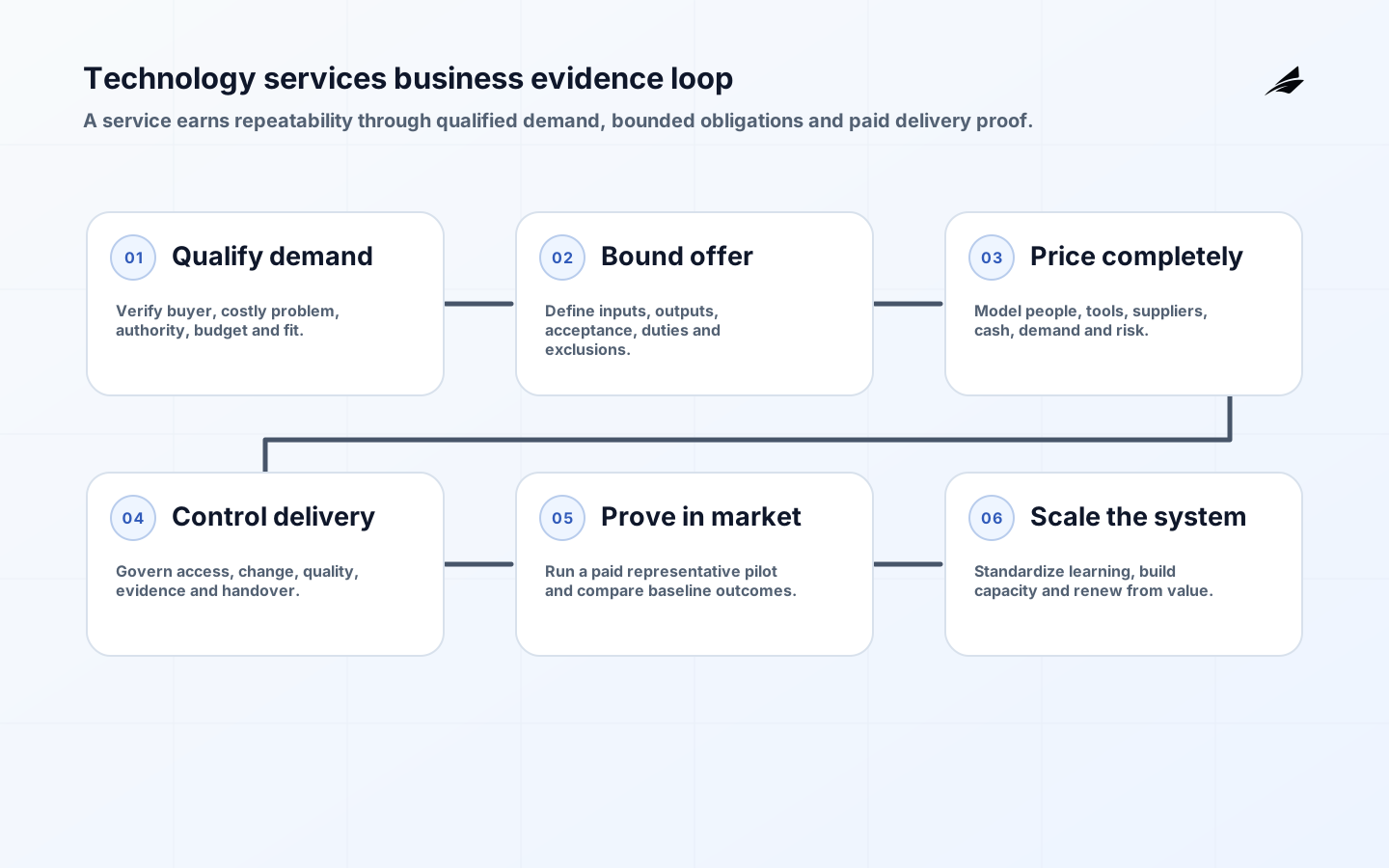
A technology services business converts specialist capability into a dependable client outcome. Its design must connect a specific market problem, a bounded offer, accountable delivery, commercial terms and measurable service performance. This scope, cost, risks and delivery plan applies to consulting, implementation and managed technology services. It avoids two common traps: selling open-ended access to experts and promising a standardized result before the work is understood.
Use the services business implementation checklist to prepare operations and the services business FAQ during offer design. Where AI is part of delivery, the enterprise AI services checklist adds model and data controls. The plan below begins with evidence from one repeatable customer problem.
Scope the technology services business around a costly problem
Define the buyer, user, trigger and consequence. A useful market statement is narrow enough to test: regional insurers need to replace manual claims document routing because queue age and correction effort delay settlement. Interview buyers, operators, security, procurement and finance; inspect current workflow evidence where permission allows. Separate stated preference from demonstrated behavior such as approved budget, existing workarounds, missed targets and willingness to provide a pilot team.
Write qualification and exclusion criteria. Industry, system landscape, transaction volume, data sensitivity, decision authority, deadline and client capacity all affect fit. Decline work when the required outcome is unlawful, success cannot be measured, the buyer cannot provide an accountable owner, or dependencies make the promise implausible. A disciplined no protects delivery capacity and produces clearer learning than accepting every adjacent request as custom scope.
Turn expertise into a bounded service offer
Describe inputs, activities, deliverables, acceptance, assumptions, client responsibilities, change process and exclusions. Distinguish an assessment, implementation project and operated service. An assessment produces evidence and options; implementation changes a defined environment; a managed service accepts continuing operational obligations. Do not hide product licensing, cloud consumption, third-party support or client-side remediation inside a vague outcome. State what transfers at handover and what requires a new service period.
Design a small set of composable modules: discovery, architecture, migration, assurance, enablement and operation, for example. Standardize evidence, not theater. Reusable questionnaires, decision records, infrastructure patterns, tests and runbooks improve consistency, while recommendations remain specific to the client's risk and constraints. The UK Service Standard links user needs, multidisciplinary teams, security, measurement and reliable operation; those principles are useful beyond government when adapted to the actual context.
| Offer type | Acceptance boundary | Primary cost driver | Typical commercial fit |
|---|---|---|---|
| Diagnostic | Agreed findings, evidence and options | Specialist time and access | Fixed fee with assumptions |
| Implementation | Working capability passes defined tests | Integration, migration and change | Milestones or capped time and materials |
| Managed service | Service objectives and operating evidence | Coverage, demand, tooling and suppliers | Recurring base plus usage |
| Enablement | Participants demonstrate target capability | Curriculum, environment and coaching | Cohort or outcome-based stage |
| Advisory retainer | Defined decisions supported within cadence | Senior capacity and response window | Reserved recurring capacity |
Build the full service cost and pricing model
Calculate labor by role and realistic utilization, then add management, sales, presales, training, leave, quality assurance, security, insurance, legal, finance, workspace, tools, cloud, travel, subcontractors, bad debt and contingency. Delivery utilization is not billable utilization: incident response, internal improvement and client coordination consume capacity. Model cash timing as well as margin. A profitable annual statement can still fail when payroll precedes milestone acceptance or a large client pays late.
Price according to a controllable unit and risk allocation. Fixed fees suit understood outputs and assumptions; time and materials suit discovery or volatile dependencies; recurring fees suit continuing obligations; usage pricing suits measurable demand. Outcome-based pricing needs a credible baseline, attribution method and cap. Include indexation, currency, taxes, minimum commitments and third-party price changes. The FinOps Framework emphasizes collaboration across engineering, finance and business; apply that collaboration to client consumption and internal delivery cost.
Contract responsibilities, evidence and change
The statement of work should identify environments, interfaces, deliverables, acceptance tests, schedule, dependencies, client decisions, access, data handling, intellectual property, open-source use, confidentiality, incident cooperation, subcontractors, support, exit and liability. Link service levels only to factors the provider can observe and influence. Define service credits carefully; they are not a substitute for recovery, termination rights or damages where those are appropriate. Obtain jurisdiction-specific legal advice rather than treating a template as universal.
Create a change control with request, reason, impact on outcome, cost, schedule, risk and authorized decision. Keep assumptions visible and date them. When a client dependency slips, present options such as resequencing, reducing scope or moving the date rather than silently absorbing delay. Record acceptance against evidence, not meeting sentiment. For agile delivery, acceptance can occur incrementally through tested capabilities while commercial boundaries remain explicit. Retain decision history so later disputes can be reconstructed fairly.
Design the delivery and quality system
Give each engagement an accountable service owner, delivery lead and technical authority. Map discovery, design, build, verification, release, handover and support with entry and exit evidence. Protect focus with work-in-progress limits and short review cycles. Reuse approved patterns, but require architecture decisions for material deviations. A client-facing status should show outcome evidence, completed scope, forecast, risks, decisions and next acceptance point rather than a percentage derived from task counts.
For software work, the NIST Secure Software Development Framework organizes practices around preparing the organization, protecting software, producing well-secured releases and responding to vulnerabilities. Tailor those outcomes into source, dependency, build, test, artifact and disclosure controls. Measure delivery flow per service. DORA's current software delivery metrics cover change lead time, deployment frequency, failed deployment recovery time, change fail rate and deployment rework rate; do not aggregate unlike services into a league table.
Control client, supplier and operational risk
Maintain an engagement risk record covering privileged access, sensitive data, architecture change, production impact, supply chain, key-person dependency, solvency, conflicts, bribery, sanctions, subcontracting and regulatory obligations. Use separate client identities and environments, least privilege, managed endpoints, approved transfer paths, secrets vaults and prompt revocation. Never use one client's code or data to accelerate another without explicit lawful permission. Rehearse lost credentials, accidental disclosure and unavailable staff.
Use the NIST Cybersecurity Framework Govern, Identify, Protect, Detect, Respond and Recover functions to communicate outcomes across the business, not as a claim of certification. Map each outcome to a control owner and evidence. Review subcontractors for access, competence, continuity and contractual flow-down. Keep a current dependency and license inventory. Professional insurance, reserves and contractual caps can transfer or absorb some financial consequence; they do not remove the need to reduce operational likelihood.
| Risk signal | Leading control | Response threshold |
|---|---|---|
| Unbounded discovery | Timebox, hypotheses and decision owner | Pause when evidence access is absent |
| Margin erosion | Weekly forecast by role, dependency and change | Replan at agreed variance |
| Quality escape | Independent review and representative tests | Stop release on critical acceptance failure |
| Key-person concentration | Pairing, records and rehearsed backup | No sole privileged operator |
| Client concentration | Revenue and receivable limits | Board review before exposure increases |
| Managed-service overload | Demand units, queue age and capacity model | Add capacity, shape demand or renegotiate |
Run a paid pilot and scale through proof
Choose one representative client problem with manageable consequence, available evidence and an empowered owner. Charge enough to test willingness to pay and the cost of professional delivery. Set a baseline, acceptance criteria, stop conditions and rights to anonymized learning. Include security and handover rather than treating them as later phases. At completion, compare customer outcome, delivery effort, reusable assets, exceptions, margin and support burden. A showcase that required founder heroics is not yet a repeatable service.
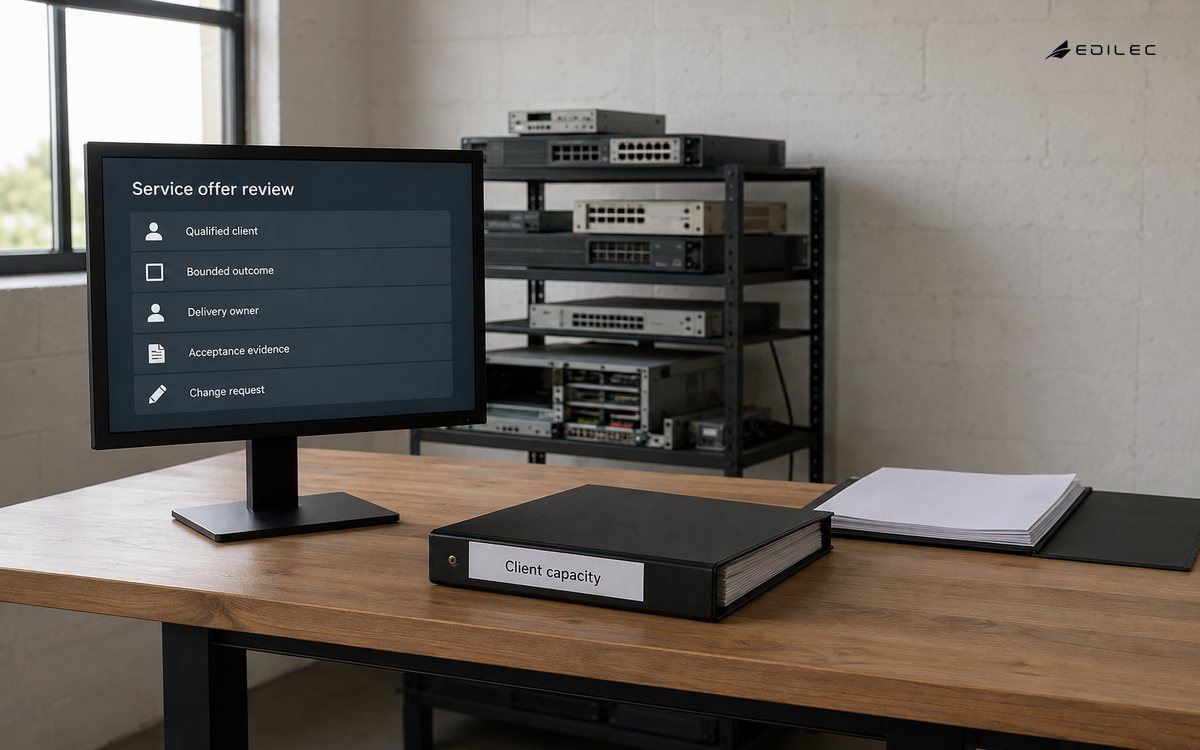
Standardize only after observing variation across engagements. Create playbooks for qualification, estimation, kickoff, access, evidence, change, acceptance, incident and closure. Certify people through supervised work, not slide attendance. Add sales capacity only when delivery and cash conversion can support it. Review whether adjacent requests share the same buyer, evidence and capability; otherwise they may be a separate offer. Preserve a narrow route for genuine custom work with explicit pricing and architecture ownership.
Measure client value and business durability together
Use a balanced view: client outcome against baseline, acceptance first-pass rate, time to first useful evidence, delivery predictability, defects and incidents, customer effort, renewal based on realized value, gross margin after full delivery cost, cash conversion, concentration and team sustainability. Avoid rewarding billable hours when the offer promises efficiency. Pair satisfaction with objective outcomes and interview lost prospects and non-renewing clients. Publish definitions internally so teams do not optimize different versions of margin or utilization.
Example: scope a managed integration service
Suppose a provider operates integrations between a retailer's order platform and regional carriers. The offer should identify supported interfaces, transaction units, coverage hours, monitoring, retry behavior, incident ownership and data retention. Baseline failed orders and manual reconciliation before the pilot. Price normal transaction volume, seasonal surge and third-party fees separately. During acceptance, inject duplicate, delayed and malformed messages, remove one carrier endpoint and confirm reconciliation. This example turns an apparently simple support retainer into measurable obligations and prevents the provider from accepting unlimited responsibility for upstream data and carrier availability.
Key takeaways
- Start with one costly customer problem and explicit qualification boundaries.
- Scope assessment, implementation and operation as different obligations.
- Price complete cost, cash timing, demand and allocated risk.
- Build reusable delivery evidence with secure software and service controls.
- Scale only after paid engagements prove outcome, margin and supportability.
Frequently asked questions
Should a new services business use fixed-fee pricing?
Only when scope, dependencies and acceptance are understood well enough to price the risk. A short paid discovery can reduce uncertainty before an implementation fee is fixed. Keep a documented change mechanism.
When should a service become a software product?
When repeated demand, stable workflow and economics show that software can deliver a common capability without recreating each client context. Productization changes support, security, roadmap and revenue obligations; it is not merely packaging a script.
Conclusion
A durable technology services business makes a credible promise and builds an operating system capable of keeping it. Bound the offer, expose assumptions, cost all obligations, control access and change, prove value through paid delivery, and scale the repeatable evidence. Commercial clarity and engineering quality are parts of the same client service.