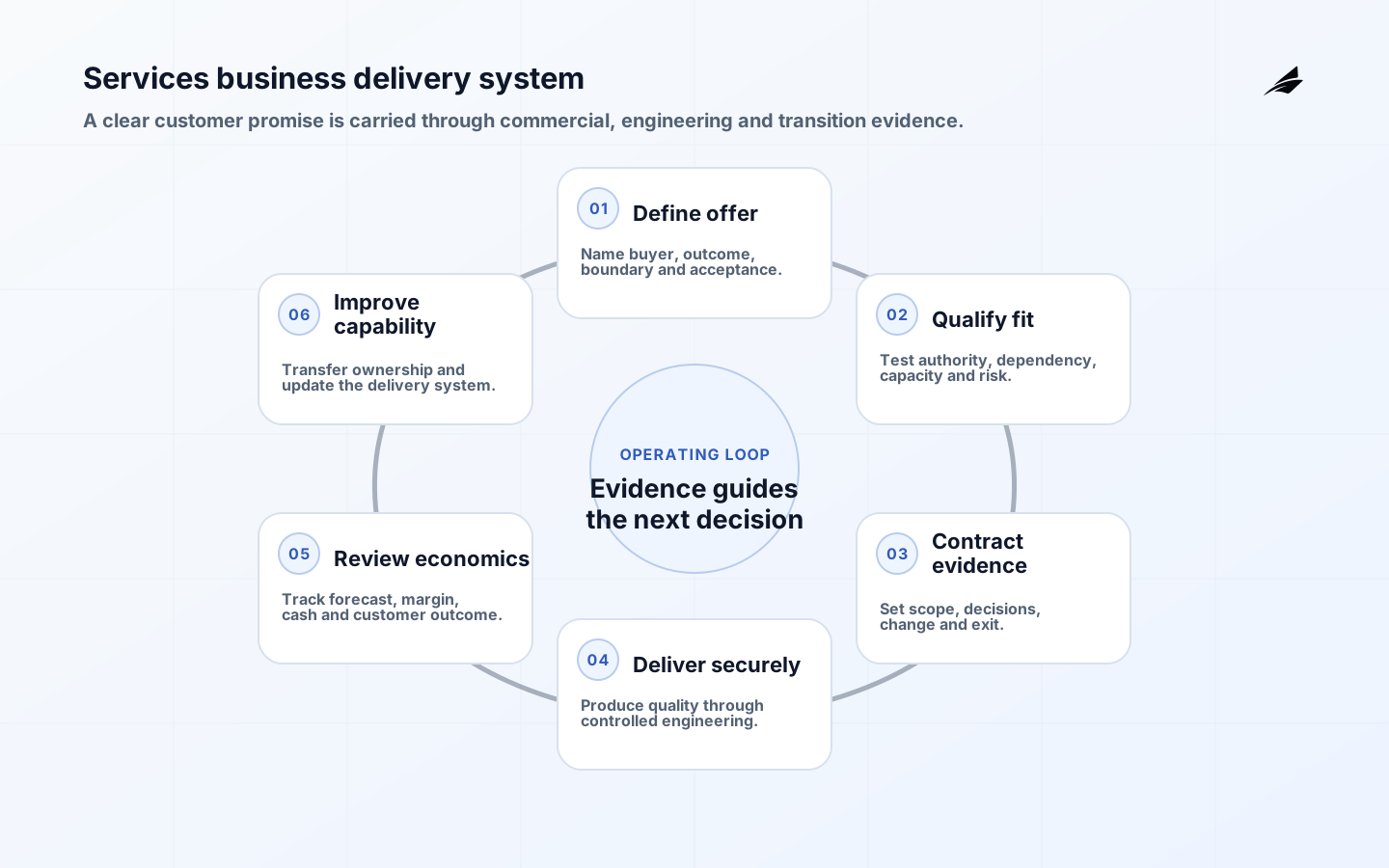
A services business becomes durable when expertise is converted into a clear promise, a controlled delivery method and evidence the customer can accept. For software and technology firms, the offer must also address security, quality, production operation and intellectual property. This services business implementation checklist covers positioning, qualification, scope, staffing, engineering controls, commercial management and learning so growth does not depend on heroic individual effort.
Begin with the services business scope and cost plan and keep the services business FAQ available during commercial design. Teams adding AI delivery can use the enterprise AI services checklist for model-specific controls.
1. Define a narrow offer and customer outcome
Name the buyer, triggering problem, deliverable outcome, boundary and proof of completion. “Digital transformation” is not an offer; an assessed migration plan with prioritized workloads, cost scenarios and decision records is. Separate advisory, build, managed service and staff augmentation because each has different authority, acceptance and risk. Publish prerequisites and exclusions so sales does not promise a result the delivery system cannot repeat.
Create an offer brief with customer responsibilities, standard phases, evidence, typical range, dependencies and transition. Validate it through interviews and paid work, then revise from observed delivery rather than adding options for every prospect. ISO 9001 emphasizes meeting customer and applicable requirements through controlled processes and continual improvement; the business should make those requirements visible before work begins.
| Offer element | Decision | Evidence |
|---|---|---|
| Outcome | What changes for which customer | Baseline and acceptance measure |
| Boundary | Included systems, roles and decisions | Responsibility matrix |
| Method | Standard phases and review points | Delivery playbook |
| Commercial unit | Time, milestone, capacity or managed result | Pricing model and assumptions |
| Exit | How work and access transfer or end | Handover and revocation checklist |
2. Qualify fit before proposing
Use a short discovery to confirm sponsor, urgency, budget range, decision process, data or system access, dependencies and procurement constraints. Identify whether the customer can provide subject experts and accept decisions. Decline or reshape work where the desired outcome is outside competence, authority is missing or the deadline requires bypassing essential controls. A full proposal should not be the first place uncertainty appears.
Maintain a bid decision record covering strategic fit, capability, delivery capacity, conflicts, security or regulatory exposure, payment risk and opportunity cost. Estimates should be ranges linked to assumptions. Separate discovery from committed build when architecture or data condition is unknown. Price risk intentionally rather than hiding it in an optimistic fixed fee that later drives rushed engineering and adversarial change control.
3. Contract evidence, authority and change
Translate outcomes into work packages with deliverables, acceptance evidence, customer inputs, owners and dates. Define decision authority, escalation, intellectual-property treatment, data processing, security obligations, subcontracting, expenses, payment, warranty, liability and termination with appropriate legal review. A statement of work should explain how scope changes are evaluated and who may approve cost or schedule impact.
Use a shared assumption and decision log from discovery onward. At each checkpoint, demonstrate working evidence and update forecast, risks and remaining scope. Do not wait until the invoice to announce that a dependency changed. For agile delivery, fund capacity or increments while keeping outcome and quality acceptance explicit; “agile” does not mean unlimited scope or absent documentation.
| Delivery risk | Preventive control | Leading signal |
|---|---|---|
| Ambiguous acceptance | Examples, quality attributes and named approver | Open acceptance questions |
| Customer dependency | Due date and escalation for each input | Blocked work age |
| Scope expansion | Costed change decision before work | Unapproved effort |
| Quality compression | Protected test and review gates | Escaped defects and rework |
| Weak transition | Receiver participates in rehearsals | Unowned runbook or access |
4. Run a secure, observable delivery system
Establish engagement kickoff, architecture and risk review, version control, peer review, dependency management, testing, release and incident practices proportionate to the work. NIST SSDF provides secure-development practices that can be integrated into the lifecycle; ISO/IEC 25010 offers quality characteristics for specifying and evaluating software. Select applicable controls and preserve evidence instead of claiming blanket compliance.
Protect customer environments and data through individual identities, least privilege, approved devices, secrets management, environment separation and timely offboarding. Inventory third-party components and services. Define how vulnerabilities and incidents are reported. Instrument delivery flow and production behavior where operation is in scope. DORA research links technical and cultural capabilities to delivery and operational performance, but metrics should guide improvement rather than rank individuals.
5. Control capacity, margin and cash
Forecast people by skill and realistic availability, including sales support, learning, leave and internal improvement. Track planned versus actual effort by phase and cause, not to surveil staff but to improve estimates and detect uncontrolled work. Monitor booked backlog, qualified pipeline, utilization, gross margin, payment timing, concentration and subcontractor exposure together. Maximizing billable utilization can remove the capacity needed for quality and capability building.
Invoice against unambiguous dates or accepted milestones and reconcile expenses promptly. Review work in progress and overdue receivables. For managed services, model on-call, tooling, cloud, support tiers and demand variance. Keep a contingency for uncertainty that the company actually owns; do not charge customers for risks transferred back to them. Commercial reviews should trigger delivery decisions early, not only explain margin after closure.
6. Accept, transfer and improve
Close with acceptance evidence, source and artifact inventory, architecture and decision records, operating procedures, known limitations, licenses, credentials transfer and access revocation. Rehearse deployment, restore, support or routine change with the receiving team. ISO/IEC 20000-1 covers planning, design, transition, delivery and improvement of services; use that lifecycle proportionately even when the engagement is a project.

Hold a review using customer outcome, quality, delivery flow, forecast accuracy, incidents, margin and team health. Convert lessons into an owner and change to the offer, estimate model, template or control. Preserve reusable knowledge only where contracts and confidentiality permit it. A strong services business improves its system after each engagement while protecting space for expert judgment where customer context genuinely differs.
Applied example and assurance notes
A standard engagement health review can combine customer outcome, accepted scope, blocked dependencies, quality, security findings, forecast, margin, invoice status and team load. Each variance receives an owner and decision, not merely a status color. Reviewing these dimensions together prevents commercial pressure from being hidden from engineers and prevents technical rework from appearing unexpectedly in finance. The customer sees the impact and options early enough to choose.
For example, a modernization offer may promise a production assessment and one migrated service, not an entire estate. Discovery identifies interfaces, data, runtime, tests and recovery. The thin migration then proves deployment, observability, rollback and receiver operation. Evidence from that slice updates the range for later services. This structure gives the customer something usable while preventing an uncertain portfolio from being sold as a precise fixed-price build.
People practices are part of service quality. Define role expectations, supervision, peer review, escalation and protected learning. Avoid staffing every engagement at maximum utilization, which leaves no capacity for incidents, proposals or improvement. When subcontractors participate, apply the same access, confidentiality, quality and offboarding controls and tell the customer where required. Sustainable delivery protects customer outcomes and the judgment of the team producing them.
- Record the accountable owner and the decision the evidence supports.
- Test a normal journey, a denied path and a realistic failure.
- Keep assumptions, versions and unresolved risks visible.
- Require acceptance evidence before expanding scope or authority.
- Review operating outcomes and close corrective actions.
Before approval, the engagement director should convene sales, delivery, engineering, security, finance and the customer for a scenario review. Walk through ordinary use, a denied request, one unavailable dependency, a partial change and recovery. For each step, identify the authoritative record, person with decision rights, expected signal, time limit and safe alternative. Challenge mis-scoping, blocked work, quality compression and weak transfer. Record assumptions that could change after launch and assign each one a trigger for reassessment. The review is successful when participants can explain not only the preferred path but also how they recognize an unsafe state, who can stop progress, and how users continue while the issue is resolved. Preserve the accepted increment, forecast review and receiver rehearsal with the configured release rather than in a detached presentation.
For Technology Services Business Implementation Checklist: From Offer to Repeatable Delivery, conduct a review thirty days after release or completion. Compare actual demand, quality, exceptions, incidents, cost and user effort with the baseline. Separate design defects from training gaps and changed operating context. Sample complete cases because averages can conceal a rare path carrying most consequence. Confirm that temporary access, duplicate infrastructure, transitional policy and manual workarounds have closed or have an owner and expiry. Reforecast the next period and publish decisions to people who operate or depend on the capability. At each material change, refresh cases, assumptions and risk treatment; assurance is a maintained operating practice, not a certificate inherited from the first release.
Technology Services Business Implementation Checklist: From Offer to Repeatable Delivery also needs a concise evidence index that a new reviewer can navigate without oral history. Link the current boundary, named owners, architecture or workflow, decisions, tests, exceptions, operating signals and closure records. Mark superseded artifacts instead of silently replacing them, and protect sensitive material by role. During a review, select one claim from the summary and trace it to its source and observed result. If that trace is slow or ambiguous, improve the index before scale. Good evidence reduces repeated discovery, supports accountable challenge and makes future migration or retirement materially easier.
Key takeaways
- Sell a bounded outcome with explicit prerequisites and acceptance evidence.
- Qualify authority, dependencies and risk before investing in a proposal.
- Connect contracts, delivery controls and commercial forecasts through shared decisions.
- Protect customer systems with secure engineering and disciplined access.
- Complete transfer and use evidence from each engagement to improve the operating model.
Frequently asked questions
Which pricing model is best?
Use the model that matches uncertainty and control. Fixed price fits well-understood outputs; capacity fits evolving priorities; milestones fit evidence gates; managed pricing fits continuing service levels. Explain assumptions and change behavior in every case.
What is a healthy utilization target?
There is no universal target. It depends on role, sales support, support obligations and investment needs. Plan enough nonbillable capacity for quality, learning, leave and improvement, then test the economics under realistic demand.
Must a small firm obtain ISO certification?
No. A firm can use relevant management-system principles without certification. Seek certification when customer, market or assurance needs justify the cost, and describe status accurately.
Conclusion
A technology services business scales through clarity and evidence: a focused offer, disciplined qualification, governable scope, secure delivery, visible economics and complete transition. Those practices let expertise remain thoughtful while the surrounding system becomes reliable enough for customers and teams to trust.