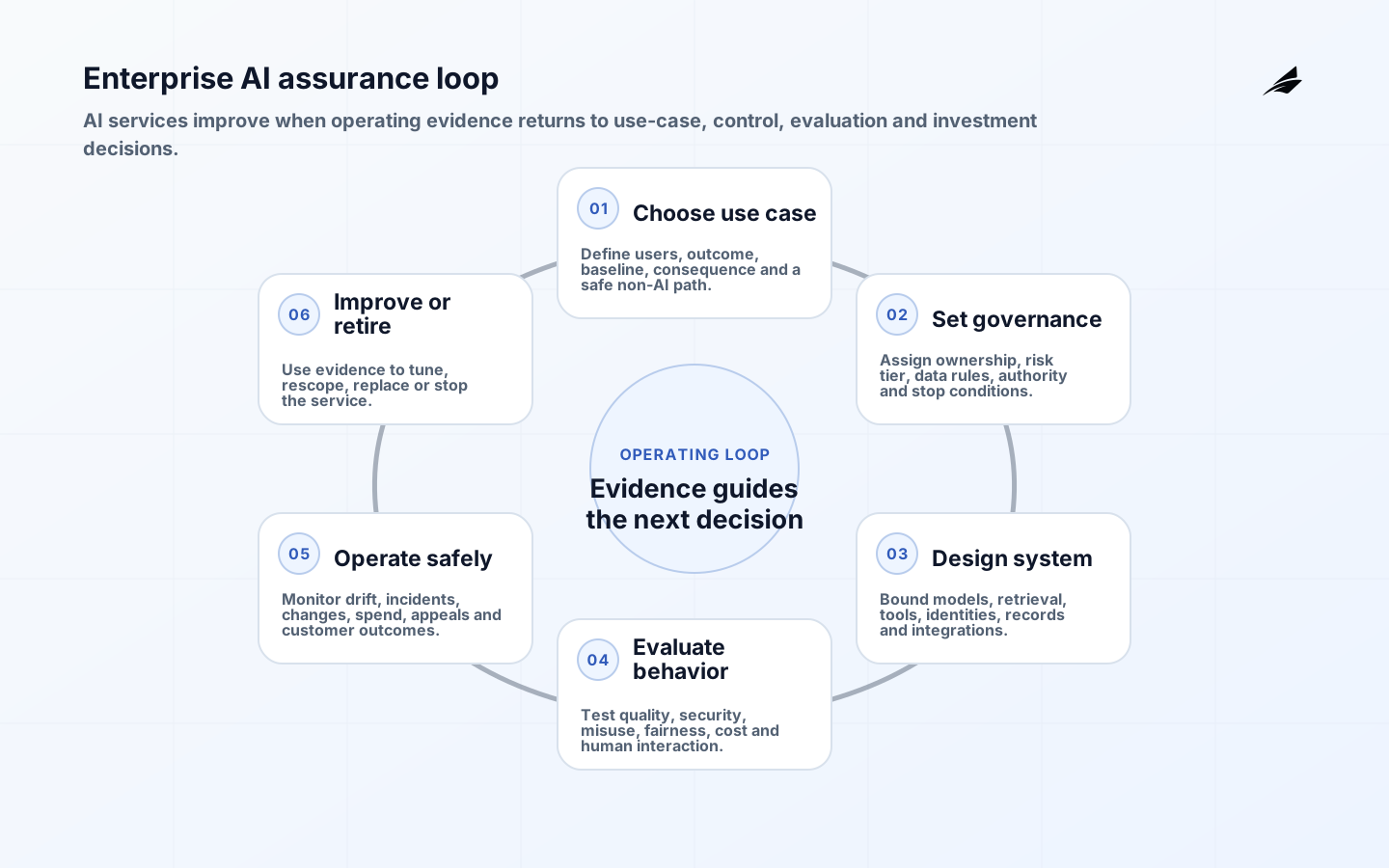
Enterprise AI Services FAQ helps teams turn a broad technology initiative into a bounded operating capability. Start with the workflow, accountable owner, unacceptable failure and baseline evidence; then make architecture, controls, support, recovery and exit explicit before scaling.
Use Edilec's enterprise AI scope and cost, the enterprise AI checklist, LLM gateway choices for adjacent decisions. The current primary references used throughout this guide are AI Risk Management Framework, Artificial Intelligence Risk Management Framework: Generative Artificial Intelligence Profile, NIST AI RMF Playbook, ISO/IEC 42001:2023 Artificial intelligence management system, AI Principles Overview, LLM Top 10 for 2025. Apply each source according to the service context and applicable obligations rather than treating a framework name as proof of implementation.
Scope the service from one consequential workflow
Start with a bounded workflow where language or probabilistic judgment is genuinely useful. Examples include support-case triage, document intake, internal knowledge search, policy summarization, contract redlining assistance or exception review. Name the user, the business owner, the triggering event, the systems touched and the consequence of a bad answer. A use case that sounds broad, such as deploy AI across operations, hides too many unresolved questions about permissions, evidence, latency, acceptance and recovery. A good first scope is narrow enough that the team can trace a complete path from request to outcome, including approval, escalation and rollback.
The service boundary should also define what the AI may not do. Record whether the system can only draft, may recommend, may invoke tools, or may complete an action automatically under stated conditions. Separate advisory outputs from authoritative decisions. If an AI system influences credit, pricing, patient handling, safety, legal interpretation or employment choices, the review and documentation burden rises because error consequences rise. The buyer needs a written statement of acceptable autonomy, data classes, retention, jurisdictions, support hours and exception authority before vendor estimates become meaningful.
| Scope layer | Decision to record | Acceptance signal |
|---|---|---|
| Workflow | Which task or decision improves, and for whom? | Named owner, baseline process and target outcome |
| Authority | What may the AI draft, recommend or execute? | Clear approval boundary and escalation path |
| Data | Which sources are approved and for what purpose? | Documented provenance, access rules and retention |
| Integrations | Which tools or APIs can be called? | Versioned contracts and reversible side effects |
| Quality | Which failures are unacceptable? | Evaluation thresholds and blocking conditions |
| Operations | Who monitors, supports and disables the service? | Runbook, alert owner and rollback method |
Design a governed AI service architecture
A governed architecture starts with identity, approved context and purpose limitation before any model call occurs. Every request should carry a user or service identity, a declared purpose, the resource boundary and the model or workflow version being used. Retrieval, prompts, tool schemas and policy checks should be versioned artifacts rather than ad hoc fragments copied between environments. Prefer the lightest mechanism that satisfies the workflow: retrieval over blind copying of records, deterministic business rules where the answer is known, and human review when the cost of a false step is material. The architecture should make it obvious where evidence enters, where the model transforms it and where control may stop or redirect the flow.

Tool use deserves the same design discipline as API access in any other enterprise service. Separate the model from the execution gateway. The model may suggest a tool call, but application code or an orchestration layer should validate arguments, enforce allow-lists, apply policy, and capture side effects with identifiers that support later investigation. Production architecture also needs prompt and retrieval observability, secret handling, environment separation, dependency inventories and the ability to disable features without deleting evidence. A buyer should be able to answer three questions at any time: what inputs shaped this output, what action path was available, and who had authority to let it continue.
Make evaluation and control design part of the service scope
Evaluation should be written into the engagement before the first model comparison. Define representative tasks, failure slices, thresholds, human-review rules and release authority. For a support assistant, that may mean measuring groundedness against approved knowledge, citation quality, refusal behavior on restricted topics, correct ticket classification, latency under realistic queue sizes and safe behavior when the knowledge source is stale. The generative AI profile is useful because it highlights risks such as confabulation, data privacy and information security that vary by use case and lifecycle stage. Those risks should shape tests, not sit in a separate governance deck.
Controls need to match the point of failure. Retrieval quality issues call for source approval, chunking review and citation tests. Harmful or policy-breaking generations call for safety evaluation, constrained prompts, refusal handling and monitored incident response. Tool-use risks call for schema validation, least privilege, rate limiting and high-value action approvals. OWASP's LLM risk guidance is especially relevant at the application boundary because enterprise harm often comes from insecure integration, over-broad permissions or leakage through prompts and tools rather than from the model alone. A vendor that cannot show how it tests those layers is not yet offering a mature enterprise service.
| Control layer | Questions to answer | Evidence to request |
|---|---|---|
| Use-case evaluation | What good and bad outputs look like for real tasks | Versioned datasets, rubrics and pass thresholds |
| Context and data | Which records may be retrieved and cited | Access mapping, provenance and retention policy |
| Model behavior | How the system handles ambiguity, refusal and safety cases | Prompt set, safety tests and regression results |
| Tool gateway | What actions are allowed and how arguments are validated | Schema validation, allow-lists and audit logs |
| Human authority | When a person must approve or override | Review workflow, queue ownership and escalation rules |
| Operations | How incidents are detected, contained and learned from | Alerting, runbooks and post-incident updates to tests |
Model cost across experimentation, operation and oversight
There is no credible fixed price for enterprise AI services without discovery because cost is shaped by workflow ambiguity, data readiness, evaluation depth, integration count, security controls, service hours and review design. Buyers should separate one-time discovery and proof work from recurring operating cost. Common cost layers include use-case discovery, source-system mapping, retrieval or prompt design, evaluation datasets, integration engineering, security and privacy review, observability, model usage, human quality review and incident support. If the statement of work prices only model calls and development hours, it is hiding the governance and operational labor that determines whether the service remains trustworthy after launch.
Commercially, time-and-materials often fits the early phases because the unknowns are concentrated in workflow detail, source behavior and evaluation design. A fixed-price pilot can work after the first slice is bounded and the acceptance evidence is explicit. Outcome-linked pricing is difficult unless the baseline, attribution model and business seasonality are already understood. Regardless of pricing form, inspect retention of prompts and logs, subcontractor access, residency, red-team responsibility, model substitution rights, export formats, retraining boundaries and termination support. Enterprise AI cost governance is not separate from architecture. The operating model determines the invoice.
| Cost layer | What usually drives it | Evidence to inspect |
|---|---|---|
| Discovery | Workflow mapping, stakeholder time and source inspection | Current process maps, samples and decision owners |
| Build | Integration engineering, retrieval design and policy enforcement | Backlog, contracts, security requirements and environments |
| Assurance | Evaluation assets, safety testing and review workflows | Dataset plan, thresholds and remediation allowance |
| Run | Model usage, observability, support coverage and human review | Traffic estimates, service hours and alert model |
| Change | Prompt updates, model swaps and new tool connections | Release process, regression suite and approval rules |
| Exit | Export, deletion, knowledge transfer and contract wind-down | Artifact inventory, account ownership and data-return terms |
Control the risks that most often derail enterprise AI work
The highest risks are usually operational, not theatrical. Teams approve a vague use case and cannot agree on success. Context sources are copied without purpose or ownership. Tool permissions are broader than review authority. Evaluation assets are too thin to detect regressions. Incidents are discovered by users because no one monitors output quality. Contracts leave logs, prompts or integration knowledge in vendor-controlled spaces. Each of these risks can be converted into an early indicator and a concrete treatment before scale. A strong services partner reduces ambiguity; it does not monetize it.
| Risk | Early evidence | Practical treatment |
|---|---|---|
| No bounded use case | Stakeholders describe different success conditions | Limit the first release to one named workflow and owner |
| Unapproved context | Teams cannot explain why a source was included | Create a source register with purpose, owner and expiry |
| Over-broad autonomy | The AI may act where people still own the consequence | Require approval gates and action-specific policies |
| Thin evaluation | A model upgrade ships on intuition or a small demo set | Build slice-based datasets and blocking regression checks |
| Weak incident handling | Users report failures before the team sees them | Monitor quality, latency, refusals and escalation volume |
| Vendor dependence | Critical prompts, logs or accounts remain supplier-controlled | Use client-owned artifacts, environments and export paths |
Evaluate an AI services partner with operating evidence
Ask shortlisted vendors to walk through one representative workflow in detail. Strong teams ask about authority, failure consequences, source provenance, evaluation design, tool boundaries, data handling and support ownership before they talk about acceleration. Review anonymized examples of evaluation reports, incident runbooks, retrieval change logs, security design decisions and decommissioning plans. Meet the people who will operate the system after release, not only the sales architect. Enterprise AI work fails when governance and operations are treated as later phases that someone else will eventually define.
Reference checks should probe what happened when the first version disappointed, when a model or source changed, and when a customer questioned a generated answer. Contracts should clarify who owns prompts, evaluation assets, connectors, moderation settings, audit records, deployment accounts and training data derived from the client's environment. If the buyer cannot regain control of the service without the original vendor, the engagement has created a dependency rather than a capability. That may be acceptable, but it should be a deliberate decision with visible cost and exit terms.
Use staged delivery gates that depend on evidence
- Frame: name the workflow, owner, consequence, approved data classes and acceptable autonomy.
- Discover: inspect real cases, source behavior, access rules, exception paths and baseline measures.
- Prove: build one end-to-end slice through retrieval, policy, tool validation, human review and logging.
- Evaluate: run representative, adversarial and policy tests before broadening the action space.
- Pilot: release to a bounded cohort with support coverage, incident routing and disable controls.
- Scale: add users, tools or workflows only when quality, security and support evidence remains healthy.
- Transfer or retire: verify export, knowledge transfer, account control and deletion obligations before contract end.
Treat each stage as a decision point, not a ceremonial milestone. A pilot is ready when the team can explain why the system should help, show how failure is detected, demonstrate who can stop it, and reproduce the evidence behind a release recommendation. Scaling on the basis of enthusiasm alone usually hides unresolved data, evaluation or ownership gaps that later become expensive operational incidents.
Key takeaways
- Scope enterprise AI services from one real workflow and its failure consequence.
- Separate model suggestions from policy enforcement and tool execution.
- Require evaluation assets, thresholds and incident handling in the statement of work.
- Model cost across discovery, assurance, human review, operation and exit.
- Keep prompts, logs, environments and approval authority under client control.
- Scale only when quality, security and support evidence remain acceptable in production.
Frequently asked questions
When should an organization buy enterprise AI services instead of building internally?
Buy external services when you need acceleration, specialist evaluation or governance expertise, or temporary capacity around a bounded workflow. Keep product ownership, risk acceptance and critical environment control inside the organization. The worst arrangement is outsourced implementation without retained authority over data, release decisions and operational evidence.
Does every enterprise AI service require fine-tuning?
No. Many useful services depend more on workflow design, retrieval quality, tool boundaries and evaluation discipline than on parameter changes. Fine-tuning becomes relevant when repeated behavior gaps remain after prompt, context and workflow design are already well understood. It should be chosen because evaluation evidence supports it, not because it sounds advanced.
How much human review is necessary?
Review depth should follow consequence, uncertainty and reversibility. Drafting low-risk internal text may need sampled review, while actions affecting money, rights, safety or customer commitments may require mandatory approval. The key is to define review rules per action type and to measure queue load so human oversight remains real rather than symbolic.
What makes an enterprise AI pilot credible?
A credible pilot uses approved data, representative cases, real users, clear evaluation thresholds, monitored incidents and a tested shutdown path. A presentation of promising examples is not enough. The team must show that quality, security and support behavior were examined under realistic conditions and that the client can keep governing the service afterward.
Conclusion
Enterprise AI services create durable value when they turn a useful workflow into a controlled operating capability. That requires bounded scope, governed architecture, evaluation before scale, visible lifecycle cost and explicit ownership of decisions and artifacts. The right partner helps the organization make those boundaries clearer, measure risk more honestly and ship AI systems that can be operated without mythology.